IEC Solar Cable Fire Standards: Guide
If I’m buying PV cable in the U.S., I don’t stop at an IEC label. I check four things first: the PV product standard itself, the fire-test set, the DC voltage rating, and whether the cable can pass NEC and AHJ review.
Here’s the short version:
- EN 50618 and IEC 62930 tell me the cable is made for PV use, often up to 1,500 V DC
- IEC 60332-1-2 checks if a single cable limits flame spread
- IEC 60754-1/2 checks halogen acid gas and corrosion risk, with limits like < 0.5% halogen, pH ≥ 4.3, and conductivity ≤ 10 µS/mm
- IEC 61034-1/2 checks smoke density, with ≥ 60% light transmittance
- LSZH claims should point to all three fire-related tests, not just one
- A cable can show IEC or EN marks and still not be cleared for a U.S. job site
Put simply: a printed standard number is only the first check, not the last one.
When I review a listing or data sheet, I want the model name, cable marking, certificate, and test results to match. I also look for H1Z2Z2-K, Class 5 tinned copper, -40°F to +194°F (-40°C to +90°C) service range, and a 248°F (120°C) max conductor temperature where listed. If key fields are blank, vague, or inconsistent, I stop and ask for proof before I issue a PO.
This guide breaks down what those IEC and EN markings mean, what each fire test shows, and how I’d check a cable before buying it for a U.S. project.
Single Cable Vertical Flame Test | IEC 60332-1-2
sbb-itb-501186b
Core IEC and EN Standards for Solar Cable Fire Safety
Solar cable standards split into two buckets: product standards and test standards. Product standards tell you how a cable is built. Test standards show how it behaves in a fire.
Here’s the simple way to use them: check the product standard to make sure the cable is PV-rated, then check the test standards to confirm fire performance.
IEC 62930, EN 50618, and IEC 60364-7-712
IEC 62930 is the main international product standard for DC-side solar cables. It covers systems up to 1,500 V DC. It sets the baseline for materials, dimensions, and voltage requirements so the cable is fit for PV use.
EN 50618 is the European counterpart. It applies to H1Z2Z2-K cables, which are cross-linked, halogen-free, and flame-retardant.
IEC 60364-7-712 is different. It’s an installation standard, not a cable product standard. It covers cable selection and routing in PV systems.
The next set of standards focuses on fire behavior - how the cable handles flame, smoke, and gas release.
IEC 60332, IEC 60754, and IEC 61034
These are fire test standards, and each one checks a different part of cable performance:
- IEC 60332-1-2 tests vertical flame spread on a single cable. A passing cable self-extinguishes and limits how far charring moves up the cable.
- IEC 60754-1/2 measures halogen acid gas emissions and acidity. For LSZH compliance, halogen acid gas emissions must stay below 0.5%, pH must be at least 4.3, and conductivity must be no higher than 10 µS/mm.
- IEC 61034-1/2 measures smoke density. A cable passes if light transmittance stays at or above 60% during the test, which helps preserve visibility during evacuation.
If a supplier claims a cable is LSZH, ask for both IEC 60754 and IEC 61034 results on the data sheet. One without the other doesn’t tell the whole story.
How IEC 60502 and Building Fire Ratings Relate
IEC 60502 is a broader power cable standard for voltage ranges from 0.6/1 kV to 30 kV. You may see it on solar cable documentation, but for DC-side solar use, IEC 62930 or EN 50618 matters more.
Some data sheets also show building fire ratings. Treat those as a second check, not a replacement for PV cable standards. In the EU, those ratings come from the Construction Products Regulation (CPR). For cables installed permanently inside EU buildings, CPR requires a Declaration of Performance (DoP) and a Euroclass fire rating.
Euroclass ratings also include sub-ratings for:
- smoke (s)
- flaming droplets (d)
- acidity (a)
If you spot a Euroclass rating on an imported cable data sheet, it’s worth noting. But the first things to verify are still the PV product standard and the fire test results.
What Each Fire and Insulation Standard Actually Tests
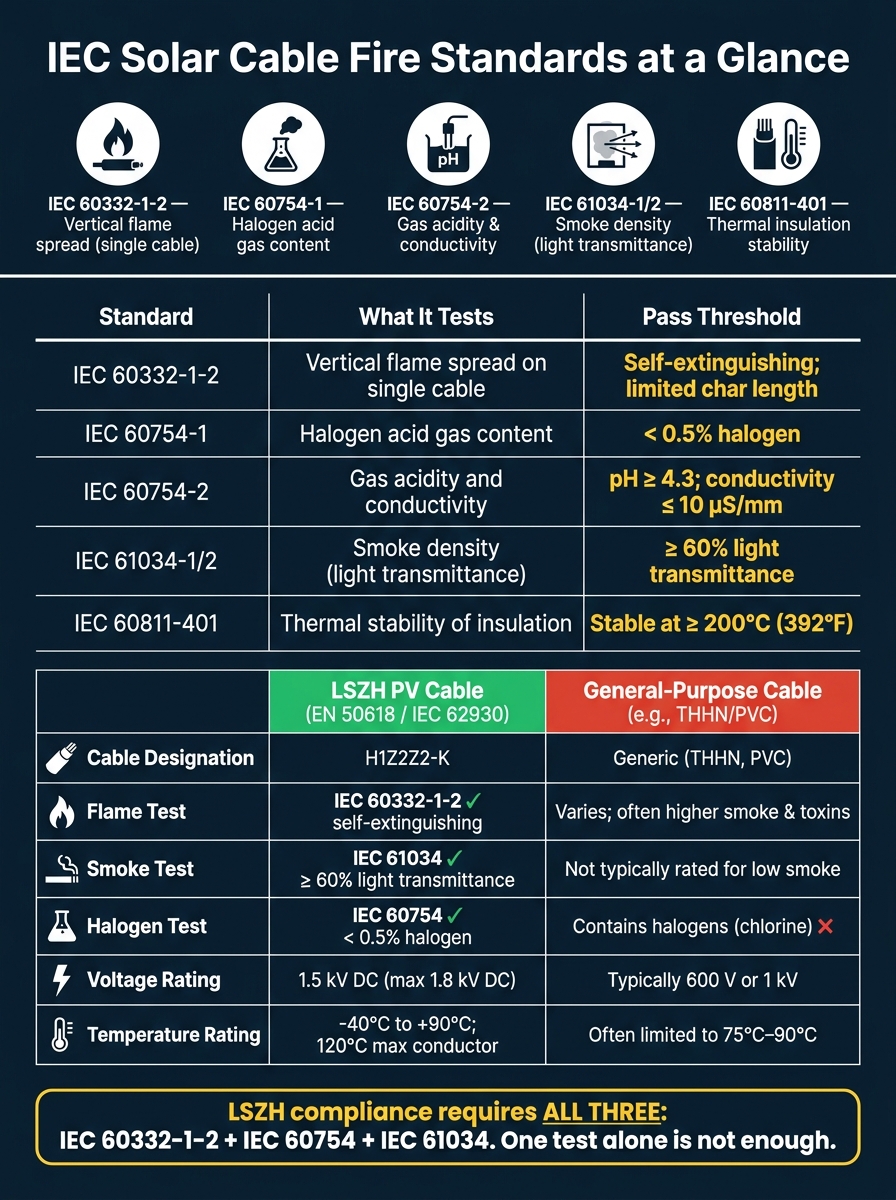
IEC Solar Cable Fire Standards: LSZH PV Cable vs General-Purpose Cable
For buyers, these test names aren't just lab jargon. They're purchase checks that help you see whether a cable's fire claim holds up. When you review a data sheet, these standards tell you what was tested for flame spread, smoke, gas, and insulation behavior.
IEC 60332-1-2: Vertical Flame Propagation
This test checks if a single cable spreads flame upward. The cable is mounted vertically, exposed to a set flame, and then watched after the flame is removed. A passing cable self-extinguishes and keeps char length under control, which means it doesn't carry fire up the cable run.
So if a data sheet says the cable complies with IEC 60332-1-2, that's the exact fire claim being supported.
IEC 60754: Halogen Acid Gas and Corrosion Risk
IEC 60754-1 measures halogen acid gas emissions. To qualify as LSZH, the result must stay below 0.5%.
IEC 60754-2 checks acidity and conductivity. The pH must be at least 4.3, and conductivity must be no higher than 10 µS/mm.
Why does this matter? Because halogen gases can turn into corrosive acids when they mix with moisture. That can damage equipment and create health risks in enclosed spaces. A cable isn't LSZH just because it passes one of these checks. It needs low halogen gas emission and low smoke generation.
IEC 61034 and Insulation Temperature Ratings
IEC 61034 measures smoke density. A cable passes if light transmittance stays at least 60% during the test, which helps keep escape routes visible.
For insulation, check the continuous temperature rating, the short-term temperature rating, and the insulation stability test. These belong in the same data sheet review as the fire test results, not off in a separate box that gets ignored.
| Standard | What It Tests | Pass Threshold |
|---|---|---|
| IEC 60332-1-2 | Vertical flame spread on a single cable | Self-extinguishing; limited char length |
| IEC 60754-1 | Halogen acid gas content | < 0.5% halogen |
| IEC 60754-2 | Gas acidity and conductivity | pH ≥ 4.3; conductivity ≤ 10 µS/mm |
| IEC 61034-1/2 | Smoke density (light transmittance) | ≥ 60% light transmittance |
| IEC 60811-401 | Thermal stability of insulation | Stable at ≥ 200 °C (392 °F) |
Next, match these test names to the exact wording on the product listing and manufacturer sheet.
How to Read a Solar Cable Data Sheet Before You Buy
A data sheet only helps if you check the compliance details first. That’s where the useful stuff is. When you review a solar cable, start with the standards, ratings, and marking details before you look at anything else.
Find the Standard Numbers, Voltage Rating, and Cable Designation
Check for EN 50618 or IEC 62930, a 1,500 V DC rating, and the H1Z2Z2-K designation on both the data sheet and the cable sheath.
If the sheet says something vague like "meets international standards", that’s not enough. It sounds fine on the surface, but it doesn’t tell you what the cable was tested against. If the designation is missing, or replaced with weak identification, ask the supplier to clear it up before you place the order.
Verify LSZH Claims, Conductor Materials, and Temperature Limits
Treat LSZH or halogen-free claims as unproven unless the data sheet lists:
- IEC 60754-1/2
- IEC 61034-1/2
- IEC 60332-1-2
For conductor material, confirm Class 5 tinned-copper conductors. For temperature, the sheet should show an operating range of -40°C to +90°C (-40°F to +194°F), with a maximum conductor temperature of 120°C (248°F).
If those temperature limits are missing, the documentation is incomplete.
Also, check the certificate number against the issuer’s record. Don’t rely on a scanned PDF alone.
Side-by-Side Procurement Comparison Table
This table gives you a fast way to compare listings. If fields are blank, that usually means the cable has not been fully documented for PV use.
| Field | LSZH PV Cable (EN 50618 / IEC 62930) | Typical General-Purpose Cable |
|---|---|---|
| Cable Designation | H1Z2Z2-K | Generic (e.g., THHN, PVC) |
| Flame Test | IEC 60332-1-2 (self-extinguishing) | Varies; often higher smoke and toxins |
| Smoke Test | IEC 61034 (≥ 60% light transmittance) | Not typically rated for low smoke |
| Halogen Test | IEC 60754 (< 0.5% halogen content) | Contains halogens (chlorine) |
| Voltage Rating | 1.5 kV DC (max 1.8 kV DC) | Typically 600 V or 1 kV |
| Temperature Rating | -40°C to +90°C (-40°F to +194°F); 120°C (248°F) max conductor | Often limited to 75°C (167°F) or 90°C (194°F) |
| Typical Use | Rooftops, conduits, buildings | General purpose; not UV/ozone optimized |
If most of the fields are blank, do not issue the PO.
Once the sheet clears these checks, move to the source listing and confirm the listing details and manufacturer documents.
Applying These Standards When Sourcing Through Electrical Trader
After you check the data sheet, use those same standard numbers to review the marketplace listing and any files attached to it. Electrical Trader listings are just the starting point. The attached documents are what confirm compliance.
The listing title matters less than whether the listing, data sheet, and certificate all match the same cable model. If any document clashes with the data sheet, treat the listing as unverified.
How to Review Listings and Linked Manufacturer Documents
Start with the listing description, but don’t rely on sales wording alone. The listing, the data sheet, and any certificate should all point to the same cable model. If a Declaration of Performance is attached, check that it names the same model, includes a unique reference number, and shows a Notified Body number that you can verify through EU NANDO. A DoP that names a different model, or a certificate holder that does not match the supplier, is a red flag.
When you open the manufacturer data sheet, look for the documented fire tests: IEC 60332-1-2, IEC 60754, and IEC 61034. A halogen-free claim needs all three references: IEC 60332-1-2, IEC 60754, and IEC 61034.
If a CPR class appears in the listing, match it against the DoP and the exact model. If the listing includes a third-party certificate, enter the certificate number into TÜV Rheinland Certipedia to confirm the holder, scope, and expiration date. A scanned PDF isn’t proof on its own; verify the certificate ID.
Pre-Purchase Compliance Checklist
Use this checklist before you request a quote or place a purchase order.
| Checkpoint | What to Confirm |
|---|---|
| Model Match | Listing, data sheet, and certificate all refer to the same cable model |
| Fire Test Suite | IEC 60332-1-2, IEC 60754, and IEC 61034 are all documented |
| Smoke Density | IEC 61034 shows at least 60% light transmittance |
| Halogen Content | IEC 60754 shows less than 0.5% halogen acid gas |
| Fire Classification | If CPR is listed, the DoP must match the exact cable model |
| Voltage Rating | A clear DC voltage rating is shown, such as 1,500 V DC |
| Low-Temperature Suitability | Cold-bend testing to IEC 60811-504 at -40°C is documented |
| Certificate Verification | Confirm the certificate ID, holder, and expiration date in Certipedia |
| Traceability | Batch codes or QR codes link reels to test results |
If any item is blank, inconsistent, or can’t be verified, ask for the missing documents before placing the order. Missing traceability information is a red flag for inconsistent production quality.
Conclusion: What to Verify Before You Order
Before you place an order, run through one last check. An IEC-compliant marking on a data sheet only helps if it’s specific, complete, and matched to your job. Check the exact product standard, fire test results, voltage rating, and temperature range for the cable model you plan to buy.
For U.S. projects, make sure the cable lines up with NEC and AHJ rules before ordering.
Then look past code issues and ask a simple question: does this cable fit the conditions it will face once it’s installed? Match the cable’s temperature, UV, mechanical, and wet-location ratings to the actual site.
Only buy when the construction, fire, insulation, and installation ratings all match the exact model.
Treat document consistency as the last gate. If anything in the data sheet, certificate, or listing feels vague, incomplete, or out of sync, ask for clarification before you buy.
FAQs
How do I confirm a solar cable is actually LSZH?
Don’t rely on a material data sheet by itself.
Ask for independent test reports that confirm both:
- IEC 60754-1/2 for halogen acid gas content below 0.5%
- IEC 61034-1/2 for smoke density, usually at least 60% light transmittance
If you’re checking against European standards, also ask for a valid TÜV EN 50618 certification. Then verify the certificate number in Certipedia.
Why isn’t an IEC label enough for a U.S. project?
In the United States, an IEC label by itself usually isn't enough. Local Authorities Having Jurisdiction and safety rules often require certification or listing from an OSHA-recognized Nationally Recognized Testing Laboratory, such as UL or CSA.
IEC standards can still help. They give you test methods and design rules that manufacturers and engineers use all the time. But an IEC mark does not automatically prove compliance with U.S. electrical codes.
For fire-rated applications, U.S. projects may also require standards such as UL 2196.
What data sheet red flags should stop a purchase?
Avoid cables that hide behind fuzzy claims like “meets requirements.” That wording isn’t enough. You want full, verifiable test reports that show the exact test method, severity, duration, and pass criteria.
Also, stop if the listing doesn’t clearly match your circuit, installation environment, or assembly method. Check that the cited standards line up with your local project needs, and get written confirmation for any deviations so you don’t run into inspection problems later.