




2026 Innovations in Fire-Resistant Cable Materials
If I had to sum up 2026 in one line: U.S. fire-resistant cable specs are moving away from PVC and toward LSZH, XLPE, EPR, mica-backed designs, and MI cable where 2-hour circuit survival is required.
If you’re choosing cable for life-safety work, the main question is simple: will the circuit keep working during a fire, and how much smoke and gas will it release while that happens? In 2026, the answer more often points to halogen-free compounds, crosslinked insulation, and barrier-based builds instead of low-cost PVC.
Here’s the short version:
- LSZH/HFFR is becoming the default pick for hospitals, transit, data centers, tunnels, and other high-occupancy spaces.
- PVC still costs less at about $1,800 to $2,400 per metric ton, but LSZH/HFFR runs about $2,800 to $4,200, or roughly 30% to 60% more.
- Crosslinked LSZH/XLPE systems handle more heat, with service temperatures up to 257°F, versus about 140°F to 167°F for PVC.
- Mica tape and MI cable are still the top choices when you need 2-hour circuit integrity under fire test rules like UL 2196.
- MI cable handles the highest heat but is harder to install and must be sealed fast because MgO absorbs moisture.
- Ceramifiable and intumescent layers are filling the gap between standard polymer cable and full MI construction.
- Standards drive the choice: in 2026, buyers are watching IEC 60332, IEC 60331, UL 2196, UL 94, and fire-stop tests tied to penetrations.
- Material changes can trigger long recertification work, with some phosphorus-based reformulations leading to up to 18 months of UL/IEC retesting.
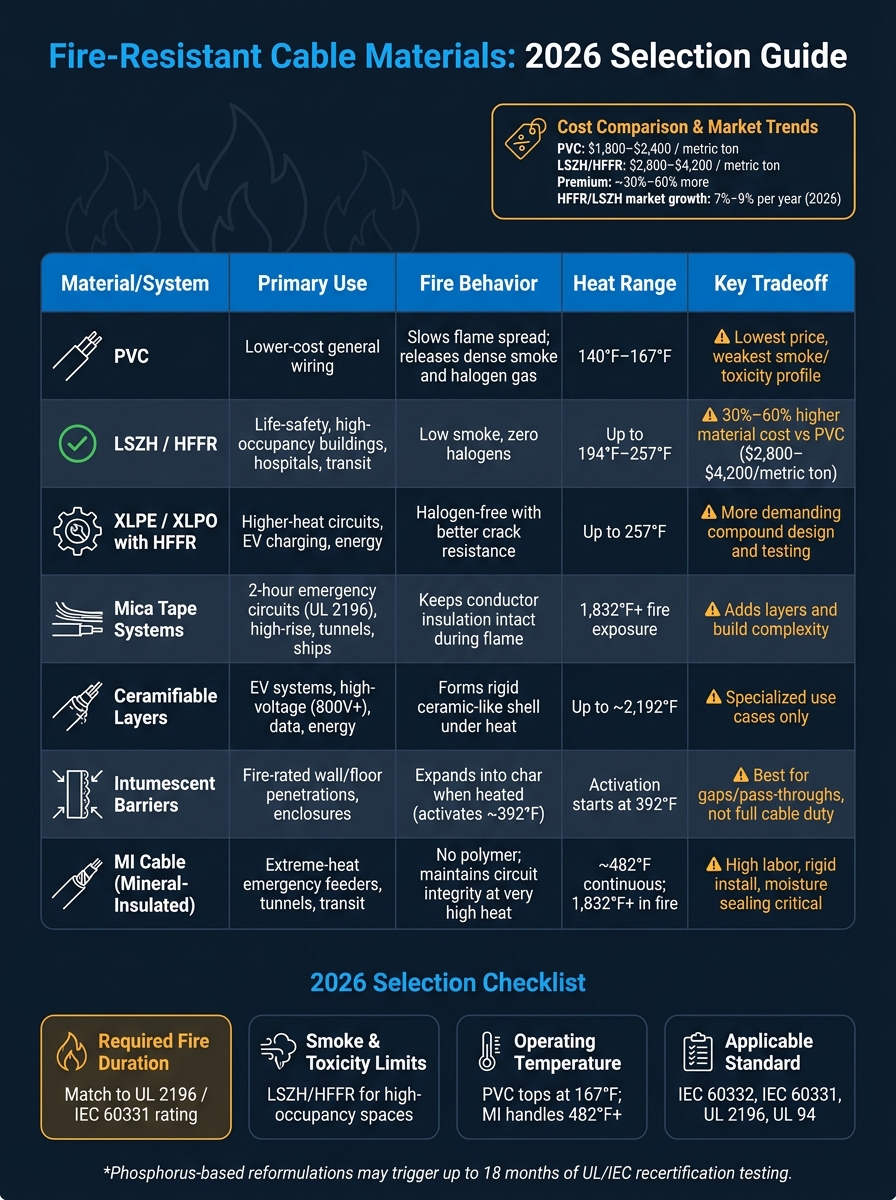
Fire-Resistant Cable Materials Compared: 2026 Guide
Quick Comparison
| Material / System | Main use | Fire behavior | Heat range | Main tradeoff |
|---|---|---|---|---|
| PVC | Lower-cost general wiring | Slows flame spread but gives off dense smoke and halogen gas | About 140°F to 167°F | Lower price, weaker smoke/toxicity profile |
| LSZH / HFFR | Life-safety and high-occupancy buildings | Low smoke, halogen-free | Up to 194°F to 257°F | Higher material cost |
| XLPE / XLPO with HFFR | Higher-heat circuits, energy, EV charging | Better heat and crack resistance with halogen-free systems | Up to 257°F | Compound design and testing are more demanding |
| Mica tape systems | 2-hour emergency circuits | Keeps conductor insulation in place during flame | Up to about 1,832°F+ in fire exposure | Adds layers and build complexity |
| Ceramifiable layers | EV, high-voltage, data, energy | Forms a hard ceramic-like shell under heat | Up to about 2,192°F | Use case is more specialized |
| Intumescent barriers | Penetrations, interfaces, enclosures | Expands into char when heated | Starts around 392°F | Best for gaps and pass-through points, not full cable duty alone |
| MI cable | Extreme-heat emergency feeders, tunnels, transit | No polymer insulation; keeps circuit integrity under very high heat | About 482°F continuous, much higher in fire | High labor, rigid install, moisture sealing needed |
Bottom line: if I’m looking at a 2026 U.S. project, I’d match the cable to four things first: required fire duration, smoke limits, install conditions, and the test standard on the spec sheet. That gets you to the right family of material much faster than starting with price alone.
sbb-itb-501186b
LSZH and halogen-free insulation systems in 2026
In 2026, LSZH and HFFR compounds are the main polymer upgrade for life-safety cables. This is where the market is moving, and the reason is pretty simple: fire safety rules are tighter, and buyers in high-risk settings don't want dense smoke or corrosive gases during a fire.
High-performance HFFR and LSZH compounds are now the fastest-growing segment in the cable materials market, growing at 7% to 9% per year as of 2026. That demand is coming from data centers, mass transit, renewable energy projects, and other mission-critical sites where smoke and acid gas release just aren't acceptable.
Cost still matters, of course. PVC remains the lower-cost option at $1,800 to $2,400 per metric ton, while HFFR/LSZH typically runs $2,800 to $4,200 per metric ton. That's a 30% to 60% premium. Even so, for life-safety work, that price gap is getting easier to defend when smoke control and code compliance are written into the project spec. LSZH is now the preferred polymer route, though it isn't the only fire-safe cable build.
Crosslinked HFFR compounds and improved filler systems
One of the main shifts in 2026 is the move toward lower-fill HFFR compounds. Older magnesium hydroxide (MDH) systems needed high loading levels, which often made cables stiffer and tougher to process. In October 2025, Kisuma Chemicals launched KISUMA™ X, a next-generation synthetic magnesium hydroxide built around a high-aspect-ratio particle shape. That shape helps cut dosage levels in polyolefin and EVA compounds, which means better processability and more flexibility in data and communication cables while still meeting strict HFFR standards.
Crosslinked HFFR systems are also moving ahead. In November 2025, SK Minerals & Additives introduced Hofnil HFFR-XL, described as India's first halogen-free flame retardant additive made specifically for XLPE wire and cable. The product is aimed at a problem the industry has wrestled with for years: the tradeoff between flame resistance and thermal stability in crosslinked systems. The goal is to prevent toxic gas release while keeping the mechanical properties needed for international safety standards.
These crosslinked HFFR systems also offer a clear service-life edge. XLPO and XLPE-based HFFR cables resist environmental stress cracking better than thermoplastic PVC. They also handle higher operating temperatures, up to 257°F, compared with 140°F to 167°F for standard PVC. That's a big deal in renewable energy projects, EV charging infrastructure, and industrial sites where heat loads run high and cable replacement is a headache. ATO-free additives are gaining ground too, as antimony trioxide faces tighter scrutiny and supply swings.
PVC versus modern LSZH systems: a direct comparison
| Feature | Traditional PVC Insulation | Modern LSZH/HFFR Systems |
|---|---|---|
| Smoke Density | High; dense black smoke | Low; minimal smoke |
| Toxicity/Corrosivity | Releases HCl and halogen gases | Zero halogens; non-corrosive |
| Operating Temp (°F) | 140°F–167°F | Up to 194°F–257°F (crosslinked) |
| Best fit | General purpose, riser, residential | Critical infrastructure, transit, tunnels, high-occupancy spaces |
PVC still has a cost edge, but its flexibility advantage is shrinking. In plenum-rated installations, high-occupancy buildings, and spaces where safe evacuation is a core design goal, modern LSZH systems are now the easier choice to defend in 2026.
When polymer systems can't meet cable integrity targets, projects shift to mineral-insulated or barrier-based constructions.
Mineral-insulated cables and reinforced barrier constructions
For projects that need more than halogen-free polymers can handle, MI cables are the next step up in fire resistance. When LSZH and XLPE systems aren't enough, mineral-insulated (MI) cables can deliver two-hour fire-resistive performance in extreme-heat settings.
How magnesium oxide insulated cables are built
MI cables use a simple but tough design. Copper conductors sit inside a continuous metal sheath, usually copper or stainless steel, with highly compressed magnesium oxide (MgO) packed tightly around them as the insulation. There is no polymer insulation in the cable.
That matters because MgO is inorganic and non-combustible. It can withstand temperatures that would destroy LSZH or XLPE compounds, especially in places where polymer jackets can't survive long heat exposure. The metal sheath adds another layer of protection too. It works as tough mechanical armor and also serves as a built-in grounding conductor.
The main issue during installation is moisture. MgO absorbs water, so any cut cable end has to be sealed right away with termination pots and sealing compounds.
This design gives MI cables a long service life in harsh conditions, but it also makes them harder to install. They're common in:
- Fire alarm circuits
- Emergency systems
- Tunnels
- Transit systems
- Industrial sites that go beyond polymer temperature limits
MI cables versus polymer-based fire-resistant cables: key tradeoffs
Choosing between MI and polymer-based fire-resistant cables usually comes down to three things: temperature exposure, physical conditions, and installation cost. Here's how the two compare in practice:
| Feature | Mineral-Insulated (MI) Cables | Polymer-Based (LSZH/XLPE) |
|---|---|---|
| Max Operating Temp | ~482°F continuous; 1,832°F+ in fire | ~194°F–230°F continuous; ~1,382°F–1,742°F in fire (with mica) |
| Mechanical Robustness | Extremely high - crush and impact resistant | Moderate - often requires conduit or tray |
| Moisture Sensitivity | High - MgO absorbs moisture; sealing is critical | Low - polymers are naturally water-resistant |
| Installation Complexity | High - rigid, requires specialized tools and sealing | Low to moderate - flexible, standard stripping |
| Cost | Higher material and labor cost | Lower initial cost; higher long-term risk in extreme heat |
| Best use cases | Tunnels, high-rise emergency feeders, BESS, transit | Fire alarm loops, emergency lighting, commercial life safety |
For industrial buyers, the rule of thumb is pretty simple: if the site goes above 482°F or needs very high crush and impact resistance, MI cables are usually the practical pick. Polymer-based systems fit most commercial fire-safety jobs, but they may need added conduit or tray protection to get closer to the mechanical performance MI cables provide out of the box.
When full mineral insulation feels too rigid or too expensive, mica tape and barrier layers can offer a lighter option.
Mica tape, ceramifiable polymers, and intumescent protection
Some projects need more fire protection than standard polymer systems can give, but they don't need the stiffness of MI cable. That's where mica tape, ceramifiable layers, and intumescent barriers come in. They sit in the middle ground.
Each one solves a slightly different problem. Mica tape helps keep circuits working during fire. Ceramifiable layers help the cable keep its structure after heat exposure. Intumescent barriers protect penetrations and connection points.
High-performance mica tape systems
Mica tape is a passive, non-combustible wrap placed directly around conductors. It keeps its shape under flame, which is why it's a standard choice for UL 2196 circuit integrity in high-rise buildings, tunnels, and ships.
Modern mica tapes are 0.08 mm to 0.18 mm thick, so manufacturers can add multiple wraps without adding much cable diameter.
Many systems use combined glass fiber, film, and mica constructions to improve moisture resistance and handling strength. On wet job sites or in humid conditions, that extra toughness can help protect insulation integrity.
In battery enclosures and jet-fire zones, 96%+ high-silica reinforcement helps limit shrinkage and brittleness during thermal shock up to 2,192°F (1,200°C).
Where mica keeps the conductor barrier in place, ceramifiable polymers focus on what happens after high heat hits.
Ceramifiable layers and intumescent barriers: how they compare
Ceramifiable polymer layers work in a different way. Instead of staying unchanged, they react under heat. As the polymer matrix breaks down, fillers fuse into a rigid, ceramic-like shell around the conductor. That shell keeps its shape, stands up to water spray, and helps preserve insulation after flame exposure. These materials are seeing more use in e-mobility and high-voltage applications at 800 V and above, where both shock resistance and stable electrical insulation matter.
Intumescent barriers use another method. They expand when heated, usually starting around 392°F (200°C), and create a char layer that fills gaps and slows heat transfer. In cable design, they make the most sense at penetrations and enclosure interfaces, where a cable passes through a fire-rated wall or floor assembly. New ammonium polyphosphate-based formulations are also being developed to be halogen-free and to contain less than 0.1% melamine.
Here's the side-by-side view for U.S. cable specs:
| Criteria | Mica Tape Systems | Ceramifiable Layers | Intumescent Barriers |
|---|---|---|---|
| Activation Mechanism | Passive physical barrier (pre-formed, non-reactive) | Chemical transformation into a rigid ceramic shield | Heat-triggered swelling and char formation |
| Temperature Resistance | Very high - 1,000°C+ (1,832°F+) | High - up to ~1,200°C (2,192°F) | Moderate - activation starts around 200°C (392°F) |
| Mechanical Shock Behavior | Flexible; relies on glass fiber or film reinforcement | Excellent - forms a hard, protective shell | Char can be brittle or prone to erosion |
| Cable Compatibility | Power, building, and transport cable wraps | E-mobility, high-voltage, and industrial compounds | Flexible PVC, insulation materials, and composites |
| Common U.S. Application Scenarios | High-rise buildings, tunnels, and ships (UL 2196) | EV systems, data centers, and renewable energy | Fire-rated wall/floor penetrations and building envelopes |
Put simply, these three systems define the tradeoff between circuit integrity, flexibility, and penetration sealing as cable fire testing keeps changing. Material selection comes down to how each one performs in flame-spread, circuit-integrity, and installation tests.
Flame-retardant formulations, standards updates, and selection guidance
Nanocomposites, moisture-crosslinkable compounds, and updated test standards
In 2026, the big formulation move is away from halogenated chemistries and toward phosphorus-based and mineral-filled systems. The push comes from tighter fire, smoke, and toxicity rules. In plain terms, picking a material is no longer just about raw flame resistance. It also has to match the test method, target fire rating, and the place where the cable will be installed.
Moisture-crosslinkable XLPE systems are gaining ground in renewable energy and medium-voltage cables. The reason is pretty simple: they pair strong dielectric performance with halogen-free fire performance.
On the filler side, high-aspect-ratio magnesium hydroxide is helping manufacturers get flame retardancy at lower loadings. That makes compounds easier to process in thin-wall designs that still need UL 94 V-0 at 0.4 mm.
For U.S. specifiers, the standards that matter most in 2026 are IEC 60332, IEC 60331, UL 2196, and UL 94. One catch: moving to phosphorus-based reformulations can set off 18-month retesting cycles for UL and IEC recertification.
The table below shows how each material strategy lines up with the standard it needs to meet in U.S. projects.
What U.S. buyers and specifiers should prioritize
| Material Strategy | Key Test / Standard | 2026 Selection Note |
|---|---|---|
| LSZH / HFFR | IEC 60332, UL 1685 | Lower-dosage magnesium hydroxide improves processability at thin walls |
| Mica Tape / Barrier | IEC 60331, UL 2196 | Primary choice for 2-hour circuit integrity in life-safety applications |
| Ceramifiable Layers | UL 94 (V-0) | Suited for e-mobility and high-voltage systems above 800 V |
| Intumescent Protection | ASTM E119, UL 1709 | Best applied at fire-rated wall and floor penetrations |
| MI (Mineral Insulated) | UL 2196 | Best for extreme-temperature circuit integrity |
For U.S. project teams, the priority is to match the material to the required fire rating duration. If the job calls for a 2-hour emergency circuit, mica tape or MI cable should be at the top of the list. Teams should also check long-term aging, outgassing, and moisture-resistance data, especially for moisture-crosslinkable systems.
Match the cable to the full circuit, not just the cable by itself. Fire-safe cable materials should line up with the breakers, transformers, and distribution gear on that same circuit. Electrical Trader can help source compatible breakers, transformers, and other distribution equipment for the same circuit.
Conclusion: Key takeaways for 2026 cable material selection
No single material works for every fire-safety job. LSZH and crosslinked HFFR compounds are the right fit for high-occupancy spaces like tunnels, hospitals, and schools. For emergency and critical circuits where circuit integrity during a fire matters most, MI cable and mica tape are still the go-to options.
For a 2026 specification, the checklist comes down to four things: the required fire rating, the installation environment, operating temperature, and applicable UL/NEC requirements. Get those lined up early, and you can cut down on redesigns and compliance issues later.
Source cable with breakers, transformers, and distribution gear as one compliant system.
FAQs
When should I choose LSZH over PVC?
Choose LSZH over PVC when the installation runs through public escape routes or occupied spaces.
PVC is a lower-cost option for general residential and commercial wiring. But if it burns, it can give off toxic, corrosive gases and create smoke that cuts visibility.
LSZH is made to limit smoke and acid gas emissions, which can make a fire scene safer for people trying to evacuate.
Do I need MI cable for a 2-hour fire rating?
No. You do not necessarily need mineral-insulated (MI) cable for a 2-hour fire rating.
MI cable works well in high-heat zones and plant rooms. But it isn’t the only option. Polymeric cables with mica tape barriers and thermoset insulation can also meet the same goal. They’re often more flexible and easier to terminate, which can make installation a lot less of a headache.
In the U.S., the key requirement is UL 2196 certification.
Which fire test standards matter most in 2026?
In 2026, the main U.S. cable fire test standards center on two things: circuit integrity and flame resistance.
UL 2196 is still the core standard for fire-rated cables. It covers fire exposure for 2 hours at 1,800°F, followed by a high-pressure water test.
Other key requirements include:
- NEC Articles 700, 760, and 728
- NFPA 72
- the VW-1 vertical flame test
- IEEE 1202 for tray applications
- UL 94 V-0 for material performance





