Fire Survival Cables in Disaster Response Facilities
If a fire starts in a hospital or 911 center, some circuits must keep working for up to 2 hours under fire exposure as high as 1,800°F. That is the core issue. I’d focus on four things first: which circuits must stay on, which survivability level the code calls for, whether the cable is CI or CIC, and whether the full listed assembly matches the planned install.
Here’s the short version:
- Fire survival cable is not the same as standard fire-rated cable.
- UL 2196 is the listing to check for 2-hour fire exposure and hose-stream testing.
- NFPA 72 Pathway Survivability drives many life-safety circuit rules.
- NEC Article 728 and the listed assembly matter as much as the cable itself.
- IBC Section 909 can require continuous raceway for smoke control wiring.
- Wrong supports, fittings, conduit, lubricant, or routing can fail inspection.
If I were reviewing a project, I’d look at these items before purchase or rough-in:
- Fire alarm and emergency voice circuits
- Smoke control and stair pressurization wiring
- Firefighter phones and area of refuge systems
- Generator auxiliaries and transfer switch controls
- Plenum, riser, outdoor, shaft, and mechanical-room routes
- Splice limits, firestopping, support spacing, and wall/floor penetrations
The main takeaway is simple: the circuit’s job comes first, and the install has to match the tested listing exactly. That is what keeps people protected when fire, water, and impact hit at the same time.
| Check | What I’d confirm |
|---|---|
| Circuit role | Must it stay on during the fire? |
| Code target | NFPA 72 survivability level on approved drawings |
| Listing | UL 2196 and UL FHIT documents |
| Cable type | CI for listed free-air use or CIC with listed conduit assembly |
| Route | Plenum, riser, shaft, exposed corridor, outdoor, or underground |
| Install parts | Raceway, couplings, supports, fittings, and lubricant match listing |
| Field limits | No unlisted splices, proper firestop, proper termination location |
That’s the lens I’d use for the rest of the article.
Where Fire Survival Cables Are Used and What Conditions They Face
Critical Systems That Rely on Fire Survival Cables
Use fire survival cable only for circuits that must stay live during an active fire. In disaster response facilities, that usually includes life-safety systems, communications, and backup power controls. Buildings that use partial evacuation or relocation need survivable pathways more than most.
After you identify the critical circuits, the next job is simple in theory but easy to get wrong in practice: match each circuit to the fire, water, and impact conditions it may face.
| System | Why Fire Survival Cable Is Required |
|---|---|
| Area of refuge communications | Occupants who cannot use stairs must be able to call for help |
| Emergency shutdown controls | Controlled shutdown of industrial machinery helps prevent secondary disasters |
| Backup generator auxiliaries and transfer switch controls | These systems must remain connected so backup power stays available during a localized fire event |
Then comes routing. That’s where many specs live or die. The same cable that performs well in one part of a building can fail in another if the setting is wrong.
Alarm circuits may need only standard survivability. EVAC and relocation systems, on the other hand, often call for Level 2 or Level 3 protection.
Installation and Environmental Conditions That Affect Cable Performance
Heat and open flame are only part of the story. During actual fires, cables can also take hits from falling debris or shifting structural parts. That’s why armored CI cable is a better fit for mechanical rooms and exposed corridors where impact risk is higher.
Water matters too. Sprinklers and fire hose streams can soak cables during a fire, and UL 2196 includes a hose stream test after the two-hour fire exposure. If a cable listing does not include that test, it has not been checked for those conditions.
In high-rise buildings, routing through vertical shafts and risers often calls for Level 2 or Level 3 pathway survivability, which usually means 2-hour protection. For air-handling spaces, specify CI cable with a plenum rating. For underground or outdoor runs, armored fire-resistant cable adds mechanical protection along with fire resistance.
Smoke control circuits are a separate case. They often need continuous raceways, so free-air or MC cable installs may not meet code for those circuits, even if the cable itself has the right fire rating. Check the raceway rule for each circuit type before locking in the design. In other words, the route shapes the spec just as much as the cable rating does.
sbb-itb-501186b
Performance Features, Ratings, and Compliance Requirements
Core Features to Review Before Specifying Cable
Once you know the cable route and exposure conditions, the next step is to check the listed assembly - not just the cable jacket. That’s where a lot of mistakes happen. A product can look right on paper, but if the listing doesn’t match the circuit, the space, and the install method, it can still miss code.
Before you specify cable, confirm the circuit type, voltage, insulation, jacket, and installation listing. The two-hour rating matters because it keeps the circuit live long enough to give occupants time to evacuate.
It also helps to look closely at how the cable is built. High-performance designs often use:
- XLPE or thermoset elastomer insulation
- mica glass tape as a fire barrier
- low-smoke zero-halogen jackets for occupied spaces
One detail that trips up a lot of specs is CI vs. CIC. CI cable is listed for free-air use in the application shown by the manufacturer. A CIC cable needs a listed conduit assembly to achieve its rating. If you swap one for the other without checking the listing, the installation will fail compliance review.
Code, Listing, and Documentation Requirements for U.S. Projects
For U.S. projects, compliance is about the system as a whole, not just the cable by itself. Under NEC Article 728, the cable, supports, raceways, couplings, and fittings all need to match the exact UL-listed assembly. Mixing parts from different manufacturers in one fire-rated run can void the listing and fail AHJ inspection.
Use the required survivability level as the compliance target for the full assembly. Match the cable system to the survivability level shown on the drawings and approved by the AHJ. For smoke control systems under IBC Section 909, control and power wiring must be enclosed in continuous raceways. That means free-air CI cable or MC cable usually won’t meet the rule.
Support spacing is another common failure point. Carson Cook, PE, and Larry D. Rietz, SET, CFPS, note:
"For all fire-resistive rated systems there are specific requirements for support types and spacing. Attachment is typically required to be made to a masonry or concrete wall/floor carrying the same rating as the cable system."
Before finalizing the design, review the manufacturer’s UL FHIT documentation. Check the listed raceway type - often EMT or IMC - and confirm the required support intervals with the manufacturer. Then verify the setup with the Authority Having Jurisdiction (AHJ), since local interpretation can affect approval.
Buyer's Checklist: Comparing Fire Survival Cable Options
Use this table as a screening tool when comparing products. It’s not about brands. It’s a practical set of checks to run before approving cable for a fire survival circuit.
| Evaluation Criteria | What to Verify |
|---|---|
| Intended application | Fire alarm, power-limited, or control use? Confirm the listing matches the circuit type. |
| Fire performance documentation | Request the UL 2196 listing and UL FHIT assembly page. |
| CI vs. CIC designation | Listed free-air use (CI) or conduit-required install (CIC)? Confirm the install method matches the listing. |
| Jacket and insulation construction | Look for XLPE or thermoset insulation, low-smoke zero-halogen (LSZH) jackets, and mica glass tape fire barriers. |
| Voltage class | Confirm the cable's voltage rating matches the system. |
| Environmental suitability | Verify that the environmental marking matches the exact route and space. |
| Raceway compatibility | Does the listed assembly specify EMT, IMC, or another conduit type? Confirm before purchasing conduit. |
| Support requirements | What spacing and attachment substrate does the manufacturer require? Verify against the project's structural conditions. |
One more point worth stating plainly: circuit class does not provide fire survivability. Circuit topology does not equal fire survivability.
Once the listing, documentation, and assembly details are checked, sourcing and installation can move ahead without rework.
DuraLife Survivable Cable Solutions - UL 2196 Certified 2 Hour Fire Rated Cable
How to Select, Source, and Install the Right Cable
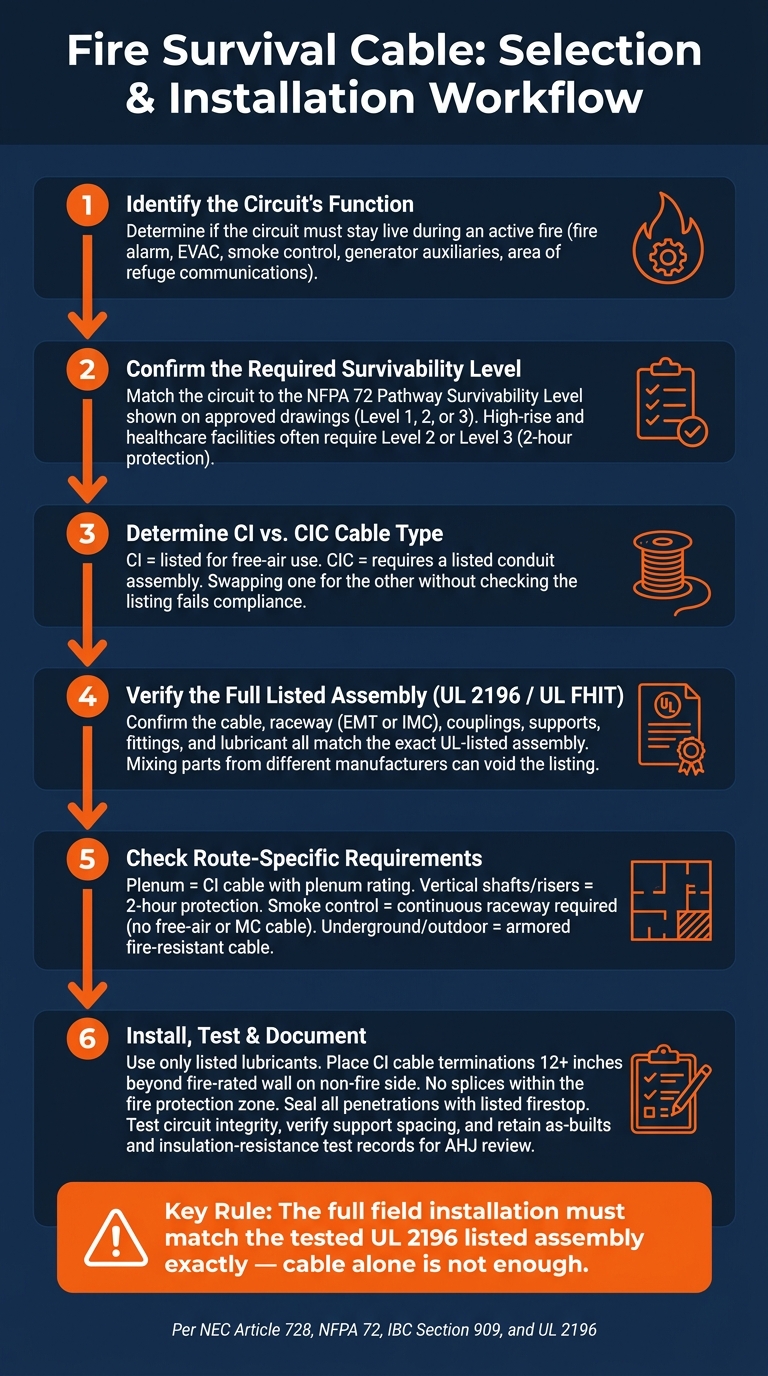
Fire Survival Cable Selection & Installation Process for Life-Safety Circuits
A Step-by-Step Selection Process for Procurement Teams and Contractors
Once you know the required survivability level, the next job is simple in theory and easy to mess up in practice: source the right listed assembly and install it the same way it was tested.
Start with the circuit's function, not the catalog. First match the circuit function to the required survivability level and cable type. In buildings that use partial evacuation and relocation plans - common in high-rise buildings and healthcare disaster facilities - the cable's survivability rating needs to line up with the fire-resistance strategy required for that space. Also confirm that the cable voltage rating fits the system's listed application. Then match the cable to the survivability level called for in the approved design.
Fire survival cable costs more up front. But rework costs more. Getting the spec right before rough-in is cheaper than tearing work out later.
The two-hour rating gives occupants time to evacuate safely.
It also helps to coordinate cable pathways early with HVAC and plumbing trades. If life-safety circuits get moved during construction without approval, the result can be expensive compliance rework.
Using Electrical Trader to Source Emergency Power and Distribution Equipment
Fire survival cable is only one part of the emergency power chain. Use Electrical Trader to source emergency breakers, transformers, distribution gear, and generators that support the life-safety load.
Installation Practices That Protect Cable Performance
After procurement, the listed installation method becomes the compliance check that matters most. A cable can be specified correctly and still fail compliance if the field installation doesn't match the listed method. As Carson Cook, PE, Fire Protection Engineer at Jensen Hughes, has noted:
"The UL 2196 listing carries specific requirements with respect to cable supports, enclosures, attachment to structure, raceway materials and even the pulling lubricant that aligns with the installation that underwent that manufacturer's fire testing."
Use only lubricants named in the manufacturer's UL 2196 listing. An unapproved product can void the fire-resistance rating for the entire run.
A few field rules matter here:
- For CI cable, place terminations at least 12 inches beyond the fire-rated wall or floor on the non-fire side.
- Splices within the designated fire protection zone are not permitted, so the run must be continuous.
- Seal every penetration with listed firestop materials.
After installation, test circuit integrity and verify support spacing. Keep as-builts, circuit schedules, and insulation-resistance test records ready for AHJ review and future maintenance.
Conclusion: What to Prioritize When Planning Fire Survival Cable Installations
In disaster response facilities, survivability starts with the job of the circuit, not the label on the cable. Fire survival cables are meant to keep critical circuits running during a fire. The first thing to get right is application fit. Start with the evacuation strategy, because that drives the NFPA 72 Pathway Survivability Level and the cable and compliance route you need to follow.
Once that survivability level is clear, the next focus is documented design discipline. In plain terms, the details matter. These systems have to work when conditions are at their worst, and small installation choices can make or break that outcome. Fire test records and U.S. code compliance need to line up with the manufacturer's listed installation method. UL 2196 covers the full assembly, which means the field installation has to match the tested setup.
That’s why early coordination matters so much. Lock in the pathway method before procurement and rough-in. If the pathway changes late, costs usually climb fast.
FAQs
When is fire survival cable required?
Fire survival, or circuit integrity (CI), cables are used when a system has to keep carrying power or signals during a fire for a set amount of time. That requirement usually comes from the building code, the project specs, or the authority having jurisdiction.
In the U.S., these cables are common in life-safety systems. That includes emergency voice and alarm communication, smoke control, and two-way emergency responder communication.
They matter most in buildings that rely on partial evacuation or relocation plans. In those cases, people may stay in part of the building while another area is cleared, so the system can't just fail when conditions get bad.
How do I know if I need CI or CIC cable?
Check your building’s required pathway survivability level under NFPA 72. In many cases, you’ll need CI or CIC cable if the facility uses partial evacuation or relocation, or if local codes call for protection of fire alarm and emergency communication systems that must keep working during a fire.
CI cable is listed to keep operating during fire exposure. CIC cable must be installed in a specified conduit system to meet its listing. Review the project specifications, local code rules, and the authority having jurisdiction before you make the call.
What voids a UL 2196 listed installation?
Any change from the manufacturer’s tested materials, hardware, or installation methods can void a UL 2196 listing. These systems are certified as complete assemblies, so if you swap in parts that aren’t listed, the fire rating may no longer apply.
The same goes for installation details. Improper support spacing, sagging or unsupported cable, or missing the exact mounting and routing requirements can weaken survivability. All hardware must match the specific system listing.