

NFPA 855: Battery Fire Safety Standards
Battery energy storage systems (BESS) are safer than ever, but risks like fires and explosions still demand attention. NFPA 855, the U.S. safety standard for stationary energy storage systems, addresses these risks with strict guidelines for installation, monitoring, and emergency planning. The latest 2026 edition introduces mandatory Hazard Mitigation Analysis (HMA) for almost all installations, ensuring better fire prevention and response measures.
Key Takeaways:
- Fire Risks: Lithium-ion batteries can experience thermal runaway, releasing toxic gases and causing fires that reignite days later.
- NFPA 855 Scope: Covers 19 battery technologies, including lithium-ion, lead-acid, and newer chemistries like iron-air and flow batteries.
- 2026 Updates: HMA is now required for all installations, removing previous exemptions. Fire detection, suppression, and separation distances have stricter requirements.
- Backup Power Systems: Systems over 600 kWh in buildings need dedicated fire-rated rooms, explosion control, and UL 9540 certification.
- Safety Measures: Gas detection, fire-rated barriers, and proper ventilation are essential for compliance.
Between 2018 and 2023, BESS failure rates dropped by 97% due to improved standards like NFPA 855. Following these guidelines not only reduces risk but also ensures compliance with insurance and financing requirements.
NFPA 855 Guide: Complying with the Battery Fire Code for Safer Energy Storage Systems
sbb-itb-501186b
Scope and Applicability of NFPA 855
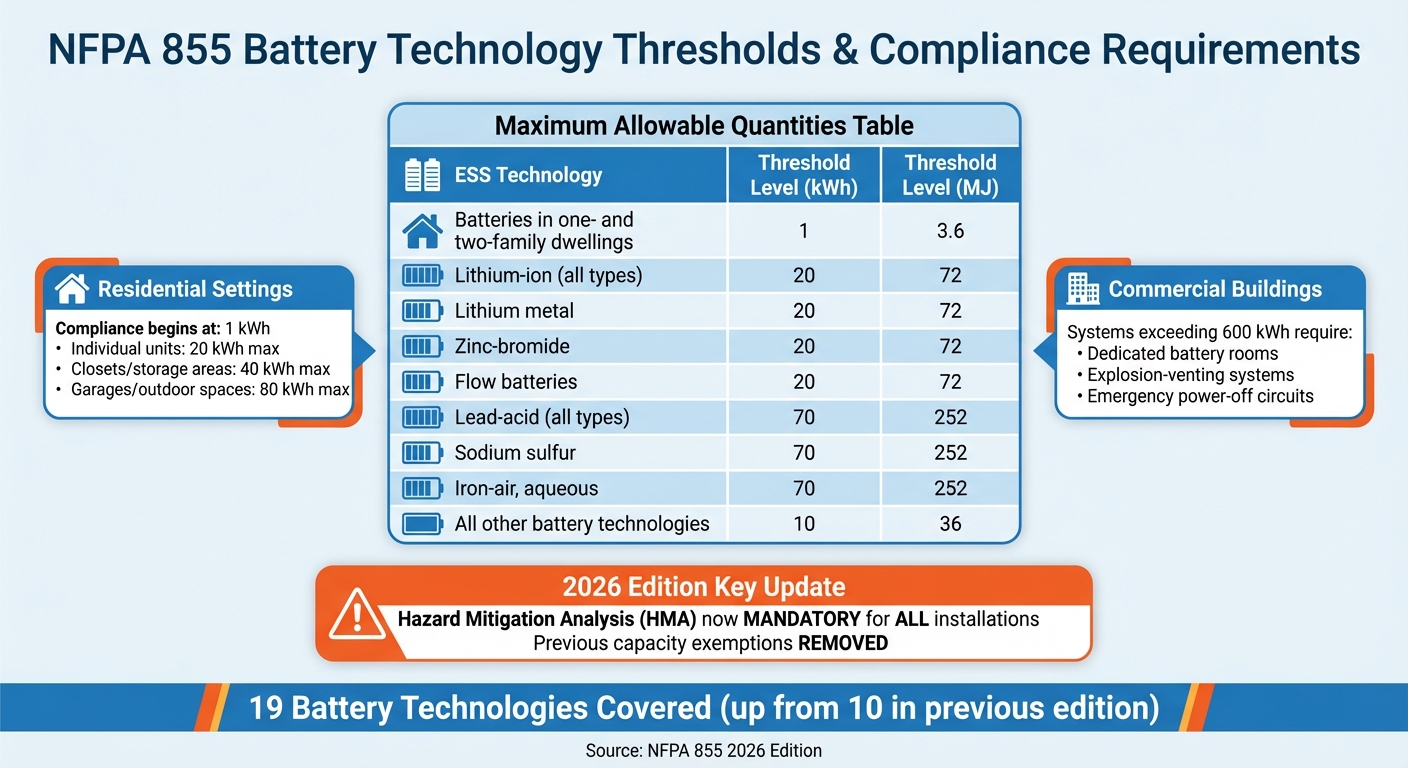
NFPA 855 Battery Technology Thresholds and Compliance Requirements
NFPA 855 takes a tailored approach to battery safety, acknowledging that different battery chemistries pose varying risks. The standard sets specific thresholds based on nameplate capacity, requiring full compliance once these limits are exceeded. This framework paves the way for a deeper dive into the battery technologies and installation thresholds outlined below.
Battery Technologies Covered
The 2026 edition of NFPA 855 has broadened its scope, now covering 19 energy storage technologies, a notable increase from the 10 listed in the previous version. This includes well-known chemistries like lithium-ion and lead-acid, alongside newer types such as iron-air, sodium-sulfur, zinc-bromide, and lithium metal batteries. Flow batteries, for example, now have their own dedicated chapter (Chapter 16) that focuses on spill control and hazard mitigation.
By explicitly naming each battery chemistry, the standard eliminates uncertainty and enables Authorities Having Jurisdiction (AHJs) to enforce safety measures tailored to the unique risks of each type. For example, LFP (Lithium Iron Phosphate) batteries produce about 86% less hydrogen fluoride during thermal runaway compared to NMC (Nickel Manganese Cobalt) batteries. This difference directly impacts ventilation and gas detection requirements. Understanding these distinctions is crucial when addressing the thresholds that dictate installation requirements.
Maximum Allowable Quantities and Site Thresholds
Compliance thresholds are determined by the fire and explosion risks associated with each battery chemistry. For lithium-ion systems, the threshold is set at 20 kWh (72 MJ), while lead-acid batteries have a higher threshold of 70 kWh (252 MJ).
For residential settings, compliance begins at 1 kWh, with specific limits based on location: 20 kWh for individual units, 40 kWh in closets or storage areas, and 80 kWh in garages or outdoor spaces. In commercial buildings, systems exceeding 600 kWh must include dedicated battery rooms, explosion-venting systems, and emergency power-off circuits.
A significant update in the 2026 edition is the removal of previous capacity tables that allowed some projects to bypass a formal Hazard Mitigation Analysis (HMA). Now, an HMA is mandatory for all installations, regardless of size. As Brian Scholl, Deputy Fire Marshal and NFPA 855 committee member, explains:
"The HMA is step number one"
These thresholds are not just about meeting installation standards - they are critical for implementing robust fire safety measures essential for backup power systems.
| ESS Technology | Threshold Level (kWh) | Threshold Level (MJ) |
|---|---|---|
| Batteries in one- and two-family dwellings | 1 | 3.6 |
| Lithium-ion (all types) | 20 | 72 |
| Lithium metal | 20 | 72 |
| Zinc-bromide | 20 | 72 |
| Flow batteries | 20 | 72 |
| Lead-acid (all types) | 70 | 252 |
| Sodium sulfur | 70 | 252 |
| Iron-air, aqueous | 70 | 252 |
| All other battery technologies | 10 | 36 |
Source: NFPA 855 2026 Edition, Table 1.3
Installation and Fire Safety Requirements
To meet NFPA 855 standards, proper installation practices are essential, especially when systems exceed defined thresholds. These requirements focus on preventing thermal runaway from spreading and ensuring enough time for safe evacuation and first responder action. Below are key guidelines for energy storage system (ESS) installations and fire safety measures.
Installation Guidelines for ESS
Under the 2026 edition, Hazard Mitigation Analysis (HMA) is now required for nearly all battery energy storage installations, removing prior exemptions based on system size or location. A licensed professional engineer (PE) should conduct the HMA early in the design process.
The HMA assesses risks such as thermal runaway, gas dispersion, and explosions. For complex setups, computational fluid dynamics (CFD) modeling can help identify issues like off-gas flow and vent placement.
Environmental controls play a vital role in safety. Exhaust systems must keep flammable gas levels below 25% of the Lower Flammable Limit (LFL). Gas detection systems should monitor for hydrogen (H₂), carbon monoxide (CO), and hydrogen fluoride (HF) to provide early warnings of thermal runaway. It's worth noting that lithium iron phosphate (LFP) batteries release about 86% less hydrogen fluoride compared to nickel manganese cobalt (NMC) batteries, which can influence ventilation design.
Location restrictions also apply. Outdoor systems must maintain at least 3 feet of clearance from doors and windows. In areas like garages, where vehicles are present, approved impact barriers are required.
Explosion control measures have become stricter. The 2026 edition states that standalone deflagration venting is no longer sufficient. Systems must now incorporate NFPA 69-compliant explosion prevention measures. For commercial buildings with systems exceeding 600 kWh, dedicated battery rooms with explosion-venting systems and emergency power-off circuits are mandatory.
Fire-Resistant Barriers and Separation Distances
NFPA 855 requires a minimum separation distance of 3 feet between battery groups or racks, as well as between racks and walls, for lithium-ion systems exceeding 50 kWh per group or array.
This 3-foot rule may be reduced if Large-Scale Fire Testing (LSFT) or UL 9540A data shows that thermal runaway won’t spread between units at closer distances [3,6]. However, many insurers prefer or mandate distances of 8 feet or more to reduce risk further. Presenting UL 9540A summary tables to Authorities Having Jurisdiction (AHJs) can help justify any reductions.
Fire-rated walls or barriers can act as an alternative or complement to physical spacing. These barriers must prove they can confine fires within unoccupied ESS rooms for the duration of their fire resistance rating. For outdoor containerized systems, barriers and spacing often support a "controlled burn-out" approach, allowing the unit to burn safely within a designated area while protecting nearby structures.
In addition to spacing and barriers, fire suppression systems are critical. Systems using lithium-ion, lead-acid, or flow batteries must include fire suppression measures. Indoor installations require automatic sprinklers per NFPA 13, with a minimum design density of 0.3 gallons per minute per square foot over an area of 2,500 square feet. The water supply must also support a minimum duration of 90 minutes to address potential lithium-ion reignition.
Engaging early with AHJs is essential for a smooth installation process [3,5]. With the shift toward performance-based designs, data-backed strategies for spacing, barriers, and suppression systems are increasingly necessary, moving beyond reliance on prescriptive table values.
Fire Protection, Suppression, and Hazard Mitigation
Fire Detection and Suppression Systems
According to NFPA 855, automatic fire suppression is mandatory for battery chemistries. For indoor systems, water-based sprinklers must comply with NFPA 13, requiring a design density of 0.3 gpm/ft² over a 2,500 ft² area, along with a water supply capable of operating for 90 minutes to address reignition risks.
Water is the preferred suppression agent because of its ability to cool and control fire spread effectively. While clean-agent systems like Novec 1230 or water-mist systems can be used, they need to activate before cell venting intensifies. However, clean agents alone often fall short in managing thermal runaway due to their limited cooling effect. A stark example is the 2019 explosion at the McMicken facility in Arizona. In this incident, a Novec 1230 system failed to stop a cascading thermal runaway, injuring four firefighters. This event directly led to stricter NFPA 855 standards, including requirements for deflagration venting and improved emergency protocols.
Gas detection systems play a critical role in identifying thermal runaway early. These systems monitor gases like Hydrogen (H₂), Carbon Monoxide (CO), and Hydrogen Fluoride (HF). Sensors must integrate with the Battery Management System (BMS) to trigger ventilation controls, ensuring flammable gas concentrations stay below 25% of the Lower Flammable Limit (LFL). Carbon monoxide is an early marker of electrolyte decomposition, while hydrogen indicates thermal runaway.
These detection and suppression systems are part of a larger framework for hazard mitigation, which is explored in the next section.
Hazard Mitigation and Battery Monitoring
The 2026 edition of NFPA 855 introduces a requirement for a Hazard Mitigation Analysis (HMA) for almost all battery installations. This analysis evaluates risks such as thermal runaway propagation, gas dispersion, and explosion hazards. Brian Scholl, Deputy Fire Marshal and a member of the NFPA 855 committee, emphasizes its importance:
"The HMA is step number one"
The findings from the HMA guide the placement of vents and the development of suppression strategies, ensuring a comprehensive approach to hazard control.
Battery Management Systems (BMS) are essential for monitoring battery conditions and initiating hazard response actions. These systems must offer real-time monitoring and work seamlessly with gas detection systems and ventilation controls. First responders are also required to have access to BMS data, allowing them to quickly assess battery conditions during emergencies. Additionally, thermal imaging should be conducted every 90 days to detect potential cell issues early.
The industry is increasingly adopting a performance-based design approach. Instead of relying solely on generic requirements, project teams now use UL 9540A Large-Scale Fire Testing (LSFT) data to justify decisions about spacing, vent sizing, and suppression methods. This shift has been instrumental in reducing BESS failure incidents by 97% between 2018 and 2023 as safety standards became widely implemented. By integrating these practices, NFPA 855 ensures that fire protection, suppression, and hazard mitigation systems work together to safeguard facilities effectively.
Compliance for Backup Power Systems
Integration with Backup Power Systems
Backup power systems need to align with NFPA 855 standards, particularly when using lithium-ion batteries for uninterruptible power supplies (UPS) or other backup installations. The standard applies to lithium-ion systems starting at 20 kWh, while systems using lead-acid or nickel-cadmium batteries have a threshold of 70 kWh due to their established safety track record.
The 2026 edition of the standard expands Hazard Mitigation Analysis (HMA) requirements to include backup power systems that previously fell below enforcement thresholds. These systems must meet UL 9540 system-level certification. UL 9540A testing data plays a critical role in determining safe separation distances between battery units and walls, potentially reducing the default 3-foot distance requirement when supported by proper testing. For larger installations exceeding 600 kWh in occupied buildings, dedicated fire-rated rooms are mandatory.
Chapter 5 of NFPA 855 outlines additional integration requirements, including disconnecting means (like breakers), communication systems for battery management systems (BMS), and supporting equipment such as transformers. Gas detection systems are also essential; they must monitor for hydrogen, carbon monoxide, and hydrogen fluoride, integrating with ventilation controls to maintain flammable gas concentrations below 25% of the Lower Flammable Limit (LFL).
To meet these stringent criteria, sourcing compliant components is a critical step.
Sourcing Compliant Equipment
Securing NFPA 855-compliant components involves early collaboration with Authorities Having Jurisdiction (AHJs), as the permitting process can take anywhere from 30 days to 6 months.
Platforms like Electrical Trader (https://electricaltrader.com) offer a centralized resource for finding compliant electrical components, including new and used breakers, transformers, and power distribution equipment tailored to battery energy storage installations.
When procuring equipment, ensure all components are part of a UL 9540-listed system to simplify AHJ approval. Comprehensive documentation is crucial - this includes the UL 9540 listing, UL 9540A test reports, and a signed HMA for submission during the permitting process. Partnering with qualified professionals, such as Registered Design Professionals or Fire Protection Engineers (FPEs) experienced in energy storage, ensures compliance with the elevated standards set forth in the 2026 edition.
Conclusion
NFPA 855 plays a key role in advancing fire safety standards, particularly for battery energy storage systems (BESS). The 2026 edition introduces a mandatory Hazard Mitigation Analysis for nearly all installations, removing previous exemptions. It also requires large-scale fire testing alongside UL 9540A data, shifting the focus from outdated checklist methods to a more performance-driven approach based on solid data and defensible design decisions.
"NFPA 855 compliance isn't just regulatory checkbox - it's risk management with measurable ROI." - Wattality
Between 2018 and 2023, BESS failure rates dropped by an impressive 97%, with every dollar spent on fire prevention saving an estimated $5 in potential losses. These numbers highlight the tangible benefits of adhering to strict safety standards.
For backup power systems, compliance starts with early engagement with Authorities Having Jurisdiction (AHJs), using UL 9540-certified equipment, and developing a coordinated Emergency Response Plan with local fire departments. Large project permitting timelines can range from one to six months, so proactive planning is essential. These steps, combined with the broader fire safety strategies discussed earlier, ensure systems not only meet regulatory requirements but also safeguard critical infrastructure.
When sourcing UL 9540-certified equipment, platforms like Electrical Trader (https://electricaltrader.com) offer access to both new and used electrical gear tailored for BESS installations. To maintain operational safety, verify system-level certification and stick to a 90-day thermal imaging schedule for consistent monitoring.
FAQs
When do I need an HMA for my BESS?
Starting with the 2026 edition of NFPA 855 standards, most Battery Energy Storage System (BESS) installations will require a Hazard Mitigation Analysis (HMA). This step ensures that safety measures and risk assessments align with the updated regulations, promoting safer and more reliable system operations.
What’s the difference between UL 9540 and UL 9540A?
UL 9540 is a safety standard that evaluates the overall safety, construction, and performance of energy storage systems (ESS) as a whole. On the other hand, UL 9540A is a specific test method designed to assess thermal runaway and fire propagation within individual ESS components. While UL 9540A test results are used to support UL 9540 certification, passing UL 9540A alone doesn’t ensure certification. UL 9540 focuses on the safety compliance of the entire system.
What additional rules apply to indoor backup batteries over 600 kWh?
Indoor backup batteries with capacities exceeding 600 kWh are required to comply with additional fire safety measures under NFPA 855. These measures cover critical systems like fire detection, suppression, explosion control, and ventilation to mitigate potential hazards. The upcoming 2026 edition broadens the scope by incorporating guidelines for a wider range of battery chemistries and larger capacities, aiming to improve safety standards for these advanced systems.