

Wind Tower Material Selection: Procurement Guide
The lowest tower quote can still be the wrong buy. If I’m sourcing wind tower materials for a U.S. onshore project, I need to check four things first: site fit, material system, supplier records, and landed cost.
Here’s the short version:
- I start with the site data: wind class, seismic inputs, geotechnical data, temperature range, altitude, and salt exposure.
- I turn that into quote-ready specs for tower steel, flanges, bolts, coatings, anchor cages, grout, concrete, rebar, and embedded steel.
- I compare steel, concrete, and hybrid towers based on transport limits, crane needs, and the effect on the base and anchor loads.
- I screen suppliers for certifications, MTCs, inspection records, traceability, and nonconformance history.
- I price total delivered cost, not just purchase price - especially for used materials, where added work can include $50,000–$300,000 for disassembly, $20,000–$100,000 for transport, and $100,000–$500,000 for reconditioning.
- I do not approve a package with missing records, weak traceability, or a schedule that does not fit the job.
Used equipment can look cheap at 40%–70% of new price, and low-hour units may land at 60%–80%. But that gap can shrink fast once recertification, hauling, inspection, and reinstall work are added. That is where many buyers get caught.
Quick comparison
| Option | Upfront Price | Transport Fit | Inspection Burden | Schedule Risk | Common Watchout |
|---|---|---|---|---|---|
| New steel tower | Highest | Can be limited by section size | Standard QC | Mill and forging lead times | Oversize transport limits |
| New concrete tower | Varies by site | Often easier in segments | Standard QC | Casting and site sequencing | Base design changes |
| Hybrid tower | Mid to high | Often better for tough access | Mixed package checks | Multi-supplier coordination | Interface risk |
| Used / reconditioned | 40%–70% of new | Depends on source and route | Highest | Recertification and permit delays | Missing history and added rework cost |
If I had to reduce the whole guide to one rule, it would be this: buy the package that matches the site, clears transport, has clean records, and holds up on total installed cost.
Course on Wind Turbine Tower and Support Structures
sbb-itb-501186b
Step 1: Turn Design Standards Into Purchase Specifications
Engineering sets the loads. Procurement turns those into quote-ready specs, inspection rules, and apples-to-apples bid terms.
The next step is simple in theory but easy to get wrong: turn site conditions into measurable material requirements.
Your RFQ needs to match the site’s wind, seismic, and geotechnical conditions, and the turbine’s wind class needs to match the site wind regime. If that data is missing, suppliers can end up working from the wrong assumptions. That can lead to mismatched steel grades, bad foundation assumptions, or extra verification work on the supplier side.
Material Property Requirements for Tower Steel and Foundation Materials
At the purchase-spec stage, spell out the limits for temperature, altitude, and salinity, along with the required structural integrity checks.
Then tie those limits to the paperwork suppliers must submit. In plain terms, don’t just say what the materials need to handle. Also state the exact submittals and test records required to prove they meet those conditions.
What to Include in the Material Requisition and Bid Package
The requisition should include only the inputs that affect supplier pricing or material verification. That keeps the bid package tight and helps suppliers quote with fewer assumptions.
The material requisition should list the technical inputs suppliers need to quote with accuracy, including:
- Tower height
- Design life
- Coating system
- Foundation interface details
- Grid-code compliance for the project jurisdiction
It should also call out any site-specific limits on tower height.
For used or relocated towers, ask for the full asset record: maintenance records, fault history, component replacement logs, lightning protection history, and certification documents. After that, have specialist engineers check the tower’s condition against the purchase spec.
Step 2: Select the Right Tower and Foundation Material System
Once the bid specs are locked in, pick the tower and foundation material system that fits the job. That decision shapes transport logistics, installation needs, and total installed cost.
Steel vs. Concrete vs. Hybrid Towers for U.S. Project Conditions
Choose the tower type based on the site’s transport, erection, and foundation limits. Steel, concrete, and hybrid towers each come with different procurement tradeoffs.
The big point here is simple: don’t judge bids by tower price alone. Look at installed cost, logistics, and the effect on the foundation.
Dimensions matter too. The tower has to fit transport and erection limits. If site access is poor, oversized steel sections may be off the table. In that case, segmented steel or hybrid systems may make more sense.
It also helps to match the tower type and foundation system before award. One change can affect anchor loads, embedment, and grout needs. What looks cheaper on paper can end up costing more once hauling, cranes, and foundation changes enter the picture.
After choosing the material system, supplier qualification should verify fabrication quality and traceability.
How Site Exposure, Temperature, and Seismic Conditions Affect Material Choices
Site conditions can rule out tower options that might otherwise work. Salinity, altitude, and temperature extremes should be used to narrow coating and steel-grade choices.
Wind class certification also needs to match the site’s wind regime. And structural integrity checks should reflect the site’s environmental history and current conditions.
In plain terms, use site exposure as a filter. If a material or coating won’t hold up in the actual project setting, it shouldn’t stay on the list.
Step 3: Qualify Suppliers and Check Compliance Records
Once the material system is locked in, supplier qualification does the next job: it removes suppliers that can't prove compliance, traceability, or fabrication quality. At this stage, you're not just asking, "Can they make it?" You're checking whether they can fabricate, document, and deliver the tower or foundation package exactly to spec.
How to Check Supplier Certifications, Fabrication Quality, and Traceability
Start with certifications. Suppliers should provide wind-class certification and any grid-code documents that apply. Before award, have engineers review structural assessments, inspection reports, and past project performance.
Traceability matters just as much. Ask for full records for tower steel, flanges, anchor cages, rebar, and coatings. That includes MTCs, nonconformance reports, coating inspection records, and delivery performance history.
Use the table below as a working scorecard during supplier evaluation:
| Evaluation Criterion | Minimum Requirement | Preferred Evidence | Rejection Triggers |
|---|---|---|---|
| Structural Integrity | Verified structural assessment | Detailed inspection reports and past project performance | Missing structural records or unverified structural repairs |
| Certifications | Wind-class certification | Official certification documents matching the site wind class | Non-compliance with local grid codes or site wind class |
| Documentation Quality | Complete records and certifications package | MTCs, prior project references, and coating inspection records | Missing MTCs or incomplete compliance documentation |
| Traceability | Full traceability records | Material records and delivery performance history | Missing documentation or unverified component origins |
Compliance Records to Review Before Supplier Approval
After you check certifications and fabrication history, go one level deeper and review the paper trail for each lot and shipment. Don't approve a supplier until MTCs for steel or rebar are complete.
Then look at nonconformance history. Were issues recorded, corrected, and closed? Did the same problems keep showing up? A clean file on paper means little if repeat issues keep slipping through. Verify that prior jobs met the same standards your project requires.
Last, make sure the documentation lines up with the site conditions listed in the purchase spec.
Step 4: Compare Lead Times, Used Material Risks, and Total Cost
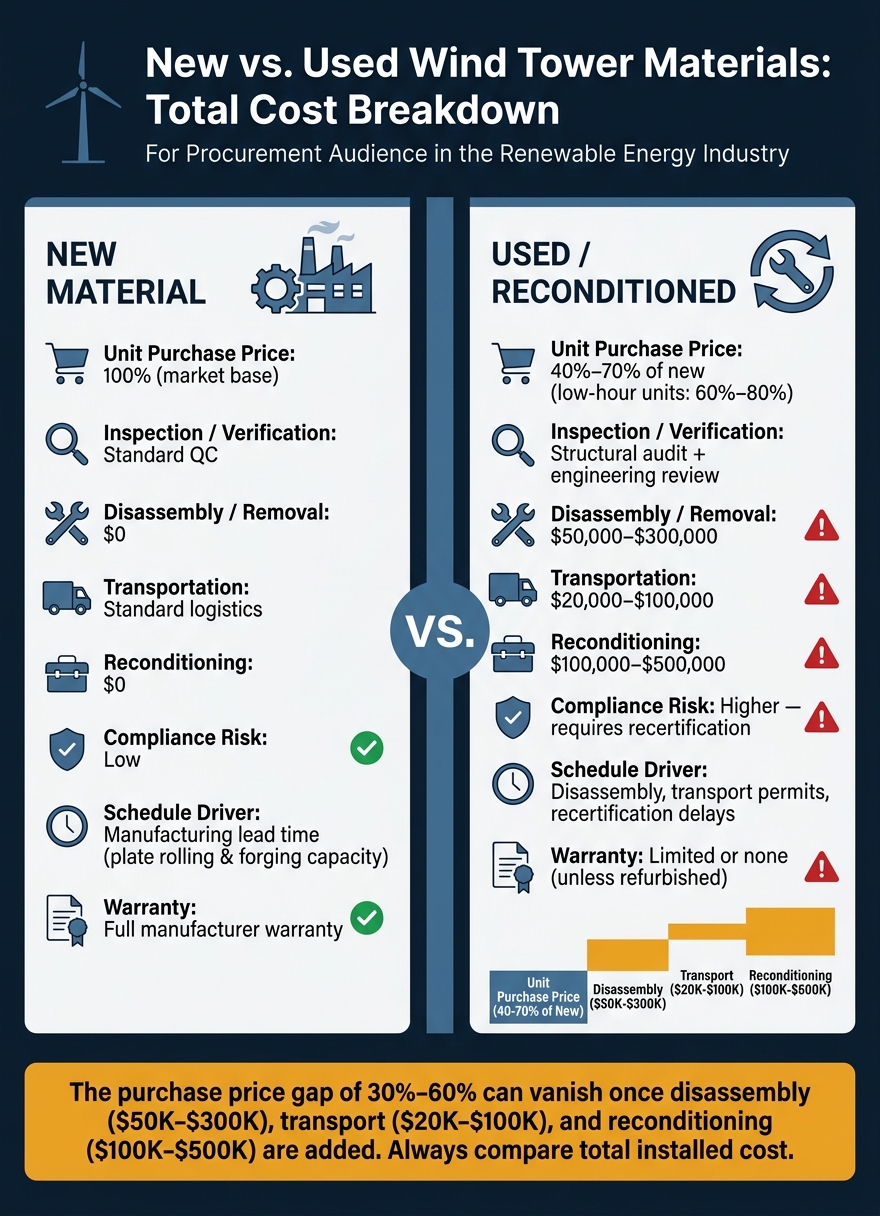
New vs. Used Wind Tower Materials: Total Cost Breakdown
Once supplier compliance is checked off, the next job is simple: compare schedule risk and delivered cost.
A cheap quote can fall apart fast if the material shows up late, needs more inspection work, or triggers recertification issues. That’s why this step is about the landed number and the actual timeline, not just the sticker price.
Lead Times for Tower Steel, Flanges, Anchor Cages, Concrete, and Rebar
For new tower steel, the biggest schedule drivers are plate rolling and forging capacity. In practice, that means you shouldn’t treat all civil and tower inputs as one bucket. Tower steel, flanges, anchor cages, concrete, and rebar each move on their own timeline.
That split matters. A project can have tower steel moving on plan while flanges slip. Or concrete can be ready while anchor cages lag behind. If you lump them together, it’s easy to miss the item that ends up setting the pace.
Used materials bring a different kind of risk. On-hand inventory can look fast at first glance, but disassembly and recertification can eat into that head start. Oversize transport permits and engineering recertification may add delay. What looks available today may not be install-ready when you need it.
Third-party inspections should also happen at the right moments. Align them with production milestones, not after fabrication. If you wait until the end, problems show up when fixes are slow and expensive.
New vs. Used Materials: Risk, Inspection Cost, and Sourcing Economics
Used or reconditioned wind equipment usually comes in at 40% to 70% of new pricing, depending on age and condition. Refurbished units with warranty coverage generally cost 50% to 75% of new pricing. Low-hour units under 20,000 operating hours often sell for 60% to 80% of new price.
On paper, that discount can look hard to pass up. But the gap often narrows after disassembly, transport, and reconditioning are added in.
For used materials, price the discount against the extra work that comes with it:
- verification
- transport
- recertification
And don’t stop there. The equipment also needs to fit the project itself. It should match site-specific wind conditions, grid code requirements, and site conditions such as temperature extremes, altitude, and salinity, along with transportation and installation constraints.
Use the table to compare landed cost, not just purchase price.
| Cost Factor | New Material | Used / Reconditioned |
|---|---|---|
| Unit Purchase Price | 100% (market base) | 40%–70% of new price; low-hour units can be 60%–80% |
| Inspection / Verification Cost | Standard QC | Structural audit and engineering review |
| Disassembly / Removal | $0 | $50,000–$300,000 |
| Transportation | Standard logistics | $20,000–$100,000 |
| Reconditioning | $0 | $100,000–$500,000 |
| Compliance Risk | Low | Higher; requires recertification |
| Schedule Impact | Manufacturing lead time | Disassembly, transport permits, and recertification delays |
| Warranty | Full manufacturer warranty | Limited or none unless refurbished |
Used wind equipment often ends up costing more than buyers expect once dismantling, transport, reinstallation, and recertification are included. That’s the trap: the purchase price looks lower, but the full delivered picture can tell a very different story.
Conclusion: A Practical Checklist for Wind Tower Material Procurement
The lowest quoted price is almost never the lowest total cost. The better standard is total installed cost. Before award, run one last check to make sure the package still fits the design, the site, the supplier record, and the project schedule.
| Checkpoint | What to Confirm |
|---|---|
| Site Conditions | Wind class certification suitable for the site's wind regime and local wind patterns, temperature extremes, altitude, salinity |
| Tower & Foundation | Structural integrity, tower height and physical dimensions for permit compliance, lightning protection review |
| Material Specs | Tower steel grade, concrete mix, rebar, grout, and coating system match the approved design |
| Compliance Records | Grid code compliance, local permits, and approved project documentation |
| Supplier Documentation | Complete records and certifications; maintenance logs, fault history, and warranty coverage for used or reconditioned units |
| Logistics | Transport route clearances, site accessibility, installation cost (20%–40% of turbine cost) |
| Used Material Audit | Operating hours, maintenance history, major repairs, and inspection records |
Missing records can slow approval, add inspection cost, and increase the chance of rework. Put simply, a complete compliance file is worth more than a cheaper bid with gaps in the paperwork.
For used or reconditioned materials, verify operational history before committing. Total hours, availability percentages, maintenance adherence, and any major component replacements all shape remaining service life. An "as-is" unit with no maintenance logs carries a very different risk profile than a factory-reconditioned unit with warranty coverage.
If a material package fails the checklist, don't award it. Make each award decision based on verified compliance, schedule fit, and total cost.
FAQs
How do I choose between steel, concrete, and hybrid towers?
Choose based on structural needs, site conditions, and cost. Steel is the standard for most onshore projects because it’s reliable and easier to transport. Concrete can handle greater heights and heavier nacelles, while hybrid towers strike a balance between cost and structural performance for taller, utility-scale turbines.
It also helps to look at turbine weight, the site’s wind conditions, and local infrastructure limits.
What documents should I require before approving a supplier?
Request documents that show the product meets U.S. safety standards. That includes certifications from NRTLs such as UL, ETL, or CSA. For electronic components, review the Supplier's Declaration of Conformity and any required General Certificates of Conformity, along with the test reports that support them.
You should also look at the supplier's quality control records. Focus on items like:
- SOPs
- staff training records
- the supplier quality management system
For equipment, ask for records that show how it performs and how it's been maintained. That includes performance data, maintenance records, testing results, recall history, and quality assurance reports.
When does used tower material stop being a cost savings?
Used wind turbine material can stop looking like a bargain once dismantling, transport, and reinstallation eat into the lower purchase price. Yes, used turbines may cost 40%–70% less up front. But logistics and reconditioning can add $170,000 to $900,000 per turbine.
The math can also shift over time. If there's no warranty, parts are in poor shape, or the equipment doesn't fit well with the site or existing systems, operating and maintenance costs can climb fast.