

Energy-Efficient Transformers: Price Trends 2026
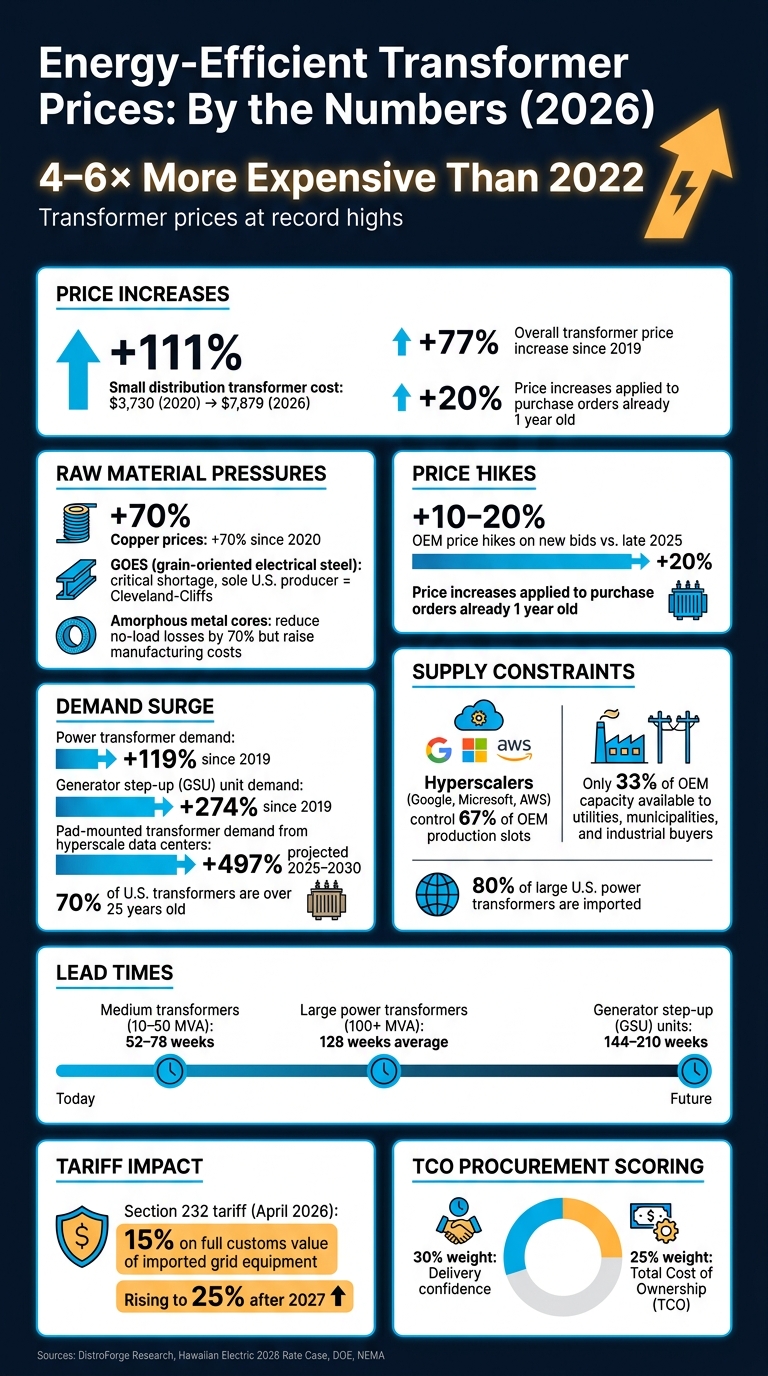
Energy-efficient transformers are now 4 to 6 times more expensive than in 2022, driven by rising raw material costs, supply chain bottlenecks, and surging demand. A small distribution transformer that cost $3,730 in 2020 now costs $7,879 - a 111% jump. Key factors include:
- Raw Material Costs: Copper prices are up 70% since 2020, and grain-oriented electrical steel (GOES) faces shortages.
- Tariffs: A 15% tariff on imported grid equipment, introduced in April 2026, raises costs further.
- Demand Surge: Power transformer demand has grown 119% since 2019, with 70% of U.S. transformers over 25 years old.
- Lead Times: Delivery for large transformers now averages 128 weeks, delaying projects.
Regulations like the Build America, Buy America (BABA) Act and stricter DOE efficiency standards are pushing buyers toward more efficient but costly designs. Buyers must focus on Total Cost of Ownership (TCO) to balance upfront costs with long-term savings.
Quick Overview:
- Price Increase: Transformer costs up 77% since 2019.
- Supply Constraints: Hyperscalers dominate production capacity, leaving limited availability for other buyers.
- Efficiency Standards: New designs using amorphous metal cores reduce energy waste but raise prices.
Navigating this market requires early planning, sourcing alternatives like surplus equipment, and prioritizing compliance with evolving regulations.
Energy-Efficient Transformer Price Surge: Key Stats 2026
Market Overview and Pricing Trends
As efficiency standards push for upgrades, the U.S. transformer market in 2026 faces a mix of challenges, with market volatility adding to procurement difficulties. Prices remain at record highs. Original Equipment Manufacturers (OEMs) have introduced 10% to 20% price hikes on new bids compared to late 2025. Some manufacturers have gone further, applying 20% increases to purchase orders placed a year earlier. These pricing shifts are just one piece of the puzzle reshaping the market.
"The price you locked at PO is no longer the price you pay at delivery." - DistroForge Research
Factors Driving Prices in 2026
The price surge is driven by what analysts call the "Triple Squeeze": record demand, tariff changes, and storm-related replacement needs.
Raw materials are a major contributor to rising costs. Copper prices have climbed over 70% since 2020, and grain-oriented electrical steel (GOES) - essential for high-efficiency transformer cores - faces a supply bottleneck. The U.S. relies on Cleveland-Cliffs as its sole domestic producer of GOES, leaving buyers with little negotiating power.
Trade policy is also playing a role. The Section 232 tariff system, implemented in April 2026, adds a 15% tariff on the full customs value of imported grid equipment - not just the raw material content. This change significantly raises costs for imported units, which is critical since 80% of large power transformers used in the U.S. are imported.
Adding to the pressure, GE Vernova's acquisition of Prolec GE in February 2026 reduced the number of independent large-scale suppliers. This consolidation has given the remaining OEMs greater pricing leverage, creating what analysts term "bundled-quote pressure".
Supply and Demand Dynamics
While prices climb, supply constraints are worsening. Demand far exceeds supply, creating a two-tiered market. Hyperscalers like Google, Microsoft, and AWS secure factory capacity through long-term "take-or-pay" agreements, leaving utilities, municipalities, and industrial buyers to compete for the remaining 33% of OEM production slots.
This imbalance is reflected in lead times. Large power transformers now average 128 weeks for delivery, while generator step-up (GSU) units - whose demand has grown 274% since 2019 - take between 144 and 210 weeks to arrive. Winter Storm Fern in January 2026 further stressed the system, forcing Entergy to replace 2,210 distribution transformers across four states in just weeks, depleting already thin safety stocks.
The competition for manufacturing capacity is fierce. In April 2026, Eaton announced a $500 million U.S. manufacturing expansion, including a 370,000 sq ft facility in Nebraska and a new campus in Virginia aimed at supporting the booming data center corridor. This investment highlights the unrelenting demand.
"When equipment availability becomes the gating factor instead of capital or permitting, your entire expansion timeline gets dictated by supply chains you can't control." - Wes Garrett, IndustrialSage
For buyers outside the hyperscaler tier, early procurement planning is essential. Waiting until a project is fully permitted could add two to four years to delivery timelines.
sbb-itb-501186b
Efficiency Standards and Cost Impact
U.S. regulations on efficiency have a direct impact on both the performance and pricing of transformers. In April 2024, the Department of Energy (DOE) issued a final rule requiring stricter efficiency standards for distribution transformers, with full compliance set for April 23, 2029. This timeline has already prompted manufacturers to redesign equipment, a shift that is expected to significantly influence production costs.
How High-Efficiency Designs Affect Costs
To meet the DOE’s new standards, manufacturers are increasingly using cores made from approximately 25% amorphous metal (AM) in their distribution transformers. While this improves efficiency, it also introduces added complexity and higher costs to the manufacturing process. Adjustments in materials, tighter design tolerances, and premium windings further amplify these cost pressures. As a result, manufacturers are passing these increased expenses onto buyers.
"Our nation's ability to meet growing demand for electricity relies on a readily available supply of distribution transformers. We remain concerned that the rulemaking may exacerbate supply chain challenges and long lead times." - Debra Phillips, President and CEO, National Electrical Manufacturers Association (NEMA)
Upfront Costs vs. Long-Term Savings
Although the initial price of high-efficiency transformers is higher, these units deliver significant savings over their operational lifespan. Transformers often remain in service for 30 years or more, and even small efficiency improvements can lead to substantial reductions in energy costs over time. This is why procurement professionals increasingly rely on the Total Cost of Ownership (TCO) model, which some frameworks suggest should account for 25% of procurement scoring.
The logic is straightforward: while AM-core transformers may have a higher upfront cost compared to cheaper GOES-core models, they waste less energy, making them more cost-effective on a yearly basis. For industrial buyers and utilities managing aging infrastructure - 70% of U.S. power transformers are over 25 years old - replacing older units with high-efficiency models is not just about regulatory compliance. It's a strategic investment in reducing long-term operating costs as electricity prices continue to rise.
Pricing by Transformer Type
Transformer prices vary widely based on their type, driven by specific application needs and market conditions. The efficiency standards and supply-demand dynamics discussed earlier directly influence these cost differences across transformer categories.
Distribution Transformers
Distribution transformers dominate the North American market, projected to hold a 69.7% share by 2026, with units under 10 MVA making up 54.4% of that segment. According to Hawaiian Electric's 2026 data, prices for standard small distribution transformers have surged by 111% since 2020.
"A unit that cost $3,730 in 2020 now costs $7,879, a 111 percent increase." - Hawaiian Electric 2026 Rate Case
Key factors driving these prices include unit size and efficiency ratings. Larger units or those with high-efficiency amorphous steel cores command higher prices. Amorphous steel cores, for instance, reduce no-load losses by over 70% compared to traditional grain-oriented electrical steel (GOES) models. Additionally, lead times for medium-sized transformers (10–50 MVA) have stabilized between 52 and 78 weeks, indirectly increasing costs due to project delays.
Pad-Mounted, Dry-Type, and Oil-Immersed Transformers
Transformers like pad-mounted, dry-type, and oil-immersed models cater to more specific applications, with their own unique pricing trends and cost drivers. Here's a breakdown:
| Transformer Type | Primary Application | 2026 Price Trend | Key Cost Driver |
|---|---|---|---|
| Pad-Mounted | Residential, data centers, EV infrastructure | +12–18% vs. 2023 | High demand; supply shortages |
| Dry-Type | Hospitals, schools, indoor facilities | Fastest-growing segment (~7% CAGR) | Specialized cast-resin insulation |
| Oil-Immersed | Utility grid, industrial, high-voltage | Elevated; fluid type drives variance | Mineral oil vs. ester fluid selection |
Pad-mounted transformers are under intense price pressure due to soaring demand from data centers and EV charging infrastructure. Prices have risen 12–18% compared to 2023, with shortages of three-phase pad-mounted units likely to persist through 2026. Hyperscale data centers alone are expected to increase demand for these units by 497% between 2025 and 2030.
Dry-type transformers, known for their solid or cast-resin insulation, are favored for indoor environments where oil leaks and fire risks are concerns. While they come with higher upfront costs, their safety benefits make them a popular choice for facilities like hospitals and schools.
Oil-immersed transformers, on the other hand, remain a staple for large-scale utility and industrial applications due to their superior cooling capabilities. However, the adoption of ester-based fluids - offering over 100% improved fire safety thresholds compared to traditional mineral oil - has pushed prices higher for buyers opting for this safer alternative.
These varying price trends highlight the importance of evaluating the total cost of ownership when choosing transformer types, as initial costs often reflect broader operational and safety benefits.
What to Consider When Buying Energy-Efficient Transformers
Choosing the right transformer in 2026 involves much more than just glancing at the price tag. With costs climbing by 45–95% depending on the model and lead times stretching to over a year, every decision comes with serious financial implications.
Total Cost of Ownership
The upfront cost is only part of the equation. Factors like delivery delays, project setbacks, and ongoing maintenance add to the overall expense. A current challenge for buyers? OEMs are increasing prices by 20% on purchase orders that are already a year old.
Extended lead times make this even tougher. For instance, large power transformers (100+ MVA) now have much longer delivery windows. A delayed project doesn’t just cost you time - it hits your budget hard. Utilities that had pre-staged inventory were able to restore service in 4–5 days after major outages, compared to 9–10 days for those that didn’t. That extra downtime directly impacts costs. One way to manage this is by considering reconditioned or surplus equipment, which can save money while ensuring reliability.
And it’s not just about the dollars. Compliance and regulatory obligations play a big role in what you can buy and how much you’ll spend.
Compliance and Project Requirements
Regulations can heavily influence transformer selection and pricing. For projects using federal funding, the Build America, Buy America (BABA) Act mandates that transformers meet a 55% domestic content threshold by cost. Since there isn’t a centralized list of compliant manufacturers, procurement teams must carefully verify certifications from suppliers.
Then there’s the issue of tariffs. Section 232 tariffs on imported grid equipment add considerable costs to large transformer purchases. With tariff rates set to rise, securing equipment sooner rather than later can be a smart financial move.
How Electrical Trader Simplifies the Buying Process
Navigating these challenges isn’t easy, but Electrical Trader makes it more manageable. Their platform connects buyers with verified sellers offering new, used, and reconditioned transformers - including substation units, pad-mount models, and high-voltage gear. Listings come with detailed documentation to support both technical and regulatory reviews.
"With manufacturing capacity constrained, many organizations are exploring surplus and used transformers to avoid multi-year waits." - Electrical Trader
For projects that can’t wait the 2+ years it often takes for a new OEM unit, Electrical Trader’s ready-to-ship inventory offers a practical alternative. Their listings include the necessary paperwork to verify equipment condition and compliance, making them especially helpful for sourcing reconditioned units for utilities or industrial projects.
Key Takeaways on 2026 Transformer Pricing
Transformer prices have skyrocketed - up 77% since 2019 and now sitting at 4–6× their 2022 levels. A big part of this increase comes from raw materials, especially grain-oriented electrical steel, which remains in short supply.
But raw materials aren’t the only factor. Market demand is pushing prices even higher. Hyperscale data centers are consuming a huge chunk of OEM capacity, leaving utilities and industrial buyers scrambling for what's left. This demand imbalance is hitting padmount transformer prices particularly hard.
Adding to the pressure, regulatory changes are driving costs up further. The Section 232 tariff restructuring, introduced in April 2026, slaps a 15% tariff on the entire customs value of imported grid equipment - not just the metal. And it’s set to rise to 25% after 2027. Timing purchases wisely will be key for buyers navigating these tariffs.
Procurement strategies are also evolving. There's a growing focus on Total Cost of Ownership (TCO). Experts now suggest using a weighted scoring model, prioritizing 30% for delivery confidence and 25% for TCO. As DistroForge Research aptly puts it:
"The price you locked at PO is no longer the price you pay at delivery."
All these factors - supply shortages, rising material costs, and stricter compliance requirements - make it clear that buyers need to plan ahead. Verifying certifications, exploring multiple sourcing options, and focusing on TCO will be crucial strategies to navigate the challenges of 2026 and beyond. Proactive planning is no longer optional - it's essential.
FAQs
How do I estimate transformer total cost of ownership (TCO)?
To figure out the total cost of ownership (TCO) for a transformer, you need to look beyond the upfront purchase price. Long-term expenses like energy losses, maintenance, regulatory compliance, and even supply chain risks all factor into the equation. Pay attention to energy efficiency, the expected lifespan of the transformer, and any regulatory requirements that might affect costs. Additionally, current trends - such as increasing prices and extended lead times - can significantly influence the overall cost throughout the transformer's lifetime.
When should I order to avoid multi-year transformer lead times?
Order now to avoid long delays. Transformer lead times have skyrocketed - from 30–60 weeks before the pandemic to as much as 4 years today. Prices have also surged by 60%–80% since 2020. Taking action immediately can help you reduce the risk of waiting years for delivery.
How can I verify BABA compliance and Section 232 tariff exposure?
To ensure compliance with BABA (Build America, Buy America) and Section 232 tariffs, it's essential to follow transformer procurement guidelines that detail the relevant Buy America provisions and tariff rules. These guidelines outline the regulatory requirements necessary for purchasing energy-efficient transformers while staying within legal standards. For the most accurate and current information on compliance and tariffs, rely on trusted industry resources and marketplaces.