How Market Trends Affect Equipment Costs
Market trends are driving up costs and delaying delivery times for electrical equipment like transformers, generators, and switchgear. Here's what you need to know:
- Demand Outpaces Supply: Since 2019, transformer demand surged by 119%, but manufacturing hasn't kept up, leading to shortages and price hikes of 45–95%.
- Delivery Delays: High-voltage transformers now take over 2 years to deliver, with some specialized units requiring up to 4 years.
- Rising Costs: Prices for key materials like copper and steel have increased, with copper reaching $5.82/lb as of March 2026. This, along with tariffs and regulatory shifts, has pushed up equipment prices.
- Global and Economic Factors: Trade policies, interest rates, and manufacturing slowdowns are adding pressure. For example, tariffs on imported copper and steel are inflating costs for U.S.-made equipment.
- Procurement Challenges: Many buyers are turning to used or refurbished equipment to avoid long waits, but these options require careful evaluation.
Key Takeaway: Understanding these trends and timing purchases strategically can help mitigate costs and delays. Tools like Electrical Trader provide insights, alerts, and access to both new and used equipment to navigate the volatile market effectively.
Why Electricity Demand Is Reshaping the Power Industry
sbb-itb-501186b
Market Trends That Affect Equipment Costs
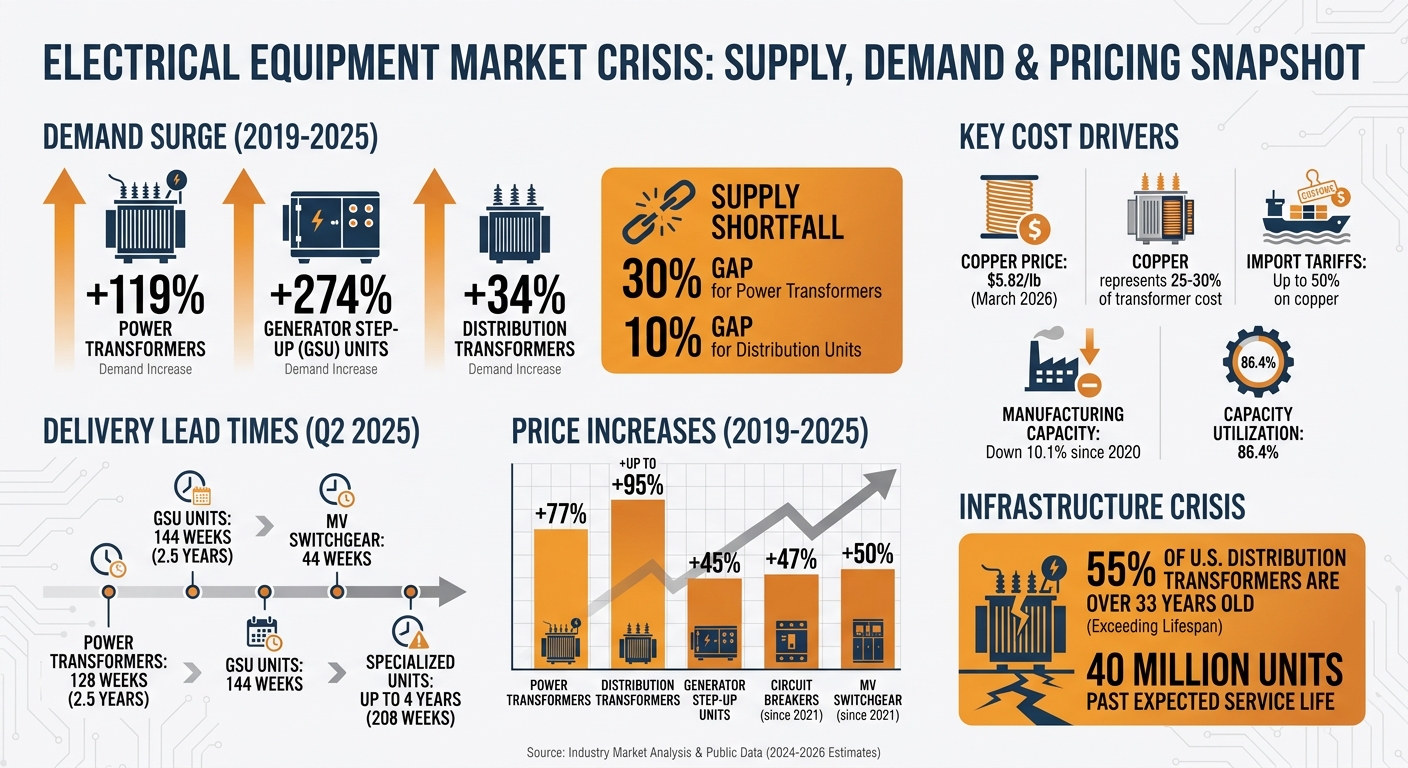
Electrical Equipment Market Trends: Demand Growth, Lead Times, and Price Increases 2019-2025
The cost of electrical equipment is influenced by a web of interconnected trends. These trends not only impact pricing but also determine how soon equipment can be delivered. Understanding these forces is crucial for managing budgets and timelines effectively.
Supply and Demand Dynamics
The demand for electrical equipment has skyrocketed, far outpacing supply. Since 2019, demand for power transformers has surged by 119%, while manufacturing capacity has struggled to keep up. This has led to a 30% shortfall in power transformers and a 10% gap in distribution units as of late 2025.
Several factors are driving this surge, including the rapid expansion of AI data centers, investments in renewable energy, and the urgent need to replace aging infrastructure. Alarmingly, more than 55% of distribution transformers in the U.S. are over 33 years old, exceeding their expected lifespan. Meanwhile, demand for generator step-up (GSU) units has soared by 274% since 2019.
The strain on supply chains has led to lengthy delivery times. For instance, large high-voltage transformers now take 128 weeks (over two years) to arrive, while GSU units average 144 weeks. Some utilities even report waiting up to four years for specialized equipment. Prices have climbed accordingly - power transformers have risen by 77%, and some distribution units have seen increases of up to 95% between 2019 and 2025.
Interestingly, not everyone agrees that the shortage is purely supply-driven. Patrick Tarver, owner of Bolt Electrical LLC, has a different perspective:
"There is not a shortage... It's all exaggerated to drive pricing. I'm telling you that we can get the supplies they need, but they don't ask."
Tarver's comments highlight how procurement bottlenecks - such as rigid vendor rules and internal hierarchies - can exacerbate the perception of shortages, limiting access to alternative suppliers.
| Equipment Type | Demand Growth (Since 2019) | Average Lead Time (Q2 2025) | Price Increase |
|---|---|---|---|
| Power Transformers | 119% | 128 weeks | 77% |
| Generator Step-Up (GSU) | 274% | 144 weeks | 45% |
| Distribution Transformers | 34% | Varies (Improving) | Up to 95% |
| Circuit Breakers | N/A | N/A | 47% (since 2021) |
| MV Switchgear | N/A | 44 weeks | 50% (since 2021) |
These supply challenges are compounded by broader economic and global factors.
Economic Cycles and Interest Rates
Economic conditions play a significant role in shaping equipment costs. During periods of economic growth, construction activity tends to accelerate, further straining supply chains. For example, manufacturing construction spending increased by 96% over three years, driving up demand for electrical infrastructure.
Interest rates also impact equipment costs in two major ways. Higher borrowing costs make large-scale projects more expensive, often delaying purchases and concentrating demand into shorter timeframes. Additionally, manufacturers often pass their increased financing costs onto buyers. While recessions may temporarily ease demand, they also slow investments in manufacturing capacity. This delay in expanding production capabilities leaves the market vulnerable when demand rebounds. Utilities and contractors who secured orders early during the current tight market conditions gained a significant advantage, avoiding the multi-year delays faced by latecomers.
Global Events and Commodity Prices
Global trade policies and raw material costs are another major factor driving price increases. Copper, a critical material for electrical equipment, now faces import tariffs as high as 50%. Additionally, expanded Section 232 duties on steel and aluminum have raised costs for equipment manufactured in the U.S. that relies on imported components.
Since 2021, circuit breaker prices have jumped 47%, and medium-voltage switchgear costs have increased by 50%. Sonal Patel, Senior Editor at POWER Magazine, explained:
"Evolving trade policy is expected to put 'additional upward pressure on both imported and domestically produced equipment,' even as expanded Section 232 steel and aluminum duties inflate costs for U.S.-made components."
New rules targeting "Foreign Entities of Concern" (FEOC) have further complicated procurement. These regulations have forced buyers to rely on more expensive domestic or allied suppliers. Historically, about 80% of large transformers used in the U.S. were imported from countries like Mexico, China, and Thailand. Shifting away from these suppliers has caused significant disruptions.
In response, manufacturers are investing heavily in domestic production. Siemens Energy announced a $150 million plant in Charlotte, North Carolina, set to begin production in 2027. Hitachi Energy is committing over $1 billion to North American projects, including a $457 million facility in Virginia, which aims to become the largest power transformer plant in the U.S. by 2028. Eaton has also allocated $340 million for a new facility in South Carolina, expected to start operations in 2027. These investments, totaling nearly $2 billion since 2023, indicate that relief is on the horizon - but not until at least 2027–2028. As Wood Mackenzie aptly puts it:
"Supply shortage persists as demand growth remains robust."
Seasonal Demand and Regulatory Changes
Seasonal shifts add another layer of complexity. Summer often brings heightened demand for cooling equipment and grid reinforcements as utilities prepare for peak loads.
Regulatory changes also play a role. In 2024, the U.S. Department of Energy postponed enforcing new energy-efficiency standards for transformers to avoid worsening supply shortages and price spikes. While this provided temporary relief, it also highlighted how tight the market has become. Even well-meaning regulations can have unintended consequences in such a constrained environment.
The combination of aging infrastructure (with 40 million units past their expected service life), growing industrial demand from sectors like data centers and EV charging networks, and evolving regulations ensures a baseline level of demand that remains high year-round. Seasonal peaks only amplify these existing pressures, making the market even more challenging for buyers.
Challenges of Managing Market Volatility
The electrical equipment market has turned into a challenging landscape for buyers, complicating efforts to manage both budgets and timelines. Prices are swinging unpredictably, and ongoing supply constraints are forcing buyers to make tough choices between maintaining quality and controlling costs.
Unpredictable Pricing Trends
Equipment costs have become increasingly erratic, breaking away from traditional pricing patterns. Prices are rising faster than the costs of raw materials. As VAWN Blog explains, "Equipment prices are significantly higher than input costs alone, and the gap is widening". Major manufacturers have taken advantage of the situation, expanding their operating margins by more than 5% over the past two years.
Shrinking manufacturing capacity has added to the pressure. Since 2020, manufacturing capacity has dropped by 10.1%, with factories operating at 86.4% capacity utilization as of early 2026. This leaves little room to increase production when demand spikes. Copper, a key material that makes up 25–30% of a transformer’s total cost, has climbed to $5.82 per pound as of March 2026. This surge is largely driven by China, which consumes 58% of the world’s copper for its power grid infrastructure. However, the rise in copper prices doesn’t fully explain the dramatic increase in transformer costs, which have jumped 75–85% since January 2020.
Timing is another major issue. Construction contracts often stretch over months or years, creating significant risks when equipment prices surge during this period. Only 34% of contracts include material escalation clauses, leaving buyers exposed to sudden cost increases. For large institutional projects, which have an average bid-to-buy window of 21 months, this risk is especially pronounced. As VAWN Blog points out, "The structural conditions that drove these increases... are not reversing. This appears to be the new baseline, not a temporary departure from it". Buyers are left struggling to balance cost concerns with the need for reliable equipment.
Balancing Quality and Cost
In the face of these volatile pricing trends, buyers are forced to make difficult decisions between waiting for new equipment or considering alternatives that might come with additional risks. With lead times stretching into years and prices spiking by as much as 95%, many buyers are turning to surplus or reconditioned units to avoid prolonged delays. However, this approach requires careful evaluation to ensure that these alternatives meet quality and reliability standards.
Refurbishing existing equipment has also become a common strategy during periods of high inflation and limited supply. Digital marketplaces have made it easier to access verified listings and connect with trusted suppliers, but buyers must remain vigilant. Thorough due diligence is essential to ensure that speed doesn’t come at the expense of reliability or long-term performance.
How to Time Your Purchases Using Electrical Trader
The fluctuations in the market, while challenging, don't leave buyers without options. By understanding how trends influence prices, you can make smarter purchasing decisions. Electrical Trader offers tools to help you navigate these changes and secure equipment at better prices.
When to Buy Equipment for Maximum Savings
Experienced buyers know that timing is everything. Certain conditions, like oversupply after seasonal slowdowns, often create opportunities for savings. For instance, after the supply chain issues of 2020, prices for used breakers and transformers dropped by 20–40% during Q3 oversupply periods.
Keep an eye out for a 20% or greater increase in listings paired with stable or falling prices. These signs often point to an oversupply caused by seasonal patterns or global events. Electrical Trader's filters make it easy to sort new listings by category and price range. You can also set up custom alerts for terms like "bulk sale" or "clearance" to spot deals, such as low-voltage equipment priced 15–25% below peak levels. With current shortages in power transformers and distribution units, Electrical Trader's ready-to-ship catalog can help you avoid the lengthy lead times - often stretching beyond two years for large high-voltage units - plaguing the new equipment market.
This approach works well when comparing both new and used equipment to find the best value.
Comparing New and Used Equipment Options
Comparing new and used equipment often highlights major price differences, especially when new equipment prices have jumped by 45–95%. Used equipment usually costs 40–70% less. For example, a new breaker priced at $5,000.00 might be available used for around $2,000.00, complete with verified condition reports.
Electrical Trader's advanced search tools allow you to filter listings by condition (new or used), price range, voltage specs, and location. The watchlist feature helps you track price trends over time. Plus, reviews, inspection photos, and test certificates make it easier to evaluate warranties and overall quality. Many electricians recommend certified refurbished equipment, which retains 80–90% of its lifespan but costs about half as much during volatile periods. Secure payment options and direct messaging on the platform also make it easier to negotiate bulk purchases.
Tracking Market Trends with Electrical Trader
Timing and product choice are important, but staying informed about market trends is just as critical. Real-time data can help you understand the unpredictable pricing patterns discussed earlier and make better decisions. Electrical Trader’s pricing analytics show 30-day trends, like $200 price drops for low-voltage panels during oversupply periods. Heatmaps and listing volume graphs for categories like transformers, breakers, and generators provide insights into seasonal demand and regulatory impacts.
Custom dashboards let you track specific equipment types, while trend alerts notify you of price shifts of 10% or more or inventory surges - early indicators of market changes. The platform integrates U.S. market data, capturing factors like Federal Reserve rate changes that can cause price swings of up to 15%. You can also export data in CSV format to keep personal records for long-term planning.
The U.S. transformer market, valued at $12.2 billion in 2024, is projected to grow at about 7.7% annually through 2034. Use Electrical Trader's "Request a Power Quote" feature during your planning process to access current pricing. Additionally, keep an eye on domestic production developments, such as Siemens Energy’s plan to produce large transformers in the U.S. by 2027, which could help ease supply pressures in the future.
Conclusion
Market trends are doing more than just influencing equipment costs - they’re reshaping how procurement strategies need to be approached. As VAWN Blog puts it: "None of this is going back to 'normal.' Equipment capacity is constrained, manufacturer backlogs stretch years... This is structural, not cyclical".
To navigate this reality, procurement strategies must shift away from waiting for prices to drop. With significant price hikes and extended lead times becoming the norm - and only 34% of construction contracts including material escalation clauses - knowing when and how to negotiate contract protections is now a critical skill. These challenges highlight the importance of having tools that simplify and speed up decision-making.
This is where Electrical Trader steps in. Its ready-to-ship catalog eliminates the need to wait on lengthy manufacturing backlogs. Plus, its pricing analytics and trend alerts help you identify opportunities when oversupply occurs. Verified listings and transparent documentation ensure you can make cost-effective decisions, even in unpredictable market conditions.
FAQs
What’s causing the biggest equipment price increases right now?
Equipment prices are climbing, and the reasons are clear: supply chain disruptions, material shortages, and growing demand. Take transformers, for instance - their prices have skyrocketed by 4 to 6 times since 2022. This spike stems from limited supplies of steel and copper, geopolitical conflicts, and tariffs. On top of that, raw materials are becoming more expensive, with copper prices alone jumping 18%. Together, these factors are driving significant price hikes across the board.
How do seasonal demand spikes change the best time to buy?
When demand for electrical components surges during peak seasons, prices tend to rise, and lead times can stretch significantly. To cut costs and sidestep delays, try buying these components during off-peak times when demand drops. This approach not only helps you lock in lower prices but also ensures quicker delivery.
How can I verify used or refurbished equipment before buying?
To ensure the quality of used or refurbished equipment, take the time to carefully examine its condition and history. Look for any visible signs of wear, corrosion, or damage. Request key documents like maintenance records, testing reports, and certifications to get a full picture of its past performance. It's also a good idea to inquire about its operational history and any previous repairs it has undergone. For added assurance, consulting with an experienced electrician or technician can help confirm the equipment's reliability and safety. Platforms like Electrical Trader offer access to surplus and reconditioned components, providing resources to make smarter purchasing decisions.