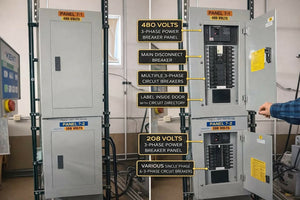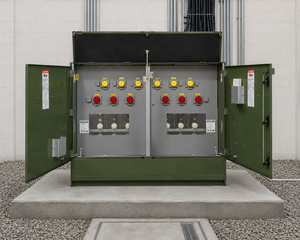


Global Standards for Voltage Equipment Certification
If I buy electrical equipment from another country, the mark on the label may not be enough for U.S. use.
That’s the main point. I need to check three things first: the target market, the voltage rating, and the approval path. A unit built around 415V IEC practice can run into trouble on a 480V U.S. system, and a CE mark alone does not mean a U.S. inspector will accept it.
Here’s the short version:
- In the U.S., I’m usually checking for NEC fit, an accepted NRTL mark like UL or ETL, and the right product standard such as UL 891 or UL 1558.
- In the EU, low-voltage gear usually follows the Low Voltage Directive, CE marking, and IEC-based rules such as IEC 61439.
- In Asia, marks such as CCC (China), PSE (Japan), and BIS (India) often involve testing, labeling, and factory review.
- For medium-voltage gear, IEC 62271-200 is a common reference for 1 kV to 52 kV AC equipment.
- The paperwork matters just as much as the label: test reports, declarations, ratings, and product build records should match the exact unit being shipped.
The bottom line: I should treat certification as a document check plus a label check. That cuts the risk of failed inspections, customs delays, insurer issues, and install problems.
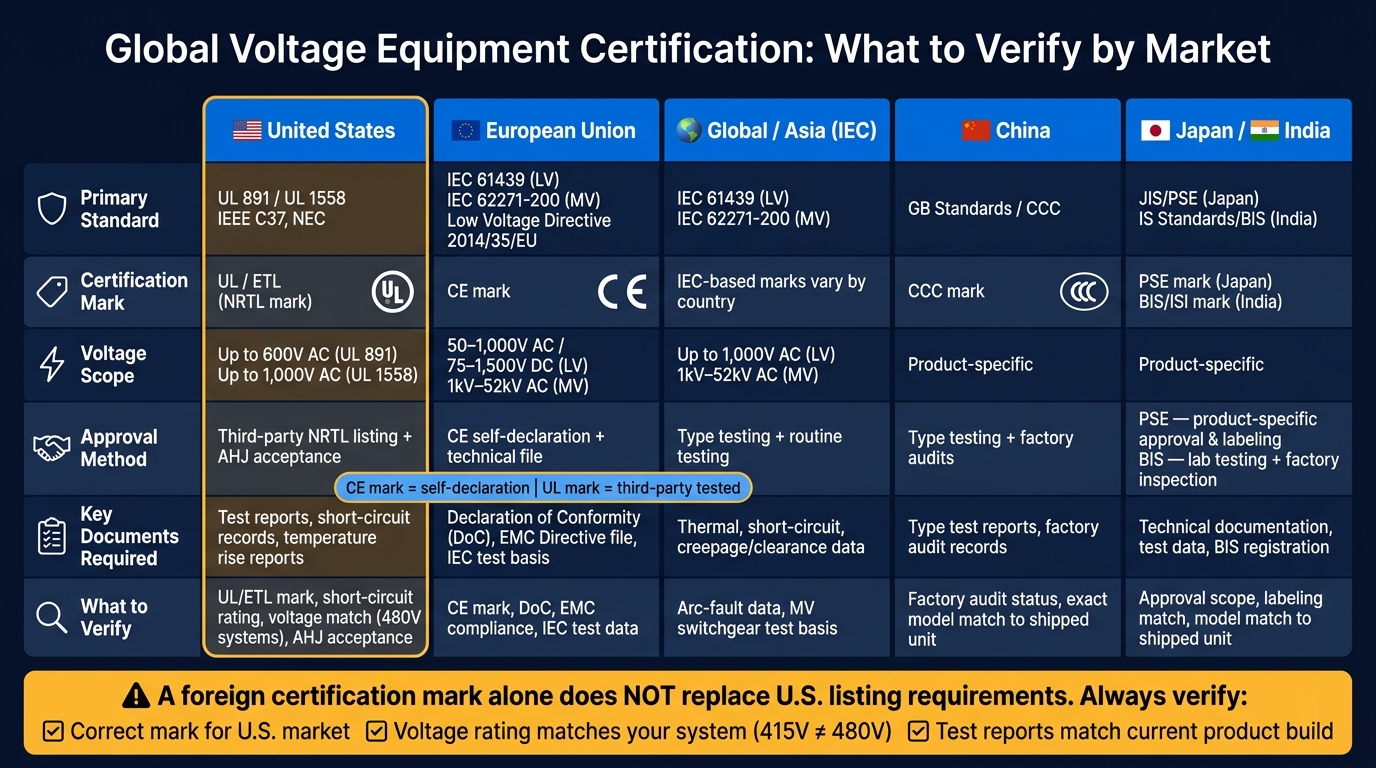
Global Electrical Equipment Certification Standards: U.S. vs EU vs Asia
UL certification process explained | Eaton PSEC

Quick Comparison
| Market | Common path | Main voltage scope in this article | What I should verify |
|---|---|---|---|
| U.S. | NEC + NRTL listing | Up to 600V AC under UL 891; up to 1,000V AC under UL 1558 | UL/ETL mark, short-circuit rating, test records, AHJ acceptance |
| EU | CE + Directive compliance | 50–1,000V AC / 75–1,500V DC | CE mark, DoC, IEC basis, EMC file |
| Global/Asia LV | IEC 61439 | Up to 1,000V AC | Thermal, short-circuit, creepage/clearance data |
| Global/Asia MV | IEC 62271-200 | 1 kV to 52 kV AC | MV switchgear test basis, arc-fault data |
| China | CCC | Product-specific | Type test reports, factory audit status |
| Japan | PSE | Product-specific | Approval scope, labeling, model match |
| India | BIS | Product-specific | Lab testing, registration, factory review if needed |
If I’m sourcing switchgear, switchboards, circuit breakers, busbar systems, or controlgear assemblies, this is the filter I’d use before I approve a purchase.
U.S. Standards: NEC, UL, and IEEE Requirements
For U.S. buyers, the big question is simple: Will the AHJ accept the equipment’s listing? In most cases, U.S. compliance comes down to three layers: NEC for installation, UL for product safety, and IEEE C37 for performance and test data. The first decision point is usually whether the equipment belongs under UL 891 or UL 1558.
UL Listing for Low-Voltage Switchgear and Switchboards
The two UL standards that show up most often in low-voltage procurement are UL 891 and UL 1558. That distinction matters before you approve a purchase, because these standards apply to different types of equipment and different operating demands.
| Feature | UL 891 (Switchboards) | UL 1558 (Switchgear) |
|---|---|---|
| Primary Application | Commercial and light industrial | Demanding industrial applications and data centers |
| Voltage Rating | Up to 600 V AC | Up to 1,000 V AC |
| Safety Design | Dead-front design | Fully compartmentalized construction; enhanced arc-flash protection |
| Short-Circuit Rating | Standard | Higher short-circuit rating and performance requirements |
UL 891 covers switchboards used in commercial and light industrial settings, usually rated up to 600 V AC. It requires a dead-front design, which means live parts stay out of reach during normal operation.
UL 1558 is the stricter standard. It applies to metal-enclosed switchgear up to 1,000 V AC and calls for higher short-circuit ratings, fully compartmentalized construction, and added arc-flash protection compared with UL 891.
How IEEE C37 Standards Support Certification Decisions
A UL certification tells you the product passed safety testing. IEEE C37 standards do a different job: they give you the performance and test benchmarks behind the equipment. That includes construction, testing, and application requirements for switchgear, such as fault interruption, short-circuit ratings, and dielectric withstand.
This is where things get practical. If you’re checking whether a product’s rated performance matches your project’s fault-duty calculations, IEEE C37 data gives you a clearer picture.
For procurement teams, this data becomes most useful when two products carry similar UL marks but differ in short-circuit interrupting capacity or duty cycle. The UL label says the equipment meets safety rules. The IEEE documentation helps you confirm it can take the electrical stress of your specific installation.
What U.S. Buyers Should Verify Before Purchase
Before purchase, verify the UL label, voltage rating, short-circuit rating, and test reports. Ask for any available test documents, including:
- Temperature rise reports
- Short-circuit test records
On Electrical Trader, request those documents directly if a listing doesn’t include them.
That same document review is the starting point for comparing EU and Asia certification schemes.
sbb-itb-501186b
EU and Asia: Certification Schemes U.S. Professionals Should Know
After U.S. listing checks, the next step is to confirm how foreign marks line up with local approval rules. For U.S. buyers, that means checking whether a foreign certification fits the equipment’s target market and paperwork.
EU Low Voltage Directive, CE Marking, and IEC-Based Standards
The EU Low Voltage Directive (2014/35/EU) applies to equipment rated 50–1,000 V AC or 75–1,500 V DC. It calls for CE marking, an EU Declaration of Conformity, and a technical file that includes risk, design, and test records.
The CE mark itself is a declaration, not a third-party stamp. For low-voltage assemblies, the paperwork should show compliance with IEC 61439, including thermal performance, short-circuit withstand strength, and creepage and clearance distances. For medium-voltage equipment between 1 kV and 52 kV AC, check for compliance with IEC 62271-200, which covers metal-enclosed switchgear and arc-flash protection. Before purchase, review the CE file, the DoC, and the IEC test basis.
The document package should also cite the EMC Directive (2014/30/EU), showing that the equipment does not create or suffer from electromagnetic interference.
In many Asian markets, the process is less about self-declaration and more about outside testing and factory review.
China CCC, Japan PSE, and India BIS Requirements
These systems lean more on third-party testing and audits than the EU model. China’s CCC calls for type testing and factory audits to confirm continued compliance. Japan’s PSE follows product-specific approval and labeling rules. India’s BIS requires testing in recognized laboratories and, in many cases, factory inspections. Even when the product itself is fine, factory audits and country-specific labeling can slow acceptance.
For procurement teams, the quickest way to compare these marks is to look at the approval method behind each one.
| Certification | Country | Key Requirement |
|---|---|---|
| CCC | China | Type testing and factory audits |
| PSE | Japan | Product-specific approval and labeling rules |
| BIS | India | Testing in recognized laboratories and, in many cases, factory inspections |
Use the product-specific reports to confirm that the marked equipment matches the exact build offered for shipment, not a similar model or an older configuration.
Comparing Regional Certification Requirements
Requirements Shared Across Major Markets
Across the biggest markets, the core approval steps look pretty similar. In most cases, certification includes type testing, routine testing, technical documentation, and product marking.
Here’s the common pattern, along with the mark each market expects:
| Region | Primary Standard | Typical Tests | Documentation | Required Marking |
|---|---|---|---|---|
| U.S. | UL 891 / UL 1558, IEEE C37 | Short-circuit, temperature rise, dielectric, clearance | Construction review, test reports | UL / NRTL mark |
| EU | IEC 61439 / 62271 (EN), LVD | EMC, dielectric, thermal, IP rating | Technical file, Declaration of Conformity | CE mark |
| China | GB/CCC | Safety, EMC, material limits | Type test reports, factory audit records | CCC mark |
| Japan | JIS/Japanese standards, PSE | Electrical safety, leakage, fire resistance | Technical documentation, test data | PSE mark |
| India | IS Standards (IEC-adopted), BIS | Short-circuit, temperature rise, dielectric | Test certificates, BIS registration | BIS / ISI mark |
At a glance, that can make the systems look almost interchangeable. They’re not. The details in each market change what a buyer needs to check before purchase and during compliance review.
Key Differences That Affect U.S. Equipment Selection
The biggest split is the approval structure.
In the EU, manufacturers often use CE self-declaration. In the U.S., the process leans on code enforcement and NRTL acceptance. That means a foreign mark by itself does not replace U.S. listing needs.
Voltage scope also matters more than many buyers expect. IEC standards are often written around 415V systems, while U.S. industrial setups commonly run at 480V. That gap sounds small on paper, but it can turn into a problem fast. Equipment built for 415V may not fit a 480V U.S. system without redesign or retesting. Busbar sizing and thermal limits can also differ.
For procurement teams, the gut-check is simple:
- Does the equipment match the target voltage?
- Does it match the required standard?
- Does it follow the right approval path for the U.S. market?
If any one of those is off, the unit may look fine in a catalog and still fail review when it’s time to install it.
Conclusion: Using Certification Data in Purchasing and Compliance Reviews
Certification marks are only the starting point. What counts is matching the document package to the exact market and installation. In plain English: the shipped unit has to match the destination market's requirements. That's where purchasing mistakes often show up, which is why the final supplier review needs to be a document check, not just a label check.
Key Takeaways for Procurement and Project Teams
The main lesson from comparing U.S., EU, and Asian certification frameworks is simple: standards are not interchangeable, and documentation matters as much as the label itself.
For procurement teams, the decision usually comes down to three checks:
- Does the equipment carry the right mark for the U.S. market, such as UL, ETL, or another accepted safety listing?
- Does the voltage rating match your system exactly? A 415V-rated unit may not operate safely in a 480V U.S. environment.
- Do the test reports and traceable technical documents match the current product construction?
If you're sourcing equipment through Electrical Trader, those same checks should happen before you commit to a purchase.
Teams that treat certification as an active verification process, not a box-ticking exercise, are less likely to run into delays, failed inspections, and liability exposure.
FAQs
Is a CE mark enough for U.S. approval?
No. A CE mark shows that a product meets European Union safety rules, but by itself it does not meet U.S. approval rules.
For installations in the United States, inspectors and local authorities usually want certification from a Nationally Recognized Testing Laboratory such as UL or ETL. They also look for compliance with local electrical codes.
Can 415V equipment be used on a 480V system?
No. 415V equipment generally should not be used on a 480V system.
These are different voltage standards. If you run equipment above its rated voltage, you can end up with performance issues, insulation breakdown, or outright equipment failure.
Electrical Trader recommends matching equipment ratings to the installation voltage for safety and performance.
What documents should I request before buying?
For voltage equipment used in the United States, ask for documents that show the product meets the required safety standards. You should also confirm that the equipment is listed by a Nationally Recognized Testing Laboratory, such as UL or ETL.
It also helps to review the product specs, component data, and manufacturing details. Then check the equipment itself for a visible label that shows:
- The manufacturer’s name
- Voltage
- Frequency
- Current
- A unique identifier, such as a UL file number or control number