

Harmonizing IEC and NEMA Standards: Challenges and Solutions
If you mix IEC equipment with NEMA-based systems in the U.S., the main risk is simple: parts may match on paper but fail at fit, rating, or inspection.
I see the same pattern again and again. Trouble usually comes from three gaps: ratings, enclosures, and approval documents. For example, a NEMA motor may carry a 1.15 service factor, while an IEC motor is often 1.0. A panel marked IP66 also does not automatically meet NEMA 4X. And IEC/CE paperwork alone will not pass many U.S. inspections without a UL or other NRTL mark.
If I had to boil the article down into a short action plan, it would be this:
-
Check equivalency before buying anything
- Motors
- Breakers
- Contactors
- Enclosures
-
Write the required standard on drawings and labels
- IEC
- NEMA
- or both
-
Use U.S. approval language in bids and submittals
- UL Listing
- NRTL mark
- NEC fault ratings
- service factor
-
Ask for proof, not claims
- lab test reports
- nameplate photos
- traceable part numbers
-
Review high-risk interfaces first
- switchgear
- motor starters
- breaker assemblies
- terminations
NEMA vs IEC Motors: Frame Sizes, Standards, and Replacement
sbb-itb-501186b
Quick Comparison
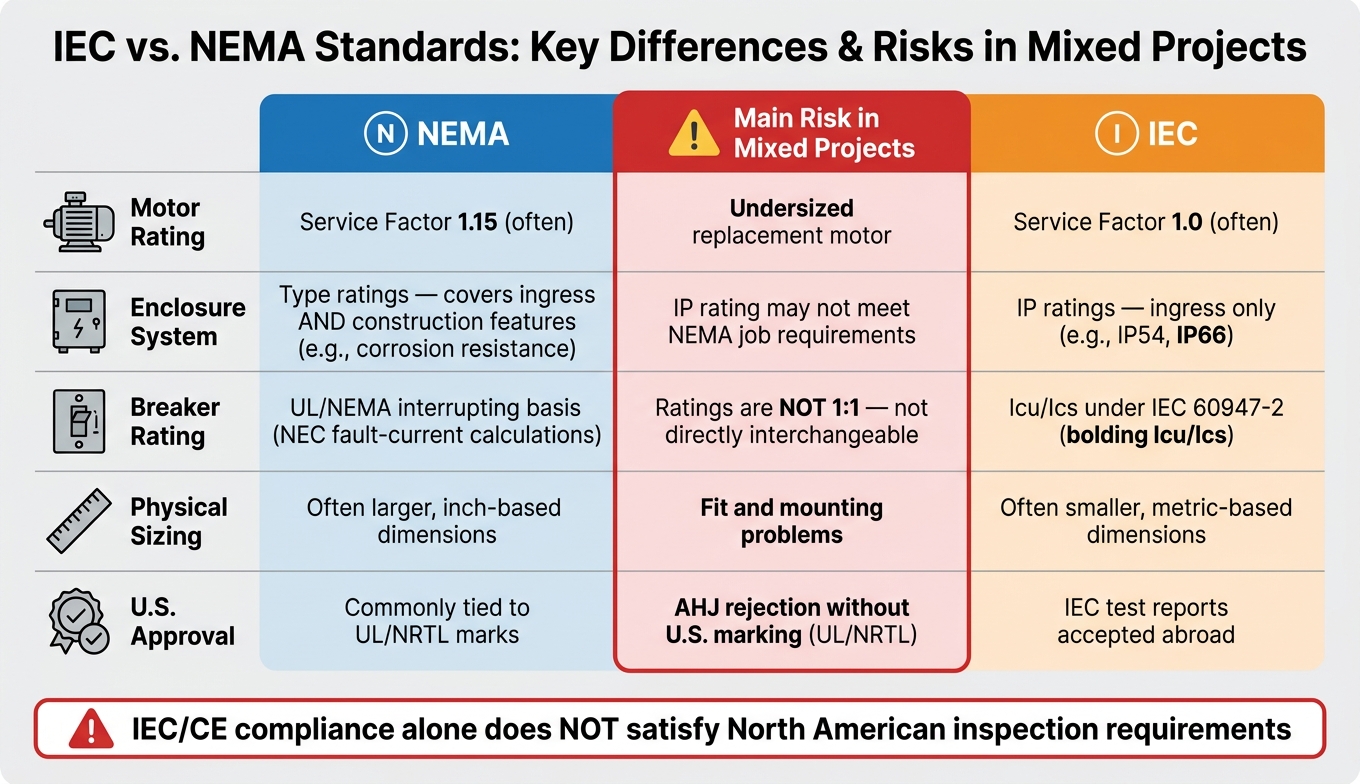
IEC vs NEMA Standards: Key Differences & Risks for Mixed Projects
| Topic | NEMA | IEC | Main Risk in Mixed Projects |
|---|---|---|---|
| Motor rating | Often 1.15 service factor | Often 1.0 service factor | Undersized replacement motor |
| Enclosure system | Type ratings, including build features | IP ratings for ingress only | IP rating may not meet NEMA job needs |
| Breaker rating | UL/NEMA interrupting basis | Icu/Ics under IEC 60947-2 | Ratings are not 1:1 |
| Physical sizing | Often larger, inch-based | Often smaller, metric-based | Fit and mounting problems |
| Approval for U.S. jobs | Commonly tied to UL/NRTL use | IEC test reports may be used abroad | AHJ rejection without U.S. marking |
My takeaway: the fix is not to pick one system and ignore the other. It is to cross-check ratings, lock standards into the documents, and buy only traceable parts with the right U.S. approvals. That is what keeps submittals, installation, and inspection from turning into a long cleanup job.
Main Challenges in Aligning IEC and NEMA Standards
Those differences get expensive fast when equipment, paperwork, and approvals all need to line up.
Different Design Approaches and Rating Methods
The biggest gap comes down to design philosophy. NEMA equipment is built for broad-duty service. IEC equipment is usually more compact and needs to be sized for the exact application.
That becomes a problem when someone swaps a motor or control without checking thermal margin and duty again. What looks like a simple replacement can turn into an overheating issue or a shortened service life. Duty-cycle labels add to the confusion. NEMA uses broad categories, while IEC uses S1 through S8.
Mismatched Enclosure, Performance, and Short-Circuit Ratings
Three technical gaps tend to create the most risk in the field: enclosures, short-circuit ratings, and temperature limits.
Enclosures are a common stumbling block. NEMA Type ratings cover both ingress and construction features, including corrosion resistance. IEC IP ratings such as IP54 and IP66 only deal with dust and water ingress. There is no direct 1:1 conversion between them. So an IP66 panel might still fall short of the full demands of a NEMA Type 4X installation.
Short-circuit ratings follow different systems. IEC 60947-2 defines Icu and Ics. UL and NEMA-based ratings use interrupting and withstand ratings tied to NEC fault-current calculations. IEC and UL/NEMA breakers use different rating systems and are not directly interchangeable. In many cases, internal parts also block a direct swap.
Temperature and termination requirements add one more problem. UL standards often set tighter temperature-rise limits than IEC. That means NEMA gear often needs larger busbars, enclosures, and terminations. If you replace parts with IEC-rated components without checking those thermal limits, temperature-rise issues can show up in service.
Once these ratings drift apart, purchasing mistakes and approval delays usually follow.
Procurement and Documentation Gaps
The technical side is only half the battle. Paperwork issues can make a bad situation worse.
On mixed-standard projects, bills of material often list NEMA and IEC part references together without calling out the difference. Nameplates can also use conflicting symbols or different terms, which creates confusion during field work. IEC equipment also depends on exact part numbers for replacements. NEMA is often more forgiving with a "like-for-like" swap, but IEC systems are modular and footprint-specific. One wrong part number can stop installation or maintenance cold.
U.S. Authorities Having Jurisdiction (AHJs) usually require NRTL marks such as UL or CSA. Submittals based only on IEC test reports, with no matching UL listing, often lead to failed inspections or field evaluations. That’s why the next step is a clear verification process before submittal.
Practical Solutions for Dual-Standard Compliance
Once you know where the gaps are, the next job is to close them in a clean, step-by-step way - before equipment ships, not after it fails inspection. Start by checking component equivalency. Then lock those decisions into drawings, labels, and submittals.
Validate Equivalency Through Cross-Reference Reviews
Don’t assume two components are equal just because the voltage or current numbers match. In dual-standard work, how a part is rated matters just as much as the rating itself.
For circuit breakers, verify testing at 480Vac under UL 489 and NEMA AB-1. For contactors, line up the IEC utilization category with the NEMA duty and thermal ratings. For motors, match duty class correctly: NEMA continuous/intermittent/special duty versus IEC S1–S8.
It also helps to favor dual-certified components when you can. That cuts down on separate product families and avoids duplicate submittals. The same logic applies to breakers: parts evaluated under both UL 489 and IEC 60947-2 can remove the need for separate breaker lines and trim redundant documentation.
Thermal performance needs a separate review. UL standards often call for lower termination temperatures than IEC, which can lead to larger rear terminations for UL-rated breakers. On paper, two parts may look close. In the field, that difference can change fit, layout, and wiring space in a hurry.
Once equivalency is confirmed, get the paperwork in line before procurement starts.
Standardize Drawings, Labels, and Test Records
Inconsistent documents are one of the easiest ways to end up with inspection failures and field mistakes on dual-standard projects.
Each drawing should state the governing standard for every component - IEC, NEMA, or both - and note any derating or application limits. That gives the AHJ a clear path to review and helps stop risky field substitutions.
For test records, require trip and timing test reports for MCCBs and ACBs so you can confirm that trip behavior and relay timing meet both compliance schemes. Equipment going to U.S. installations also needs the correct UL certification label:
The matching UL-marked documents should go in with the test record. If the label, test file, and submittal package don’t match, that’s where reviews often start to stall.
Focus Interface Reviews on High-Risk System Points
After the component review, shift attention to the assemblies where mixed standards create the most risk.
The trouble spots are usually motor starters and contactors, circuit breakers, switchgear assemblies, and enclosures. These are the places where IEC and NEMA parts tend to meet - and where mismatched ratings, termination rules, or short-circuit coordination can turn into jobsite problems.
Switchgear deserves extra attention. UL 1558 and IEC 61439 use different short-circuit test durations, and that can affect fault performance on U.S. systems. A unit may seem fine during a document review, yet the test basis behind the assembly may not line up with what the U.S. installation calls for under fault conditions.
Project and Sourcing Strategies for Global Compliance
Once the technical review is done, procurement has to protect what was approved. If contracts and sourcing leave gaps, those choices can fall apart fast.
Write Clear Bid and Submittal Requirements
Vague specs are where dual-standard problems start. Bid documents should require a UL Listing or another NRTL mark, call out UL/NEC voltage and ampacity ratings, state the motor service factor, and define fault ratings in UL terms.
For enclosures, spell out dual ratings such as UL Type 4X / IP66. For motors, make the required service factor a firm purchasing rule. If the bid package says nothing, a vendor may supply an IEC motor that is too small for the job. For short-circuit performance, state the rating in UL language, not broad wording.
That only works if your internal approval rules back it up.
Build Internal Rules for Equipment Approval
A one-time spec review won’t carry the load. Teams working across IEC and NEMA need a repeatable approval process so every project doesn’t start from scratch.
A practical place to begin is a dual-market approved product list (APL) built around MCCBs and contactors cleared for both IEC and NEMA use. Dual-certified assemblies cost more up front, but they can cut rework and failed inspections.
Internal checklists should focus on the technical gaps that cause trouble most often:
| Review Item | What to Check |
|---|---|
| Short-circuit duration | UL 1558: 2 cycles (~0.033s); IEC 61439: 1–3 seconds |
| Busbar temperature rise | UL: 65°C max rise, 105°C absolute; IEC: typically 60 K above ambient |
| Motor service factor | NEMA: 1.15; IEC: 1.0 - size up if substituting |
Don’t take a manufacturer’s word that two products are “equivalent.” Ask for test reports from the issuing laboratory during submittals, then verify them directly.
After those approval rules are in place, each purchase has to follow them.
Source Equipment With Traceable Specifications
Require traceable part numbers, nameplate photos, and lab test files before anything is bought.
For motors, check shaft dimensions and mounting hole spacing during submittal review. NEMA uses inch-based dimensions, IEC uses metric, and the two are not interchangeable without adapters. It also helps to lock down wiring methods early: specify terminal blocks for IEC-oriented equipment or lead connections for NEMA-oriented equipment so installation stays consistent.
Conclusion: A Direct Roadmap for Harmonizing IEC and NEMA Standards
IEC is performance-based. NEMA is more prescriptive about construction and application. That split shows up most clearly during approval, procurement, and inspection.
The same trouble spots keep coming back: ratings, enclosure protection, and documentation. Those gaps are what derail product selection, slow submittals, and create friction with AHJ approval on mixed-standard projects. And one point needs to be plain: IEC/CE compliance alone does not satisfy North American inspection requirements.
The fix isn’t complicated, but it does need to be explicit. Cross-reference ratings. Write bid requirements that leave no room for guesswork. Require verified test reports.
Traceable sourcing ties the whole process together. Standardized approvals and traceable records help keep mixed-standard projects compliant from purchase through inspection. Clear review rules also stop the same IEC/NEMA mistakes from popping up again on the next job.
FAQs
How do I verify IEC and NEMA parts are equivalent?
Compare the parts’ electrical, mechanical, and physical traits. Since NEMA is design-based and IEC is performance-based, look closely at specs like voltage tolerances, efficiency ratings, duty cycles, and mounting dimensions.
Don’t assume two parts are the same based on output power alone. Check the manufacturer’s technical data, and if you’re replacing a part, review NEMA MG 1 or IEC 60034 to spot differences in service factors, temperature rise limits, and enclosure ratings.
Can CE-marked equipment be used on U.S. projects?
Not on its own.
The CE mark means a product meets European Union rules. But that does not mean it meets the U.S. National Electrical Code (NEC) or North American product standards.
In the United States, equipment usually needs to be certified or listed by a Nationally Recognized Testing Laboratory (NRTL) such as UL or CSA. Local inspectors, acting as the Authority Having Jurisdiction, often look for that approval before the equipment can be accepted.
Which mixed IEC/NEMA components create the most risk?
The biggest risk shows up when you mix parts built around different design approaches and test methods. NEMA standards are more prescriptive and lean toward tough, general-purpose design. IEC standards, on the other hand, are performance-based and rely on exact application data.
That gap matters. If load, duty cycle, thermal management, temperature rise testing, or enclosure ratings don’t line up, the result can be equipment failure or lower safety margins.