IEC vs. UL Standards: Low-Voltage Equipment Testing
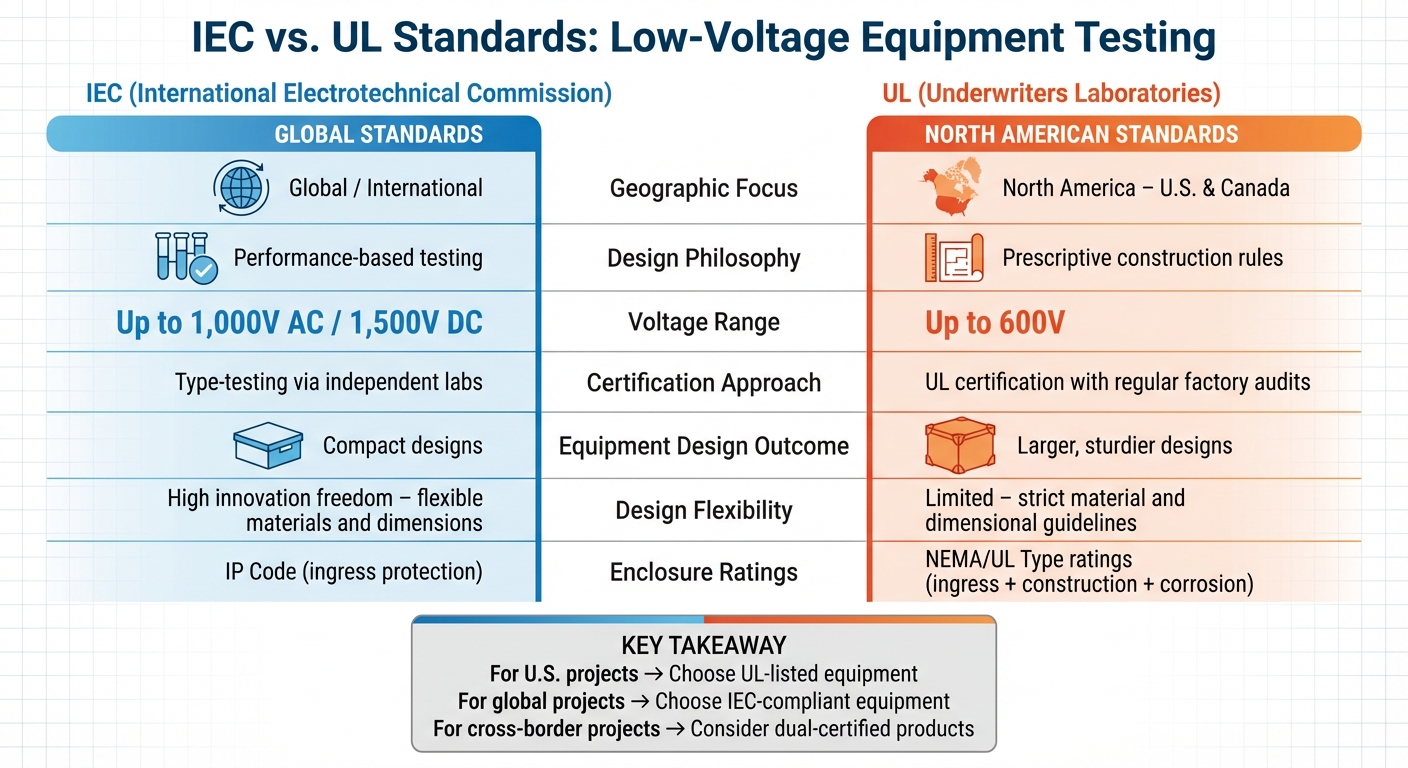
Choosing between IEC and UL standards for low-voltage equipment depends on your project location and compliance needs. Here's the key difference: IEC standards are globally recognized and focus on performance-based testing, while UL standards are mandatory in North America, with strict, prescriptive construction requirements tied to U.S. safety codes.
Key Points:
- IEC Standards: Flexible, performance-driven, and designed for international use. Defines low voltage up to 1,000V AC or 1,500V DC. Prioritizes testing over rigid design rules.
- UL Standards: Required in the U.S., focusing on specific construction guidelines like material thickness and spacing. Limits low voltage to 600V for most equipment.
- Compliance: UL certification is essential for U.S. projects, while IEC compliance suits global installations. Dual-marked products meet both standards, simplifying cross-border use.
Quick Comparison:
| Feature | IEC Standards (Global) | UL Standards (North America) |
|---|---|---|
| Design Philosophy | Performance-based testing | Prescriptive construction rules |
| Voltage Range | Up to 1,000V AC / 1,500V DC | Up to 600V |
| Market Focus | International | U.S. and Canada |
| Certification | Type-testing via independent labs | UL certification with audits |
| Equipment Size | Compact designs | Larger, sturdier designs |
For U.S. projects, always prioritize UL-listed equipment to avoid inspection issues. For global projects, IEC compliance ensures compatibility. When working across regions, consider dual-certified products to save time and costs.
IEC vs UL Standards Comparison for Low-Voltage Equipment
Voltage Definitions and Scope
IEC Voltage Definitions and Scope
The IEC takes a broad approach to defining low voltage. According to IEC 61140:2016, the low-voltage range extends up to 1,000 V AC RMS or 1,500 V DC. This wide range reflects the IEC's global perspective, accommodating a variety of electrical systems worldwide. Additionally, IEC 60038 standardizes nominal supply voltages between 100 V and 1,000 V AC. It also classifies extra-low voltage as anything below 50 V AC or 120 V DC, aiming to reduce the risk of accidental contact.
UL Voltage Definitions and Scope

UL, on the other hand, adopts a more conservative stance. For example, UL 845 (Motor Control Centers) and UL 891 (Dead-Front Switchboards) generally limit low-voltage equipment to 600 V. This aligns with the U.S. National Electrical Code (NEC/NFPA 70), which governs electrical installations in the U.S. Specifically, the NEC defines low distribution system voltage as up to 49 V. Additionally, UL 508A outlines low-voltage limited energy circuits with thresholds capped at 42.4 V peak. This narrower scope reflects North America's focus on stricter safety margins and precise design requirements.
Main Differences in Scope
These differing voltage definitions can create practical challenges in equipment design. For instance, a photovoltaic module rated for 1,000 V under IEC standards might only qualify for 600 V under UL. This isn’t due to differences in the equipment itself but rather the distinct testing assumptions and safety considerations. In the U.S., projects must adhere to UL's 600 V cap, even if IEC permits higher ratings.
The IEC emphasizes performance and global functionality, while UL's prescriptive approach caters to specific U.S. inspection standards. Consequently, any equipment intended for U.S. installations must secure UL certification, as Authorities Having Jurisdiction require marks from Nationally Recognized Testing Laboratories. This disparity in voltage limits significantly impacts construction and testing standards for equipment destined for different regions.
Construction and Design Requirements
UL's Prescriptive Construction Requirements
UL standards are known for their detailed guidelines, specifying exactly how equipment must be constructed. These requirements cover everything from material thickness and venting setups to hinge sizes, locking mechanisms, and even bus washer details. For example, UL 845 (Motor Control Centers) and UL 891 (Dead-Front Switchboards) govern equipment rated up to 600V with fault currents as high as 200kA rms. They also enforce safety measures like the ANSI "rod entry test", which ensures a 0.50-inch (12.7 mm) test rod cannot touch live parts inside an enclosure.
"UL Standards: Highly prescriptive. They dictate details such as venting, barriers, louvers, enclosures, material thickness, maximum cover size, flange overlap, hinge size, locking mechanisms, fastening dimensions, and bus washer specifications." - As Beam
This prescriptive approach reflects UL's focus on worst-case North American installation practices, ensuring equipment can handle less-than-ideal conditions. This results in larger, more robust designs that simplify inspections for safety officials. UL also incorporates Type ratings (e.g., Type 1, 3R, 4X), which combine ingress protection with specific construction and corrosion resistance requirements. By contrast, IEC standards take a more flexible, performance-oriented route that allows for creative design solutions.
IEC's Flexible Design Standards
IEC standards prioritize performance testing over rigid construction rules, giving manufacturers the freedom to innovate. For example, IEC 61439-1 emphasizes "Design Verification", requiring manufacturers to prove their designs work through type-testing. Instead of dictating exact material or dimension specifications, IEC uses functional language like "materials shall withstand" or "design must have sufficient strength". This approach encourages engineers to explore new materials, layouts, and compact configurations.
"IEC Standards: Principally performance-driven. They rely on type-testing to confirm equipment suitability. Statements such as 'materials must withstand' or 'design must have sufficient strength' dominate the IEC approach." - As Beam
For safety, IEC often specifies IP4X (protection against objects larger than 1mm) or IP2X (protection against finger-sized objects) ratings for assemblies. Standards like IEC 62208 cover empty enclosures with rated voltages of up to 1,000 V AC or 1,500 V DC. Additionally, the IEC framework includes the IK code to define resistance to mechanical impacts. Many IEC designs also incorporate 24V control systems (SELV), which limit shock risks by reducing voltage rather than relying solely on physical barriers.
Construction Standards Comparison: UL vs. IEC
The table below highlights the major differences between UL's prescriptive approach and IEC's performance-driven philosophy:
| Feature | UL Standards (Prescriptive) | IEC Standards (Performance-Based) |
|---|---|---|
| Design Focus | Specific construction rules (material thickness, dimensions) | Functional performance validated through testing |
| Enclosure Rating | NEMA/UL Type (ingress + construction + corrosion) | IP Code (ingress protection against solids/liquids) |
| Material Selection | Dictates specific thickness and material types | Flexible; must pass "suitability" tests |
| Safety Verification | Direct certification and regular factory audits | Design verification via type-testing and CB reports |
| Design Outcome | Larger, robust equipment with conservative safety margins | Compact, application-focused designs |
| Innovation Flexibility | Limited due to rigid rules | Greater freedom for creative solutions |
This contrast in standards affects everything from equipment size to certification costs. UL-compliant designs often require larger enclosures and more internal space to meet strict safety margins, while IEC designs achieve similar safety levels with compact, efficient layouts. To streamline global operations, many manufacturers now develop dual-marked platforms that meet both UL and IEC standards, reducing product variations and simplifying international documentation.
Testing and Performance Parameters
UL Testing Requirements
UL testing involves rigorous checks like calibration, overload, endurance, and short-circuit tests before certification is granted. For example, UL 489 circuit breakers are designed to remain functional even after a fault, ensuring reliable branch circuit protection. On the other hand, UL 1077 supplementary protectors are "Recognized" components meant to operate within UL-Listed assemblies rather than as standalone protection devices. UL also specifies pole spacing requirements - 1 inch through air and 2 inches over surfaces for UL 489, compared to 3/8 inch and 1/2 inch for UL 1077 - to prevent arcing. Additionally, standards like UL 845 and UL 891 ensure safety for fault currents up to 200 kA rms at voltages as high as 600 V. UL's stricter temperature-rise limits dictate the use of specific conductor types and insulation classes, which often results in larger enclosures compared to IEC designs.
"UL 489 and UL 1077 devices must pass a series of calibration, overload, endurance and short-circuit tests... the UL 489 testing is more rigorous. Unlike UL 489, a UL 1077 circuit protection device does not necessarily need to survive the test." – c3controls
IEC Testing Requirements
IEC standards take a different approach by focusing on performance through type-testing without mandating specific design details. IEC 60947-2, for instance, defines short-circuit capacity using parameters like Icu (ultimate breaking capacity), Ics (service breaking capacity), and Icw (short-time withstand current). This performance-driven approach allows manufacturers to demonstrate compliance with safety requirements without adhering to rigid material or dimensional specifications. Type-testing on representative units ensures that the designs are functional, suitable, and effective for their intended uses.
"IEC defines how equipment should perform internationally; UL determines whether it can legally pass inspection in North America without redesign or inspection setbacks." – Justin Liu, Co-founder, TopCabinet
IEC standards also offer more flexibility in temperature limits and conductor selection, enabling compact designs as long as performance criteria are satisfied. For enclosure protection, IEC uses IP ratings (e.g., IP65) to measure resistance to dust and water ingress. In contrast, UL/NEMA Type ratings not only assess ingress resistance but also consider corrosion resistance and overall construction durability.
Testing Parameters Comparison: UL vs. IEC
The differences in testing philosophies between UL and IEC standards highlight their distinct approaches to equipment design and safety. Below is a summary of these variations:
| Parameter | UL Standards | IEC Standards |
|---|---|---|
| Testing Philosophy | Prescriptive, requiring survival of tests | Performance-based, focusing on function |
| Short-Circuit Metrics | Interrupting and withstand ratings (NEC) | Icu, Ics, and Icw ratings |
| Survival Requirement | UL 489: Must survive tests; UL 1077 exempt | Verified through type-testing |
| Pole Spacing (Air) | UL 489: 1 inch; UL 1077: 3/8 inch | Based on performance criteria |
| Temperature Limits | Conservative, specific conductor types | Flexible, supporting compact designs |
| Enclosure Testing | NEMA/UL Type ratings | IP ratings |
| Compliance | Rigorous tests and regular audits | Type tests and certification reports |
sbb-itb-501186b
IEC vs UL and NEC Key Electrical Standard Differences
Safety and Compliance Implications
Understanding the differences in voltage definitions, construction requirements, and testing parameters between UL and IEC standards is critical for ensuring equipment compliance and gaining access to various markets. These distinctions influence both regulatory approval and design flexibility.
Benefits of UL Standards
UL standards provide a consistent safety framework across North America, detailing specific construction requirements like metal thickness and flange overlap. This prescriptive method guarantees that all UL-listed products meet the same mechanical and electrical integrity benchmarks. Additionally, rigorous testing and regular factory audits ensure manufacturers maintain consistent production quality.
That said, this strict approach can limit design flexibility. By mandating exact materials, clearances, and dimensions, UL standards often restrict engineers from exploring more compact layouts or alternative materials that could achieve similar performance. This rigidity can lead to bulkier enclosures and increased material costs compared to IEC-compliant designs. However, UL certification offers a significant advantage: it ensures regulatory acceptance in the U.S. market, reducing the risk of failed inspections or costly field evaluations.
On the other hand, IEC standards cater to different priorities, especially for global markets.
Benefits of IEC Standards
IEC standards focus on functional performance rather than prescriptive construction, giving designers more room to innovate. As long as equipment meets performance criteria like Icu and Ics ratings through type-testing, the choice of materials and dimensions is left to the manufacturer. This flexibility allows for more efficient designs and potential cost savings - an important consideration for global OEMs managing diverse product lines across multiple markets.
However, IEC-certified equipment often faces challenges in the U.S. market. Without dual certification, such equipment may not meet the expectations of U.S. inspectors. Compliance with the National Electrical Code (NEC) and obtaining a UL or NRTL mark is typically required for IEC-certified products to gain U.S. approval. While dual certification adds time and expense, it’s increasingly necessary for manufacturers aiming to serve both domestic and international markets. Efforts to harmonize standards, such as the adoption of UL 60947 to replace UL 508, are helping to ease this burden, though differences remain in areas like enclosure ratings and temperature limits.
IEC and UL Advantages and Disadvantages
The table below highlights the key compliance and design implications of both standards:
| Feature | UL Standards | IEC Standards |
|---|---|---|
| Safety Approach | Prescriptive construction rules ensure consistent mechanical integrity | Performance-based testing allows for design flexibility |
| U.S. Market Access | High acceptance by AHJs; aligns with NEC requirements | Limited acceptance without field evaluation or dual certification |
| Innovation | Restricted by strict material and dimensional guidelines | Greater freedom for innovative materials and compact designs |
| Compliance Oversight | Certification includes regular factory audits | Relies on type-testing by independent labs; no direct IEC mark |
| Cost | Higher due to extensive testing and ongoing audits | Lower initial certification costs |
| Typical Outcome | Sturdy, NEC-compliant designs; often larger enclosures | Streamlined, globally adaptable designs; may need modifications for U.S. |
Conclusion
Main Points Summary
UL standards set specific construction requirements critical for inspections in the U.S. and Canada. In contrast, IEC standards emphasize performance-based criteria, offering flexibility for global applications. UL operates as both a developer and certifier, performing rigorous testing and regular factory audits. Meanwhile, IEC provides technical specifications used by independent labs for conformity assessments.
With these distinctions in mind, here’s some actionable advice to help you navigate compliance effectively.
Practical Advice for Compliance
Start by identifying your target market. If your project is in North America, prioritize UL-listed equipment to avoid inspection failures or expensive field evaluations. For international projects, IEC-compliant products are often the better choice due to their compatibility and ease of integration across borders. For designs spanning multiple regions, consider using UL/NEC ampacity and voltage limits as your baseline, even if IEC ratings allow for higher thresholds.
"Whenever budget allows, develop dual-marked platforms tested to both IEC and UL standards. This minimizes SKUs, simplifies documentation, and opens more tenders with the same core hardware." - Justin Liu, Co-founder, TopCabinet
For installations in harsh conditions, choose equipment that meets both IP (IEC) and NEMA/UL Type ratings. This ensures protection against environmental challenges while satisfying safety and performance needs.
How Electrical Trader Can Help
Whether you’re sourcing UL-listed breakers for a U.S. project or IEC-compliant transformers for international use, Electrical Trader offers a wide range of new and used electrical components tested to meet strict safety standards. Their categorized listings make it simple to find region-specific equipment, from low-voltage switchgear to power distribution systems. With Electrical Trader, you can streamline your compliance process and access certified equipment tailored to your needs.
FAQs
What are the key differences between IEC and UL standards for low-voltage equipment?
When it comes to low-voltage equipment, IEC and UL standards differ in their focus, scope, and intended regions of application.
IEC standards, developed by the International Electrotechnical Commission, are designed with a global perspective. They set baseline safety and performance requirements for electrical devices, aiming to encourage worldwide consistency in standards.
In contrast, UL standards, created by Underwriters Laboratories in the U.S., are tailored to meet North American regulations. They place a strong emphasis on detailed safety testing and certification processes, ensuring products align with U.S. codes and practices.
The primary distinction lies in their purpose: IEC standards focus on international compliance, making them more universally applicable, while UL standards incorporate additional safety measures specific to the U.S. market, often resulting in stricter testing requirements. This makes UL-compliant products particularly suited for meeting the higher safety expectations in the United States.
How do IEC and UL standards impact the design and size of low-voltage equipment?
IEC standards are designed with a global perspective, emphasizing safety and universal application. This often leads to equipment that is more compact and adheres to standardized designs, making it suitable for international markets.
On the other hand, UL standards cater specifically to North American safety and performance requirements. As a result, equipment designed to meet these standards tends to be larger, reflecting the localized focus on certain safety features and performance criteria.
Because of these distinctions, manufacturers need to carefully evaluate their target market. Compliance with one set of standards doesn’t necessarily ensure compatibility with the other, making strategic planning essential in the design process.
Why is dual certification necessary for international projects?
Dual certification plays a key role in international projects by ensuring that low-voltage equipment complies with both IEC (International Electrotechnical Commission) and UL (Underwriters Laboratories) standards. Meeting these standards ensures safety, compatibility, and regulatory adherence across different regions, which is crucial for operating in global markets.
By adhering to both international and regional requirements, businesses can sidestep delays, cut down on expensive re-certifications, and improve the global appeal of their products. This approach not only streamlines operations but also helps build confidence with customers and regulators worldwide.