3rd-Party Testing: Why It Matters for Electrical Brands
Third-party testing ensures electrical products meet stringent safety standards, preventing hazards like fires and electrocution. Independent labs, recognized by OSHA as Nationally Recognized Testing Laboratories (NRTLs), verify compliance with U.S. regulations such as the National Electrical Code (NEC). Without proper certification, products cannot be legally used in workplaces, insurers may deny claims, and businesses risk fines, legal issues, and reputational damage.
Key Takeaways:
- Safety Risks: Uncertified products are linked to 12–13% of structure fires and 2% of fatal workplace injuries.
- Legal Compliance: OSHA mandates NRTL certification for 39 product categories; uncertified products violate NEC standards.
- Financial Impact: Non-compliance can lead to fines, denied insurance claims, and market rejections.
- Market Trust: Certification marks like UL and ETL signal product safety and quality, building buyer confidence.
For brands, third-party testing is not just a regulatory step - it safeguards users, ensures compliance, and strengthens market credibility. Always verify certifications when sourcing electrical equipment to avoid costly mistakes.
Deep Dive Into the Electrical Product Certification Process
Problems with Electrical Products That Lack Third-Party Testing
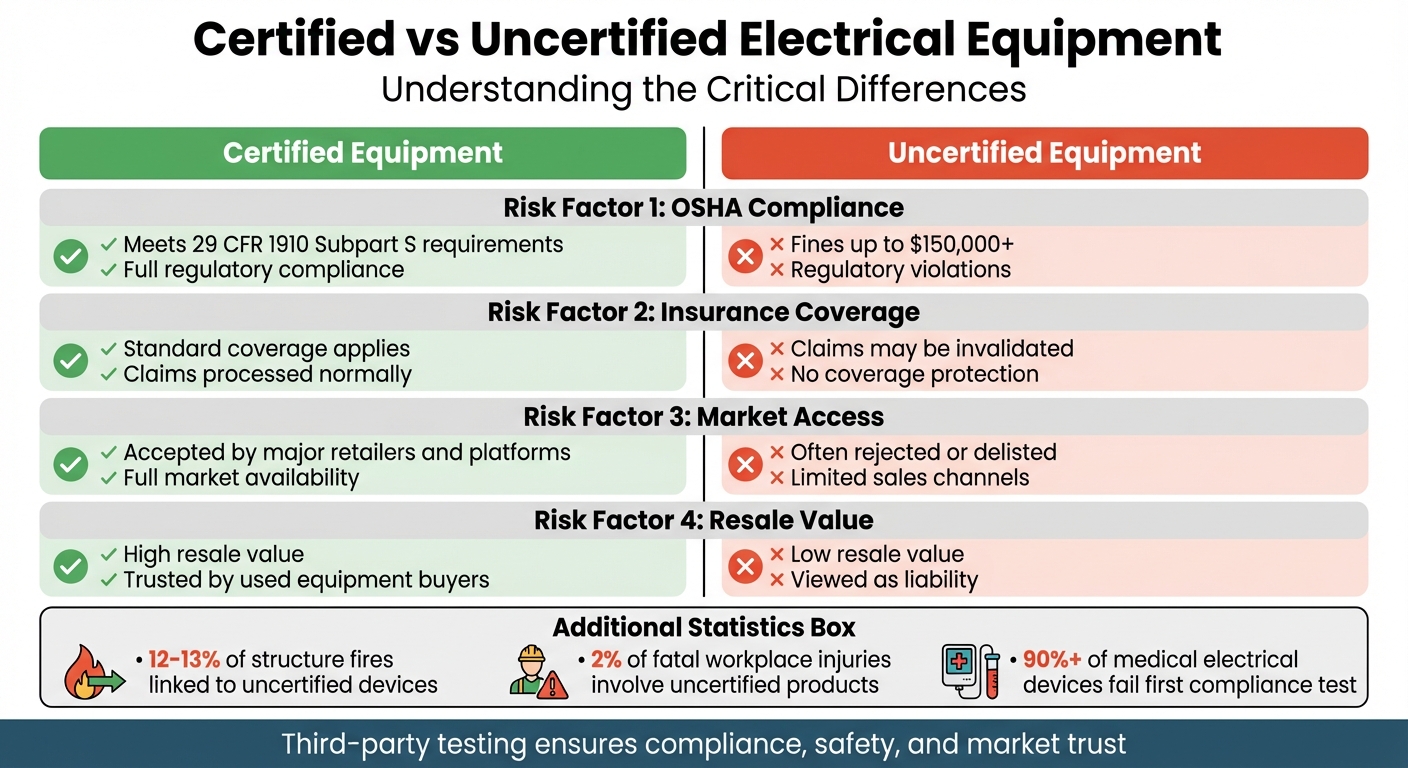
Certified vs Uncertified Electrical Equipment: Safety and Compliance Comparison
When it comes to electrical products, skipping third-party testing can lead to serious consequences, both in terms of safety and compliance.
Safety Risks and Equipment Failures
Avoiding independent testing creates a range of hazards, from fires to equipment malfunctions and even electrocution. For instance, uncertified products often use wires that are too thin for the power load or materials that aren’t fire-resistant. These flaws can result in sparks and fires. In fact, uncertified devices are linked to roughly 12–13% of structure fires and nearly 2% of fatal workplace injuries.
Electrocution is another major risk. Products without proper testing may suffer from poor grounding, subpar insulation, or flawed designs that cause overheating, short circuits, or arcing.
"Using uncertified electrical equipment is like playing with fire, literally. These devices skip all the safety tests and ignore the rules designed to keep people safe."
- Andrew Marks, Lead Purchasing Agent, United Industries
Failure to Meet Industry Standards
Beyond the immediate safety concerns, uncertified products often fail to meet industry regulations. Without third-party testing, manufacturers struggle to comply with mandatory standards. For example, over 90% of medical electrical devices fail their first compliance test. Counterfeit products frequently cut corners, such as using conductors measuring 0.475 mm instead of the required 0.485 mm for 24 AWG wire, which undermines safety.
The National Electrical Code mandates certification from a Nationally Recognized Testing Laboratory (NRTL) for many products. Using uncertified equipment not only violates building codes but can also lead to forced replacements, delays, and legal disputes. Additionally, products that fail to meet regulations like RoHS 2.0 for hazardous substances may face shipment rejections or penalties.
"Article 110.3(B) says you must install listed equipment following the listing instructions. ... Any modifications kill the certification and break the code."
- National Electrical Code (NFPA 70)
Financial and Business Risks
The financial fallout from uncertified equipment can be severe. Insurance companies might deny claims for damages or injuries caused by uncertified products, leaving businesses to cover the costs themselves. Emergency shutdowns and production delays are also common when uncertified components fail during critical operations.
Market access is another issue. Many major retailers and online platforms require proper NRTL certification, meaning uncertified products often get rejected or delisted. This limits sales opportunities and can harm a brand’s reputation. On top of that, uncertified installations tend to have a lower resale value, as buyers view them as liabilities. Third-party testing helps avoid these risks by ensuring products meet compliance and quality standards.
| Risk Factor | Certified Equipment | Uncertified Equipment |
|---|---|---|
| OSHA Compliance | Meets 29 CFR 1910 Subpart S requirements | Fines up to $150,000+ |
| Insurance | Standard coverage applies | Claims may be invalidated |
| Market Access | Accepted by major retailers and platforms | Often rejected or delisted |
| Resale Value | High; trusted by used equipment buyers | Low; viewed as liability |
How Third-Party Testing Confirms Quality and Compliance
Independent Confirmation of Standards
Independent testing is a key step in ensuring products meet safety and reliability standards. These third-party labs operate separately from manufacturers, vendors, and users, providing unbiased evaluations of products. As Robert "Bob" Lawrie, Senior Editor at EC&M, puts it:
"Asking a vendor to test his or her own equipment is like asking an author to review his or her own book. An independent, unbiased third party is bound to be more objective."
In the U.S., OSHA designates certain private organizations as Nationally Recognized Testing Laboratories (NRTLs). These labs are responsible for testing and certifying products to meet strict safety requirements. They evaluate product samples that reflect typical manufacturing processes and materials, focusing on critical safety measures.
Once testing is completed, labs issue a detailed technical report. Products that pass are listed, and the labs conduct quarterly inspections to ensure ongoing compliance with safety standards.
Certifications That Prove Reliability
Beyond testing, certifications from trusted organizations solidify a product's reliability. OSHA mandates NRTL approval for 39 product categories used in workplaces. Well-known certifications, like UL (Underwriters Laboratories) and ETL (Intertek), hold equal weight because they adhere to the same safety standards. Joan Sterling, Vice President at Intertek, explains:
"A listing mark indicates a product complied with applicable standards when it left the manufacturing location."
Consumers are increasingly aware of these certifications. According to statistics, 80% of consumers recognize NRTLs, 76% understand what certification signifies, 50% actively seek certified electronics, and 33% prefer certified products. These marks directly address concerns about safety and compliance.
It’s worth noting the difference between "Listed" and "Recognized" products. A "Listed" product has undergone full assembly testing, while a "Recognized" component, marked with a backward UR, means only that part was tested. For complete safety assurance, look for the "Listed" designation on finished electrical products.
sbb-itb-501186b
Why Third-Party Testing Benefits Brands and Buyers
Better Safety and Longer Product Life
Independent testing plays a critical role in identifying defects before products hit the market. By uncovering weaknesses and non-compliance issues early, brands can address these problems during the development phase, avoiding the financial and reputational damage of a recall. This process ensures higher-quality components, leading to fewer failures and returns.
The benefits of testing don’t stop at production. Field acceptance testing ensures proper shipping and installation. As Robert Lawrie, Senior Editor at EC&M, emphasizes:
"Without third-party acceptance testing performed by qualified test personnel immediately prior to energizing, potential problems could go undiscovered."
This thorough approach not only enhances the product’s lifespan but also gives buyers confidence in their purchase right from the start.
Buyer Confidence and Brand Trust
Independent certification is a cornerstone of buyer trust. Certification marks like UL or ETL signal that an impartial expert has verified the product’s safety, going beyond the manufacturer’s claims. These marks reassure buyers that the product meets stringent safety standards.
For electricians and inspectors, certification isn’t optional - it’s required under the National Electrical Code. Without it, they won’t install the product, effectively barring it from use in commercial projects. Certification also provides brands with legal protection. If equipment fails, investigators and insurers will check if it was certified by a recognized lab. Certified products not only reduce defects but also cut down on customer service costs, boosting profitability. Brands that embrace certification position themselves as leaders in electrical safety, earning long-term trust from buyers.
Market Advantage for Electrical Brands
Certification doesn’t just ensure safety - it also creates a competitive edge. Many major online retailers and commercial distributors now require NRTL certification before listing electrical products. In the B2B space, designers, architects, and procurement teams prioritize certified products to protect their reputations and ensure compliance. As Swathi Kodaikal from Contract Laboratory explains:
"Displaying an NRTL mark signals high-level engineering and a commitment to quality, enhancing your company's credibility."
Beyond reducing risks, third-party testing helps brands stand out in regulated markets. It also simplifies international expansion by meeting regional standards like UL for North America, VDE for Europe, and CCC for China. While initial testing may seem costly, the long-term benefits - lower liability, reduced operational expenses, and the ability to charge premium prices - far outweigh the investment.
How to Select Third-Party Testing Services
What to Look for in a Testing Partner
Selecting the right testing partner begins with confirming their credentials. In the U.S., ensure the lab is an OSHA-accredited Nationally Recognized Testing Laboratory (NRTL). For Canadian sales, verify accreditation from the Standards Council of Canada (SCC).
The lab must operate independently from manufacturers and installers to guarantee unbiased results. Look for labs that employ technicians certified to standards like ANSI/NETA ETT-2000, with registered electrical engineers reviewing their reports. As Jim White from IAEI Magazine explains:
"Third-party testing organizations best support the interest of the owner, and the objectivity and competency of testing organization is as important as the competency of the individual technician performing the work".
Respected labs also conduct unannounced quarterly inspections to ensure ongoing compliance. Joan Sterling, Vice President of Public and Government Affairs at Intertek, highlights this:
"A listing mark indicates a product complied with applicable standards when it left the manufacturing location. Changes, alterations, or reconditioning will invalidate the certification".
Once you've verified credentials, assess the lab's focus on compliance and independence. For businesses planning to expand globally, choose a partner with expertise in testing across multiple standards like UL, CSA, and IEC. They should also provide marks recognized internationally, such as CE for Europe or CCC for China. Be aware, though, that the CE mark often indicates self-declaration rather than independent testing. For equipment buyers, verifying certifications through trusted platforms is a crucial next step.
Finding Certified Products on Electrical Trader
After identifying a reliable testing partner, the next step is verifying certifications when sourcing products. This is especially important when purchasing components. Electrical Trader offers a variety of breakers, transformers, and power distribution equipment, but it's essential to confirm the certification status before making a purchase. Always request the UL or ETL file number from the seller, then cross-check it using official directories like the UL Product iQ Database or the Intertek Certified Product Directory.
Understanding certification marks can save you from costly errors. For complete equipment like breakers or transformers, look for the "UL Listed" mark (a circle logo), which certifies the entire assembly is safe. In contrast, the "UL Recognized" mark (a backward "UR") applies only to individual components and does not certify the entire product. Keep in mind that licensed electricians and inspectors will refuse to install uncertified equipment, as the National Electrical Code mandates proper certification. This makes verification a critical step in any commercial project.
Electrical Trader makes it easier to find certified equipment, including breakers, transformers, and power distribution tools. When reviewing listings, ask sellers for supporting documentation and independently confirm their claims. As LightingDepotUSA wisely advises, "Trust, but verify". This careful approach not only protects your investment but also ensures compliance with essential safety standards.
Conclusion
Third-party testing plays a critical role for electrical brands. Without NRTL certification, products are barred from entering 39 OSHA-regulated workplace categories, and licensed professionals won’t install them due to requirements in the National Electrical Code.
Beyond compliance, certification protects businesses from severe liability risks. Many insurance policies won’t cover incidents involving non-compliant products, leaving businesses vulnerable. As LightingDepotUSA aptly puts it:
"The most expensive mistake you can ever make is the one that puts your entire business at risk".
When a product fails and causes injury or property damage, the lack of third-party testing leaves companies exposed to significant legal and financial consequences.
Certification also strengthens buyer trust by demonstrating a commitment to safety standards, which can directly improve market access and build customer loyalty. Contractors, facility managers, and distributors recognize marks like UL and ETL as symbols of reliability, giving certified brands a competitive edge.
Additionally, certification ensures ongoing compliance through unannounced quarterly inspections, verifying that approved components and processes remain in use. For electrical brands aiming for sustained success, third-party testing isn’t optional - it’s essential.
FAQs
What’s the difference between UL Listed and UL Recognized?
The UL Listed mark indicates that a product has been thoroughly tested and approved for safety as a complete, standalone item. This means it’s ready for installation or sale without requiring any additional safety evaluations. Examples of such products include appliances or lighting fixtures.
On the other hand, the UL Recognized mark applies to components designed to be part of a larger system. While these parts meet specific safety standards, they must undergo a final evaluation when integrated into the finished product to ensure full compliance.
How can I verify a UL or ETL file number is real?
To confirm a UL or ETL file number, head to the certification body’s website and use their online verification tools. For UL certifications, visit the UL Online Certifications Directory. For ETL certifications, use Intertek’s verification database. These resources allow you to verify the file number or product details, ensuring the certification is authentic and the product complies with established testing standards.
Do I need NRTL certification for workplace use?
Yes, NRTL certification is mandatory under OSHA regulations for electrical products used in U.S. workplaces. This certification confirms that the products comply with established safety standards, helping to minimize risks and protect workers from potential hazards.