

Ultimate Guide to LED Energy Efficiency Ratings
LED energy efficiency ratings help you understand how well a product converts electricity into light while maintaining performance. These ratings impact energy costs, lifespan, and overall lighting quality. Key metrics include:
- Efficacy (lm/W): Measures light output per watt. Look for 130+ lm/W (good) or 150+ lm/W (excellent) in 2026.
- L70 Rated Life: Indicates how long the light maintains 70% of its brightness. DLC-certified products require at least 50,000 hours.
- Power Factor (PF): Efficiency of power usage. Aim for ≥ 0.90.
- Total Harmonic Distortion (THD): Measures electrical noise. Keep it ≤ 20%.
- Color Rendering Index (CRI): Accuracy of color representation. CRI 80+ is standard; CRI 90+ is ideal for retail and healthcare.
Certifications like ENERGY STAR and DLC ensure products meet quality and efficiency standards. Starting July 2025, all efficiency claims for integrated LED lamps must comply with DOE testing standards. By 2026, DLC V6.0 will raise efficacy benchmarks by about 14%.
For commercial LED projects, verify specifications like luminaire lumens (actual light output), driver quality, and certifications to ensure energy savings, rebate eligibility, and long-term performance. Properly selected LEDs can reduce costs, improve lighting quality, and ensure compliance with updated standards.
Testing LED Bulbs - Do The Manufacturer's Claims Stack Up? - With Giveaway
sbb-itb-501186b
LED Energy Efficiency Metrics Explained
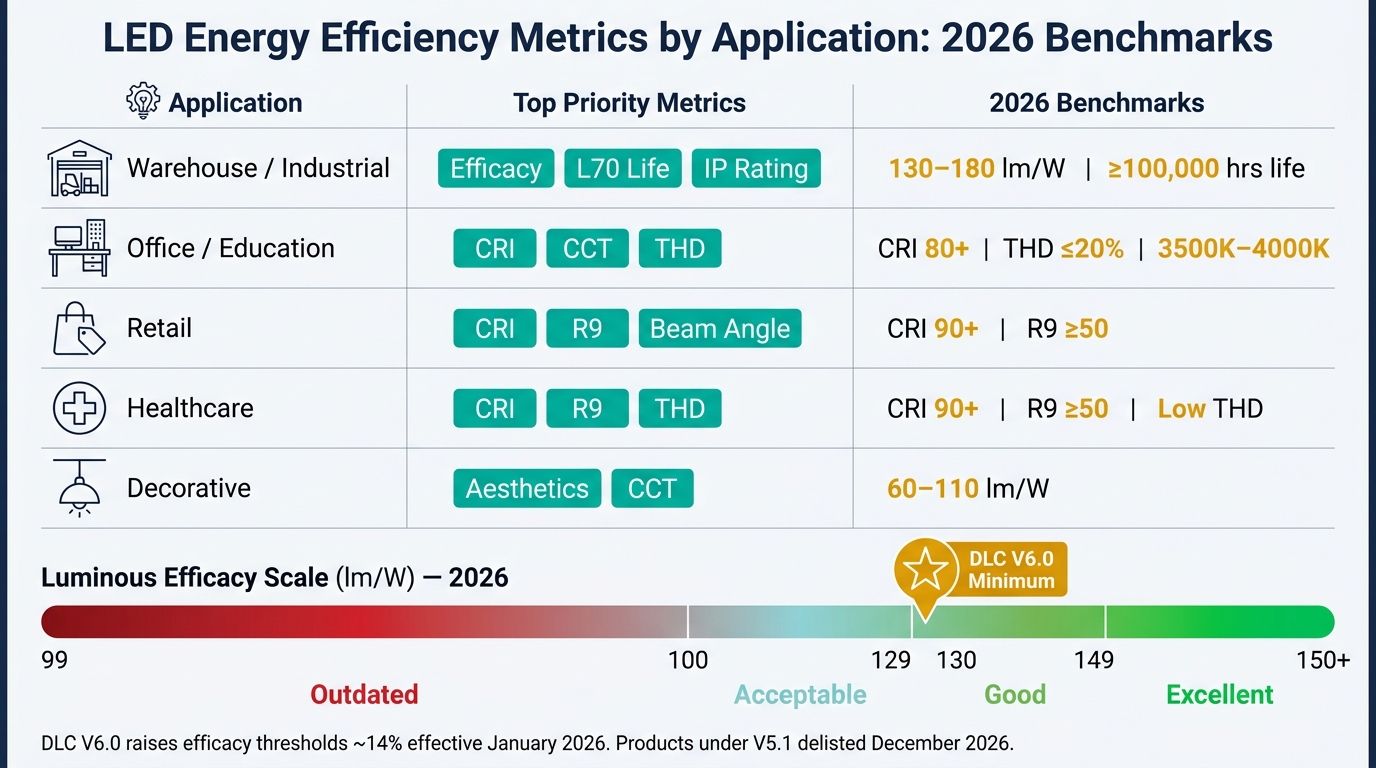
LED Energy Efficiency Metrics by Application: 2026 Benchmarks
Lumens, Watts, and Lumens Per Watt (lm/W)
Let’s break this down: lumens measure the amount of light a fixture produces, watts indicate the energy it consumes, and lumens per watt (lm/W) - also called luminous efficacy - shows how efficiently the fixture converts electricity into light.
Here’s the catch: wattage doesn’t directly equate to brightness. For example, two LED fixtures using 20 watts can produce vastly different light outputs - one might deliver 1,600 lumens, while another achieves 2,400 lumens. That difference boils down to their luminous efficacy. Smile Lighting sums it up perfectly:
"A fixture's wattage tells you its cost to run. Its lumen output tells you how much light it produces. Only luminous efficacy - the ratio of the two - tells you whether it is doing both efficiently."
When calculating efficiency, use luminaire lumens instead of raw chip output. Why? Driver and optical losses can reduce actual light output by 20% or more.
In addition to efficiency, two other electrical metrics - Power Factor and Total Harmonic Distortion - play a big role in understanding LED performance.
Additional Performance Metrics
Two key measures of an LED driver’s quality are Power Factor (PF) and Total Harmonic Distortion (THD). Here’s why they matter:
- Power Factor (PF): This shows how effectively the driver uses AC power. A low PF means the fixture draws more current than necessary, which can strain your electrical system. For DLC-listed products, a PF of at least 0.90 is required.
- Total Harmonic Distortion (THD): THD measures the electrical noise a fixture introduces into the power supply. High THD can disrupt sensitive equipment, especially in places like hospitals, data centers, or factories. DLC-listed products must keep THD at or below 20%.
Another factor to consider is Color Rendering Index (CRI). High CRI (90+) is often used in settings where accurate color representation is critical, like retail or healthcare. However, achieving high CRI typically reduces efficacy by 5%–10%, as more energy is needed to produce red wavelengths. This trade-off should be weighed when specifying fixtures.
How Metrics Differ by Application
The importance of these metrics varies depending on where the lighting is used. For instance:
- Warehouses prioritize high efficacy and long lifespans, as fixtures are used for extended hours and mounted at great heights.
- Retail stores focus on CRI and beam angles to make products look their best.
- Hospitals demand both high CRI (≥ 90, with an R9 value of at least 50) and low THD to avoid interference with sensitive medical devices.
Here’s a quick comparison of metrics by application:
| Application | Top Priority Metrics | Typical 2026 Benchmarks |
|---|---|---|
| Warehouse / Industrial | Efficacy, L70 Life, IP Rating | 130–180 lm/W; ≥ 100,000 hrs |
| Office / Education | CRI, CCT, THD | CRI 80+; THD ≤ 20%; 3500K–4000K |
| Retail | CRI, R9, Beam Angle | CRI 90+; R9 ≥ 50 |
| Healthcare | CRI, R9, THD | CRI 90+; R9 ≥ 50; Low THD |
| Decorative | Aesthetics, CCT | 60–110 lm/W (due to design focus) |
Industrial high-bay fixtures lead the pack in system efficacy, hitting 130–180 lm/W, thanks to their simple, efficient optical designs. On the other hand, decorative fixtures usually fall into the 60–110 lm/W range, as aesthetics often take priority over efficiency. Choosing the right metrics for the application ensures optimal performance and maximizes eligibility for utility rebates.
How to Read LED Specification Sheets
If you're serious about evaluating LED products, knowing how to read a specification sheet is a must. It’s the key to understanding the product’s performance and ensuring you make the right choice.
Key Sections of an LED Spec Sheet
An LED spec sheet typically includes four main areas: electrical data (such as input watts, power factor, and total harmonic distortion or THD), photometric data (like lumen output, efficacy, and beam angle), color characteristics (including CRI, CCT, and R9 values), and lifetime metrics (like the L70 rated life). Skipping any of these sections can lead to poor product selection.
Start by checking how lumens are labeled. If you see terms like "LED lumens" or "source lumens", this refers to the raw output of the LED chip, not the actual light delivered by the fixture. Optical losses, which can reduce output by 10%–25%, aren't factored into these numbers. Look for terms like "luminaire lumens", "fixture lumens", or "delivered lumens" to get the real output. If this information is missing, you can cross-check the product's model number on the DLC Qualified Products List (QPL) to find tested values. Getting the correct lumen value is essential for evaluating efficiency.
How to Evaluate Efficiency Data
When calculating efficiency, always use the delivered lumens. Divide the luminaire lumens by the total system watts (including the power consumed by the driver) to determine efficacy in lumens per watt (lm/W). This metric is one of the most telling indicators on the spec sheet. For 2026, anything above 130 lm/W is considered solid, while 150 lm/W or more is excellent. Below 100 lm/W? That’s outdated for most commercial applications.
Driver quality is another crucial factor. Look for a power factor (PF) of at least 0.9 and THD of 20% or less - these are the minimums required by DLC V6.0 standards. For spaces requiring accurate color rendering, such as retail or healthcare, check the CRI and specifically look for the R9 value, which measures how well deep reds are rendered. This detail often gets overlooked but can make a big difference in color-critical applications.
Lastly, pay close attention to the rated life. Claims like "100,000 hours" mean little without context. Look for references to L70 (the point at which the light output drops to 70% of its initial value) and IES TM-21 projections. As Jarvis Staff from Jarvis Lighting explains:
"The contractor who cannot read the difference will spec the cheaper fixture, lose the rebate (because it does not meet DLC efficacy thresholds), and get a callback in three years when the drivers start failing."
Also, make sure the warranty covers both the LEDs and the driver. The driver is often the first component to fail.
Using Testing Standards for Verification
Understanding a spec sheet isn’t just about reading numbers - it’s about knowing which numbers are trustworthy. Independent testing standards validate these figures, ensuring they reflect actual performance.
- IES LM-79: This standard measures the complete fixture’s performance, including lumens, watts, efficacy, and color, under controlled lab conditions (77°F ±2°F / 25°C ±1°C).
- IES LM-80: This focuses on how LED chips degrade over time, providing the data needed for long-term projections.
- IES TM-21: Using LM-80 data, this standard estimates the L70 rated life of an LED fixture.
For added assurance, ask the manufacturer for the .ies photometric file. Reputable companies offer this file for free, and if they don’t, it’s a red flag that the product might not have undergone proper testing. Also, check that the LM-79 report comes from a lab accredited by NVLAP or an equivalent ISO 17025 program. This accreditation separates verified data from mere marketing claims.
| Standard | What It Measures | Why It Matters |
|---|---|---|
| IES LM-79 | Fixture-level lumens, watts, efficacy, and color | Confirms actual delivered performance |
| IES LM-80 | LED chip lumen depreciation over time | Provides data for life projections |
| IES TM-21 | Projected L70 rated life | Turns LM-80 data into a lifespan estimate |
| DLC V6.0 QPL | Efficacy, PF, THD, and life compliance | Ensures rebate eligibility and meets efficiency standards |
Energy Labels, Certifications, and Regulations
Certifications play a key role in verifying the claims found on product spec sheets, ensuring that LED performance and safety standards are met. In the U.S., several programs are in place to validate these claims.
ENERGY STAR and DLC Certifications
When it comes to LED products, ENERGY STAR and DLC (DesignLights Consortium) are the two major certifications, each serving distinct markets. ENERGY STAR focuses on residential and light-commercial products, such as household lamps and downlights. In contrast, DLC certification is geared toward commercial and industrial applications, covering items like high bays, troffers, and outdoor fixtures.
For commercial buyers, DLC certification is often a must, as it's tied to rebate eligibility for roughly 70% of North American utility efficiency programs. Starting in January 2026, the DLC SSL V6.0 standard will take effect, increasing minimum efficacy thresholds by an average of 14% across all product categories. Products certified under the older V5.1 standard will be delisted on December 15, 2026. If you're working on a project requiring rebate eligibility beyond this date, ensure the product carries the V6.0 certification.
"The SSL (LED) Qualified Products List improves both consumer confidence and sustainability of the LED lighting market as a whole through well-researched criteria for efficiency and quality." - DesignLights Consortium
Outdoor fixtures may also feature LUNA V2.0 certification, which combines dark-sky compliance with energy efficiency standards.
In addition to performance certifications, commercial LED installations must have a UL or ETL listing from a Nationally Recognized Testing Laboratory (NRTL). This ensures electrical safety and compliance with the National Electrical Code (NEC). These labels also indicate location ratings - Dry (indoor), Damp (covered outdoor or high-humidity), or Wet (exposed to rain). For food service areas, look for NSF certification, which confirms the fixture meets sanitation standards for food-splash zones.
How to Read Energy Labels
For consumer LED bulbs, the FTC "Lighting Facts" label is a quick way to compare products. This label is mandatory on most general service lamps with medium screw bases sold in the U.S..
| Label Component | What It Shows |
|---|---|
| Brightness | Lumens (rounded to the nearest 5) |
| Estimated Yearly Energy Cost | Based on 3 hours/day use at $0.11/kWh |
| Life | Estimated years based on 3 hours/day use |
| Light Appearance | Correlated Color Temperature (CCT) in Kelvin |
| Energy Used | Watts consumed |
The estimated yearly energy cost is calculated using 3 hours of daily use at $0.11/kWh. While this provides a baseline for comparison, actual costs will depend on your local electricity rates and daily usage patterns.
The ENERGY STAR logo, often found on the side or back of the packaging, signifies that a product has met third-party verified standards for efficiency and performance. This is especially useful for homeowners and smaller-scale buyers making quick purchasing decisions.
While these labels offer a snapshot of efficiency, federal codes and standards ensure the accuracy of these figures.
Key Energy Codes and Standards
Federal regulations dictate how LED efficiency is tested and reported. The DOE Uniform Test Methods (10 CFR Part 430) require that, starting July 15, 2025, all efficiency representations for integrated LED lamps comply with Appendix BB of these procedures. Efficiency claims made before this date may not align with current testing standards.
The FTC Energy Labeling Rule (16 CFR Part 305) mandates what information must appear on consumer packaging. This rule underpins the FTC Lighting Facts label, while DLC technical requirements serve a similar purpose for commercial products by setting minimum performance standards.
When specifying commercial products, always verify the model number against the DLC QPL (Qualified Products List). With the December 2026 delisting deadline approaching, this step ensures your chosen product won't lose rebate eligibility mid-project.
How to Choose the Right LED for Energy Efficiency
Comparing LEDs by Application
When selecting LEDs, it's crucial to focus on the luminaire lumens - the actual light output from the fixture - rather than lamp lumens. This distinction matters because lamp lumens can overstate brightness by 10% to 25% due to losses from optics and housing.
Each application has different priorities. For example, warehouses need high efficacy, a strong L70 life rating, and a high ambient temperature (Ta) rating to handle heat buildup. Offices, on the other hand, benefit from good Color Rendering Index (CRI), dimming compatibility, and low Total Harmonic Distortion (THD). Retail spaces should prioritize CRI (especially the R9 score for accurate reds) and beam angle to highlight merchandise effectively.
| Application | Top Priority Specs |
|---|---|
| Warehouse | Luminaire lumens, efficacy, L70 life, Ta rating, IP rating |
| Office | CRI, CCT, efficacy, dimming protocol, THD |
| Retail | CRI (especially R9), CCT, beam angle |
| Healthcare | CRI ≥ 90, R9 ≥ 50, CCT, dimming, THD |
| Parking | IP rating, distribution type, DLC LUNA listing |
(Source: Jarvis Lighting Application Guide, 2026)
For industrial high bays, the FEMP minimum efficacy threshold stands at 175 lumens per watt, reflecting advancements in LED technology.
Thermal management is a must. Heat is the leading cause of LED failure - just a 10°C (18°F) rise in junction temperature can cut an LED's lifespan by up to 50%. Always confirm that the fixture's thermal ratings align with your environment. Effective thermal management can also be enhanced with integrated control systems.
Once you've matched the LED to your application, incorporating controls can further optimize energy use.
Using Controls to Improve Energy Savings
After choosing the right LED specifications, controls can take energy efficiency to the next level. Daylight harvesting uses sensors to dim LEDs automatically when there's enough natural light, reducing energy use by 5% to 25%. Occupancy sensors are another great addition, turning off lights in unused spaces to prevent waste.
The success of these systems depends on the dimming protocol. 0-10V dimming is widely compatible and ideal for most commercial settings. For more complex environments like healthcare facilities, DALI (Digital Addressable Lighting Interface) offers individual fixture control. Residential setups often use phase-cut (TRIAC/ELV) dimming.
"The choice of commercial lighting is not easy... You'll make a cost center a game-changer by ensuring the greatest efficacy in the lighting fixtures, thermal management in the Texas heat, and the greatest rebates." - Evan Carter, Bright LED Tx
An excellent example of control integration comes from Westover Air Reserve Base, which adopted occupancy heat mapping in June 2023. This system improved energy savings, shortened the payback period, and enhanced space utilization. This showcases how Networked Lighting Control (NLC) - where fixtures act as data nodes - is becoming standard in commercial and government facilities.
Once controls are in place, it's time to evaluate the financial return.
Calculating Payback Period and Lifecycle Costs
To calculate the payback period, use this formula: (Total LED System Cost − Utility Rebates) ÷ (Annual Energy Savings + Annual Maintenance Savings).
In high-use commercial settings, LED upgrades often pay for themselves within 14 to 18 months, with utility rebates covering 20% to 50% of upfront costs.
Don't forget to consider ballast losses in older fixtures. Metal halide and fluorescent systems can consume 10%–15% more power than their rated wattage. LEDs also require less maintenance, reducing costs like scissor lift rentals, which can run $500–$1,500 per day.
Additional savings can come from the Section 179D tax deduction, which offers up to $5.00 per square foot for energy-efficient lighting upgrades in 2026. Lastly, pay attention to the driver warranty. Since drivers are a common failure point, a solid warranty can protect you from unexpected expenses.
Conclusion: Key Takeaways for LED Energy Efficiency Ratings
Understanding LED efficiency ratings means focusing on the numbers that truly make a difference. Start with efficacy (lm/W) - a rating of 130+ lm/W is solid for 2026, while 150+ lm/W indicates top performance. Make sure you're evaluating luminaire lumens, not lamp lumens, as the difference can range from 10% to 25%. This distinction can significantly impact the amount of light delivered, potentially leaving spaces underlit if overlooked. Beyond these efficiency metrics, certifications are just as important. DLC V6.0, effective November 2025, has raised minimum efficacy standards by around 14% across all categories. Keep in mind that products listed under the older V5.1 standard will be delisted by December 2026, so checking the Qualified Products List (QPL) ensures rebate eligibility and compliance for the long term.
Electrical performance is another key factor. Look for fixtures with a Power Factor (PF) of ≥ 0.9 and Total Harmonic Distortion (THD) ≤ 20%. A PF of 0.5, for instance, means the fixture draws twice the current compared to one rated at 1.0 for the same wattage - an inefficiency that can inflate utility costs, especially in commercial settings. Combine this with a verified L70 life rating, based on IES TM-21 projections, for a realistic sense of how long the fixture will maintain its performance.
Lastly, pay attention to the driver warranty. Since the driver is often the first component to fail, a warranty that excludes it offers limited protection. Whether you're choosing LEDs for a warehouse, office, or retail space, applying these standards consistently - from technical specs to certifications - can mean the difference between a wise investment and a costly oversight. By carefully evaluating these factors, you can ensure your LED choice delivers both efficiency and reliability.
FAQs
How do I verify a fixture’s real lumens?
To confirm the actual lumens of a fixture, look at the spec sheet for luminaire or fixture lumens. Avoid relying on raw chip or LED lumens, as these can exaggerate output by 10–25%. For accuracy, cross-check the fixture's lumens with the DLC QPL listing, which offers verified data. If you need precise details, ask for the IES LM-79 report - this document includes lab-tested luminous flux to validate the fixture's claimed performance.
What do PF and THD change in a building?
Power Factor (PF) indicates how effectively a driver uses AC power. When PF is low, it can lead to overloaded circuits and higher utility demand charges, which can drive up costs unnecessarily.
Total Harmonic Distortion (THD), on the other hand, measures the level of electrical noise within a circuit. High THD can result in several issues, including flickering lights, overheating, reduced lifespan of fixtures, and even interference with sensitive electronic equipment.
Properly managing both PF and THD is essential for maintaining good power quality. Neglecting these factors can lead to inefficiencies, higher expenses, or even equipment failures.
How do I keep DLC rebates after 12/15/2026?
To ensure you're eligible for utility rebates beyond December 15, 2026, it's essential to use fixtures that comply with the DesignLights Consortium (DLC) SSL V6.0 standard. After this date, products listed under the older V5.1 standard won't qualify for rebates.
When planning your project, make sure to:
- Specify DLC SSL V6.0 products in your documentation.
- Verify the product's status on the DLC Qualified Products List (QPL) during key stages: submittal, purchase, and project closeout.
By following these steps, you'll secure your eligibility for rebates while staying up to date with the latest standards.