LED vs. Fluorescent: Energy Efficiency Comparison
Switching to LED lighting is a no-brainer for businesses looking to cut energy costs and meet new regulations. LEDs outperform fluorescent lights in nearly every category: they use up to 40% less energy, last over 5 times longer, and eliminate maintenance headaches. Plus, with fluorescent tubes being phased out due to bans and stricter efficiency standards, LEDs are the future of commercial lighting. Here's why:
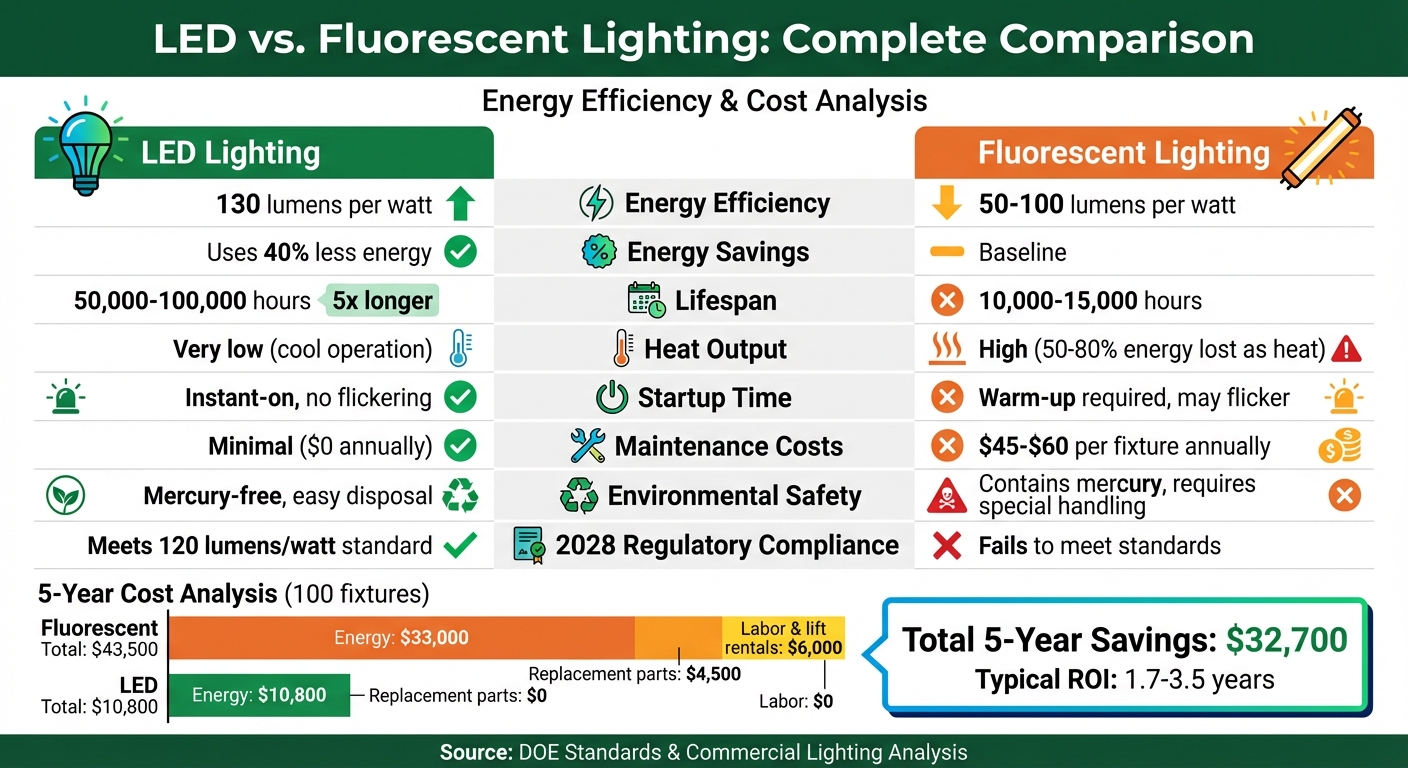
- Energy Savings: LEDs deliver 130 lumens per watt compared to 50–100 for fluorescents, cutting power use significantly.
- Longer Lifespan: LEDs last up to 100,000 hours, while fluorescents need replacement after 10,000–15,000 hours.
- Lower Costs: LEDs reduce energy bills and maintenance expenses, with a typical 100-fixture facility saving over $32,700 in 5 years.
- Regulatory Compliance: By 2028, all lighting must meet a minimum of 120 lumens per watt - fluorescents simply can't compete.
- Environmental Safety: LEDs are mercury-free, unlike fluorescents, which require special disposal due to hazardous waste.
Quick Comparison
| Feature | LED Lighting | Fluorescent Lighting |
|---|---|---|
| Energy Efficiency | 130 lumens per watt | 50–100 lumens per watt |
| Lifespan | 50,000–100,000 hours | 10,000–15,000 hours |
| Heat Output | Low | High |
| Startup Time | Instant | Warm-up required |
| Maintenance Costs | Minimal | High (frequent replacements) |
| Regulatory Compliance | Meets 2028 standards | Fails to meet standards |
| Disposal | Mercury-free | Requires special handling |
Switching to LEDs offers better lighting, reduced costs, and compliance with future standards. Waiting to upgrade only increases expenses and risks non-compliance.
LED vs Fluorescent Lighting: Energy Efficiency and Cost Comparison
LED Energy Efficiency Explained
How LED Technology Works
LED lighting works by converting electrical energy into light using semiconductor technology. This process involves electrons moving through specialized materials to produce light. Unlike fluorescent tubes, which rely on ionizing gas and waste energy as heat, LEDs are far more energy-efficient.
For context, LEDs produce about 130 lumens per watt, while fluorescent tubes typically range between 50 and 100 lumens per watt. This means LEDs can use up to 40% less energy while delivering equal or even greater brightness. For example, a standard 2×36W (72W total) fluorescent fixture can be replaced by a 32W LED luminaire, providing better light output in most situations.
One key advantage of LEDs is their directional light output. They emit light in a focused 180° arc, ensuring nearly all the light is directed where it’s needed. On the other hand, fluorescent tubes emit light in a 360° pattern, wasting a significant portion as it disperses away from the target area. In fact, only about 60–70% of the light from fluorescent fixtures typically reaches the workspace.
LEDs are also far more efficient at converting energy into visible light rather than heat. They emit much less heat than fluorescents, making them ideal for energy-saving applications. Additionally, LEDs maintain their performance in extreme temperatures, often working even better in cooler conditions. For example, at around –4°F (–20°C), fluorescent lights can lose up to 80% of their brightness, while LEDs remain unaffected or even improve.
Modern LED luminaires can also include secondary optics, allowing for controlled beams tailored to specific needs - such as lighting warehouse aisles or retail corridors. This precise light placement further reduces energy waste, ensuring illumination is focused exactly where it’s required.
These efficiencies not only enhance energy conversion but also contribute to significant operational savings, especially in commercial settings.
Benefits for Commercial Applications
The advantages of LED technology translate directly into meaningful benefits for businesses. For instance, replacing 2,000 fluorescent fittings (72W each) with 32W LED equivalents can cut power demand by over 80 kW. This reduction leads to noticeable savings on monthly utility bills and a strong return on investment.
LEDs also offer an impressive lifespan - over 100,000 maintenance-free hours, compared to the 6,000–15,000 hours typical of fluorescent tubes. This longevity means fewer replacements, reduced maintenance costs, and less disruption to operations.
"Unlike a fluorescent fitting, the 'failure' of an LED equivalent does not mean that the LEDs will stop providing light output altogether, but instead the term is used to describe when 50% of the LEDs in a fitting drop to 70% of their original lumen output." – Raytec
With LEDs, "failure" doesn’t mean the light stops working entirely. Instead, it refers to a gradual reduction in brightness - specifically, when 50% of the LEDs drop to 70% of their original output. This gradual decline ensures consistent lighting over time. In comparison, fluorescent tubes experience photochemical degradation, losing nearly 40% of their initial brightness over time, while LEDs only see about a 6% reduction over an 18-month period. This reliability ensures stable and predictable lighting levels in commercial spaces, making LEDs a smart choice for long-term applications.
sbb-itb-501186b
Fluorescent Lighting Performance and Drawbacks
Power Consumption and Output
Fluorescent lighting falls short when compared to LEDs in terms of energy efficiency. While LEDs deliver an impressive 120–150 lumens per watt, fluorescent bulbs manage only 70–80 lumens per watt. This means fluorescents need considerably more power to achieve the same brightness. For instance, a standard 2×2 ft. fluorescent troffer consumes 32–40 watts, whereas an equivalent LED panel uses just 24–30 watts - a 37.5% reduction in power usage for the same level of illumination.
Another drawback is how fluorescent tubes emit light in all directions. This omnidirectional output results in a significant amount of light being wasted, as it disperses upward or sideways instead of focusing on the workspace. On average, only about 68% of the light from fluorescent fixtures reaches the intended area, with nearly 7% wasted upward.
Fluorescent lights also lose brightness over time due to the degradation of their phosphor coating. This results in a 20% reduction in light output over their lifespan. To counteract this dimming, businesses often over-light spaces initially, which increases energy use.
Temperature sensitivity is another issue. At temperatures as low as -4°F (-20°C), fluorescent bulbs can lose up to 80% of their original brightness. Additionally, frequent on/off switching and dimming can cause problems. As Jaydon Leo from JCLGL explains:
"Fluorescent bulbs hate dimming - they flicker, lose efficiency, or even burn out".
These limitations make fluorescent lighting unsuitable for environments that require adaptable or frequently adjusted lighting, adding to both operational and maintenance costs.
Commercial Use Limitations
Fluorescent lighting isn't just less efficient - it also comes with higher long-term costs due to frequent replacements and maintenance. With a lifespan of 10,000–15,000 hours, fluorescent bulbs fall far behind LEDs, which last 50,000+ hours - a ratio of at least 5:1. In a typical office running lights for 10 hours daily, fluorescents generally need replacing within 4 years, leading to multiple replacement cycles over time.
This short lifespan directly translates to increased labor costs and disruptions. For example, in a 500 sq. ft. office using 20 lights, the 10-year cost for fluorescent lighting - including electricity at $0.15 per kWh and five bulb replacements - totals approximately $4,504. This figure doesn’t even factor in the labor required for replacements or the productivity lost during maintenance.
Fluorescent lights also pose environmental challenges. They contain mercury, which requires careful disposal to comply with regulations. Businesses often face additional costs for recycling and specialized transportation, particularly in remote areas. Between 2012 and 2018, the number of commercial buildings using fluorescent lighting dropped by 16%, signaling a shift toward more sustainable options. This transition is being pushed further by regulatory changes. For instance, T5 and T8 fluorescent tubes were banned in the UK and EU starting August 25, 2023, due to mercury content restrictions. These challenges not only increase costs but also make it harder for businesses to meet evolving DOE standards and sustainability goals.
LED vs. Fluorescent: Performance Comparison
Energy Performance Data
When you compare the performance of LED and fluorescent lighting, the differences are striking. For starters, LED bulbs use about 40% less energy than fluorescent bulbs to produce the same level of brightness. Fluorescent lights, on the other hand, lose between 50% and 80% of their energy as heat, especially in recessed fixtures where trapped heat further reduces their efficiency [7,10,11]. This wasted heat forces HVAC systems in commercial buildings to work harder, driving up cooling costs. LEDs, by contrast, operate much cooler, converting most of their energy into light, which cuts down both lighting and cooling expenses.
LEDs also shine when it comes to startup performance. They turn on at full brightness instantly, with no flickering or delay, unlike fluorescent lamps that often require a warm-up period and may flicker during startup. Additionally, LEDs use up to 44% less energy compared to standard 4-foot fluorescent T8 lamps, resulting in noticeable savings on utility bills [11,12].
| Performance Metric | LED Lighting | Fluorescent Lighting |
|---|---|---|
| Energy Efficiency | Up to 44% less energy use than T8 [11,12] | Up to 80% energy lost as heat [11,12] |
| Startup Time | Instant-on; no flickering | Requires warm-up; may flicker |
| Heat Output | Very low | High (up to 80% of energy lost) |
| Lifespan | 25,000 to 50,000 hours | 7,000 to 15,000 hours |
| UV Emissions | None | Emits UV light |
These differences go beyond energy efficiency and directly affect environmental impact and operational costs.
Environmental Considerations
When it comes to environmental impact, the contrast between LEDs and fluorescent lamps becomes even more pronounced. Fluorescent bulbs contain mercury vapor, a toxic substance that poses serious risks to both health and the environment if mishandled or broken [12,5]. LEDs, however, are free of mercury and other hazardous materials, making them safer to use and easier to recycle.
Another major advantage of LEDs is their longevity. With lifespans of up to 15 times longer than traditional bulbs, LEDs generate far less waste over time. They also require less power, which helps reduce overall carbon emissions, especially in regions where electricity is generated from non-renewable sources. In fact, projections suggest that widespread LED use by 2027 could cut U.S. electricity consumption by an amount equal to the annual output of 44 large power plants.
Fluorescent lights also emit UV radiation, which can pose safety risks in certain environments. For example, in commercial kitchens and food service operations, the heat and UV emissions from fluorescent lamps can degrade food quality and freshness. Switching to LEDs eliminates these concerns entirely. These combined environmental and performance benefits make LEDs a smart choice for businesses looking to reduce costs, improve safety, and meet regulatory standards.
Operating Costs and Return on Investment
LED Cost Analysis
When you look at the total cost of ownership, the financial benefits of LED lighting become undeniable. LED high bays use 70% less energy compared to fluorescent systems, which translates into noticeable savings on monthly utility bills. For example, in a 24/7 operation, a single LED fixture costs around $118 per year to operate at 9¢/kWh, while a fluorescent unit costs about $185 per year. That’s an annual savings of $67 per fixture - and as electricity prices rise, those savings only grow.
LEDs also have impressively long lifespans, ranging from 50,000 to over 100,000 hours, which eliminates the recurring expenses tied to maintenance. Unlike fluorescent systems, LEDs don’t require frequent relamping, ballast replacements, or lift rentals. For a typical fluorescent setup, maintenance costs can run between $45 and $60 per fixture annually, adding up to $4,500–$6,000 every year for a 100-fixture warehouse. In Texas, many commercial LED retrofit projects achieve full payback in 14 to 22 months, and 24/7 operations often see returns in as little as 1.7 years.
"The longer those old fixtures sit in your ceiling, the longer they are actively draining capital that could be used to grow your business." - Evan Carter, Bright LED TX
Fluorescent systems, on the other hand, come with hidden costs that steadily erode their value.
Fluorescent Operating Expenses
While LEDs shine with their low operational costs, fluorescent systems rack up expenses that are easy to overlook. Frequent replacements mean higher costs for fluorescent tubes, along with labor and disposal fees. In facilities with high ceilings, replacing a single fluorescent fixture can cost between $45 and $60, factoring in electrician labor (typically $75–$120 per hour) and lift rentals (ranging from $300 to $500 per day). Additionally, as fluorescent bulbs age, they continue to consume the same amount of energy while producing less light, further reducing their cost-effectiveness.
Disposal costs add another layer of expense. Since fluorescent tubes contain mercury, they’re classified as "Universal Waste" in states like Texas, requiring documented recycling at a cost of $0.50–$1.00 per foot of tube. For a 100-fixture warehouse retrofit, disposal fees can total $1,600–$4,000. Regulatory changes are also accelerating the decline of fluorescent technology. As of January 1, 2025, seven U.S. states have banned fluorescent tubes, and federal standards mandating 120 lumens per watt by July 2028 are expected to phase them out entirely. With major manufacturers like GE, Philips, and Sylvania exiting the fluorescent market in 2024–2025, replacement parts are becoming scarce and more expensive.
Here’s a clear breakdown of the cost differences over five years:
| Cost Factor (5-Year Period) | Fluorescent/HID | LED Solution |
|---|---|---|
| Energy Consumption | ~275,000 kWh | ~90,000 kWh |
| Estimated Energy Cost | $33,000 | $10,800 |
| Replacement Parts | $4,500 | $0 |
| Labor & Lift Rentals | $6,000 | $0 |
| Total 5-Year Cost | $43,500 | $10,800 |
Over a five-year period, a 100-fixture facility would spend about $43,500 on traditional fluorescent lighting compared to just $10,800 with LEDs. That’s a difference of $32,700, which could be redirected to other business priorities instead of being lost to inefficiencies. This cost advantage, combined with the energy savings and reduced environmental impact, makes LEDs a smart choice for modern operations.
Compliance and Upgrade Guidelines
Department of Energy Requirements

Federal and state regulations are driving the shift from fluorescent to LED lighting, with the U.S. Department of Energy setting clear benchmarks. By July 2028, lighting systems must meet a minimum efficacy of 120 lumens per watt, a level fluorescent technology cannot achieve. In contrast, LEDs comfortably meet this standard, delivering 140–170 lumens per watt. Additionally, state bans on fluorescent lighting add urgency to this transition.
Fluorescent lamps, classified as "Universal Waste" due to their mercury content, come with recycling costs ranging from $0.50 to $1.00 per foot, further highlighting the financial and environmental advantages of switching to LEDs.
"The Department of Energy implemented a minimum efficacy standard of 45 lumens per watt in 2025... But the next standard - 120 lumens per watt by July 2028 - is technically impossible for fluorescent to meet." – Epic Electrical
These evolving standards underline the long-term economic and operational benefits of LEDs, making them a smart investment for businesses aiming to stay compliant and reduce costs.
Where to Buy LED Components
With stricter efficiency mandates in place, sourcing high-quality LED components becomes essential. For spaces with ceilings over 15–20 feet, it’s recommended to replace entire fixtures rather than using retrofit tubes. Ensure that the new fixtures are listed on the DesignLights Consortium (DLC) Qualified Products List to qualify for utility rebates, which can cover 20–40% of project costs.
Electrical Trader offers a wide range of industrial-grade LED components and power distribution equipment designed for commercial retrofits. Their LED fixtures feature heavy aluminum heat sinks, ensuring reliable operation in demanding environments and lifespans of 50,000–100,000 hours. To get started, conduct a professional lighting audit to evaluate current illumination levels and usage patterns.
Here’s what to budget for a typical project:
- LED high bay fixtures: $80–$140 each
- Installation labor (including lift rentals): $60–$120 per fixture
Utility rebates, ranging from $30 to $160 per fixture, can significantly offset these costs, making the transition to LEDs more affordable.
Fluorescent Lighting BANNED | LEDs vs. Fluorescent Lighting
Conclusion
Switching from fluorescent to LED lighting isn't just a wise financial move - it’s quickly becoming a regulatory requirement. LEDs offer 70% lower energy consumption, eliminate annual maintenance costs of $45–$60 per fixture, and easily meet the upcoming federal standard of 120 lumens per watt by July 2028. Meanwhile, fluorescent technology lags behind with a maximum efficiency of 80–90 lumens per watt and is on the verge of being completely phased out as manufacturers exit the market.
The financial benefits are hard to ignore. Facilities running 24/7 can achieve payback in just 1.7 years, while operations with two shifts see a return on investment in about 3.5 years. Add in utility rebates that cover 20–40% of project costs, and the transition becomes even more cost-effective.
LEDs also bring clear environmental and safety advantages. They’re mercury-free, operate at cooler temperatures, and maintain steady brightness throughout their 50,000–100,000 hour lifespan. This eliminates the disposal costs and hazardous waste concerns tied to fluorescent tubes.
When upgrading, quality is key. Industrial-grade LED fixtures with heavy aluminum heat sinks are built to handle tough conditions, reducing the risk of early failures often seen with cheaper options. Ensure all components are DLC-listed to qualify for rebates and meet performance standards.
For businesses ready to make the switch, Electrical Trader offers a wide range of industrial-grade LED fixtures and power distribution equipment. Their platform connects users with reliable, compliant lighting solutions - both new and used - that deliver long-term performance and value.
FAQs
How do I choose the right LED replacement for my T8/T5 fixtures?
When selecting an LED replacement for T8 or T5 fixtures, start by identifying your fixture type and checking for compatibility with your existing ballast. If compatibility is an issue, consider using a ballast-bypass tube instead. Pay attention to the lumens to ensure the lighting meets your needs - remember, LEDs are much more efficient than fluorescent options. Look for tubes with a lifespan of at least 50,000 hours to reduce maintenance costs over time. Also, keep in mind that as of August 2023, fluorescent T5 and T8 tubes are no longer allowed under updated regulations, making LEDs the go-to choice.
What’s the typical payback period for an LED retrofit in my building?
The payback period for switching to LED lighting generally falls between 1.7 and 3.5 years, influenced by factors such as how often the lights are used, the type of existing lighting, and local utility rates. For instance, facilities operating around the clock, like warehouses, can see returns within 1.8 to 3.5 years, while spaces with less frequent usage might take a bit longer. Thanks to utility rebates and energy savings, some projects recoup their costs in as little as six months, making it a fast and efficient investment.
Do I need to replace the whole fixture or can I use LED tubes?
If your fixture is compatible, you can often swap out fluorescent tubes for LED tubes without replacing the entire fixture. However, some setups might need rewiring or adjustments, so it's crucial to follow the manufacturer's guidelines and confirm compatibility. Many LED tubes are built for straightforward installation, making it simple to upgrade while retaining your current fixtures.