




Top 7 Benefits of Smart Lighting and HVAC Control
Smart lighting and HVAC control systems offer a modern way to cut energy costs, improve comfort, and streamline building operations. These systems use sensors, automation, and smartphone apps to optimize heating, cooling, and lighting based on real-time data. Here's a quick breakdown of their key advantages:
- Energy Savings: Reduce lighting energy use by 40–60% and HVAC energy consumption by up to 25%.
- Lower Costs: Save $180/year for homeowners or $10,000–$40,000 annually for commercial buildings.
- Convenience: Automated adjustments handle temperature and lighting changes without manual input.
- Better Comfort: Features like geofencing and human-centric lighting improve daily life.
- Longer Equipment Life: Smart systems reduce wear and tear, extending HVAC and lighting lifespan by 15–20%.
- Healthier Air: Sensors monitor and adjust air quality, reducing indoor pollutants.
- System Integration: Manage HVAC, lighting, and security from one centralized platform.
These systems not only save money but also improve how buildings function, creating smarter and more efficient spaces.
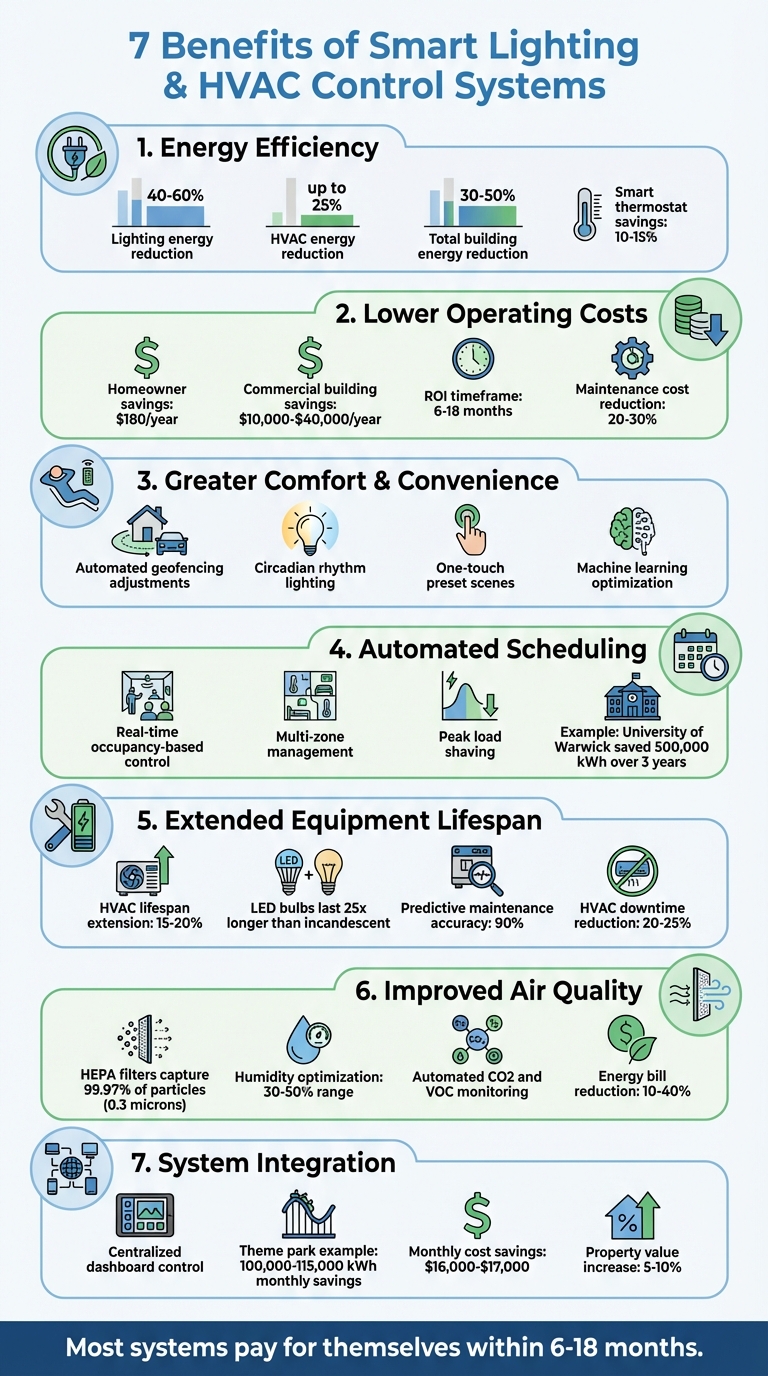
Smart Lighting and HVAC Systems: 7 Key Benefits with Energy Savings and Cost Data
Integrating Lighting and HVAC Controls for Deeper Energy Savings
sbb-itb-501186b
1. Better Energy Efficiency
Smart lighting and HVAC systems are game-changers when it comes to cutting down on energy waste. These systems rely on real-time data from occupancy sensors, daylight detectors, and even weather feeds to provide just the right amount of heating, cooling, or lighting - no more, no less. By adjusting dynamically, they prevent unnecessary energy use and pave the way for even more savings through occupancy-based control.
Here’s how it works: occupancy sensors detect when spaces like conference rooms are empty and automatically dim or turn off lights while signaling the HVAC system to adjust. A 2023 study by the DesignLights Consortium found that combining Networked Lighting Controls with HVAC systems could save businesses massive amounts - around $217 million in Arizona and $1.2 billion in Connecticut by 2030.
As Levin Nock, Senior Technical Manager at DesignLights Consortium, put it: "Total electric energy consumption in commercial buildings can drop by up to 20% when lighting controls are paired with HVAC systems to deliver occupancy signals".
Daylight harvesting is another smart feature. By using photocells to measure natural light, systems can dim artificial lighting when sunlight is sufficient, cutting lighting energy use by 10–30% in perimeter zones. Task tuning takes efficiency further by setting lights to the lowest brightness needed for specific tasks, saving an additional 5–15%. Meanwhile, smart thermostats learn your habits and adjust based on live weather data, trimming heating and cooling costs by 10–15% on average.
Even small changes, like using smart plugs to eliminate "vampire power" (the electricity wasted by devices left plugged in), can save 5–10% of energy. On a larger scale, building automation systems that integrate lighting, HVAC, and other controls can slash total energy use by 30–50%. These systems work together seamlessly, shifting from static, wasteful operation to responsive, need-based performance. And the best part? Smart thermostats often pay for themselves in energy savings within a year. It’s a win for both the planet and your wallet.
2. Lower Operating Costs
Smart controls don't just improve energy efficiency - they also bring noticeable cost savings to operating budgets.
The energy savings from smart lighting and HVAC systems directly translate into lower utility bills. For example, smart thermostats help homeowners save an average of $180 per year on heating and cooling costs. On a larger scale, commercial buildings can cut HVAC expenses by $10,000 to $40,000 annually, depending on their size and local energy rates. Add lighting controls that reduce energy use by 40–60%, and it's clear that these systems make a big financial difference. These immediate savings are just the start - there’s even more potential for cost reductions through smarter maintenance.
Predictive maintenance is a game changer for long-term savings. With IoT sensors monitoring equipment health - tracking things like vibration, pressure, and energy use - small issues can be fixed before they turn into costly breakdowns. This approach can cut HVAC downtime by 20–25% and extend the lifespan of equipment by 15–20%. Instead of scrambling to replace a failed compressor on a weekend (and paying premium emergency rates), you can schedule repairs ahead of time at standard costs.
Smart lighting systems also reduce maintenance expenses by 20–30% thanks to remote diagnostics. These systems can self-report problems, allowing technicians to zero in on failures without wasting time on unnecessary inspections. Plus, LED bulbs in these systems last 25 times longer than traditional incandescent bulbs, meaning fewer replacements and less time spent climbing ladders.
The financial benefits kick in quickly. Occupancy sensors and scheduling controls typically pay for themselves within 6–12 months, while more advanced systems recover their costs in 12–24 months. Most smart system investments break even within 6–18 months, making them a sound financial decision.
"Buildings with smart controls can achieve substantial energy savings without sacrificing comfort, making them an attractive investment for commercial property owners." - U.S. Department of Energy
3. Greater Comfort and Convenience
Smart lighting and HVAC systems do more than save energy - they make life easier and more comfortable. Instead of fiddling with controls all day, automated systems handle adjustments for you, ensuring your spaces stay pleasant without any effort on your part.
Take geofencing, for example. By using your smartphone's GPS, it can adjust HVAC settings and turn on entry lights before you arrive, sparing you from walking into an overly hot or cold space. When you leave, the system shifts to energy-saving mode automatically, so you don’t have to remember to make changes. These features not only enhance convenience but also tie in seamlessly with the energy and cost benefits discussed earlier.
Smart lighting adds another layer of comfort by syncing with your natural circadian rhythm. With tunable LEDs, the lighting gradually transitions from cool, blue tones in the morning - helping you feel refreshed and alert - to warm, soft hues in the evening, promoting relaxation and better sleep.
Simon Sage from Digital Trends explains it well: "A cozy, warm, dim light is perfect for lounging on the couch and reading a book. If it's rainy outside and you need to stay awake and focus on work, a cool light can add a surprising edge to your environment".
Another perk? Preset scenes that simplify everything. With one voice command or press of a button, you can activate "Movie Night" mode, instantly dimming the lights, lowering motorized shades, and adjusting the temperature to create the perfect atmosphere.
The real game-changer comes from systems that learn your habits. Advanced HVAC controllers use machine learning to understand your preferences over time, eventually making adjustments on their own - no input required.
4. Automated Scheduling and Control
Automated scheduling takes energy efficiency to the next level by fine-tuning system performance in real time. Unlike traditional fixed timers, smart systems rely on real-time data to adjust heating, cooling, and lighting based on actual occupancy and environmental conditions. This ensures your building adapts to what’s happening now, rather than sticking to a pre-set program created weeks ago.
A key component of this approach is occupancy sensors, which provide continuous updates to the system. These sensors enable precise, targeted adjustments in underutilized spaces. For example, the Texas Facilities Commission installed smart temperature controls across 9.5 million square feet of managed spaces, cutting HVAC electricity use by 25% and saving hundreds of thousands of dollars annually. By constantly feeding real-time data, these sensors help align each zone’s schedule with actual usage, ensuring no energy is wasted.
Multi-zone control takes this a step further by tailoring schedules to specific areas based on their unique usage patterns. This allows you to condition only the zones that are occupied, maximizing efficiency. Additionally, smart systems can implement peak load shaving - they identify high-demand periods when energy rates spike and pre-condition spaces during off-peak hours to save on costs.
Monte Hartranft captures the potential of such systems perfectly:
"Imagine your building could 'learn' when rooms were typically occupied, adjust temperatures accordingly, and even tap into cheaper energy sources at the right times. That's essentially what a smart system does".
Real-world examples highlight the impact of automated scheduling. The University of Warwick library implemented the Organic Response wireless lighting control system on two floors in 2021. By using real-time occupancy data, they saved 500,000 kWh over three years, translating to $195,000 annually. This success prompted the university to expand the system throughout the entire building. These results underline how systematic, data-driven control not only enhances energy efficiency but also delivers substantial cost savings.
5. Extended Equipment Lifespan
Smart controls are game-changers when it comes to extending the life of your equipment. Unlike traditional systems that operate on fixed schedules - often running HVAC units and lighting at full power regardless of actual demand - smart systems adjust based on real-time needs. By using occupancy sensors and real-time data, they ensure equipment runs only when necessary, significantly reducing mechanical stress. This shift not only cuts down on wear and tear but also makes proactive maintenance much easier.
For instance, IoT sensors can extend the lifespan of HVAC systems by 15–20% and reduce lighting maintenance costs by 20–30%. Features like soft starting, which gradually powers up equipment to avoid electrical surges, and peak load shaving, which pre-conditions spaces during off-peak hours, help minimize strain on systems. These strategies keep equipment running efficiently while avoiding the damage caused by overuse.
Predictive maintenance further enhances equipment longevity. By continuously monitoring key factors like vibration, pressure, and temperature, IoT sensors can identify potential issues early on.
"HVAC systems experience less strain because smart controls optimize their usage. Less strain means less frequent repairs and longer lifespans for system components, saving money on maintenance and replacements".
With 90% accuracy, these systems can catch small problems - like clogged filters or worn belts - before they escalate into costly failures, such as a compressor breakdown.
Smart lighting also contributes to this extended lifespan. LED smart lights last up to 25 times longer than incandescent bulbs. Plus, LEDs generate less heat, which reduces the cooling load on HVAC systems. This creates a ripple effect: your lights last longer, and your HVAC units experience less stress. Predictive maintenance also minimizes unexpected downtime, keeping operations smooth and avoiding disruptions.
6. Improved Indoor Air Quality
Smart HVAC systems aren’t just about keeping your home or office at the right temperature - they also play a big role in improving the air you breathe. Considering that Americans spend about 90% of their time indoors and indoor pollutant levels can be 2–5 times higher than outdoor levels, maintaining clean, healthy air indoors is a big deal.
These systems use IoT sensors to monitor factors like CO2 levels, humidity, volatile organic compounds (VOCs), and room occupancy. For example, if CO2 levels rise in a packed room, the system automatically increases fresh air circulation. Similarly, if humidity creeps above 50%, the system adjusts to bring it back to an ideal range of 30–50%. The result? Consistently healthier air without you lifting a finger.
"The use of artificial intelligence (AI) and machine learning (ML) lets software make those decisions on your behalf... AI and ML can make the minor adjustments required to optimize air quality far better than could be accomplished with a team of HVAC technicians." - Andrew Froehlich, Founder, West Gate Networks
To take it a step further, advanced filtration and purification systems add another layer of protection. HEPA filters, for instance, trap 99.97% of particles as tiny as 0.3 microns, including allergens like pollen, mold spores, and even pet dander. UV-C light systems are used to kill airborne bacteria and viruses, while activated carbon filters tackle odors and harmful gases. Plus, these systems are smart enough to monitor their own filters using differential pressure sensors. When a filter is clogged, you’ll get an automated alert to replace it, ensuring that contaminants are consistently kept at bay.
And it’s not just about air quality - smart HVAC controllers can also cut energy bills by 10–40%. Multi-zone control ensures that air quality is prioritized in high-use areas, balancing comfort, health, and cost-efficiency. This makes it a seamless addition to the energy management strategies already in place across many buildings.
7. Easy Integration with Building Systems
Smart lighting and HVAC control systems work seamlessly with building management platforms, giving facility managers the ability to control heating, cooling, lighting, and security from a single, centralized dashboard. This setup not only enhances energy efficiency and reduces maintenance needs but also simplifies the overall management process.
Standardized protocols make this integration possible. For example, BACnet is commonly used for large-scale buildings, Modbus links sensors, and LonWorks supports older, legacy systems. A BACnet gateway can connect existing HVAC systems with smart lighting controls, enabling data sharing with platforms like Johnson Controls, Siemens, Honeywell, and Schneider Electric.
By integrating these systems, manual oversight is reduced, and operational efficiency improves significantly.
"HVAC shouldn't be an island. Your heating and cooling system should be part of a team - working with lighting, security, and automation to make your building smarter and your life easier." - Michael Haines, HVAC Expert and Author, AC Direct
A real-world example highlights the impact of such integration: In May 2025, a 60-acre theme park adopted the Autani EnergyCenter system to unify its operations. The result? Monthly energy savings of 100,000–115,000 kWh, translating to $16,000–$17,000 in cost reductions.
Integrated systems also offer remote diagnostics and real-time alerts, which can identify issues - like a stuck damper or a failing LED driver - before they lead to downtime. This proactive approach keeps operations running smoothly and efficiently.
Integration with Facility Power Management
Smart systems depend on a solid electrical foundation. Components like transformers, breakers, and distribution panels are the essential hardware that supports remote access, automated control, and real-time monitoring. Without dependable, high-performance components, even the most sophisticated smart controls can fall short in delivering consistent energy efficiency and operational reliability.
When smart systems optimize electrical loads using features like occupancy-based scheduling and task tuning, they also alter how power moves through a building. For instance, LEDs convert about 50% of input power into visible light, while incandescent lamps manage only about 4%. This significant reduction in heat output not only lowers cooling demands but also minimizes resistive losses in transformers and wiring. Advanced Building Management Systems (BMS) take this a step further by connecting sensors and relays to digital controllers, creating finely tuned control zones that distribute electrical loads evenly across breakers and phases. This efficient power flow allows building management systems to fully leverage the capabilities of smart controls.
Case studies have shown that a strong electrical infrastructure - featuring appropriately rated transformers and breakers - can handle the frequent digital switching and variable power demands of smart systems. This ensures smoother operation and greater energy savings over time.
"The HVAC, BAS/BMS, and NLC systems all need to work together, so the people designing, procuring, installing, configuring, and operating these systems need to work together." - Levin Nock, Senior Technical Manager, DesignLights Consortium
To maintain the advantages of smart systems, it’s essential to invest in durable, reliable electrical components. Partnering with specialized suppliers like Electrical Trader can help facility managers source industrial-grade equipment tailored to the needs of modern smart buildings. Their inventory includes breakers, transformers, and power distribution tools designed to handle the unique challenges of harmonics and digital switching. When upgrading to smart controls, it’s critical to confirm that all electrical components are rated for the new load profiles. This ensures the system’s backbone can support the demands of advanced controls, safeguarding reliability and maximizing energy efficiency.
Conclusion
Smart lighting and HVAC control systems are redefining how buildings operate, delivering measurable improvements in energy efficiency, cost savings, and occupant comfort.
By adopting these technologies, facilities can cut energy use by 30–50%, with smart lighting alone reducing consumption by up to 60%. These savings directly impact operating costs - take a 100,000-square-foot building, for instance, which could save as much as $60,000 annually. Most systems recover their installation costs within 2–5 years.
Beyond energy and cost efficiency, these systems also enhance comfort. Automated adjustments based on real-time data address common issues like overly warm meeting rooms or poorly lit work areas. Human-centric lighting, designed to simulate natural daylight, further supports productivity by aligning with circadian rhythms and reducing eye strain. This can lead to a productivity boost of up to 10% for occupants.
When integrated with building management systems, these technologies offer even greater benefits. For example, occupancy sensors that coordinate lighting and HVAC operations can reduce total energy consumption by an additional 20%. Such integration not only optimizes efficiency but also protects long-term investments in infrastructure.
However, achieving these results depends on a strong electrical foundation. Essential components like transformers, breakers, and distribution panels must be up to the task of handling digital switching and variable loads. Partnering with specialized suppliers such as Electrical Trader ensures that these critical elements deliver the reliability and efficiency needed for advanced systems.
Finally, the advantages extend beyond immediate savings. Smart systems can increase property value by 5–10%, thanks to reduced operating costs and improved tenant satisfaction. Whether you're upgrading a single space or an entire campus, smart lighting and HVAC controls provide a clear path to better performance and tangible returns for modern facilities.
FAQs
Do I need to replace my existing HVAC and lighting to go smart?
You don’t have to overhaul your entire HVAC or lighting system to enjoy the perks of smart technology. Many smart devices, such as smart bulbs, controllers, or thermostats, are designed to integrate seamlessly with your existing setup. These upgrades can improve energy efficiency, offer greater automation, and give you more control - all without the expense or hassle of replacing your entire system. It’s a practical and budget-friendly way to modernize your space.
What sensors are most important for smart HVAC and lighting control?
Smart HVAC and lighting systems rely on three main types of sensors: occupancy sensors, air quality sensors, and ambient light sensors. These sensors work together to make real-time adjustments based on factors like how a space is being used, the quality of the air, and the amount of natural light available. The result? Improved energy efficiency and a more comfortable environment.
Will my electrical panel, breakers, and transformers support smart controls?
When it comes to smart controls, whether your electrical panel, breakers, and transformers can support them largely depends on their design and specifications. Standard electrical panels and breakers aren't typically equipped with smart capabilities out of the box. However, many can be upgraded with smart circuit breakers or control modules, allowing for features like remote monitoring and automation.
On the other hand, traditional transformers generally lack smart functionality. That said, certain advanced systems may incorporate smart transformers designed specifically for these capabilities. To determine what’s possible with your setup, it’s best to consult a licensed electrician who can evaluate your equipment and recommend any necessary upgrades.





