Guide to Arc Flash Label Placement Standards
Arc flash labels are critical for worker safety, providing essential information about electrical hazards. Compliance with NFPA 70E, NEC, and OSHA ensures labels are accurate, visible, and durable. Key updates in the 2026 NEC now require labels on all service and feeder equipment in non-dwelling units, regardless of amperage. Here's what you need to know:
- NFPA 70E: Specifies label content like incident energy, PPE requirements, and arc flash boundaries. Labels must be updated every 5 years or after system changes.
- NEC: Requires labels on all service and feeder equipment, emphasizing visibility and durability. Labels must include the hazard assessment date.
- OSHA: Enforces safety through general regulations, using NFPA 70E as a benchmark.
Best practices include placing labels at eye level, ensuring they’re visible before accessing equipment, and using durable materials like adhesive vinyl. Regular inspections and updates are essential, especially after equipment modifications or relocations. By following these guidelines, you can maintain compliance and protect workers from arc flash hazards.
2026 NEC – Changes to Arc Flash Labeling
sbb-itb-501186b
Regulatory Requirements for Arc Flash Labels
Arc Flash Label Standards: NFPA 70E vs NEC vs OSHA Compared
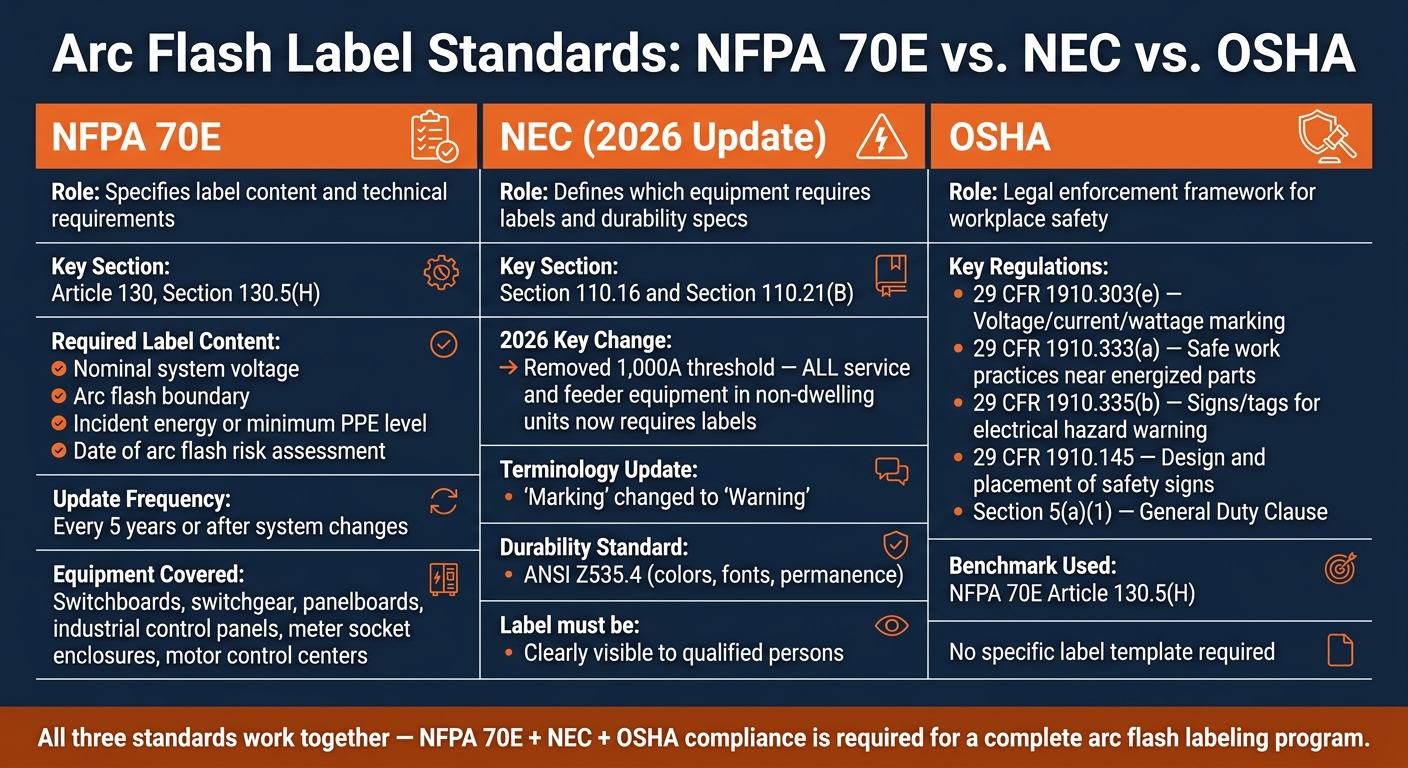
In the U.S., three key standards govern the placement and maintenance of arc flash labels: NFPA 70E, the NEC, and OSHA. Each plays a distinct role in ensuring compliance and safety. Together, they create a robust framework for labeling arc flash hazards effectively.
NFPA 70E Label Placement Guidelines
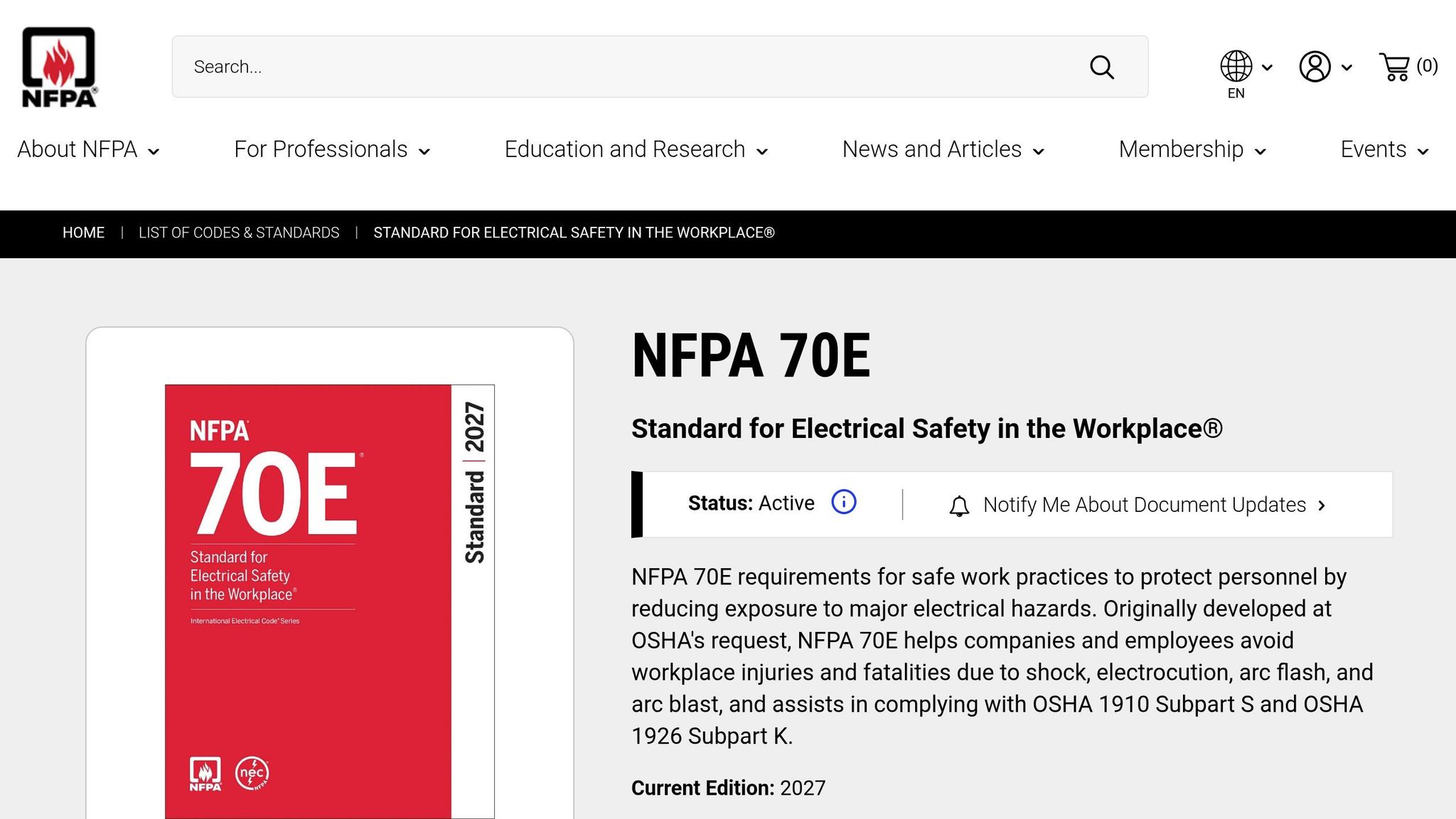
NFPA 70E Article 130, specifically Section 130.5(H), lays out the essential details that must appear on an arc flash label. These include:
- Nominal system voltage
- Arc flash boundary
- Incident energy or minimum PPE level
- Date of the arc flash risk assessment (not the label's printing or application date)
Labels must be placed on the exterior of equipment so that qualified workers can see the warning before opening the panel. This applies to various types of equipment, such as switchboards, switchgear, panelboards, industrial control panels, meter socket enclosures, and motor control centers.
Additionally, labels need to be reviewed and updated every five years or sooner if there are significant changes to the electrical system. While NFPA 70E specifies the content and placement of labels, the NEC provides additional guidance on durability and equipment coverage.
NEC Standards for Label Placement and Durability
NEC Section 110.16 is the primary code governing arc flash labeling. The 2026 NEC introduced two key updates:
- The terminology was updated from "marking" to "warning."
- Labeling requirements were expanded to include all service and feeder equipment in non-dwelling units, regardless of amperage.
"The 2026 NEC removes the 1,000A threshold, requiring all service and feeder equipment, except in dwellings, to have arc flash hazard labels." - Dean Austin, NFPA Senior Electrical Specialist
This means commercial and industrial equipment supplied by service or feeder lines must now have labels, regardless of their amperage rating. The updated NEC also aligns closely with NFPA 70E Article 130, providing contractors and inspectors with a standardized checklist.
"The marking shall... be located so as to be clearly visible to qualified persons, and be in accordance with applicable industry practice." - 2026 NEC Section 110.16
NEC Section 110.21(B) requires labels to be permanently affixed and durable enough to remain legible in their specific environment. The ANSI Z535.4 standard outlines the necessary specifications for colors, fonts, and durability to ensure labels withstand industrial conditions.
While NFPA and NEC standards address specific labeling requirements, OSHA regulations provide broader enforcement mechanisms.
OSHA Requirements for Hazard Warning Labels
OSHA approaches arc flash labeling through a combination of regulations and the General Duty Clause, rather than prescribing a specific label format. Its focus is on ensuring workplace safety by emphasizing hazard awareness.
The table below outlines key OSHA regulations relevant to arc flash labeling:
| OSHA Regulation | Focus Area | Relation to Arc Flash Labeling |
|---|---|---|
| 29 CFR 1910.303(e) | General Marking | Requires marking of voltage, current, and wattage ratings |
| 29 CFR 1910.333(a) | Work Practices | Mandates safety practices near energized parts |
| 29 CFR 1910.335(b) | Alerting Techniques | Requires signs or tags to warn of electrical hazards |
| 29 CFR 1910.145 | Sign Specifications | Establishes design and placement standards for safety signs |
| Section 5(a)(1) | General Duty Clause | Enforces safety when specific standards are absent |
While OSHA does not require a specific template for arc flash labels, it often uses NFPA 70E as a benchmark when assessing compliance.
"§1910.335(b) requires the use of safety signs, safety symbols, or accident prevention tags to warn employees about electrical hazards (e.g., electric-arc-flash hazards) which may endanger them as required by §1910.145." - Edwin G. Foulke, Jr., Assistant Secretary, OSHA
Adhering to NFPA 70E Article 130.5(H) is one of the most reliable ways to meet OSHA's broader requirements. By following these guidelines, employers can ensure their labels align with both OSHA's expectations and industry best practices.
Best Practices for Arc Flash Label Placement
General Placement Rules
To ensure arc flash hazards are communicated effectively, labels must be positioned where they’re visible before accessing equipment. Avoid placing them behind obstructions like conduit or cable trays. As the Avery Editorial Team advises:
"Place arc flash labels where they can easily be seen for inspection, adjustment, or maintenance of electrical enclosures and control systems."
Use a red "Danger" header for equipment exceeding 600V or with incident energy above 40 cal/cm². For lower levels, an orange "Warning" header is appropriate, following ANSI Z535.4 standards. This color-coding provides workers with an immediate visual indication of the hazard's severity before they dive into specifics.
Additionally, label height and orientation play a key role in ensuring visibility as workers approach the equipment.
Visibility, Height, and Orientation
Positioning labels at the right height and angle ensures they’re noticed and understood. For equipment at ground level, place labels between 4 and 6 feet high to align with a worker's natural line of sight. For elevated equipment like transformers, ensure the label is visible from the worker’s approach angle, not just from the front.
Always mount labels horizontally to avoid making workers tilt their heads or reposition themselves to read them. Misaligned labels, especially on crowded panels, can easily go unnoticed during time-sensitive tasks. Choose label sizes like 3.5″×5″, 5″×7″, or 7″×10″ to strike a balance between visibility and accessibility without obstructing equipment access.
Environmental and Material Factors
The durability of a label is just as important as its placement. NFPA 70E Article 130.5(H) mandates that labels must withstand the environmental conditions they’re exposed to. This makes material selection a compliance issue, not just a preference.
Here’s a quick breakdown of materials and their best applications:
| Label Material | Best Use Case | Key Durability Features |
|---|---|---|
| Adhesive Vinyl | General industrial equipment | High UV and water resistance; thicker material |
| UltraDuty GHS (PET) | Chemical-heavy environments | Waterproof; resists extreme temps, UV, and submersion |
| Standard Paper | Not recommended | Lacks durability for industrial arc flash safety |
Avoid heat-sensitive paper, which can degrade in warm environments. Hugh Hoagland of e-Hazard emphasizes this:
"Make the labels with a long lasting, colorfast, UV resistant ink and label so it will be legible in the setting it is exposed to."
For printing, thermal transfer printers are the top choice. These printers create durable labels by permanently bonding ink to the surface, making them resistant to heat and pressure. If using a laser printer, apply a heavy laminate to protect the label from contaminants. Adjust printer settings to "labels", "specialty", or "heavy-weight" to accommodate the material thickness.
A good benchmark? High-quality industrial vinyl labels are rated to last at least 5 years in direct sunlight, aligning perfectly with NFPA 70E’s five-year review cycle.
Arc Flash Label Placement by Equipment Type
Arc flash label placement should align with the specific characteristics of each equipment type, following established standards for safety and clarity.
Power Distribution Equipment
Placement rules depend on the type of equipment. For switchboards, labels should be positioned where un-terminated wires or cables are located, especially in areas prone to abrasion or chemical exposure. On panelboards, labels should be placed near cables, particularly where wiring curves or bundles.
For motor control centers (MCCs), labels are essential on the incoming compartment. If the MCC spans more than five sections or has a back-to-back configuration, additional labels should be added at the opposite end and on the rear side. Disconnect switches require labels near multi-conductor cables or bundled wires.
Switchgear now mandates a label on every compartment housing a draw-out device, as well as on covers for the incoming power compartment. This change aligns with the updated 2026 NEC guidelines:
"The 2026 NEC removes the 1,000A threshold, requiring all service and feeder equipment, except in dwellings, to have arc flash hazard labels."
Next, let’s examine the labeling requirements for control panels, transformers, and generators.
Control Panels, Transformers, and Generators
For industrial control panels, labels should be applied where terminated cables or wires are present, taking into account potential exposure to chemicals or abrasion. These labels must be placed on the exterior of the enclosure, ensuring they are visible before any door or cover is opened.
In multi-door control panels, each primary access point needs its own label, rather than relying on one label near the main door. The same rule applies to generators - any access cover exposing energized parts at 50V or higher must display a label.
Labeling for transformers depends on their mounting height. Ground-mounted transformers should have labels placed at eye level near the operating handle. For high-mounted transformers, labels should be positioned to be visible from the worker’s natural approach angle. If rear access is available, labels should be applied both on the front (near the operating handle) and the center of the rear access panel.
Electrical Rooms and Multi-Equipment Areas
In areas with multiple pieces of equipment, a unified labeling strategy is essential. For enclosures with varying hazard levels, the label should indicate the highest arc flash hazard present. Each door or removable cover that exposes energized parts must have its own label.
For panelboards with separate covers for the main disconnect, each piece should be labeled individually to distinguish between line-side and load-side hazards. Removable covers should also be marked to identify their specific compartments, minimizing the risk of misplacement during maintenance.
Consistency across a facility is key. As Electric Arc notes:
"It is a very good idea to put those definitions into writing so that everyone who assists or who comes along later, has something to help them understand the original intent."
Drafting a written guideline before installation - detailing the number of labels required per equipment type and their exact placement - helps ensure clarity and consistency. For equipment with selectable maintenance settings to reduce trip settings during work, dual labels should be used to indicate both the normal and reduced arc flash hazard levels.
Maintaining and Verifying Arc Flash Label Placement
Once installed, arc flash labels must stay accurate, readable, and compliant through ongoing maintenance and checks.
Periodic Reviews and Label Updates
The NFPA 70E Section 130.5(H) requires arc flash assessments to be reviewed at least every five years. However, any changes to the electrical system - like adjustments to fault currents, equipment replacements, or modifications to protective devices - demand immediate updates to the labels.
The 2026 NEC introduces additional accountability. According to Section 110.16, labels now need to include the date of the assessment, not just the application date. Dean Austin, Senior Electrical Specialist at NFPA, emphasizes this point:
"Labels must now include the date of the assessment, not just the label application date, ensuring more accurate safety information."
This change helps track when labels are nearing their five-year review deadline and ensures they match the current system's conditions. It's also worth noting that labels using outdated "Category 1–4" terminology are no longer valid. These must be replaced with labels showing either the calculated incident energy or specific PPE requirements.
Routine inspections are key to spotting physical damage or wear, making these updates part of a broader maintenance strategy.
Installation and Field Verification
Scheduled reviews should go hand-in-hand with regular field inspections to catch label wear and tear promptly. While proper installation is critical, labels can degrade over time, especially in challenging environments like cold storage, dusty factories, or rooftops. Safety teams should routinely check for labels that are smudged, faded, or damaged and replace them as needed.
For high-stress environments, laminated or industrial-grade labels are a better choice. These materials stand up to UV exposure, chemicals, abrasion, and heat far better than standard paper labels. Another useful upgrade is adding QR codes to labels, linking them to updated one-line diagrams and assessment dates.
| Maintenance Task | Frequency | Standard |
|---|---|---|
| Arc flash data accuracy review | Every 5 years (maximum) | NFPA 70E 130.5(H) |
| Label update after system change | Immediately upon change | NFPA 70E 130.5(H) |
| Employee retraining on electrical safety | Every 3 years | NFPA 70E |
| Infrared thermography inspection | Annually | NFPA 70E (2023 Update) |
| Visual label condition check | Routine field inspection | OSHA 1910.333 |
Maintaining accurate labeling also becomes crucial when equipment is moved or acquired.
Label Verification When Acquiring or Relocating Equipment
Relocated or used equipment can pose a safety risk if its arc flash label isn't updated. For example, when panels, switchboards, or transformers are moved to a new facility - or purchased secondhand from sources like Electrical Trader - their existing labels reflect the conditions of their previous installation, not the new one. Changes in factors like feeder length, upstream protection, or available fault current can significantly affect incident energy levels, making the old label data unreliable.
To stay compliant, ensure a fresh arc flash assessment is performed for any relocated or pre-owned equipment. If the label's assessment date predates the relocation or recent system changes, it must be updated. This process is critical for maintaining safety and compliance as system conditions evolve.
Conclusion
Ensuring proper arc flash label placement hinges on understanding the relevant standards, applying them correctly, and keeping information up to date. NFPA 70E, the NEC, and OSHA each play a distinct role in this process: OSHA sets the legal framework for safe work practices, the NEC outlines which equipment requires labeling and details the necessary information, and NFPA 70E provides the technical specifics, such as incident energy levels, arc flash boundaries, and PPE requirements.
The 2026 NEC introduces a significant change by eliminating the 1,000-amp threshold and requiring all labels to include the hazard assessment date. Dean Austin, NFPA Senior Electrical Specialist, explains:
"The 2026 NEC removes the 1,000A threshold, requiring all service and feeder equipment, except in dwellings, to have arc flash hazard labels."
This update emphasizes the importance of accurate and up-to-date labels. A well-maintained label provides critical information - like nominal voltage, arc flash boundary, incident energy, and required PPE - without needing additional documentation. R.W. Hurst, Editor at Electricity Forum, highlights this point:
"Arc flash studies and risk assessments provide the data, but labels are the point where safety information meets the worker."
As previously noted, regular assessments and updates remain essential for maintaining system safety.
Special care is also needed during equipment transitions. Platforms such as Electrical Trader offer a variety of electrical components, including switchboards, transformers, and panelboards. However, any newly acquired equipment must undergo a fresh arc flash assessment before being placed back into service. Moreover, installation should ensure that labels are clearly visible to qualified personnel. Equipment owners bear the responsibility of keeping labels accurate, intact, and compliant, treating labeling as an ongoing element of their safety system.
FAQs
Which equipment must have arc flash labels under the 2026 NEC?
Under the 2026 NEC, arc flash labels are mandatory for service and feeder-supplied equipment in non-dwelling units. These labels must clearly display the following details: nominal system voltage, arc flash boundary, available incident energy or PPE level, and the date of the assessment. Including this information is essential for maintaining safety and meeting the updated code requirements.
What is the difference between the label assessment date and the print date?
The assessment date on the label indicates when the arc flash hazard assessment was completed. This date is crucial because it ensures the hazard data aligns with the NFPA 70E requirement to review assessments every five years. On the other hand, the print date shows when the label was either printed or applied.
When should labels be replaced after system changes or moving equipment?
Labels need to be replaced whenever system changes or equipment relocation affect incident energy calculations or assessment details. They also need to be updated at least every five years to stay compliant and accurate. Keeping labels current is essential for maintaining safety and meeting regulatory standards.