

Solid-State Battery Buying Guide
If I were buying a solid-state battery system today, I’d treat safety proof, U.S. code paperwork, and warranty limits as more important than a low $/kWh quote. Solid-state batteries can offer higher energy density, broad temperature ranges, and long life claims, but many numbers still come from cell tests, not from full installed systems.
Before I issue a PO, I’d make sure the vendor can show:
- Usable capacity, not just nameplate capacity
- AC system efficiency, not just cell efficiency
- Cycle life at the same test conditions
- UL 1973, UL 9540, and full UL 9540A test records
- NFPA 855 and NEC-ready design documents
- U.S. service support, lead times, and data access
- Warranty limits tied to throughput, temperature, SOC, and DoD
- Proof that the system fits my site, controls, and one-line
A few numbers matter right away:
- A 4,000 kWh system at 90% DoD gives about 3,600 kWh usable before inverter and transformer losses
- Many lithium-ion BESS projects land around 85%–95% AC round-trip efficiency
- Some solid-state cells show 96%–97% efficiency, but that is often cell-level lab data
- Solid-state discharge ranges often run from –4°F to 140°F
- Used second-life packs often enter reuse around 70%–80% of original capacity
Solid-state batteries - The science, potential and challenges
sbb-itb-501186b
Quick Comparison
| What I’d Check | Solid-State Battery | Conventional Li-Ion |
|---|---|---|
| Field track record | Early market stage, less site history | More U.S. project history |
| Cycle-life claims | Often high, but test basis varies | More warranty-backed field data |
| Temperature range | Often wider on discharge | Usually narrower, with heat derating |
| Safety review | Needs close review of chemistry and fire test scope | More familiar to AHJs and engineers |
| Buying risk | Higher if data is thin | Lower if vendor record is strong |
Bottom line: I’d buy solid-state only after the vendor proves system-level performance, U.S. compliance, service coverage, and warranty terms in writing. If those records are thin, I’d slow down before signing.
Technical Specs to Review When Comparing Systems
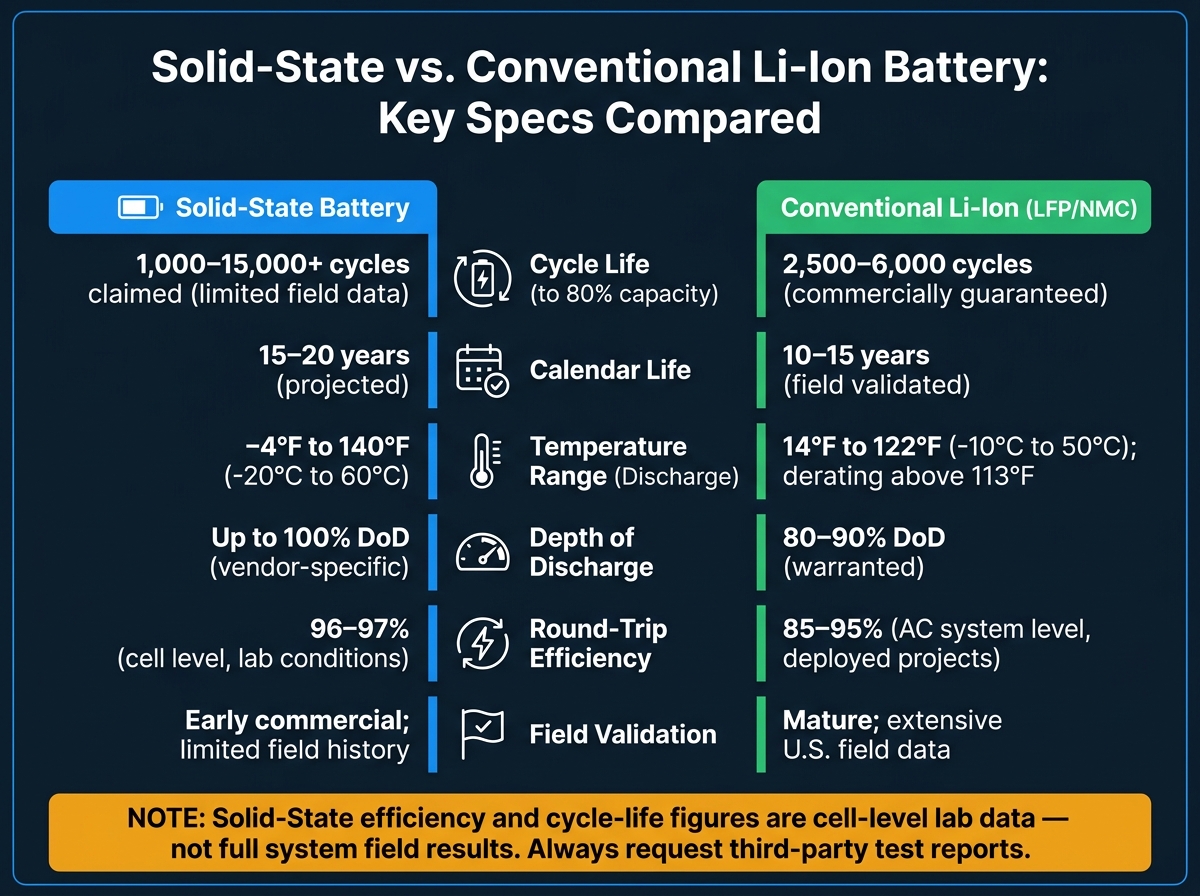
Solid-State vs. Conventional Li-Ion Battery: Key Specs Compared
Capacity, Power, Efficiency, and Service Life
Start with usable kWh, not nameplate kWh. Nameplate tells you the stated maximum. Usable capacity tells you what you can actually get after DoD limits and conversion losses. A 4,000 kWh system at 90% DoD delivers about 3,600 kWh usable before inverter and transformer losses.
For lithium-ion BESS, system-level round-trip efficiency usually lands around 85–95% at the AC level. That drop happens because the power conversion system (PCS) and auxiliary loads take their share. Some solid-state cells report 96%–97% RTE at moderate C-rates and room temperature, but that figure is cell-level, not full-system. So when you compare bids, ask for DC-to-AC system efficiency, not cell efficiency.
Cycle-life claims need the same yardstick or they don't mean much. Normalize them to cycles to 80% capacity at 80% DoD and 77°F (25°C). If a vendor uses a different benchmark, don't treat it as a clean comparison.
Once the life-cycle numbers look sound, the next step is simple: see whether the system can keep that output in your actual site conditions.
Operating Conditions, Thermal Limits, and Controls
Ask for the full environmental spec sheet: temperature range, humidity limit, altitude derating, and enclosure rating. A good-looking rating on paper doesn't help much if the unit derates where you plan to install it.
Solid-state systems often publish discharge operating ranges of –4°F to 140°F (–20°C to 60°C), with tighter charge windows, usually 32°F to 113°F (0°C to 45°C). Conventional lithium-ion stationary systems usually run in the 14°F to 122°F (–10°C to 50°C) range, with automatic derating often starting around 113°F (45°C). If your site runs hot, pin down the derating point and how much power you lose at that temperature.
Check the other site limits too:
- Humidity limits are often 5–95% non-condensing
- Altitude derating often starts above 3,300–6,600 ft
- Outdoor BESS enclosures in the U.S. usually use at least NEMA 3R or NEMA 4 for rain and dust exposure
On controls, make sure the BMS and system controller support Modbus TCP over Ethernet and CAN bus. Ask for register maps and IP addressing before design freeze. Fixing that stuff during commissioning can get expensive fast.
Comparison Table: Solid-State vs. Conventional Lithium-Ion
Use this table to separate lab claims from procurement-grade data.
| Spec | Solid-State Battery | Conventional Li-Ion (LFP/NMC) |
|---|---|---|
| Cycle life (to 80% capacity) | 1,000–15,000+ cycles claimed; most field data still limited | 2,500–6,000 cycles guaranteed in commercial LFP systems |
| Calendar life | 15–20 years projected for stationary designs | 10–15 years under typical U.S. stationary conditions |
| Temperature tolerance (discharge) | –4°F to 140°F (–20°C to 60°C) typical | 14°F to 122°F (–10°C to 50°C) typical; derating above ~113°F (45°C) |
| Depth of discharge | Up to 100% DoD in some designs; vendor-specific | Commonly 80–90% DoD for warranted performance |
| Round-trip efficiency | 96–97% at cell level (lab conditions) | 85–95% at AC system level in deployed projects |
| Field validation | Early commercial; limited field validation | Mature; extensive U.S. field data |
On paper, the efficiency and cycle-life numbers for solid-state look strong. The catch is that most of those figures come from cell-level lab tests, not multi-MWh projects with years of operating history. Before issuing a PO, ask vendors to support every claim in this table with third-party test data or field performance records from a similar installation.
Certifications, Vendor Review, and Documentation Checks
After the technical review, the next step is paperwork that proves the system can actually be sold, installed, and supported in the U.S. These documents should back up the safety and control claims you already checked in the spec review. Once the performance side looks good, move to certification, code compliance, and vendor support.
Safety Standards and Code Compliance to Verify
Solid-state battery systems sold into U.S. commercial and grid projects need to line up with several overlapping standards. Each one applies at a different layer, from the cell itself to the installed system.
| Standard | Scope | Documentation to Request | Applies To |
|---|---|---|---|
| UL 1973 | Battery safety for stationary and motive auxiliary power applications | UL listing certificate plus test summary covering electrical, mechanical, environmental, and abuse tests | Cell, module, rack/cabinet |
| UL 9540 | Product safety for complete energy storage systems | UL 9540 listing certificate for the full system configuration, including the battery, PCS, enclosure, controls, and installation conditions | System/unit level |
| UL 9540A | Test method for thermal runaway fire propagation | Full UL 9540A test report showing the test scope, chemistry, state of charge, initiation method, ventilation, and suppression conditions | Cell, module, unit, installation |
| IEC 62619 | Safety for secondary lithium cells and batteries used in industrial applications | Test reports or certification statements from accredited labs | Cell, battery level |
| IEC 62933 | Grid-level ESS performance, safety, and environmental requirements | Lab test reports or compliance statement noting applicable parts and operating limits | System level |
| NFPA 855 | U.S. installation standard for stationary ESS | Code-compliant design package, stamped engineering review, AHJ approval records | Installation level |
| NFPA 70 (NEC) | Electrical installation requirements for wiring, overcurrent protection, and grounding | Stamped electrical drawings and AHJ sign-off | System and facility level |
| UN 38.3 | Transport safety testing for lithium cells and batteries | UN 38.3 test summary and manufacturer declaration for each shipped battery format | Cell, battery level |
UL 9540A is a test method, not a product certification. A vendor can't honestly say its product is "UL 9540A certified." What it can provide is the full test report. That report should spell out the test scope, conditions, and how the results were used for NFPA 855 installation decisions. If a vendor sends over a one-page marketing sheet instead of the report itself, treat that as a red flag.
It also helps to keep one more point straight: NFPA 855 and NFPA 70 don't produce product certificates. Compliance is shown through stamped engineering drawings and AHJ approvals, not through a listing document.
Key Questions to Ask Vendors Before Buying
The point here is simple: make sure the system can be installed, serviced, and approved in the U.S.
Start with the battery chemistry. Ask the vendor to name the electrolyte type and explain how that chemistry affects flammability, gas generation, mechanical strength, and low-temperature performance. Then move to the cell format. Is it prismatic, pouch, or cylindrical? How many amp-hours does each cell carry? And how does that format shape the thermal management and mechanical protection design?
Next, dig into certification and testing. Ask which levels of UL 9540A testing were completed - cell, module, unit, or installation. Ask about the worst-case abuse scenarios and how those findings changed alarm thresholds and emergency procedures. Also ask whether UL 1973 or IEC 62619 data exists for that specific electrolyte family.
After that, shift to field use and support. How many systems are deployed in the U.S.? How many MWh have been cycled? Have any AHJs accepted this system under NFPA 855? Ask how many service technicians the vendor has in the U.S., what the usual on-site response time looks like, and whether 24/7 remote monitoring is included.
Then get into data access. Ask what data streams are available - cell voltages, temperatures, state of charge, alarms - how that data is secured, and whether the platform ties into SCADA or building management systems. Last, ask how firmware updates are tested, delivered, and documented for owners and AHJs. That part can feel boring until an inspector asks for records and nobody has them.
Vendor Comparison Table for Procurement Review
Use this table to screen vendors before contract review.
| Evaluation Criteria | What to Look For | Scoring Basis |
|---|---|---|
| Certifications | UL 1973 + UL 9540 listings; full UL 9540A reports at relevant test levels; IEC 62619/62933 coverage; NFPA 855/70 compliance package | Complete = 3, Partial = 2, Missing = 1 |
| Technology maturity | Years of field operation and cumulative MWh cycled | Mature/proven = 3, Early commercial = 2, Pre-commercial = 1 |
| Project references | Similar U.S. projects with AHJ acceptance and owner testimonials | 3+ verified references = 3, 1–2 = 2, None = 1 |
| Manufacturing traceability | Serial-number-level tracking for cells and modules; lot-based quality records tied to UL/IEC test data | Full traceability = 3, Partial = 2, None = 1 |
| Service support | U.S. technician coverage, documented SLA, 24/7 remote monitoring, SCADA or building management system integration | Strong = 3, Adequate = 2, Weak = 1 |
| Lead time | Standard and worst-case lead times for full systems and key components disclosed; supply-chain risk acknowledged | Transparent + short = 3, Transparent + long = 2, Unclear = 1 |
| Data transparency | Full test reports, field data, and disclosure | Open = 3, Partial = 2, Opaque = 1 |
Score each vendor across all seven rows, then compare totals before moving into contract talks. If a vendor scores a 1 in certifications or data transparency, stop the PO. Those gaps are much harder to fix once equipment is already on-site.
Next, compare warranty terms and lifecycle risk before deciding whether new or used equipment makes sense for the project.
Warranty Terms, Lifecycle Risk, and Used Equipment Fit
Warranty Clauses That Affect Real-World Value
A 10-year warranty can sound great on paper. But the fine print is what gives it value in practice.
The clauses that matter most are the capacity retention guarantee, the energy throughput cap, and the operating envelope. A commercial warranty may promise a capacity-retention threshold for the full term, or a set MWh throughput limit - whichever comes first. That last phrase trips people up all the time. If your site cycles the battery hard, you can hit the throughput cap long before the calendar term ends. When that happens, the warranty can end years earlier than expected.
Operating envelope exclusions matter just as much. Contracts often spell out allowed ambient temperature ranges, state-of-charge (SOC) windows, and maximum depth of discharge (DoD). If the system is pushed to 100% DoD again and again, or operated above its rated temperature range, a warranty claim can be denied. That’s why these limits can’t live only in a PDF or binder. They need to be built into SCADA or BMS controls so the system stays inside the allowed range by default.
Maintenance rules are another trouble spot. Miss a scheduled inspection, skip a firmware update, or ignore an alarm in the log, and the vendor may point to user negligence. Get the claims process in writing before you buy:
- Who starts the claim
- What records are needed, such as serial numbers, commissioning files, BMS logs, and temperature history
- How fast the vendor is required to respond
For a mission-critical site, response time is a big deal. A warranty with no set turnaround can leave you waiting when the battery is down and the clock is ticking.
These limits matter even more once a battery has already gone through prior cycling.
When Used Equipment Works and When It Does Not
Used solid-state equipment is uncommon. In most cases, the used-market option is second-life lithium-ion packs.
When capacity drops to about 70%–80% of original value, those packs may still work well in lighter stationary roles. Good examples include behind-the-meter load shifting, solar self-consumption buffering, and occasional peak shaving at a light commercial site. In those settings, lower capacity tends to hit project economics more than safety-critical performance.
That said, some sites should stay away from used equipment. Data centers, hospitals, emergency operation centers, and any setup with tightly defined runtime needs fall into that camp. The issue isn’t only lower capacity. It’s uncertainty. Cells and modules age unevenly, which makes runtime and power delivery less predictable, especially during an emergency load event. And there is still no widely accepted standardized method for checking second-life battery safety. For mission-critical work, that risk can be hard to defend.
Before buying used equipment, ask for hard test data and current paperwork. At a minimum, you want:
- Capacity and internal-resistance test results
- Prior-duty-cycle records
- Current certification status
UL 1974 covers repurposing, but that alone is not enough. The system also needs a current listing for the stationary use you plan to install. If that documentation is missing, the equipment is not ready for a permitted U.S. installation.
Once you know the risk level, check the sourcing details before moving ahead.
Risk-Benefit Table: New vs. Used Solid-State Battery Equipment
| Factor | New Equipment | Used / Second-Life Equipment |
|---|---|---|
| Upfront cost | Higher; full market price | Lower acquisition cost, but testing and certification add back expense |
| Warranty strength | Full commercial warranty with defined capacity retention, throughput limits, and remedies | Warranty coverage may be limited; verify any seller-provided terms carefully |
| Documentation quality | Complete: current certification, test reports, commissioning records | Often incomplete; prior duty-cycle data and test history may be missing or partial |
| Certification status | Current for the intended use | Must verify repurposing certification (UL 1974) plus new-application listing (UL 1973, UL 9540) separately |
| Expected remaining life | Predictable from design data; one field study found a mean expected storage life cycle of 13.1 years across sites | Highly variable; depends on prior use, SoH at acquisition, and depth of prior cycling |
| Performance uncertainty | Low; performance is more predictable from design data and commissioning records | Higher; uneven cell aging can produce unpredictable runtime and power under load |
Use these tradeoffs to decide whether new or used equipment fits, then move to the pre-purchase checklist.
Buying Checklist and Sourcing Through Electrical Trader
After the technical review and warranty check, shift to procurement for the full installed package.
Pre-Purchase Checklist for Batteries and Supporting Equipment
Before you issue a PO, verify the technical package, certification package, and balance-of-plant (BoP) equipment against the site one-line and operating profile. The quoted system should match the site's duty cycle and ambient conditions, not a seller's best-case performance numbers. Require UL 9540 for the assembled system and UL 1741/IEEE 1547.1 for the power conversion system.
The battery is only part of the job. You also need to confirm that transformer and breaker sizing has been reviewed against a short-circuit study, not just guessed from rough estimates. Check:
- kVA rating with a contingency margin
- Primary and secondary voltage levels, such as 13.8 kV to 480 V
- Impedance
- Breaker interrupting rating against available fault current
- 60 Hz frequency compliance
Also verify NFPA 855 spacing, ventilation, fire protection, signage, and early AHJ review.
Commissioning scope should be written into the contract. Don't leave it sitting in the gray area. That scope should include factory acceptance testing (FAT), site acceptance testing (SAT), SCADA/EMS integration verification, and operator training. You should also get lead times in writing for both the battery system and the supporting BoP equipment, then line those up with the construction schedule before signing.
Using Electrical Trader for Related Power Distribution Equipment
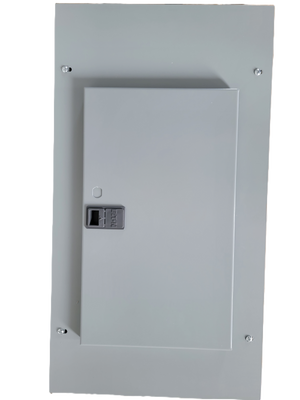
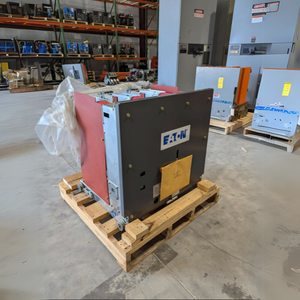
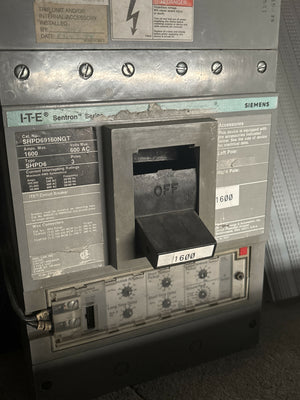
Once the battery package is approved, source the supporting electrical gear to the same one-line and protection study. Use Electrical Trader to source breakers, transformers, switchgear, and distribution panels that match the installed system's voltage class and interrupting rating. For battery storage projects, it can be a practical option for sourcing supporting BoP equipment, especially for retrofit installations or expansions where site voltage and layout limits narrow the list of compatible choices.
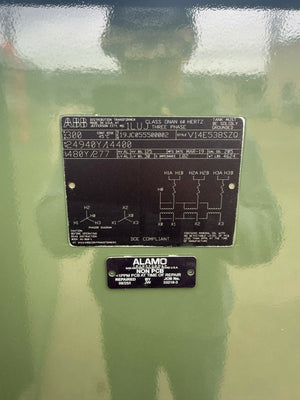
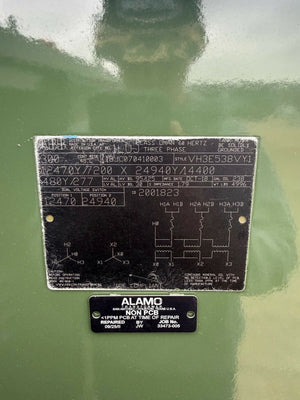
When you review any listing, whether it's new or used, cross-check the nameplate data against your project's one-line diagram and protection study. Confirm voltage rating, continuous current rating, interrupting rating in kA, kVA, enclosure type, such as NEMA 3R or 4X for outdoor installations, and that the equipment is rated for 60 Hz U.S. service. For used equipment, ask for test documentation before issuing a PO, including insulation resistance results, contact resistance, and breaker trip test records. Your electrical engineer of record should formally approve any selected components before a PO is issued.
What to Confirm Before You Buy
Use the checklist above to verify technical fit, compliance, serviceability, and lifecycle value before issuing the PO. Then release the order only after engineering review.
FAQs
How do I compare cell-level claims with system-level performance?
Compare cell-level claims with full-system losses from inverters, thermal management, and auxiliary loads. A spec sheet might show ideal cell efficiency of 83% to 92%. But once you look at a grid-connected system, round-trip efficiency often lands between 72% and 89%.
That gap matters. Cell numbers can look strong on paper, yet they don’t reflect what happens after conversion losses, cooling demand, and other support loads kick in.
Put the most weight on AC-to-AC efficiency data. It shows what the system delivers in practice, not just under ideal lab conditions. It also helps to collect commissioning data across different power levels and ambient temperatures, because performance can shift quite a bit as conditions change.
On the contract side, spell out State of Health in plain terms. If the definition is vague, field results may not match what the project expects.
Which certifications matter most before I buy?
For solid-state battery solutions, safety certifications aren't optional. They're a core part of regulatory approval and insurance review.
Start with UL 9540 for system-level safety. Then look for UL 9540A test data to check thermal runaway risk. For battery packs, UL 1973 should be on your list.
You should also confirm compliance with:
- NFPA 855
- NEC Articles 705 and 706
- IEEE 1547-2018
- UL 1741 SA, where it applies
One more thing: don't just take a spec sheet at face value. Verify every certification in the issuing organization's database.
When does used battery equipment make sense?
Used battery equipment often makes sense for less critical or backup applications, where the cost of a new system may not be worth it.
For critical operations - like hospitals or utility grids - it’s usually not the right call. In those settings, downtime can lead to major losses, so cutting corners on battery equipment can backfire fast.
If you go with used equipment, stick with well-documented, refurbished units from reputable firms. Review the service logs, repair receipts, and inspection reports to check safety and compliance.