High-Density Battery Materials: Buyer Guide
If I were buying stationary storage in the U.S. today, I’d start with LFP. It usually gives the best mix of cost, life, safety, and supply access for solar-plus-storage, microgrids, and utility-scale BESS.
Here’s the short version:
- LFP is the default pick for most projects because it often delivers 4,000–10,000+ cycles and pack pricing near $70–$100/kWh
- NMC/NCA fit tight sites better because they pack more energy into less space, but they usually cost more and wear out sooner
- Silicon-rich anodes can add roughly 10%–30% more energy density at moderate silicon loading, but life and calendar aging are still weak for long-life grid use
- Solid-state aims for 350–500 Wh/kg at the cell level, but it still comes with high cost, long lead times, and thin field history
- For most buyers, pack-level specs, warranty terms, lead time, supplier strength, and UL 9540A / NFPA 855 support matter more than headline cell numbers
If you only remember one thing, make it this: stationary storage is usually not won on cell energy density alone. It’s won on installed $/kWh, cycle life, degradation, footprint, and delivery risk.
Quick comparison
| Material | Density | Cycle Life | Cost | Best Use |
|---|---|---|---|---|
| LFP | Lower | Long | Lower | Daily-cycling BESS, microgrids, solar-plus-storage |
| NMC/NCA | Higher | Shorter | Higher | Space-limited sites |
| Silicon-rich anodes | Higher than graphite-based cells | Mixed | Premium | Pilot projects |
| Solid-state | Highest target | Early-stage range is mixed | Highest | Demo and watch-list programs |
I’d use this guide to make one fast call: pick LFP unless your site is space-limited or your project is a pilot.
LFP vs Sodium-Ion: Jeff Dahn Explains the Battery Tradeoffs
sbb-itb-501186b
1. Lithium Iron Phosphate (LFP)
LFP is the default chemistry for most stationary storage projects. The reason is pretty simple: it gives buyers a solid mix of cost, safety, and cycle life. In practice, the big buying question usually isn’t whether LFP can do the job. It’s whether the footprint and lead time work for the project.
Energy Density
LFP cells usually land in the 120–180 Wh/kg range, with volumetric energy density around 227–396 Wh/L. At the pack level, once you add enclosures, busbars, and thermal management, LFP systems usually end up around 100–140 Wh/kg.
That lower density mostly affects footprint, not project viability, for stationary storage. So the buying check is straightforward: confirm the usable kWh per container, then make sure the site can support the footprint, structural loading, and permitting needs.
Cycle Life
LFP often reaches 4,000–8,000 cycles to 80% capacity, and top-tier cells now come with 10,000+ cycle warranties. At one cycle per day, that works out to about 16–22 years to 80% capacity.
Nickel-rich chemistries like NMC and NCA usually reach 1,500–3,000 cycles under similar conditions. That gap matters. If you’re building an LCOS model, use the warranted end-of-life capacity, which is usually 70%–80%.
Cost
In 2025, average LFP pack prices were around $70/kWh, and some aggressive utility-scale deals went as low as $50/kWh at the pack level. NMC packs averaged about $128/kWh.
A good benchmark for quotes is $70–$100/kWh at pack level. Installed system pricing usually falls in the $200–$500/kWh range, depending on storage duration and project size.
Raw material pricing has also moved a lot. LFP cathode prices dropped from about $25,000/ton in early 2023 to roughly $8,000–$10,000/ton by mid-2025.
Lead Time
Buyers often see battery pack and module lead times of 3–6 months, while turnkey containerized BESS projects usually need 6–12 months once integration, shipping, and commissioning are included.
Smaller commercial systems in the 250 kWh–5 MWh range that use standard LFP cabinets can often move faster. Why? Integrators often stock them or can build repeat units without much delay. Custom builds are a different story. Schedule risk goes up when project specs get more tailored or when domestic-content rules come into play.
Most LFP manufacturing capacity sits in China, so those sourcing rules can have a direct effect on timing. For buyers managing a portfolio, framework agreements and multi-sourcing can help cut schedule risk.
Next: nickel-rich cathodes, where higher density can make sense on sites that are short on space, even with higher cost and shorter life.
2. Nickel-Rich Cathodes (NMC/NCA)
NMC and NCA make the most sense when your site is tight on space and you need more stored energy in a smaller footprint. Both use nickel-rich layered oxide cathodes. And both come with the same basic trade-off: more energy density, but shorter life, higher cost, and stricter thermal control.
So the main buying question is simple: Do the footprint savings justify the shorter life and higher system cost?
Energy Density
This is where NMC and NCA stand out.
At the cell level, NMC usually delivers 150–300 Wh/kg, with many commercial cells landing in the 200–260 Wh/kg range. High-nickel NMC 811 can reach 240–290 Wh/kg. NCA is in a similar band, often reaching 200–300+ Wh/kg at the cell level.
At the pack level, NMC systems usually come in around 140–180 Wh/kg, while NCA lands around 150–174 Wh/kg. That gap can matter a lot when you're trying to fit more MWh into a fixed number of containers or a tight substation site.
Cycle Life
This is one reason NMC and NCA are still less common in stationary storage. For many stationary projects, long life matters more than peak density.
Typical NMC cycle life is about 500–2,000+ cycles to 80% capacity, depending on the chemistry mix and operating conditions. High-nickel NMC 811 usually sits near the lower end, often around 500–1,500 cycles, especially at high states of charge or higher temperatures. NCA generally falls in the 500–1,500 cycle range too.
That said, test conditions can make a big difference. Under mild duty cycles at 0.5C, 77°F (25°C), and 80% depth of discharge, some NMC cells have shown 3,000–5,000 cycles to 80% capacity.
The catch? Lower cycle life can increase replacement risk and hurt LCOS. That's why it helps to ask for degradation curves based on your duty cycle. Headline cycle counts can look good on paper and still miss what happens in field use.
Cost
NMC pack prices average about $128–$150/kWh at the pack level, compared with $81–$95/kWh for LFP packs. At the cell level, NMC 811 can run around $69–$75/kWh.
Installed system cost is also higher, not just cell cost. You may need more thermal management and more safety controls, which adds to the total project bill.
There's also a supply-side issue. Nickel and cobalt prices can move around a lot in global markets. That can affect quote stability and stretch the time between bid and order.
Lead Time
Lead time risk usually comes down to cell allocation, production slots, raw-material swings, and shipping limits.
Before you sign a purchase order, ask vendors a few direct questions:
- Are the cells in stock, or tied to an allocated production line?
- What is the country of origin?
- Are split deliveries allowed for larger projects?
Also ask for written commitments on:
- Delivery windows
- Substitute-material policies
- Escalation steps if a commodity or logistics disruption hits
Next: silicon-rich anodes, which push density even further but bring a different set of trade-offs.
3. Silicon-Rich Anodes
Nickel-rich cathodes push density on the cathode side. Silicon-rich anodes try to push it even further on the anode side. The tradeoff is hard to ignore: silicon can swell by 280% to 300% during charging, and that swelling can cause cracking, loss of contact, and faster degradation.
For stationary buyers, the upside only matters if a smaller footprint is worth shorter life and more qualification risk.
Energy Density
Most silicon-rich designs use silicon-graphite composites, not pure silicon.
At about 15% to 25% silicon loading, buyers can expect roughly 10% to 30% higher energy density than standard graphite cells. Designs with more silicon can push density higher, but those products are usually aimed at mobility use, not stationary storage.
So the main question for stationary projects is pretty simple: does the extra density justify shorter life and tighter qualification?
Cycle Life
This is where silicon-rich anodes run into the biggest problem for stationary use.
High-silicon cells without stabilization can fall below 50% capacity retention after just 100 cycles. That's far below what grid storage usually needs. More practical silicon-graphite composites with about 5% to 15% silicon can reach around 1,500 to 3,000 cycles to 80% retention, which is much closer to graphite-based cells.
Calendar life is still a problem. DOE-linked research from PNNL found that current silicon-rich cells made by industry have calendar lifetimes of less than two years, well short of the 10-year target for stationary storage.
That puts silicon-rich anodes in a weak spot for long-life BESS, unless the project can accept earlier replacement.
Cost
Silicon-rich anode systems usually come at a premium versus standard graphite or LFP options. The extra cost comes from specialized materials, more complex composite designs, and limited scale.
Using fewer cells can reduce packaging cost a bit, but buyers should still treat these as premium systems.
Lead Time
Procurement is less predictable here than with LFP or standard NMC.
Silicon-rich anode production is concentrated among a small group of specialized suppliers, and factory capacity is still a known constraint. For low-silicon composite cells from major OEMs, lead times may be close to standard lithium-ion. For higher-silicon or next-generation designs, expect longer timelines, tighter allocation, and more extensive qualification work.
For buyers, that means more schedule risk than LFP or mainstream NMC. Build in extra schedule contingency and verify supplier capacity before signing contracts.
Next: solid-state materials, which aim to push density higher again while changing the safety and manufacturing equation.
4. Solid-State Battery Materials
Solid-state is the next jump in energy density, but it’s also the least mature option in this group. Solid-state batteries (SSBs) replace the liquid electrolyte with a solid one. That opens the door to lithium-metal or anode-free designs, which can push energy density above liquid-electrolyte lithium-ion cells. It also removes the flammable liquid electrolyte, giving stationary installations a meaningful safety edge.
For stationary storage, though, higher density is only part of the story. The bigger issue is whether that density gain makes up for higher cost, longer lead times, and the risk that comes with a less proven product.
Energy Density
Solid-state batteries target cell-level gravimetric energy densities of about 350–500 Wh/kg, and some lab or highly tuned designs aim for 600–800 Wh/kg. On a space-constrained BESS site, that can translate into more MWh in the same footprint, or the same capacity with fewer racks and containers.
That said, cell-level numbers don’t tell the whole story. Once you add containment, cooling, and safety layers, the gain gets smaller. So buyers should ask for pack-level Wh/kg and Wh/L, not just the top-line cell figure.
And for most buyers, the key question isn’t only density. It’s whether the system can be sourced, qualified, and insured on the project schedule.
Cycle Life
Solid-state cells are often pitched as longer-life batteries because they can cut dendrite growth and electrolyte breakdown. Commercial targets sit around 2,000–5,000+ cycles to 80% retention. But early prototypes have shown only 300–800 cycles.
That gap matters. Under grid duty cycles, the life edge may be a lot smaller than the marketing implies. In plain terms, lab promise and field behavior are not the same thing.
For BESS buyers, warranty terms and field degradation data matter more than headline cycle claims. In stationary storage, first-generation solid-state products may end up matching the best lithium-ion options rather than clearly beating them.
Cost
Early solid-state systems cost several times more than mainstream lithium-ion. The reasons are pretty straightforward: solid electrolytes are hard to make, manufacturing yields are lower, and supply chains are still limited.
For U.S. stationary buyers, that likely keeps solid-state in a premium niche through the late 2020s.
Lead Time
Solid-state is moving from pilot lines into early commercial deployment, but most early volume is aimed at electric vehicles, not grid storage. Pilot-scale products can come with lead times of 12–24 months or more from design freeze to delivery. Limited factory capacity and custom engineering are the main reasons.
That makes solid-state a poor fit for projects driven by tight schedules and firm delivery dates. A safer move is to treat it as a long-lead item and include fallback chemistries in the RFP.
Next: compare these materials side by side on density, lifespan, cost, and procurement risk.
Side-by-Side Comparison: Density, Lifespan, Cost, and Procurement
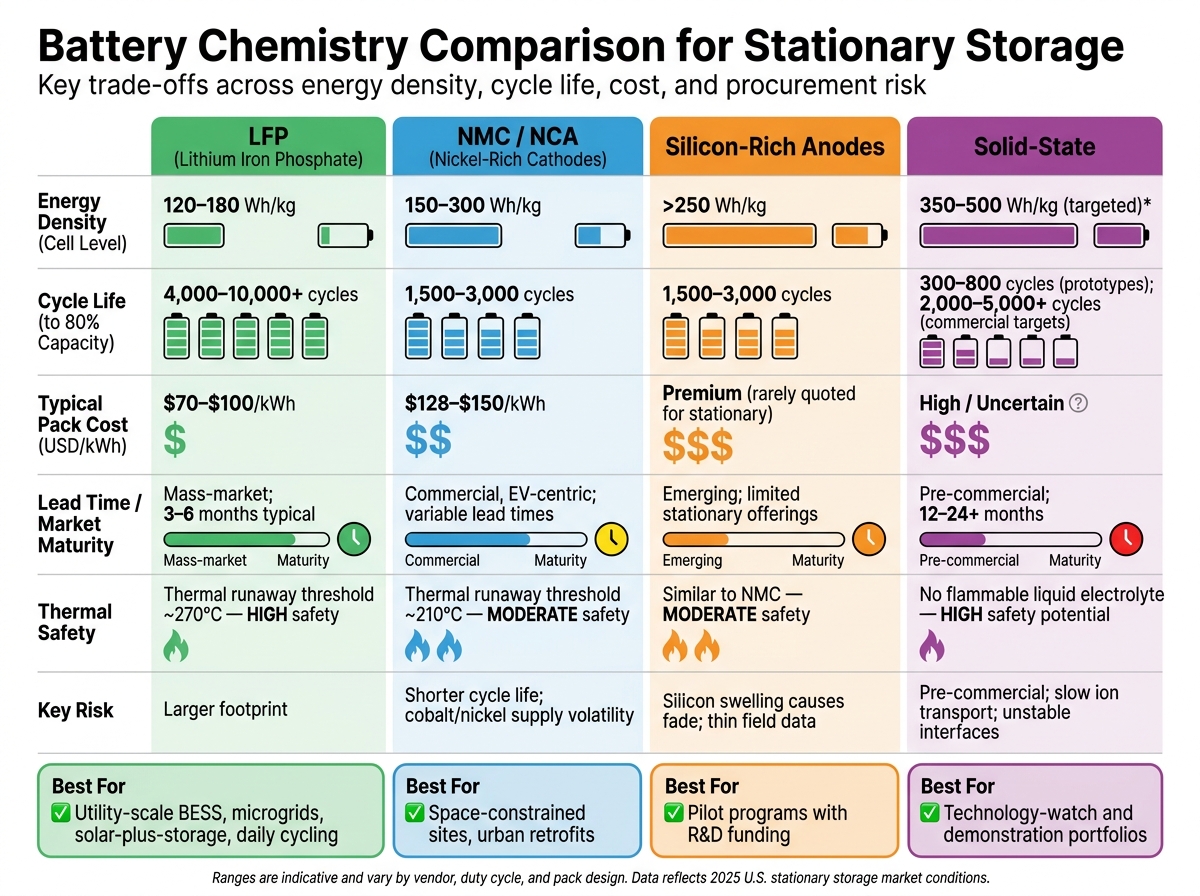
Battery Chemistry Comparison for Stationary Storage: LFP vs NMC vs Silicon vs Solid-State
After looking at each battery chemistry on its own, the table below shows the buyer trade-offs in one place.
| Material | Energy Density (Cell Level, Wh/kg) | Cycle Life (to 80% Capacity) | Typical Pack Cost (USD/kWh) | Lead Time / Maturity | Best-Fit Stationary Applications |
|---|---|---|---|---|---|
| LFP | 120–180 Wh/kg | 4,000–10,000+ cycles | $70–$100/kWh | Mass-market; 3–6 months typical for U.S. BESS orders | Utility-scale BESS, C&I peak shaving, microgrids, long-life backup |
| NMC/NCA | 150–300 Wh/kg | 1,500–3,000 cycles | $128–$150/kWh | Commercial, but EV-centric; lead times can depend on automotive demand | Space-constrained retrofits and behind-the-meter sites |
| Silicon-Rich Anode | >250 Wh/kg | 1,500–3,000 cycles | Premium; rarely quoted for stationary storage | Emerging; limited stationary offerings, custom programs | Pilot programs; not ready for long-life grid storage |
| Solid-State | 350–500 Wh/kg (targeted) | 300–800 cycles (prototypes); 2,000–5,000+ cycles (commercial targets) | Still uncertain and high | Pre-commercial; long, uncertain lead times | Demonstrations and technology-watch portfolios |
When you get into procurement, pack-level specs matter more than headline cell claims. The same goes for warranty terms and delivery risk. On paper, a chemistry can look great. In an actual project, missed ship dates or weak warranty coverage can blow up the economics fast.
Ranges are indicative and vary by vendor, duty cycle, and pack design.
For most U.S. stationary projects that cycle daily over 10 to 20 years, LFP is usually the safer bet on lifecycle cost and project risk. A big reason is thermal behavior: LFP has a thermal runaway threshold of around 270°C (518°F), compared with about 210°C (410°F) for NMC. That gap can lower fire-protection design demands and trim insurance costs in large installations.
Higher-density chemistries can still make sense, but usually only when space or weight is a hard site limit. If that’s the trade-off, buyers should plan for shorter replacement intervals and heavier thermal management.
Silicon-rich anodes and solid-state materials bring a different problem: procurement risk. Supplier capacity is still limited, lead times are less certain, and field data is thinner. For projects tied to hard delivery dates or financing deadlines, that can be a serious issue.
Pros and Cons by Battery Material
Use this table as a quick way to narrow down battery chemistries by site footprint, service life, cost, and sourcing risk.
| Material | Key Pros | Key Cons |
|---|---|---|
| LFP | Lowest cost per kWh; strong thermal stability; long cycle life; cobalt-free; widely deployed | Lower density; larger footprint |
| NMC/NCA | Higher density; smaller footprint for tight sites | Shorter life; higher thermal management burden; nickel/cobalt supply risk |
| Silicon-Rich Anodes | Higher density than graphite; fewer racks or containers per MWh | Swelling drives fade; limited stationary field data; higher tech risk |
| Solid-State | No flammable liquid electrolyte; high-density potential | Pre-commercial at grid scale; high cost; slow ion transport and unstable interfaces still limit performance; long lead times |
For procurement, this table works best as the first pass, not the final call. The last choice still comes down to three practical issues: footprint, warranty, and delivery window.
Conclusion
There’s no one-size-fits-all battery chemistry. The right pick depends on what matters most for your project: site footprint, service life, cost, or the risk that comes with newer products.
Use the matrix below to turn the chemistry comparison into a buying decision.
| Project Type | Best-Fit Material | Primary Reason |
|---|---|---|
| Space-constrained (urban yards, rooftops) | NMC/NCA | Fits tighter sites |
| Long-life daily-cycling (solar-plus-storage, microgrids) | LFP | Strong cycle life and thermal stability |
| Budget-sensitive (municipal, community storage) | LFP | Often the lowest total cost; simpler thermal management |
| Pilot-scale / innovation programs | Silicon-rich anodes, solid-state | Best for instrumented pilot projects |
For most U.S. stationary storage projects today, LFP is the practical place to start. It tends to work well when teams need long daily cycling, lower total project cost, and less complicated thermal management.
NMC/NCA can still be the right call when square footage is tight and the project can carry the added cost and complexity of thermal management and fire mitigation. If the site is small, that trade-off may be worth it.
Silicon-rich and solid-state materials make more sense in pilot programs with strong monitoring, clear fallback plans, and grant or R&D funding. They are not the best fit for projects where day-one dependability is non-negotiable.
One more point: model total installed cost, not just cell price. And line up your procurement schedule with firm in-service dates. LFP and standard NMC/NCA systems are usually available through established supply chains on more predictable timelines, while silicon-rich and solid-state products often come with longer and less certain lead times.
Even then, procurement risk can outweigh chemistry choice. Final selection should still come down to footprint, warranty, delivery window, and verified NFPA 855 and UL 9540A compliance.
FAQs
Why is LFP usually the best choice for stationary storage?
Lithium iron phosphate (LFP) is often the best pick for stationary storage because it strikes a solid balance between safety, long life, and cost.
It handles heat well and has strong fire resistance. It can also deliver about 6,000 to 10,000 cycles over 15 to 20 years, which makes it a good fit for systems that need to keep working year after year. Another plus is its flat discharge voltage, which helps provide steady power output instead of a choppy drop-off.
LFP also avoids relying on cobalt or nickel, and that matters for buyers who want a simpler battery chemistry with fewer supply chain concerns.
When do NMC or NCA make more sense than LFP?
NMC and NCA make more sense when your top priority is high energy density in a compact form. They fit best in projects where space is tight, like urban installations or existing substations with very little land to work with.
The tradeoff is pretty clear. They often cost more, come with tougher supply chain issues, and have lower thermal stability than LFP. But if you need more power in a smaller footprint, they can be a strong fit.
What should I compare besides battery energy density?
Compare total cost of ownership across the full life of the system. That means looking past the sticker price and digging into cycle life, degradation rates, and the contract terms tied to State of Health. A battery that costs less up front can end up costing more if it loses capacity faster or hits its warranty limits too soon.
It also helps to review efficiency from end to end. Check round-trip efficiency or AC-to-AC efficiency, total losses across the system, and how much usable capacity you get compared with the nameplate rating. On paper, two systems can look similar. In practice, the amount of energy you can put in and get back out may be quite different.
Safety and compliance should be part of the same review, not a separate box to tick later. If a system fits your site, your risk profile, and local code needs, it can save a lot of headaches during design, permitting, and operation.
You’ll also want to check practical items that affect deployment and uptime:
- Lead time
- Maintenance needs
- Availability targets
- Compatibility with your existing inverters, transformers, and controls
- Fit with site constraints
This is where projects often get won or lost. A battery may look good in a proposal, but if it doesn’t work cleanly with the gear you already have - or if the site has space, access, or interconnection limits - you can run into delays, extra cost, and change orders fast.