




How to Size RV Batteries for Power Upgrades
Most RV battery banks are sized wrong because people start with amp-hours instead of daily watt-hours. I’d size the bank from your daily energy use, then add inverter losses, reserve days, and the usable depth of discharge for AGM or LiFePO4.
Here’s the short version:
- I’d total every load you use in a day, including standby draws like detectors, control boards, and inverter idle power.
- I’d convert that daily use into battery capacity with: Battery Ah = (Daily Wh × days of autonomy) ÷ (battery voltage × usable DoD).
- I’d treat AC loads separately, because inverter losses often add 10%–15%.
- I’d size for how you camp:
- 1 day if you charge daily
- 1.5–2 days for mixed campground and dry camping
- 2–3 days for remote boondocking
- I’d compare batteries by usable watt-hours, not the label on the case.
- I’d also check the rest of the system: inverter surge, charger output, cable size, and fuse/breaker ratings.
A few numbers show why this matters. A normal day of RV use can land around 1,592 Wh, or about 133 Ah at 12V before reserve time. And an inverter left on at just 20W idle can burn 480 Wh per day by itself. That can drain a small bank much faster than most people expect.
AGM and LiFePO4 do not size the same way. AGM is often planned around 50% usable DoD, while LiFePO4 is often planned around 80%–100%. So the same runtime may need a much bigger AGM bank, with much more weight.
How Much RV Battery Do You Really Need? | Full Power Audit + Setup Guide for Off Grid Living
sbb-itb-501186b
Quick comparison
| What to check | AGM | LiFePO4 |
|---|---|---|
| Usable capacity | About 50% | About 80%–100% |
| Weight per 100 Ah | About 60–70 lb | About 25–30 lb |
| Cycle life | About 300–800 cycles | About 2,000–5,000+ cycles |
| Charging setup | Lead-acid profile | Lithium-ready profile |
| Bank size for same runtime | Larger | Smaller |
If I were planning an RV power upgrade, I’d use usable Wh, not guesswork, and stop sizing once the bank covers my daily load, reserve time, and peak demand without going past what my charging system can refill.
Step 1: Calculate your daily watt-hour use
Start with the load list from the introduction and total up one full day of use. Use Wh = W × hours to find daily energy, then convert that number to 12V battery capacity with Ah = Wh ÷ 12. So if you use 1,200 Wh/day, that works out to about 100 Ah.
List every load, including standby and phantom draws
Write down every powered device, not just the big obvious ones. That includes always-on, standby, and phantom loads too. Propane and CO detectors, fridge control boards, routers or Wi-Fi hotspots, stereo memory, battery monitors, and inverter idle draw are common ones people miss.
Those small loads don’t look like much at first. But they run all day, and that adds up fast. Two detectors with a combined draw of 0.2A use about 58 Wh per day. An inverter that stays on while idle can use 10–40W nonstop. At 20W, that’s 480 Wh per day before you even turn on an appliance.
Taken together, these background loads can eat up 20–30 Ah (240–360 Wh) per day and shrink a small battery bank in a hurry.
Separate DC loads from AC loads running through the inverter
Keep DC and AC loads in two separate groups. DC loads run straight from the battery. AC loads go through the inverter, which means the battery has to deliver more power than the appliance itself uses because inverter efficiency is usually 85%–93%.
The table below shows a realistic sample day for a mid-size travel trailer dry camping in the Southwest in spring. DC loads are figured straight from battery voltage. AC loads are adjusted for a 90% efficient inverter.
| Load | Type | Watts | Daily Use | AC-Side Wh | Battery Wh |
|---|---|---|---|---|---|
| LED lights (4 fixtures × 6W) | DC | 24W | 4 hrs | - | 96 Wh |
| Vent fan | DC | 24W | 3 hrs | - | 72 Wh |
| Furnace blower | DC | 60W | 3 hrs | - | 180 Wh |
| Water pump | DC | 72W | 15 min | - | 18 Wh |
| Propane fridge controls | DC | 12W | 24 hrs | - | 288 Wh |
| Phantom loads (detectors, misc.) | DC | - | - | - | 60 Wh |
| Phone charging via 12V outlets | DC | - | - | - | 20 Wh |
| Microwave | AC (inverter) | 1,000W | 10 min | 167 Wh | 186 Wh |
| Coffee maker | AC (inverter) | 900W | 15 min | 225 Wh | 250 Wh |
| TV | AC (inverter) | 60W | 3 hrs | 180 Wh | 200 Wh |
| Laptop charger | AC (inverter) | 60W | 2 hrs | 120 Wh | 133 Wh |
| Router | AC (inverter) | 10W | 8 hrs | 80 Wh | 89 Wh |
| Total | ~772 Wh | ~1,592 Wh (~133 Ah) |
Even a pretty normal mix of daily gear comes out to about 1,592 Wh, or roughly 133 Ah at 12V, and that’s before you add reserve time or battery chemistry limits.
If you’ve added heavier-use gear like a Starlink dish (~70W × 8 hrs = 560 Wh) or an induction cooktop (1,500W × 30 min = 750 Wh), put those in their own line items and apply the same inverter efficiency factor. One upgraded appliance can double your daily total without much warning.
Use that daily Wh total in Step 2 to account for inverter losses and reserve time.
Step 2: Convert watt-hours into battery bank size
Now take the daily Wh total from Step 1 and drop it into this formula:
Battery Ah = (Daily Wh × days of autonomy) ÷ (battery voltage × usable depth of discharge)
Daily Wh comes from Step 1. Days of autonomy means how long you want the system to run without charging. Voltage is your battery bank’s nominal voltage. Usable DoD is the portion of the rated capacity you plan to use.
Once you have that starting point, the big decision is reserve time. That choice has a direct effect on bank size.
Account for inverter and system losses before sizing
If Step 1 still shows appliance-side AC watts, multiply those numbers by 1.10–1.15 before you size the bank.
That small adjustment matters. Power doesn’t move through an RV system without a little friction, so if you skip losses, your battery math can come out light.
Choose reserve time based on your camping and charging conditions
Autonomy is the multiplier that scales your battery bank. For mixed campground and dry-camp use in the U.S., use 1.5–2 days. For remote off-grid boondocking, use 2–3 days. If you run a generator every day, 1 day is usually enough.
Using the 1,592 Wh/day total from Step 1, here’s what the math looks like:
| System | Voltage | DoD | Autonomy | Formula | Required Ah |
|---|---|---|---|---|---|
| 12V AGM | 12V | 0.50 | 2 days | (1,592 × 2) ÷ (12 × 0.5) | ~531 Ah |
| 24V LiFePO₄ | 24V | 24V | 0.80 | 2 days | (1,592 × 2) ÷ (24 × 0.8) |
Higher voltage and a deeper usable DoD cut the amp-hour requirement for the same daily load.
Check runtime against peak and continuous loads
After you land on a target Ah figure, convert it back into usable watt-hours to make sure it can cover your heaviest loads:
Usable Wh = total Ah × voltage × DoD.
For the 531 Ah AGM example above, the math is:
531 × 12 × 0.5 ≈ 3,186 Wh
That gives you about 3,186 Wh of usable energy, which lets you check that the bank can handle your daily use and still leave some breathing room.
Then comes the part people often miss: surge capacity.
A compressor load can be easy one second and brutal the next. A 13,500 BTU RV air conditioner may draw 1,300–1,500W while running, but startup surge can jump to 2–3× that. So it’s not enough for the inverter to handle the steady draw on paper. It also needs a surge rating that can absorb that startup spike.
Your battery bank has to do its part too. It must supply that burst of current without a voltage drop that trips low-voltage protection. If surge demand is higher than what the inverter or battery bank can deliver, you’ll need to go bigger or leave that load on shore power or a generator.
Next, compare how much of that capacity is actually usable in AGM versus LiFePO4.
Step 3: Adjust your plan for lithium vs AGM batteries
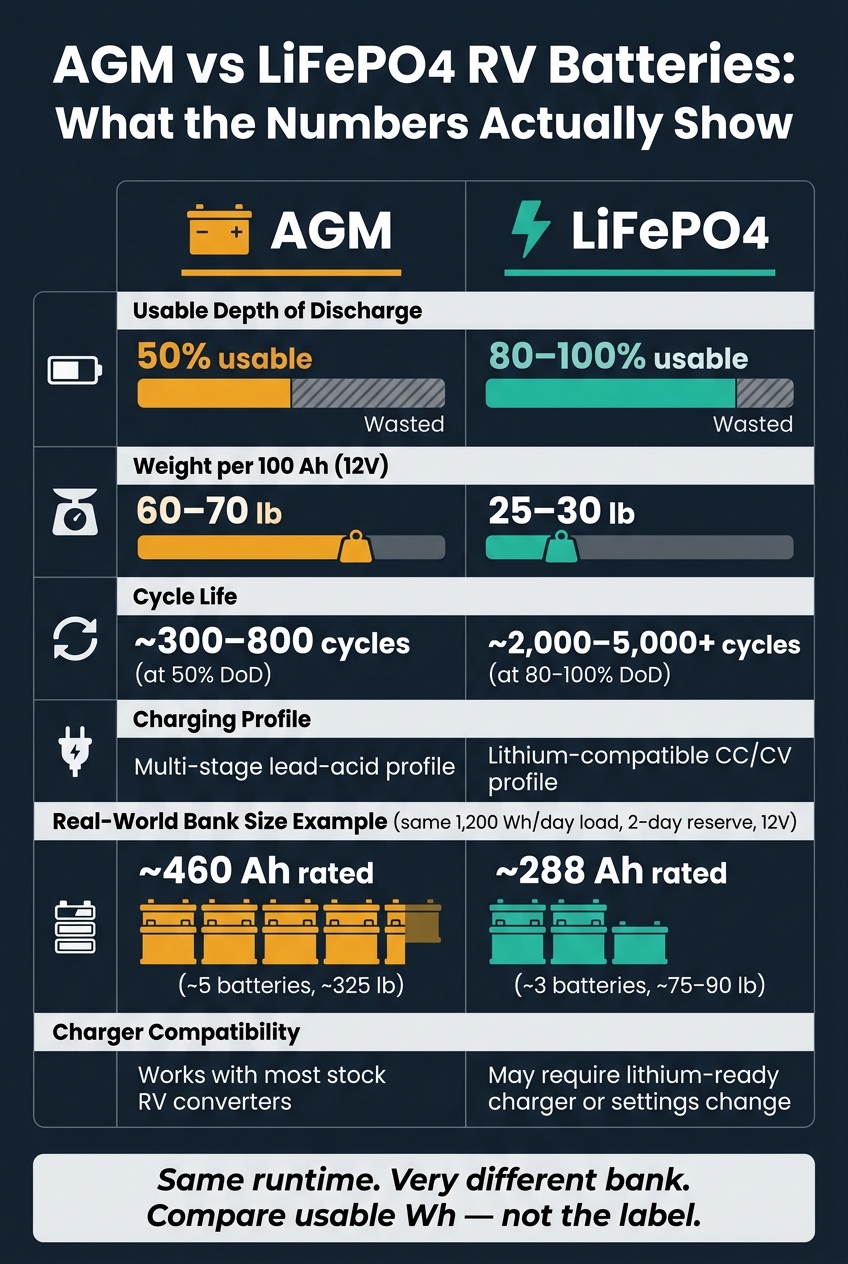
AGM vs LiFePO4 RV Batteries: Size, Weight & Cost Compared
The Ah number you got in Step 2 needs one more adjustment: battery chemistry.
An AGM battery and a LiFePO4 battery can show the same rated capacity on paper, but that does not mean they give you the same usable energy. That’s where a lot of RV battery plans go sideways.
How usable depth of discharge changes the math
AGM is often sized around 50% usable DoD. LiFePO4 is often sized around 80% to 100%.
Here’s what that looks like for a 1,200 Wh/day load with 2 days of reserve on a 12V system, with 15% losses already included. In that case, you need about 2,760 Wh from the battery bank:
- AGM at 50% DoD: 2,760 Wh ÷ 12V ÷ 0.50 ≈ 460 Ah of rated capacity. That’s about five 100 Ah AGM batteries, or roughly 325 lb total.
- LiFePO4 at 80% DoD: 2,760 Wh ÷ 12V ÷ 0.80 ≈ 288 Ah of rated capacity. That’s roughly three 100 Ah batteries at about 26 lb each, or about 75–90 lb total.
Same runtime. Very different battery bank.
With LiFePO4, you usually end up with fewer batteries, less space taken up, and about 70% to 80% less weight. In an RV, that matters fast once you start looking at axle ratings and cargo capacity.
Charging also changes with chemistry. AGM uses lead-acid charging settings. LiFePO4 needs lithium-compatible settings. So if your RV converter or solar charge controller was set up for lead-acid, a lithium swap may mean changing the voltage settings or replacing the charger.
AGM vs LiFePO4 comparison table
| Attribute | AGM | LiFePO4 |
|---|---|---|
| Usable DoD | About 50% of rated capacity | About 80% to 100% of rated capacity |
| Typical cycle life | About 300–800 cycles at 50% DoD | About 2,000–5,000+ cycles at 80% to 100% DoD |
| Weight per 100 Ah (12V) | About 60–70 lb | About 25–30 lb |
| Charging profile | Multi-stage lead-acid charging | Constant-current/constant-voltage charging |
| Charger compatibility | Usually works with lead-acid RV chargers | May need lithium-compatible charging settings |
Pick the chemistry first. Then size the charger, cabling, and protection around that battery bank.
Common sizing mistakes and the final equipment check
Mistakes that cause short runtime or unnecessary cost
When the numbers look fine on paper but the system still falls short, the problem usually comes back to a handful of sizing mistakes.
| Mistake | Symptom | Corrective Action |
|---|---|---|
| Guessing daily energy use | Runtime shorter than expected; inverter low-voltage alarms trigger early | Do a full load audit: list every device, its wattage, and daily run time |
| Ignoring inverter standby draw | Batteries drain overnight with minimal AC use | Add inverter idle draw to your daily Wh total; turn the inverter off when not needed |
| Sizing from nameplate Ah instead of usable capacity | AGM banks hit low-voltage cutoff before expected | Compare usable Wh, not rated Ah |
| Too little reserve time | No buffer for cloudy weather or generator-free days | Short reserve leaves no margin for cloudy weather or generator-free days |
| Bank bigger than the charging system can recharge | Batteries rarely reach 100% SOC; lead-acid banks develop chronic partial-charge issues | Upgrade solar, converter output, or DC-to-DC charging to match bank size |
A lot of people get tripped up by the same thing: they size from labels instead of how the system works in daily use. A battery bank may look big in Ah, but if the usable energy is lower than expected, runtime drops fast. The same goes for standby draw. An inverter that sits on all night can quietly chip away at the bank, even when almost nothing is plugged in.
Reserve time is another one. On a sunny day, a thin buffer may seem fine. Then a cloudy stretch hits, or you skip generator charging for a day, and suddenly the bank feels too small. On the flip side, going too big creates its own mess if the charging sources can't refill the bank.
Match batteries with chargers, breakers, cabling, and power equipment
Once you size the battery bank, the rest of the system has to keep up with the current that comes with it.
A 2,000 W inverter on 12V can draw about 167 A at full load, which usually means 2/0 AWG cable and about a 200 A fuse on the DC side if you want to keep voltage drop under about 3%. If the wire is too small, performance drops and the cable can get hot. Put the main fuse or breaker within 7–12 inches of the positive battery terminal to protect the section of cable with the highest risk if something goes wrong.
Overcurrent protection and disconnects also need the right DC voltage rating for the system's nominal voltage, whether that's 12V, 24V, or 48V. They also need enough capacity for the full continuous current, plus some headroom. Under NEC-based guidance, conductors and overcurrent devices that feed inverters should be rated for at least 125% of maximum continuous inverter current.
Charging gear matters just as much. A charger or solar controller has to match the battery chemistry. LiFePO4 needs a lithium-ready charging profile, while AGM needs a lead-acid profile. If those settings don't line up, the bank may never charge the way it should.
Conclusion: Use the formula, compare usable capacity, avoid oversizing
Use usable Wh, match recharge capacity, and stop when the bank meets your real load.
FAQs
How do I estimate my RV’s daily watt-hour use?
List each device you want to power, write down its wattage, and estimate how many hours it runs over a 24-hour day. If the label only shows volts and amps, you can figure out the wattage with this formula: watts = volts × amps.
Next, multiply the watts for each device by the number of hours it runs per day. That gives you watt-hours. Add those watt-hour totals together to find your daily energy use.
Some appliances don’t run at a steady rate. Fridges, freezers, and similar items switch on and off throughout the day, so a plug-in meter will give you a better estimate. It also helps to factor in seasonal shifts, since energy use can change during hotter or colder parts of the year.
Should I choose AGM or LiFePO4 for my RV battery upgrade?
LiFePO4 is usually the better pick for an RV battery upgrade.
It tends to last much longer than AGM and gives you more usable capacity. Why? Because you can usually discharge LiFePO4 to 80%–100%, while AGM is usually best kept to around 50%.
AGM does have one edge: it can handle high-surge loads better.
Still, LiFePO4 is often the smarter long-term choice because it’s more efficient, more compact, and tends to cost less over time.
How much reserve time should my RV battery bank have?
For most RV setups, 2 to 3 days of autonomy is the usual target. That means your batteries can keep your systems running for that long without solar input or shore power.
If you camp a lot in cloudy weather or places with weak sun, 5 to 7 days may make more sense. It gives you more breathing room when conditions don’t go your way.
To figure out the right battery size, multiply your daily energy use by the number of reserve days you want. Then adjust for depth of discharge and inverter efficiency. It’s also smart to add a 20% safety buffer to help cover battery aging over time.





