Lead-Acid vs. Lithium-Ion for Solar Battery Banks
When choosing a solar battery, the decision often comes down to lead-acid or lithium-ion options. Here's the key takeaway: Lithium-ion batteries outperform lead-acid batteries in efficiency, lifespan, and overall cost-effectiveness, but they come at a higher upfront price. Meanwhile, lead-acid batteries are cheaper initially, making them a better choice for low-use or budget-constrained setups.
Key Differences:
- Efficiency: Lithium-ion is 92–98%, while lead-acid is 80–85%.
- Usable Capacity: Lithium-ion supports 80–100% depth of discharge (DoD), compared to lead-acid’s 30–50%.
- Lifespan: Lithium-ion lasts 8–15 years (3,000–10,000 cycles), while lead-acid lasts 2–4 years (400–1,200 cycles).
- Weight: Lithium-ion is lighter (22–33 lbs/kWh) than lead-acid (45–65 lbs/kWh).
- Cost: Lead-acid costs $100–$200/kWh upfront; lithium-ion costs $300–$500/kWh but is cheaper over time.
Quick Comparison:
| Feature | Lead-Acid | Lithium-Ion |
|---|---|---|
| Efficiency | 80–85% | 92–98% |
| Depth of Discharge | 30–50% | 80–100% |
| Lifespan | 2–4 years | 8–15 years |
| Weight | 45–65 lbs/kWh | 22–33 lbs/kWh |
| Upfront Cost | $100–$200/kWh | $300–$500/kWh |
| Maintenance | Regular upkeep | Minimal |
Summary:
If you need a long-lasting, low-maintenance solution for daily use, lithium-ion batteries are worth the investment. For occasional or backup use, lead-acid batteries may suffice at a lower cost. Choose based on your energy needs, budget, and system setup.
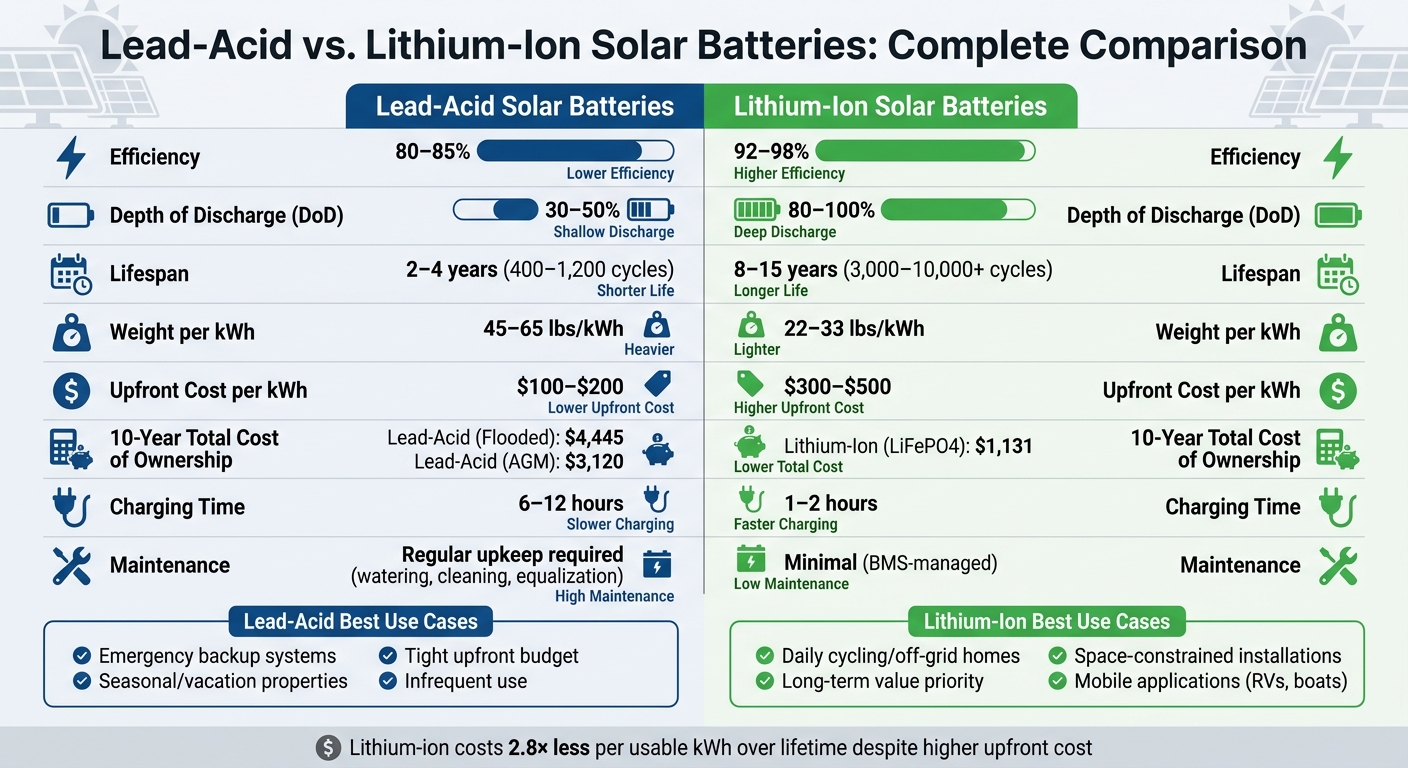
Lead-Acid vs Lithium-Ion Solar Battery Comparison: Efficiency, Lifespan, and Cost Analysis
Solar Batteries: Lithium LiFePO4 vs. Lead Acid? Which is best?
sbb-itb-501186b
Technical Specifications Comparison
When looking at lead-acid versus lithium-ion batteries for solar storage, the differences are striking. These variations affect how much energy you can use, how long the batteries last, and how much space they take up. Understanding these factors helps clarify each battery's role in a solar energy setup.
Efficiency and Depth of Discharge
Round-trip efficiency measures how much energy is lost during charging and discharging. Lead-acid batteries typically operate at 80–85% efficiency, meaning 15–20% of energy is lost as heat. In comparison, lithium-ion batteries achieve a much higher efficiency of 92–98%. This means more energy is available for use in solar applications.
Depth of discharge (DoD) refers to the percentage of a battery's capacity that can be safely used without reducing its lifespan. Lead-acid batteries are generally limited to 30–50% DoD, while lithium-ion batteries can handle 70–90% DoD, with some models, like the Tesla Powerwall 2, rated for 100%. For example, a 4.8 kWh lead-acid battery bank might provide just 1.9–2.4 kWh of usable energy, while a lithium-ion bank of the same size could deliver 3.4–4.8 kWh.
Lithium-ion batteries also charge faster due to their ability to handle higher charging currents. Lead-acid batteries slow down significantly after reaching about 85% capacity, entering a long "absorption" phase that can waste valuable solar energy. Here’s a real-world example: in October 2025, a campervan owner replaced a 12V 110Ah AGM battery with a 12V 100Ah LFP battery. Despite the lower capacity on paper, the LFP battery charged faster with a 200W solar array and eliminated morning voltage drops. Over a six-month trip, this change saved an estimated $110–$275 in campsite hookup fees.
Cycle Life and Lifespan
Cycle life and overall lifespan are critical for long-term performance.
Cycle life refers to how many charge-discharge cycles a battery can handle before its capacity drops significantly. Lead-acid batteries typically last for 400–1,200 cycles, whereas lithium-ion batteries (especially LiFePO4 types) can deliver 3,000–10,000+ cycles. For daily use, this means lead-acid batteries generally last 2–4 years, while lithium-ion batteries can last 8–15 years.
For instance, in October 2025, a remote cabin owner compared two battery banks, each with a 4.8 kWh capacity. The lead-acid system, limited to 40% DoD, provided only 1.9 kWh of usable energy and required generator use 5–6 nights per week. After switching to an LFP bank with an 80% DoD, usable energy increased to 3.8 kWh, cutting generator use to just 1–2 nights weekly. Over a 20-week winter, this saved about $380 in fuel costs.
"If panels are the engine, the battery is the fuel tank. Choose poorly and you overspend or run short on usable energy."
- Thomas Gauci, Commissioning Engineer at Beyond the Urban
Energy Density and Weight
Energy density and weight are crucial considerations, especially in setups with limited space or mobile applications.
Energy density indicates how much energy a battery can store relative to its weight. Lead-acid batteries typically store 14–18 Wh per pound, while lithium-ion batteries offer a much higher 68–91 Wh per pound.
Weight also matters, particularly for mobile systems like RVs or boats, or in installations with limited floor support. Lead-acid batteries weigh about 45–65 lbs per kWh, whereas lithium-ion batteries weigh only 22–33 lbs per kWh. This lighter weight and smaller footprint make lithium-ion batteries a better choice for space-constrained or weight-sensitive applications. Additionally, lead-acid batteries are more prone to damage from vibrations, which can loosen components or crack casings. Lithium-ion batteries, with their sealed and sturdy design, are far less affected by these issues.
| Specification | Lead-Acid | Lithium-Ion |
|---|---|---|
| Round-Trip Efficiency | 80–85% | 92–98% |
| Depth of Discharge | 30–50% | 70–90%+ |
| Cycle Life | 400–1,200 cycles | 3,000–10,000+ cycles |
| Lifespan | 2–4 years | 8–15 years |
| Energy Density | ~14–18 Wh/lb | ~68–91 Wh/lb |
| Weight per kWh | ~45–65 lbs | ~22–33 lbs |
These specifications highlight the key differences between the two battery types, offering a solid foundation for evaluating their long-term costs and suitability for solar energy systems.
Cost Analysis
When evaluating battery options, upfront costs only tell part of the story. To understand the full picture, you need to consider replacement cycles, efficiency losses, and maintenance expenses.
Initial Purchase Costs
Lead-acid batteries are priced at $100–$200 per kWh, while lithium-ion batteries come in at $300–$500 per kWh. This means lithium-ion batteries generally cost two to three times more initially. Installed costs further widen the gap: lead-acid systems range from $500 to $1,000+ for installation, whereas lithium-ion setups can cost between $5,000 and $15,000.
However, lead-acid batteries require additional capacity to deliver the same usable energy as lithium-ion. With a depth of discharge (DoD) of only 30–50%, a 100 kWh lead-acid bank is necessary to provide 50 kWh of usable energy, while a lithium-ion system only needs 50 kWh. For instance, a January 2026 analysis of a small home with a 14 kWh daily load found that a flooded lead-acid bank cost $5,278.80 upfront, compared to $13,450 for a LiFePO4 system. Though the lithium system had a higher initial price, the lead-acid batteries needed replacement every three years over a 27-year span.
Now let’s take a closer look at how these costs stack up over the battery's lifecycle.
Total Cost of Ownership
When you account for lifetime costs, lithium-ion batteries come out ahead. Their total cost per usable kWh is estimated to be 2.8 times lower than lead-acid systems. A May 2025 study by Enexer Technologies compared a DL-12100 LiFePO4 battery with industry-standard lead-acid batteries over 10 years. The lithium battery cost $800 upfront, while a flooded lead-acid battery cost $250. However, the lithium battery required no replacements over its 4,000-cycle lifespan, whereas the lead-acid battery needed 11 replacements and $500 in maintenance labor. The total 10-year cost? $1,131 for lithium versus $4,445 for flooded lead-acid.
"When you look at lifetime cost per usable kWh instead of sticker price, quality lithium banks usually beat lead-acid by a wide margin in off-grid and other high-cycle systems."
- Dax Mercer, Lead Technical Expert, Vipboss
Lithium-ion batteries also operate at over 95% efficiency, compared to 70–85% for lead-acid. In high-cycle applications like solar storage, lithium-ion systems typically break even within 3–5 years.
| Cost Component | LiFePO4 (Lithium) | AGM (Lead-Acid) | Flooded (Lead-Acid) |
|---|---|---|---|
| Initial Purchase | $800 | $350 | $250 |
| Replacements Required | 0 | 6 | 11 |
| Battery Replacement Cost | $0 | $2,100 | $2,750 |
| Maintenance Labor | $0 | $0 | $500 |
| Charging Cost (10 years) | $281 | $314 | $334 |
| Total Cost of Ownership | $1,131 | $3,120 | $4,445 |
This breakdown demonstrates why lithium-ion batteries, despite their higher upfront costs, are a smart long-term investment. With fewer replacements and minimal maintenance, they’re an excellent choice for solar and other high-use scenarios.
Performance in Solar Applications
When it comes to solar battery banks, their real-world performance - like how quickly they charge, how well they handle temperature changes, and how much maintenance they need - can make or break their ability to meet daily energy needs.
Charge and Discharge Rates
Lithium-ion batteries charge 3 to 5 times faster than lead-acid batteries. While lithium batteries can hit full capacity in just 1–2 hours, lead-acid batteries often take 2 to 4 hours or longer. This speed advantage comes from lithium's ability to handle higher amperage from solar charge controllers without overheating. However, on cloudy days, lithium batteries may experience longer charging times due to their slower absorption phase.
"Lithium charges quickly and does not require long absorption tails. You finish earlier on short winter days and reduce generator time."
- Thomas Gauci, Beyond the Urban
Switching to lithium can save both time and money. For instance, one user upgraded from a 4.8 kWh AGM lead-acid system to a 4.8 kWh Lithium LFP bank. The change allowed the batteries to fully recharge by early afternoon, cutting generator use from five–six evenings per week to just one or two. Over a 20-week winter, this saved about $345 in fuel costs.
When it comes to discharging, lithium-ion batteries deliver consistent power throughout the cycle. Lead-acid batteries, on the other hand, start strong but lose output as their capacity drops. A campervan owner saw this firsthand after replacing a 12V 110Ah AGM battery with a 12V 100Ah Lithium LFP battery. The AGM battery struggled with voltage sags in the mornings, while the LFP battery maintained stable voltage even under heavy loads and recovered faster with a 200W solar array.
Temperature also plays a big role in how these batteries perform, especially in challenging climates.
Temperature Tolerance
Lithium-ion batteries maintain 95–98% of their capacity at 32°F (0°C), while lead-acid batteries drop to just 70–80% under the same conditions. In extreme cold, lead-acid batteries can lose as much as 50% of their usable capacity. For example, at –22°F (–30°C), their performance plummets, and a discharged lead-acid battery can even freeze at –7°F, which could cause permanent damage. Fully charged lead-acid batteries fare better, freezing only at –80°F.
Lithium batteries, however, face their own cold-weather challenges. They can't safely charge below freezing unless they have built-in heaters or low-temperature charge protection. On the bright side, lithium batteries naturally warm up during discharge, which improves their performance by reducing internal resistance. For cold climates, choosing lithium batteries with self-heating features can help keep solar systems running smoothly during the winter.
Maintenance Requirements
When it comes to maintenance, lithium-ion batteries are virtually hassle-free compared to lead-acid systems. Flooded lead-acid batteries require regular attention, such as adding distilled water every 1 to 3 months to maintain electrolyte levels. They also need periodic "equalization" charges to prevent sulfation and must be installed in ventilated spaces to safely release hydrogen gas.
Sealed lead-acid batteries (AGM and Gel) eliminate the need for watering but still require precise voltage regulation to avoid damage. Lithium-ion batteries, on the other hand, need no watering, venting, or equalization. Their built-in Battery Management System (BMS) handles cell balancing and protection. The only recommendation for lithium batteries is to charge them to 100% at least once a month so the BMS can rebalance the cells.
| Feature | Flooded Lead-Acid | Sealed Lead-Acid (AGM/Gel) | Lithium (LiFePO4) |
|---|---|---|---|
| Maintenance | High (watering, cleaning) | Low (cleaning only) | Minimal (BMS-managed) |
| Ventilation | Required | Not required | Not required |
| Charge Rate | Slow (C/5 typical) | Moderate | Fast (1–2 hours) |
| Cold Weather Charging | Charges below freezing | Charges below freezing | Requires heaters |
| Efficiency | 80–85% | 80–85% | 95%+ |
For solar systems used daily, lithium-ion batteries offer a clear advantage. Their fast charge times mean they can reach full capacity even during short winter days, reducing the need for generator use. Lead-acid systems, however, often require larger solar arrays and carefully sized charge controllers to manage their slower charging rates and prevent overheating.
Pros and Cons Comparison
When it comes to solar installations, choosing the right battery technology is a balancing act between upfront costs, performance, and long-term reliability. Both lead-acid and lithium-ion batteries have their own strengths, making each better suited for specific applications depending on priorities.
Lead-acid batteries are known for their affordability and reliability as an established technology. Upfront costs range between $100–$200 per kWh, significantly lower than the $300–$500 per kWh price tag of lithium-ion batteries. Another advantage is their ability to charge even in freezing temperatures without needing special heaters. Sealed models, such as AGM or Gel batteries, reduce maintenance needs compared to their flooded counterparts.
However, lead-acid batteries come with notable trade-offs. They have a limited usable capacity, are bulky and heavy, and require consistent upkeep. For example, flooded lead-acid batteries demand regular watering, cleaning of corrosion-prone terminals, and occasional equalization charges. Their charging speed is also slow, taking 6–12 hours, with an efficiency of just 80–85%.
On the other hand, lithium-ion batteries, particularly LiFePO4 models, stand out for their superior performance. They boast a lifespan of 10–15 years and can handle 3,000–6,000+ cycles, far outlasting lead-acid batteries, which typically last 3–12 years with only 500–1,200 cycles. Lithium-ion batteries also offer a high depth of discharge (80–100%), meaning a 100 Ah lithium-ion battery can deliver as much usable energy as a 200 Ah lead-acid battery. Additional benefits include minimal maintenance, faster charging times (just 1–2 hours), and efficiencies exceeding 95%.
The main drawback of lithium-ion batteries is their higher upfront cost. They also need built-in heaters or low-temperature protection to safely charge in freezing conditions and are sensitive to extreme heat. However, their performance can lead to significant savings in other areas. For instance, one cabin owner reduced generator usage from 5–6 evenings per week to 1–2, saving approximately $380 in fuel costs over a 20-week winter period.
Here’s a quick comparison of the two battery types:
| Battery Type | Key Advantages | Key Disadvantages |
|---|---|---|
| Lead-Acid | Affordable upfront cost ($100–$200/kWh); proven technology; charges in freezing temperatures; highly recyclable (99%) | Short lifespan (3–12 years); limited usable capacity; heavy; slow charging; requires regular maintenance |
| Lithium-Ion (LFP) | Long lifespan (10–15 years); 80–100% usable capacity; over 95% efficiency; fast charging; lightweight; minimal maintenance | Expensive upfront cost ($300–$500/kWh); requires low-temperature protection; heat-sensitive |
Both options have their place in solar energy systems, depending on the specific needs and budget of the user.
Sourcing Batteries via Electrical Trader
Finding the right battery is a critical step after assessing performance and overall costs. Once you've done the math, the next move is choosing a reliable supplier.
Electrical Trader’s marketplace is a great place to start. They offer a wide selection of both new and pre-owned solar-compatible batteries, along with various electrical components and power distribution equipment. Whether you're setting up a residential solar system or powering an off-grid cabin, you’ll find options like Flooded Lead-Acid (FLA) batteries, Sealed Lead-Acid (SLA) batteries (including AGM and Gel types), and Lithium Iron Phosphate (LiFePO4) batteries. These come in configurations such as 12V, 24V, 48V, and even 400 VDC.
When shopping, make sure the battery is compatible with your inverter. For example, lithium batteries require a compatible Battery Management System (BMS) and inverter, like the Generac PWRcell or Sol-Ark. On the other hand, lead-acid batteries are more versatile and work with a wider range of inverters, such as those from Outback or Schneider Electric.
If you’re considering used batteries, focus on the cycle life - the number of full charge and discharge cycles the battery has gone through - rather than just the manufacturing date. This will give you a clearer picture of the battery's remaining lifespan.
For systems that demand frequent, daily cycling (like off-grid homes), lithium batteries are a worthwhile investment, even with their higher upfront cost of $1,000–$1,500 per kWh. If your needs are less demanding, such as backup power for a vacation property, sealed lead-acid batteries are a more budget-friendly option, costing under $500 per kWh, and they don’t require ongoing maintenance.
Don’t forget about ventilation. FLA batteries release gases during operation and require ventilated enclosures, which can add to installation costs. Lithium and SLA batteries don’t have this requirement, giving you more flexibility in where you can install them.
Conclusion
Choosing the right battery depends on your system's daily energy demands and your long-term goals. If you're cycling batteries daily, living off-grid, or prioritizing long-term value, lithium-ion batteries are a strong contender. They offer better efficiency, a longer lifespan, and require little to no maintenance.
"For daily cycling, compact spaces, and fewer chores, lithium LFP is the clear winner on usable energy, charging speed, efficiency, and lifespan, even with a higher upfront price." - Thomas Gauci, Commissioning Engineer, Beyond the Urban
On the other hand, lead-acid batteries might be a practical option for specific scenarios, such as emergency backups, seasonal cabins, or when you're working with a tight upfront budget. With costs ranging from $100–$200 per kilowatt-hour compared to lithium-ion's $300–$500 per kilowatt-hour, the initial savings are appealing. However, lead-acid batteries often need replacing every 2 to 4 years, while lithium-ion systems can last well over a decade.
For primary residences or daily battery cycling, lithium-ion batteries shine with their ability to handle deeper discharges (80–100% compared to lead-acid's ~50%) and faster charging. These features make them a cost-effective choice over time. But if you're looking at infrequent use cases, lead-acid's lower upfront cost might be more practical.
Before making your final decision, ensure that your inverter and charge controller are compatible with the battery type you choose. Lithium-ion systems require a Battery Management System (BMS) and a charging profile suited to lithium chemistry, while lead-acid systems are generally more forgiving. Also, remember that flooded lead-acid batteries need proper ventilation, and lithium-ion systems require temperature protection in freezing conditions. Matching your battery choice to your specific energy needs is key to getting the best performance from your solar system.
FAQs
How big should my battery bank be for my daily kWh use?
To determine the right size for your battery bank, start by calculating your daily energy consumption in kilowatt-hours (kWh). Once you have that number, select a battery capacity that is 1.5 to 2 times your daily usage. This extra capacity helps offset inefficiencies and provides room for future growth.
Lithium-ion batteries are a popular choice because they offer higher usable capacity and better efficiency, meaning you can often get by with a smaller battery bank compared to lead-acid options. Be sure to align the type and size of your battery bank with your energy requirements to ensure dependable performance and lasting efficiency.
Will my inverter and charge controller work with LiFePO4?
Yes, your inverter and charge controller can work with LiFePO4 batteries, as long as they are compatible with lithium iron phosphate chemistry. Many solar charge controllers are programmable, allowing you to adjust their settings to meet the charging needs of LiFePO4 batteries. Likewise, hybrid inverters often support lithium batteries when configured correctly. Be sure to review the compatibility and settings of your specific models to ensure they perform efficiently with LiFePO4 batteries.
What’s the safest way to handle freezing temperatures with lithium?
To keep lithium batteries in good shape during freezing temperatures, never charge them when they're below 32°F (0°C). Charging in such conditions can lead to damage. Before using or charging the battery, make sure it's warmed up to a temperature above freezing. Taking these precautions helps maintain the battery's performance and prevents any lasting damage.