Profibus vs Modbus for MV Motor Control
If I need a short answer, it’s this: Profibus DP usually fits larger, coordinated MV motor systems, while Modbus RTU/TCP usually fits retrofits and mixed-vendor plants.
For medium-voltage motor control in the 2.4 kV to 13.8 kV range, I’d make the call based on four things:
- Setup work: Profibus needs more engineering and fieldbus know-how.
- Diagnostics: Profibus gives more consistent fault data across devices.
- Retrofit fit: Modbus is often easier to add to older gear already in service.
- Cost over time: Modbus often starts lower in upfront cost, but Profibus can cut troubleshooting time later.
If your plant mainly needs start/stop, status, alarms, and basic monitoring, Modbus is often enough. If you need deterministic cyclic control, cleaner device-to-PLC handling, and more uniform trip data, Profibus is usually the better pick.
In plain terms: Profibus asks for more work at the start. Modbus asks for more cleanup later.
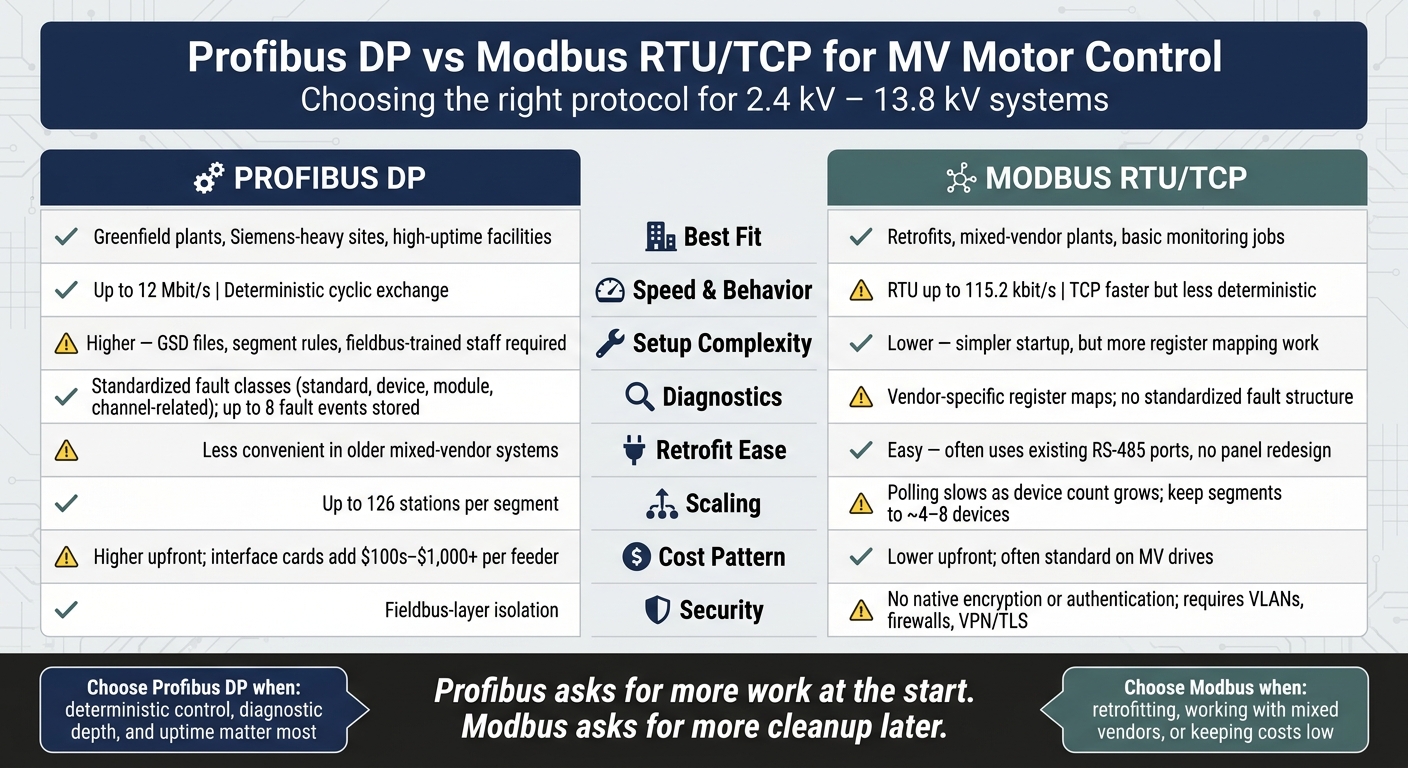
Profibus DP vs Modbus RTU/TCP for MV Motor Control
Modbus and Profibus Explained: The Hidden Language of PLC Automation
sbb-itb-501186b
Quick Comparison
| Criteria | Profibus DP | Modbus RTU/TCP |
|---|---|---|
| Best fit | Large MV drive systems, Siemens-heavy sites, plants focused on uptime | Retrofits, mixed-vendor sites, basic monitoring jobs |
| Setup | More engineering, GSD files, segment rules, fieldbus tools | Simpler startup, but more register mapping |
| Speed and behavior | Up to 12 Mbit/s with deterministic cyclic exchange | RTU up to 115.2 kbit/s; TCP is faster than RTU but less deterministic |
| Diagnostics | Standardized fault handling and device diagnostics | Fault data depends on each vendor’s register map |
| Retrofit use | Less convenient in older mixed systems | Often easier, especially with existing RS-485 ports |
| Cost pattern | Higher upfront; cards/adapters may add $100s to $1,000+ per feeder | Lower upfront in many cases |
| Scaling limits | Up to 126 stations per segment | Polling slows as device count grows |
So if I were buying for a greenfield MV project or a plant already built around Siemens/Profibus, I’d lean Profibus. If I were working on a brownfield upgrade with relays, meters, and starters from different vendors, I’d lean Modbus.
That’s the core tradeoff this article covers: more structure and fault depth with Profibus, or lower entry cost and easier retrofit work with Modbus.
Profibus for MV Motor Control
Compared with simpler fieldbus options, Profibus is the more structured choice when you need cyclic control and standardized diagnostics. Profibus DP is common in MV motor control centers and VFD lineups that rely on deterministic cyclic data exchange with a PLC or DCS. That timing keeps commands, status, and trip signals moving on schedule, which matters when a late trip or missed interlock can damage equipment or shut down production.
Setup, Network Design, and Engineering Requirements
Profibus DP uses an RS-485 physical layer on shielded twisted-pair cable. The tradeoff is tighter network design rules. The shield needs to be grounded per site standard, and each bus segment must be terminated at both ends. Cable length limits also get shorter as baud rate goes up, so long MCC lineups or runs between switchgear rooms may call for repeaters or fiber couplers.
Each device needs its own Profibus address, usually set with DIP switches or software. It also helps to leave spare address space for later additions. Before commissioning, engineers import a GSD file for each device into the PLC or DCS engineering tool so the master can read cyclic I/O data and diagnostics the right way.
This isn’t usually a “just pull cable and land wires” job. It often needs controls engineers or a system integrator, not only field wiring labor. Small mistakes in termination, addressing, or GSD setup can create faults that take time to track down. A Profibus commissioning guide lays out an eight-step process that includes visual inspection, acceptance measurements, system configuration, address verification, master/slave commissioning, I/O testing, and checklist creation.
Device Support and Diagnostic Depth
Many MV drives and soft starters offer Profibus DP as a standard or optional interface, and motor protection relays can connect through protocol adapters.
Where Profibus often earns its keep is diagnostics. PROFIdrive defines a fault buffer that records fault numbers, fault codes, optional timestamps, and fault values, and devices usually store up to eight fault events. That gives maintenance teams a repeatable way to trace recurring trips instead of guessing at what happened last shift. Standard and extended diagnostics add more detail, including trip causes such as overload and phase imbalance in motor management relays.
Because the diagnostic structure is standardized, technicians can follow a consistent troubleshooting approach across different vendors and device types.
Best-Fit Projects and Cost Factors
Those diagnostic and integration gains matter most on projects that can handle the added engineering effort. Profibus DP is a strong fit for large greenfield plants, major modernization projects, and continuous-process facilities where uptime and diagnostic consistency matter enough to justify the extra work. It also fits well when a site already uses Profibus-based automation, such as Siemens SIMATIC with SINAMICS drives. In that case, extending what’s already in place can cut down protocol sprawl and reduce training needs.
Profibus interface cards or modules for MV VFDs, soft starters, and relays are often optional. They can add several hundred dollars to more than $1,000 per feeder, depending on the device and voltage rating. Then there’s the rest of the bill: cable, connectors, repeaters, configuration, programming, HMI integration, and commissioning can push project cost up fast.
In large MV systems, that higher upfront cost can pay back through faster fault isolation and less downtime.
Modbus for MV Motor Control
If Profibus is the disciplined choice, Modbus is the flexible one. For MV motor control, Modbus tends to fit best in retrofits and mixed-vendor plants because it’s simple, low-cost, and supported by a long list of devices. It also takes less specialized commissioning and support, which matters in many U.S. plants where in-house electricians and controls techs handle the work instead of a dedicated automation group.
Setup with RTU and TCP
Modbus RTU over RS-485 is the main version used in MV starters and protection relays. RS-485 uses a two-wire, half-duplex daisy chain with termination resistors at each end. Setup is pretty direct: assign device addresses and communication settings, then configure the master to poll each slave. The catch is speed. As you add devices, polling gets slower. In practice, keeping each RS-485 segment to about 4–8 devices helps maintain faster update rates.
Modbus TCP over Ethernet swaps serial slave IDs for IP addresses and lets multiple clients connect at the same time. That means SCADA and HMI can both talk to the same device without much drama. It makes startup easier in one sense, but it pushes more of the work into register mapping and clean documentation.
Device Availability and Vendor-Specific Register Maps
The upside of Modbus is broad device support. Major MV relay families from ABB, GE, Eaton, and MiCOM support Modbus RTU or TCP. The same goes for most MV drives, soft starters, and meters. That makes it possible to gather data from a mixed lineup of new and legacy gear without needing a protocol converter for every device type.
The downside is where the data lives. Modbus does not define which register address holds which value, so each vendor makes that call on its own. The MiCOM P211 exposes phase currents, thermal state, fault records, and I/O status through its own register addresses. GE 369/469 series and Eaton EMR relays each use separate register layouts for overload level, motor start attempts, event logs, and analog outputs.
So the day-to-day issue for maintenance teams isn’t usually wiring. It’s paperwork. Engineering teams have to collect and maintain model-specific register documentation for every device on the network. That’s the real tradeoff: Modbus cuts upfront effort, but it adds more long-term documentation work.
Retrofit Strengths and Long-Term Limits
That’s a big reason Modbus still shows up so often in brownfield MV systems. Many installed motor protection relays already include RS-485 Modbus ports, so adding a new PLC or SCADA front end may take only an RS-485 converter and some register mapping work. No panel redesign. No switchgear door replacement.
But there’s a ceiling. As device counts go up, polling update rates drop. At conservative baud rates, that limit can arrive earlier than many engineers expect. Security adds another problem. Standard Modbus RTU and TCP have no encryption, authentication, or authorization, and all traffic is sent in plaintext.
For Modbus TCP devices on plant Ethernet, teams need compensating controls such as:
- Network segmentation
- Firewalls
- VPN or TLS tunnels
A practical way to scale Modbus is to use short RS-485 loops, keep Modbus TCP at the supervisory layer, and separate control traffic with VLANs. That’s where Modbus works well - and where its limits start to show.
Profibus vs Modbus: A Direct Comparison for Maintenance and Procurement Teams
For MV motor control, this choice usually comes down to four things: commissioning effort, diagnostics, retrofit fit, and lifecycle cost. On paper, Profibus and Modbus can both do the job. In practice, they create very different day-to-day workloads for maintenance and procurement teams.
Setup Effort, Speed, and Commissioning
Profibus takes more engineering up front. Modbus is easier to get running at first, but teams often pay for that later with extra documentation and register tracking.
| Aspect | Profibus DP | Modbus RTU/TCP |
|---|---|---|
| Physical layer | Dedicated fieldbus cable, termination resistors, and segment design | RS-485 two-wire serial (RTU) or Ethernet (TCP) |
| Typical speed | Up to 12 Mbit/s; cyclic and deterministic | RTU up to 115.2 kbit/s; TCP offers faster raw throughput but less determinism |
| Configuration effort | Higher; GSD file management, node addressing, and segment validation | Lower for RTU; TCP adds IP management and register documentation work |
| Commissioning workload | Needs fieldbus-trained staff and tools | Easier for in-house teams |
If you need deterministic cyclic updates, Profibus is usually the better fit. If the job is mostly start/stop commands, alarms, and basic monitoring, Modbus is often enough.
That difference matters most during commissioning. Profibus asks for more planning, more setup discipline, and staff who know fieldbus tools. Modbus tends to be easier for in-house teams to deploy, especially on retrofit jobs where the goal is to get data in and move on.
Device Integration, Fault Data, and Maintenance Impact
This is where the gap becomes more obvious for maintenance. Profibus supports structured diagnostic classes - standard, device-related, module-related, and channel-related - which gives teams a clearer view of what failed and why.
| Factor | Profibus DP | Modbus RTU/TCP |
|---|---|---|
| Standardized diagnostics | Yes; structured fault classes built into the protocol | Not standardized; depends on vendor register map |
| Cross-vendor consistency | Stronger within a Profibus-certified device ecosystem | Weaker; each vendor defines its own register addresses and fault words |
| Register dependence | Lower; diagnostic behavior is protocol-defined | Higher; teams must manage model-specific documentation |
| Troubleshooting burden | Lower when staff are trained on fieldbus tools | Increases in mixed-vendor plants with inconsistent documentation |
For a maintenance team, the big issue isn't just whether a fault shows up. It's whether the fault tells you something useful right away.
With Profibus, diagnostics are more consistent across certified devices. With Modbus, much depends on the vendor's register map, fault words, and how well that documentation has been saved, shared, and kept up to date. In a mixed-vendor plant, that can turn a simple trip into a scavenger hunt.
Retrofit Fit, Budget, and Purchasing Factors
From a procurement angle, the protocol choice affects lead time, module availability, adapter needs, and total installed cost.
| Factor | Profibus DP | Modbus RTU/TCP |
|---|---|---|
| Best project type | Greenfield or brownfield already standardized on Profibus | Retrofit, mixed-vendor, or basic monitoring upgrades |
| Upfront cost | Higher; may require optional communication cards or third-party adapters | Lower; often standard or default on MV drives |
| Expansion scalability | Strong within a Profibus ecosystem; up to 126 stations per segment | Practical limits on RS-485 segment size; polling slows as device count grows |
| Spare parts availability | Protocol-specific modules; verify lead time and adapter compatibility | Broader availability across devices and vendors |
In plain terms, Profibus often makes more sense in greenfield projects or brownfield plants that already use it as a plant standard. Modbus fits more naturally in retrofit work, mixed-vendor sites, or projects where basic monitoring is the main goal.
The PowerFlex 6000 MV drive shows this pretty clearly: Modbus RTU Slave and Modbus TCP are listed as available options, while PROFIBUS Slave requires a third-party adapter. That means protocol choice can affect both procurement lead time and total installed cost, not just the price of a communication module.
So the buying decision shouldn't rest on module cost alone. It needs to match the project type, the plant's installed base, and how much troubleshooting effort the team can absorb later.
Choosing the Right Protocol for an MV Motor Project
Protocol Recommendations by Use Case
Pick the protocol based on the job, the team’s skill set, the budget, and how much diagnostic detail you need. That lines up with the tradeoffs above: commissioning time, diagnostics, retrofit fit, and support over time.
| Use Case | Recommended Protocol | Key Reason |
|---|---|---|
| Large coordinated MV drive systems (conveyors, mills, process lines) or existing Profibus-based facilities (Siemens S7, PCS 7, TIA Portal) | Profibus DP | Deterministic cyclic control; matches existing Siemens architecture |
| Smaller relay-and-meter MV networks, budget-limited retrofits, or mixed-vendor plants | Modbus RTU or TCP | Low cost for basic control and status; fast retrofit with minimal hardware; common across mixed-vendor gear |
| Plants targeting condition-based maintenance on MV drives | Profibus DP | Structured health states support proactive maintenance |
Team knowledge matters just as much. If your crew knows Modbus but not Profibus, forcing in Profibus can make commissioning harder and leave you leaning on outside integrators for years.
For used or surplus MV gear sourced through Electrical Trader, Modbus is often the easier fit. Relays, meters, and basic controllers commonly offer it as a standard option.
Profibus DP makes more sense for large systems where diagnostics and uptime carry a lot of weight. Modbus is often the better call for retrofits, mixed-vendor plants, and simpler setups where installed cost needs to stay low. For maintenance and procurement teams, the right pick usually comes down to what the plant already knows, what devices are already in place, and how much downtime the operation can handle.
FAQs
Which protocol is better for a retrofit?
For a retrofit, the right pick comes down to your current setup and how much integration work you need to do. Modbus is often the simpler, lower-cost option for brownfield retrofits, especially if you want to keep your existing serial wiring and register maps.
A serial-to-Ethernet gateway can link legacy Modbus devices with newer systems. If the setup is more mixed and includes gear from different vendors, a multi-protocol PLC gateway can bridge Profibus and Modbus without forcing you to rip out equipment that still works.
When is Profibus worth the extra cost?
Profibus is worth the extra cost when your medium-voltage motor control setup needs deep diagnostics, fast communication, or tighter system integration than Modbus can usually deliver.
It also makes sense when maintenance teams rely on detailed fault data to cut troubleshooting time. And if a single, high-performance control platform helps reduce downtime and gives operators a clearer view of what’s happening, the added cost can pay off.
How many MV devices can Modbus handle well?
For Modbus RTU, a standard RS-485 network segment supports up to 32 devices. Each device needs its own Slave ID, with values from 1 to 247.
If you need room for more devices, gateways can link multiple serial segments to an Ethernet-based network.