Case Study: Motor Control Automation in Manufacturing
This upgrade cut fault-finding from days to hours, finished commissioning in 4 days per facility, and kept migration downtime at zero.
If you run a plant with medium-voltage motors, that’s the big takeaway. I’d sum this case up like this: the team replaced old hard-wired relay control with a PLC/SCADA setup, gave operators a clear view of start permissives and alarms, ordered long-lead gear early, and used phased startup checks to avoid delays.
Here’s the article in plain English:
- The problem: old relay logic, weak diagnostics, slow troubleshooting, and too much wiring
- Why they upgraded: lower maintenance load, less trial-and-error during faults, and a better path than repeated repair
- What changed: one PLC-based control system, SCADA access, HMI screens, dual-channel transmitters, and high-speed I/O
- What they checked at startup: protection settings, communications, motor permissives, and alarm response
- What they got: zero downtime during migration, 4-day commissioning, and better operator visibility after startup
One point stands out: better hardware alone wasn’t enough. The project worked because the team made fault status easy to see, tested the control logic before energization, and phased the cutover instead of forcing a risky one-shot change.
If you want the short answer, it’s this: clear diagnostics, phased installation, and early equipment planning were the main reasons the motor control upgrade worked.
The Plant's Starting Point and the Decision to Upgrade
Limitations of the Existing Medium-Voltage Motor Control Setup
The plant's original medium-voltage motor control system ran on proprietary relay logic and aging analog controllers. On paper, that setup worked. In practice, it made even basic permissive checks hard to follow.
When something went wrong, technicians often had to isolate pumps, breakers, and sensors one at a time just to find the source of the problem. That stretched outages longer than anyone wanted. Troubleshooting could take days. A failed transmitter or relay could trip a unit right away, and the fixed sequence logic made even routine maintenance changes hard to carry out.
Operational and Financial Reasons for Automating
The push to automate came down to two plain issues: reliability and maintenance workload. The plant needed a more flexible platform that could cut reactive troubleshooting and make maintenance more efficient.
A replace-vs.-repair analysis showed that an upgrade made more sense than continuing to patch the aging system. That finding set the scope for the control-system upgrade.
sbb-itb-501186b
Control System Upgrade and Integration Scope
New Motor Control Architecture and Protection Devices
To fix those problems, the plant moved away from hard-wired relay logic and shifted to one unified control setup. The new open PLC-based control platform gave the plant team direct access to logic and diagnostics, which made troubleshooting far less of a guessing game.
At key process points, dual-channel transmitters helped keep units online if one channel failed. Instead of forcing a needless trip, the system sent an alarm. High-speed I/O modules with onboard intelligence took care of trip signal processing and surge protection right at the I/O level.
That control layer then fed straight into the PLC, network, and operator interface.
PLC, Network, and SCADA Integration
The team also got rid of isolated control islands and brought the evaporator cooler, ammonia injection, and CEMS controls into one PLC-based environment. All three were tied into a single PLC network with SCADA access.
Custom HMI graphics made startup issues much easier to spot. Operators could see exactly which permissive was stopping a sequence, whether that meant an open breaker or a pump that wasn’t running. As a result, diagnosis time dropped from days to hours.
With the control scope set, the next step was locking in long-lead electrical gear early.
Equipment Sourcing and Replacement Planning
Long-lead equipment like transformers and capacitor banks had to be ordered early. The project team also had to work closely with the local utility on any new power line installation.
Procurement was handled as part of keeping the upgrade on schedule and within budget. For long-lead breakers, transformers, and other replacement gear, Electrical Trader can help source new and used electrical components to help control schedule and cost risk.
Installation, Commissioning, and Risk Control
Installation Sequence and Legacy Tie-In
Once procurement was done, the project shifted into installation and commissioning. The new control-room annex moved operators away from live MV equipment, which cut arc-flash exposure during motor start and stop sequences. At the same time, the team tied legacy relay logic and field devices into the new centralized platform.
Startup Testing and Fault-Response Verification
Before energization, the team ran structured checks across four areas.
- Protection settings: reviewed to make sure a single transmitter failure would trigger an alarm, not a trip
- Communications: checked by monitoring live control logic data at the engineering workstation
- Motor start permissives: walked through on the HMI graphics to confirm breaker positions, pump status, and interlocks before energization
- Fault alarms: validated so motor and process issues could be identified fast
The engineering workstation gave technicians a live view of the control logic and let them tune settings during startup. That mattered. It helped keep commissioning on track, even with a temporary fix in place that avoided a week-long delay.
With startup verified, the team moved into performance tracking.
CENTERLINE 1500 Medium Voltage Motor Control Centers Help Increase Productivity and Safety
Results, Lessons Learned, and Final Takeaways
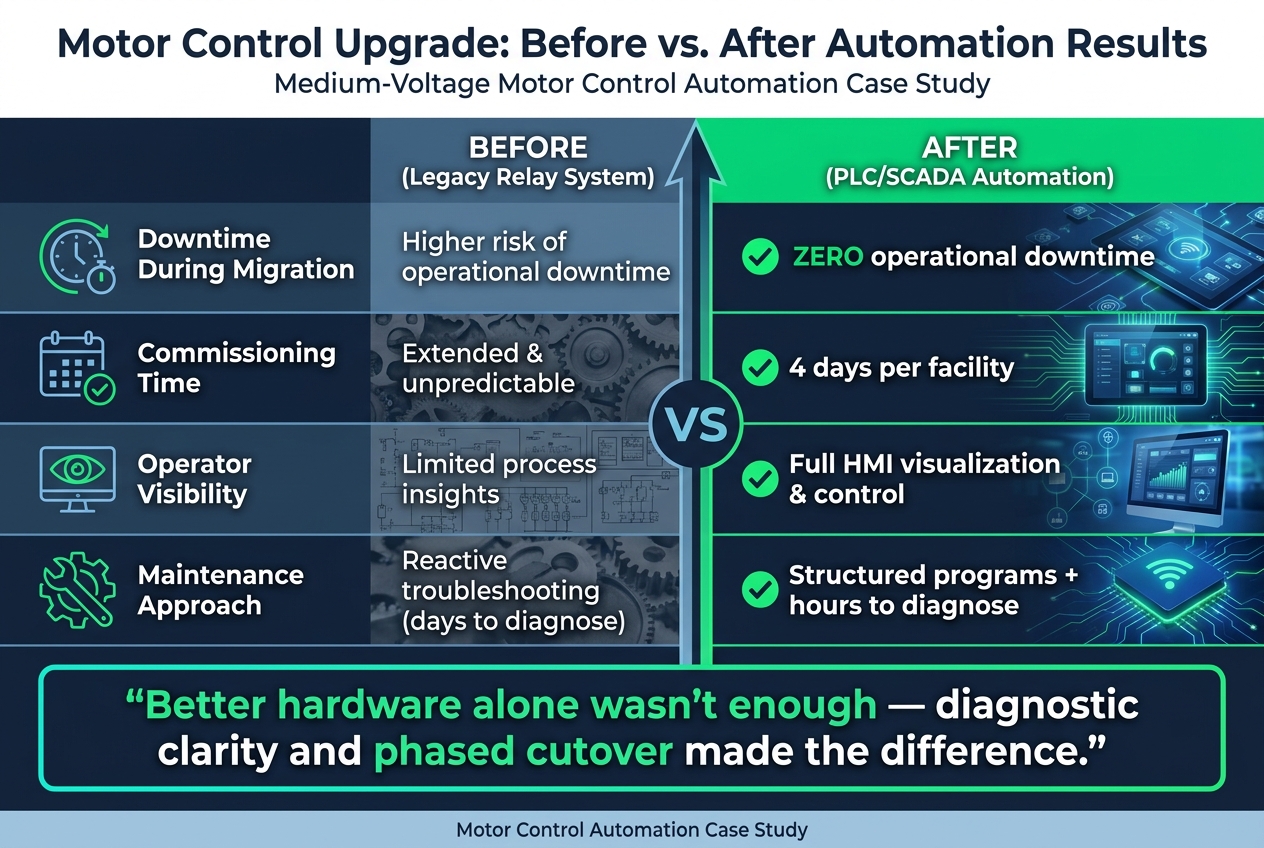
Motor Control Upgrade: Before vs. After Automation Results
Before-and-After Performance Results
The upgrade removed downtime during migration and cut commissioning to four days per facility. Those decisions paid off once commissioning was done.
| Performance Area | Before Upgrade | After Automation |
|---|---|---|
| Downtime During Migration | Higher risk of operational downtime | Zero operational downtime |
| Commissioning Time | Extended and unpredictable | 4 days per facility |
| Operator Visibility | Limited process insights | Improved visualization and control |
| Maintenance Approach | Reactive troubleshooting | Structured service programs after commissioning |
One lesson stood out: diagnostic clarity and a phased cutover mattered just as much as the hardware. Good equipment helps, of course. But if operators can't tell why a sequence stopped, even solid hardware won't save time.
Key Lessons for Future Motor Control Projects
The main lesson was simple: phase the cutover, standardize the logic, and design the HMI for fast fault isolation. That sounds basic, but it makes a huge difference on the plant floor. When operators can see the exact permissive blocking a sequence - like an open breaker or a pump that isn't running - they can act fast and keep production moving.
Pre-startup testing was just as important. That included protection settings, communications, motor permissives, and fault alarms. Doing that work up front kept commissioning on schedule and helped stop delays from turning into outages. For any plant planning a similar MV motor control upgrade, a structured service program is critical for maintaining and further improving system operation over time.
Conclusion
This project moved from legacy relay logic to an integrated PLC/SCADA control setup with better operator visibility, shorter commissioning, and zero downtime during migration. The end result was a system that was easier to run and easier to support. For plants looking at a similar move, the takeaway is pretty direct: the technology can deliver strong results, but success depends on disciplined migration planning, clear operator-focused HMI design, and support that continues after startup.
FAQs
Why did the plant replace relay logic with PLC/SCADA?
The plant moved away from relay-based controls and switched to PLC and SCADA. That change solved many of the limits that came with older control systems.
With PLC and SCADA, the team could run more advanced control logic, including better starting sequences and smarter load management. It also made remote monitoring and centralized control possible, which cut down on on-site visits and helped teams respond faster when something went wrong.
Just as important, stronger data analysis gave operators a clearer view of system performance. They could spot and isolate faults faster, which helped stop small problems from turning into costly downtime or equipment failure.
How did the upgrade avoid downtime during migration?
The facility sidestepped downtime by lining up installation work with planned production gaps. That way, crews could get in, do the work, and get out without throwing the whole operation off schedule.
It also relied on medium-voltage switchgear to shut off power only where maintenance was needed. So instead of stopping everything, the team could isolate one section while the rest of the plant kept running.
For systems that couldn’t be rebooted, virtual patching handled software updates and security protections without interrupting critical motor control operations.
What should plants test before energizing MV motors?
Before energizing medium-voltage motors, plants need to test the system from end to end. The goal is simple: make sure everything is sound, stable, and ready to run.
That work should include vulnerability assessments, patch management for control software, and diagnostic checks like partial discharge detection and arc monitoring. These steps help teams spot weak points before startup instead of finding them during operation.
It also helps to verify core electrical parameters and review asset health scores. That means looking at data such as vibration, temperature, and past performance. Put together, these checks can help prevent unplanned downtime and equipment failure.