

How Remote Operation Transforms Power Generation
Remote operation is reshaping power generation by enabling centralized control of facilities through advanced technologies like AI, real-time analytics, and predictive maintenance. Here's what you need to know:
- Cost Savings: Remote systems reduce travel expenses and downtime. For instance, eliminating 600 site visits saved $1.2 million annually for one company.
- Efficiency: AI and machine learning detect issues weeks before alarms, optimizing turbine performance and preventing costly failures.
- Safety: Fewer on-site staff means reduced exposure to high-energy environments.
- Flexibility: Centralized centers allow one operator to manage multiple plants, addressing workforce shortages and intermittent plant operations.
Key technologies include AI-driven analytics, predictive maintenance tools, and distributed control systems, all of which streamline operations while ensuring reliability and safety. This shift is changing the way power plants operate, making them more responsive and resilient in the face of challenges like workforce shortages and rising costs.
Core Technologies Enabling Remote Operation
Model Predictive Control and Real-Time Data Analytics
Remote power generation relies heavily on AI-driven analytics to keep equipment running smoothly. These systems use neural networks and pattern recognition to establish baseline parameters for assets, monitoring key metrics like temperature, pressure, vibration, and speed. By comparing live data to these baselines, they can identify potential issues early on.
But this isn't just about basic alerts. Advanced Pattern Recognition (APR) processes continuous data from sensors to detect subtle deviations, catching problems like compressor fouling or bearing damage long before they escalate. For instance, an EtaPRO Monitoring & Diagnostic Center once flagged a drop in compressor efficiency at a 2x1 Combined Cycle plant caused by wildfire particulates. This early detection allowed the plant to schedule cleaning, restoring 5 MW of lost capacity per gas turbine and correcting a 200 Btu/kWh heat rate increase - saving an estimated $150,000.
Gaussian Process Regression (GPR) takes things further by optimizing operations in real time. This machine learning tool can automatically adjust turbine cooling flow during partial-load operations, eliminating the need for manual intervention and reducing downtime while boosting efficiency.
"What started as very manual processes has now evolved to mostly automatic and automatically generated monitoring activities. What used to take operators and engineers days to troubleshoot problems is now an automated process via advancements in technology." - Daniel Tegtmeier, Performance Center Director, EthosEnergy
In late 2024, EthosEnergy showcased its Houston-based Performance Center, which uses AI and machine learning to remotely start and stop plants over 1,000 miles away. With a secure data feed, the system models baseline behavior and only dispatches teams when absolutely necessary. Tegtmeier explained that the AI "executes extensive simulations to determine alert thresholds".
These advanced analytics lay the groundwork for predictive maintenance, further streamlining operations.
Predictive Maintenance Systems
Predictive maintenance moves the industry away from fixed schedules and toward maintenance based on actual equipment conditions. Instead of relying solely on operating hours, operators now use real-time data to decide when maintenance is needed.
For example, remote monitoring can detect even minor increases in bearing metal temperatures - just 10°F - after an outage, preventing catastrophic damage to shafts. It can also identify problems like condenser air in-leakage, which, when fixed, can save up to $100,000 monthly. A 1.5% drop in efficiency can lead to a 200 Btu/kWh heat rate increase and a 5 MW capacity loss per gas turbine.
During the COVID-19 pandemic in 2020, the Altamira II power plant in Mexico used Mitsubishi Power's Remote Monitoring Center to analyze plant data securely. Based on these insights, engineers recommended delaying a major scheduled outage by six months, transitioning the plant to a condition-based maintenance schedule.
Speed is another critical advantage. In 2019, 62% of operational cases handled by Wärtsilä Expertise Centres were resolved remotely, with 67% of those cases fixed on the same day they were reported. Remote troubleshooting can resolve engine issues in about 2 hours, compared to the 2-3 days it typically takes when a technician has to travel on-site.
Simulation tools like VirtualPlant further enhance decision-making by quantifying the financial and operational impact of detected issues. For instance, one plant used remote diagnostics to identify a piping failure that caused a heat rate penalty of nearly 500 Btu/kWh at lower loads. These tools provide solid ROI calculations to justify maintenance investments.
While predictive maintenance identifies potential issues, Distributed Control Systems (DCS) ensure real-time execution of necessary adjustments.
Distributed Control Systems (DCS)
DCS plays a crucial role in bridging data insights with on-site operations. Modern Distributed Control Systems enable remote start/stop capabilities and real-time adjustments for turbines and other components. Acting as the nerve center, the DCS gathers sensor data and feeds it into cloud-based platforms for advanced diagnostics.
Advanced systems, like the Omnivise T3000, integrate with Energy Management Systems (EMS) to automate plant dispatch based on grid signals, market prices, and capacity needs. For example, since July 2023, the Leipheim power plant in Germany has been remotely operated by Siemens Energy's Remote Operating and Analytic Center (ROAC). This setup allows the plant to deliver 300 MW of power within 30 minutes, supporting grid stability for the Trans European Replacement Reserves Exchange (TERRE) network.
The shift to automation is a game-changer. As Tegtmeier notes, past methods required operators to physically manipulate controls, while modern systems enable a "supervisory overview", where an engine can start with the press of a single button, and the control system handles the sequencing.
| Technology | Primary Function | Key Benefit |
|---|---|---|
| AI/Machine Learning | Pattern recognition and baseline behavior modeling | Detects issues weeks before DCS alarms |
| GPR (Gaussian Process Regression) | Real-time process optimization (e.g., cooling flow) | Improves plant efficiency during partial-load |
| Remote Start/Stop | Computer-aided physical control of assets | Reduces need for on-site staffing |
| VirtualPlant Simulation | Quantifying cycle effects and financial impact | Supports data-driven ROI for repairs |
Currently, Siemens Energy remotely operates over 30 power plants worldwide. Since 2018, its ROC in Argentina has managed two SGT-A65 power plants, overseeing all turbine and balance-of-plant operations while serving as the primary point of contact for grid dispatchers.
sbb-itb-501186b
Power Plant Services at the Remote Expert Center | Siemens Energy
Benefits of Remote Operation: Research Findings
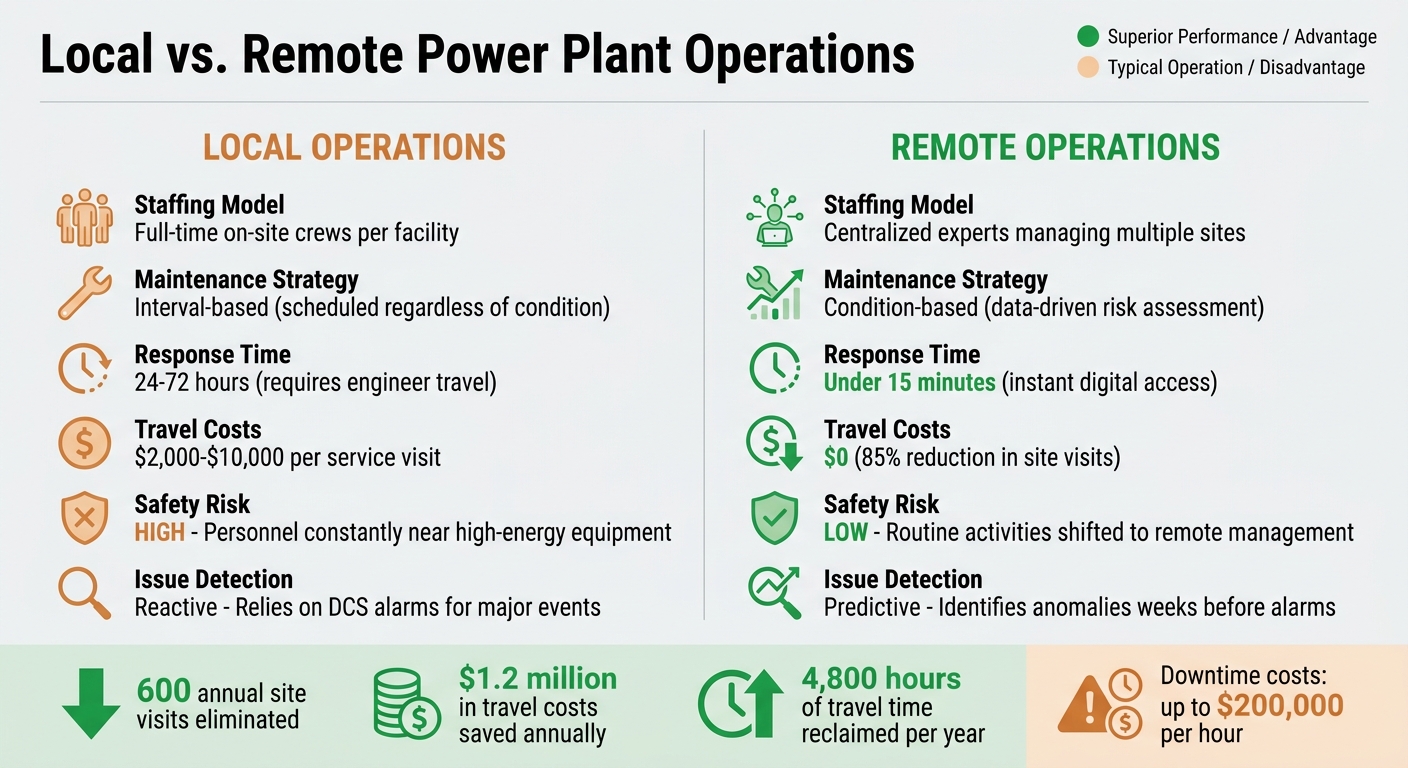
Local vs Remote Power Plant Operations: Cost, Safety, and Efficiency Comparison
Efficiency Gains and Cost Savings
Remote operations deliver clear financial and operational advantages by reducing travel expenses, cutting downtime, and addressing problems before they escalate. For example, a global gas turbine manufacturer supporting over 200 plants standardized on the Xona Systems platform in April 2026. This move eliminated 600 annual site visits, saving $1.2 million in travel costs and reclaiming 4,800 hours of travel time for engineers each year. Domestic site visits typically cost over $2,000, while international trips to remote locations range from $5,000 to $10,000.
The cost of downtime is staggering, with outages running up to $200,000 per hour, making quick remote support indispensable. Remote systems have reduced response times for engineers from 24–72 hours to under 15 minutes, ensuring minor issues are addressed before they snowball into costly emergencies. With remote diagnostics, facilities can spot performance issues early, plan corrective actions, and recover lost capacity before significant failures occur.
Another game-changer is the adoption of condition-based maintenance (CBM). Unlike rigid maintenance schedules, CBM uses real-time data to determine when servicing is truly necessary. In 2020, Altamira II delayed a major outage by six months using remote monitoring, saving substantial costs by transitioning to CBM. Marco Sanchez, Vice President at Mitsubishi Power Americas, highlighted the importance of this approach:
"The option to safely postpone or eliminate a planned outage wouldn't be possible without data-driven risk assessment and decision-making".
In addition to saving money, remote operations enhance safety and allow for more flexible workforce management.
Safety Improvements and Workforce Flexibility
The financial benefits are undeniable, but the safety and flexibility offered by remote operations are equally compelling. By reducing the need for personnel to work near high-energy equipment, facilities lower the risk of on-site accidents. Daniel Tegtmeier, Performance Center Director at EthosEnergy, emphasizes this point:
"Economics seems to drive the decision-making behind remotely operating a facility or not. However, there's a huge safety aspect to this because people aren't around equipment with a lot of energy 24 hours a day".
Centralized operations centers allow one operator to manage multiple plants, consolidating expertise and reducing the inefficiency of constant travel. Tegtmeier explains:
"We take several plants and operate them through [the Performance Center] with only one person rather than rotating people around the clock all over the country".
This model is especially advantageous for facilities that operate intermittently, as it reduces the need for full-time on-site staffing. Flexibility also extends to new projects. In February 2026, ABB implemented a "remote-first" substation design for the Dogger Bank Offshore Wind Farm (phases A, B, and C, totaling 3.6 GW capacity). This setup enabled system verification and troubleshooting to occur from shore, minimizing offshore staffing needs and avoiding delays caused by North Sea weather conditions.
During disruptions like the COVID-19 pandemic or extreme weather, remote capabilities ensured uninterrupted operations by limiting on-site personnel. Experts could support multiple facilities without travel delays, addressing critical issues in minutes instead of days.
Comparison Table: Local vs. Remote Operations
| Feature | Local Operations | Remote Operations |
|---|---|---|
| Staffing Model | Full-time on-site crews per facility | Centralized experts managing multiple sites |
| Maintenance Strategy | Interval-based (scheduled regardless of condition) | Condition-based (data-driven risk assessment) |
| Response Time | 24–72 hours (requires engineer travel) | Under 15 minutes (instant digital access) |
| Travel Costs | $2,000–$10,000 per service visit | $0 (85% reduction in site visits) |
| Safety Risk | High; personnel constantly near high-energy equipment | Low; routine activities shifted to remote management |
| Issue Detection | Reactive; relies on DCS alarms for major events | Predictive; identifies anomalies weeks before alarms |
Current Applications of Remote Operation
Remote Tuning and Optimization of Gas Turbines
In May 2026, GE Vernova's Remote Diagnostic Services (RDS) team helped address a startup noise issue in a 7FA heavy-duty gas turbine. By utilizing a remote services gateway, the team identified a speed ratio valve oscillation problem within just two hours. Their recommendation to replace the valve potentially saved the customer anywhere between $50,000 and $1,000,000.
These systems rely on digital twins to detect anomalies earlier than traditional alarms. Daniel Tegtmeier, Performance Center Director at EthosEnergy, sheds light on the capabilities of modern monitoring systems:
"We monitor the whole plant while some OEMs just monitor the turbine... If it has a sensor, we can learn the normal behavior of that equipment and, when it's abnormal, we can dig into that issue."
This kind of precise diagnostic approach not only enhances turbine efficiency but also paves the way for comprehensive plant-wide monitoring.
24/7 Monitoring of Power Plants
Remote operation isn’t limited to turbines - it now extends to entire power plants. For instance, Siemens Energy has been remotely operating the Leipheim gas-fired power plant in Germany from its Erlangen center since January 2026. The plant can ramp up to 300 MW within 30 minutes to support the Bavarian grid.
Vinzenz Hannig, an Electrical and Automation Engineer at the Leipheim Gas Plant, underscores the importance of this capability:
"The facility must constantly be ready to power up to 300 megawatts within 30 minutes. And that's what we're there for."
Another example comes from Wärtsilä's Expertise Centres, which in 2021 managed to resolve 96% of support cases remotely for over 250 power plants. Impressively, 91% of these cases were resolved the same day. In one instance, when an engine at a customer site shut down overnight, experts at Wärtsilä's Trieste center used a remote interface to analyze performance data and alarm lists. Within two hours, they identified the issue and guided on-site staff to restart the engine, avoiding the typical 2–3 day wait for an on-site technician.
Patrik Strand, General Manager at Wärtsilä, highlights the value of this expertise:
"There is always a Wärtsilä expert evaluating the deviations and supporting the customer by making the diagnosis and giving the recommendations."
Future Developments in Remote Power Generation
AI and Machine Learning Applications
Artificial intelligence (AI) and machine learning (ML) are becoming game-changers for remote power generation, especially in how operations are managed. These technologies are now being used to predict equipment issues before they become critical. By using neural networks, AI systems can learn what "normal" equipment behavior looks like, allowing them to spot even the smallest anomalies before alarms go off.
Daniel Tegtmeier, Performance Center Director at EthosEnergy, explains how advanced these systems have become:
"It's 100% ML and AI. It creates millions of Monte Carlo simulations and comes up with a model that dictates when it'll send an alert or not."
This shift means maintenance can now be proactive rather than reactive. Instead of waiting for equipment to fail or sticking to fixed inspection schedules, AI evaluates thermal behavior across entire facilities - covering turbines, pumps, boilers, and other components. This predictive approach ensures maintenance happens only when necessary. EthosEnergy's Performance Center, launched in 2023, exemplifies this progress by offering 24/7 real-time remote start/stop capabilities powered by AI.
As AI continues to evolve, the industry is moving toward centralizing operations for even greater efficiency.
Centralized Remote Operation Centers
The expansion of centralized remote operation centers is shaping the future of power generation. These hubs allow a single operator to monitor and control multiple power plants at once, even if they're separated by over 1,000 miles. This approach is particularly valuable for addressing two key challenges: a shortage of skilled engineers and the high costs of running plants that operate intermittently.
For example, in late 2024, Drax began using Siemens Energy's Remote Operational and Control Center in Newcastle, UK, to oversee the commissioning of three new Open Cycle Gas Turbine (OCGT) peaking plants - Hirwaun, Millbrook, and Progress. Each of these plants is fully controlled remotely and can supply power to 150,000 households.
Ian Kinnaird, FlexGen Assets Director at Drax, underscores the importance of this approach:
"Our new OCGT assets will have limited operating hours due to market spreads and environmental permit limitations. Without utilizing a remote operational center, the economics of the project would have become challenging."
This centralized model not only improves cost efficiency but also ensures that remote operations remain viable even under tight operating constraints.
Conclusion
The transformation in power generation through remote operation is undeniable. By leveraging advancements in technology, the industry has seen improvements in efficiency, safety, and cost management. A prime example is the shift from interval-based maintenance to condition-based maintenance, which allows decisions to be driven by real-time equipment health rather than fixed schedules. At Altamira II in 2020, this approach enabled a six-month delay of a major outage, offering critical flexibility during the challenges of the COVID-19 pandemic.
Safety has also taken a leap forward. Reducing the need for on-site personnel near high-energy equipment significantly lowers risks while maintaining full operational control.
Cost management is another standout benefit. Remote diagnostics catch issues like efficiency losses or equipment wear early, preventing costly repairs and avoiding capacity losses before they escalate.
Centralized Remote Operation Centers are addressing skilled labor shortages while enhancing efficiency. Rick Kephart from Emerson's Power and Water Solutions highlights this advantage:
"One of the key benefits of remote monitoring is that it empowers utilities and generating companies to do more with less - particularly in the area of experienced personnel".
Companies like Enchanted Rock exemplify this shift, managing over 300 sites and nearly 1,500 generating units from a single Network Operations Center.
As AI and machine learning continue to evolve, the industry is steadily moving toward fully autonomous operations. These technologies provide constant, round-the-clock monitoring that surpasses traditional methods in reliability and effectiveness. This evolution is reshaping power generation, making it safer, more efficient, and more economical than ever before.
FAQs
What cybersecurity controls are needed for remote plant operation?
Protecting remote plant operations from cyber threats requires a strong focus on cybersecurity measures. Here are some key practices that can help safeguard critical infrastructure:
- Secure Communication: Using encrypted and redundant communication channels ensures data integrity and confidentiality, even in the face of potential cyberattacks.
- Industry Standards Compliance: Adhering to frameworks like IEC 62443 and NERC CIP provides a reliable foundation for maintaining security and meeting regulatory requirements.
- Secure-by-Design Software: Implementing software designed with security at its core minimizes vulnerabilities from the outset.
- Access Protocols: Employing robust methods like multi-factor authentication (MFA) restricts unauthorized access to sensitive systems.
- Continuous Monitoring: Ongoing surveillance of networks and systems helps detect and respond to threats in real time.
- Regular Risk Assessments: Evaluating potential vulnerabilities and updating security measures ensures that protections evolve alongside emerging threats.
These strategies play a crucial role in maintaining operational resilience and protecting critical infrastructure from cyber risks.
What data and sensors are required to make predictive maintenance work?
Predictive maintenance uses real-time sensor data to keep an eye on critical parameters like equipment performance, temperature, vibration, and operating conditions. By analyzing this data, it becomes possible to spot early warning signs of potential failures and fine-tune maintenance schedules for better efficiency.
How do plants handle emergencies if most staff are off-site?
Plants can handle emergencies more effectively with the help of remote monitoring and control technologies. These systems deliver real-time data on essential metrics such as fuel levels, battery health, and engine performance, making it easier to spot issues quickly. Through secure communication channels, alerts can be sent via SMS, email, or even phone calls, ensuring fast responses when something goes wrong.
Remote operation centers, combined with advanced analytics, provide constant oversight. This helps minimize downtime, improve safety, and maintain stability - even during outages or severe weather conditions.