Unified IoT Standards: Benefits for Energy Management
Buildings consume 40% of global energy and generate 33% of greenhouse gas emissions. With urbanization increasing, smarter energy management is critical. Unified IoT standards like BACnet, Modbus, OPC UA, and MQTT play a key role in integrating devices and systems, enabling energy savings of up to 30% and reducing costs by 20%. These protocols streamline communication across HVAC, lighting, and energy systems, eliminating data silos and improving efficiency.
Key Takeaways:
- Unified IoT standards ensure seamless communication between devices, boosting energy efficiency.
- BACnet: Ideal for building management systems; object-oriented structure simplifies integration.
- Modbus: Reliable for industrial devices but requires manual mapping.
- OPC UA: Structured data for IT/cloud systems; supports predictive analytics.
- MQTT: Lightweight, scalable messaging for real-time data.
Quick Comparison:
| Feature | BACnet | Modbus | OPC UA | MQTT |
|---|---|---|---|---|
| Primary Role | Building management | Field devices | IT/cloud integration | Real-time messaging |
| Data Model | Object-oriented | Register-based | Structured | None (requires add-ons) |
| Complexity | High | Low | High | Low-Medium |
| Best Use Case | HVAC, lighting, access | Energy meters, VFDs | Analytics, SCADA | Remote monitoring |
Each standard has its strengths, and combining them can optimize energy management systems for cost savings and efficiency.
Energy Management IoT: Smart Grids & Meters Explained | Beginner's Guide to IoT Energy Systems
sbb-itb-501186b
How Unified IoT Standards Support Energy Management
Modern smart buildings often rely on a mix of systems - HVAC controllers, lighting sensors, energy meters, and security platforms - each operating with its own protocol. This lack of a shared language creates isolated data silos, forcing facility managers to juggle multiple dashboards just to get a basic understanding of building performance. Unified protocols change the game by enabling seamless integration, which paves the way for smarter energy management.
For instance, when a CO₂ sensor, a thermostat, and a smart meter all communicate using the same protocol, their data can be pooled into a single system for immediate action. This integration isn’t just convenient - it’s effective. Unified smart building platforms have been shown to reduce energy consumption by 15–30% within a year, with some cases exceeding 40%. These savings arise from capabilities that only unified systems can offer: HVAC settings that adjust automatically based on occupancy, lighting systems that dim or brighten in response to daylight, and detailed load profiling that identifies high-energy equipment and usage patterns.
A practical example highlights the potential of unified systems. In October 2022, researchers implemented the PHOENIX architecture at the University of Murcia's Pleiades building in Spain, a facility covering about 118,000 square feet. They integrated more than 400 devices, including older Modbus and Z-wave equipment, into a single platform. The project showcased strategies like a demand response system, which automatically adjusted HVAC settings during high-tariff periods, and ventilation controls that activated based on CO₂ levels - all without human intervention. This case demonstrates how blending legacy and modern systems can lead to significant energy savings.
"The monitoring, control and optimization of energy consumption in buildings will play a critical role in the coming years in improving energy efficiency in the building sector and in reducing greenhouse gas emissions." - Aristotelis Ntafalias et al., MDPI
Unified standards also address the challenge of device discovery, which is often a tedious and time-intensive process. A compelling example comes from February 2026, when the Coalition for Smarter Buildings (C4SB) showcased this at the PAE Living Building in Portland, Oregon. By leveraging the ASHRAE 223P semantic standard and SkyCentrics' "Discover" function, the team reduced the time needed for endpoint mapping from months to mere minutes. This streamlined approach allowed HVAC, lighting, and energy management systems to share data seamlessly across an integrated stack.
1. BACnet
BACnet (Building Automation and Control Networks) plays a key role in modern commercial building automation. Unlike traditional register-based protocols that simply deliver raw data, BACnet uses an object-oriented structure. This means each component - like thermostats, air handlers, or energy meters - is represented as an object with specific properties, states, and relationships. So, when an energy meter connected via BACnet reports a value, the system immediately knows what that value means, its source, and how it connects to other system data.
"The protocol describes components as objects with defined properties, states, and relationships, creating a natural link between technical systems and the building's function." - Zaphire
This structured approach simplifies data integration and helps address the complexities of managing large, interconnected networks.
Managing integration challenges is critical, especially in multi-site networks. One common issue is duplicate Device Instance IDs, which can cause intermittent communication failures. To avoid this, every device on the network must have a unique identifier. For instance, in 2025, Alpha Controls successfully upgraded a 16-floor Fan Coil Unit system at Pinsent Masons in London. Using Trend controllers on a BACnet/IP backbone, they assigned unique Device IDs and pre-labeled controllers before deployment. This proactive step helped them avoid the communication issues that often arise in large-scale integrations.
"The total cost of proprietary integration - gateways, driver licenses, consultant time, and the long-term cost of vendor dependency - consistently exceeds the marginal cost of proper open-protocol design from the start." - Alpha Controls
BACnet’s scalability is another standout feature, allowing it to handle everything from single buildings to multi-campus portfolios. It supports real-time write access, enabling adjustments to setpoints based on factors like occupancy, weather, or utility rates. This functionality has been shown to deliver about 10% energy savings and reduce service calls by 15% through automated fault detection. By combining its scalability with actionable insights, BACnet provides a solid foundation for unified energy management across diverse building systems.
2. Modbus
Modbus has become a go-to choice in industrial energy management, largely because of its straightforward design. Instead of relying on analog signals, it uses a single twisted-pair cable or Ethernet connection to transmit hundreds of data points. This shift simplifies operations for energy managers who oversee power meters, inverters, and sensors across large facilities, offering a major boost in efficiency.
The protocol operates using either RTU (a compact binary format) or TCP encapsulation, which helps reduce the processing load on devices. At a speed of 19,200 baud, a Modbus device can process between 50 and 100 registers per second. Thanks to the SunSpec Alliance, register definitions for renewable energy systems have been standardized, making it easier to access about 95% of photovoltaic (PV) system data through third-party gateways using uniform register blocks.
However, integration with Modbus can be a bit of a challenge. Unlike BACnet's object-oriented structure, Modbus presents its data as numbered registers without any accompanying metadata. This means energy managers often have to manually map registers to meaningful data points, relying heavily on manufacturer documentation. As GlacierGrid puts it:
"Integration through Modbus is reliable but labor-intensive. Each register must be mapped to a meaningful data point, often using manufacturer documentation." - GlacierGrid
Another issue arises from discrepancies in how manufacturers number registers - some use 1-based numbering while others use 0-based. This mismatch can lead to errors during setup. Running a Modbus scanner to confirm register readings before connecting to a Building Management System (BMS) is a smart way to catch these issues early.
The scalability of Modbus depends on the version in use. For example, RS-485 serial networks can support up to 32 devices per segment (expandable to 247 with repeaters) and cover distances of up to 3,940 feet (1,200 meters). On the other hand, Modbus TCP eliminates many of these limitations by leveraging standard Ethernet infrastructure. This makes it better suited for managing multi-site portfolios, where cloud-based analytics platforms can consolidate data from hundreds of locations. With this setup, energy managers can compare site performance and pinpoint equipment that isn't operating as expected.
Modbus also plays a role in demand response and peak shaving through modern functional blocks. The 2026 edition of IEC TR 61850-80-5 offers a standardized way to map Modbus data into utility-grade automation systems, helping connect simple field sensors with advanced substation controllers. A practical starting point is to focus on read-only data integration. This approach allows energy managers to establish a reliable data baseline before moving on to more complex tasks like writing setpoints for optimization. Understanding these capabilities provides a solid foundation before diving into more advanced protocols like OPC UA.
3. OPC UA
OPC UA stands out by offering labeled, structured data, unlike Modbus, which provides numbered registers without context. It uses an object-oriented AddressSpace to organize energy data into logical hierarchies - think Site > Building > Floor > Meter - and adds metadata like units, relationships, and meanings directly to the data stream. This makes it possible for analytics platforms to automatically interpret a node as, for example, a "power meter measuring kWh on Floor 3", without requiring manual setup.
One of OPC UA's strengths is its Report-by-Exception subscription model, which sends data only when values change, cutting down on network traffic. Additionally, its binary encoding minimizes bandwidth usage, making it ideal for high-frequency tasks like power quality monitoring, where text-based formats could slow things down. For larger deployments, the Publish-Subscribe (PubSub) extension takes efficiency a step further. It allows sensors to broadcast data to a middleware layer, avoiding the need for individual client connections. This is much more efficient than managing thousands of direct point-to-point sessions.
However, integrating OPC UA with legacy systems requires upfront effort. Information modeling is necessary, and tools like UA-EdgeTranslator help translate data from older protocols into OPC UA's structure. Standardized Companion Specifications, such as those aligned with IEC 61850 or ISA-95, simplify this process by providing ready-to-use data models. OPC UA also includes built-in Discovery services, which allow IT systems to automatically locate available energy data points without custom coding.
The PubSub model also simplifies managing multiple sites. Sensors can broadcast data directly to a cloud analytics platform, making remote monitoring easier. Security is another key feature: OPC UA includes audit trails and X.509 certificate-based security to ensure data remains safe and traceable, even across public networks.
OPC UA isn't just about efficiency - it also supports advanced energy management. It enables predictive analytics by streaming normalized historical data to cloud platforms. Plus, its Methods feature allows external systems to trigger actions like demand response or load-shedding directly on field devices. As the OPC Foundation explains:
"The OPC UA information modeling framework turns data into information. With complete object-oriented capabilities, even the most complex multi-level structures can be modeled and extended." - OPC Foundation
A growing practice among energy teams is using OPC UA as the semantic backbone of a Unified Namespace. By pairing it with MQTT as the transport layer, they achieve a combination of structured, contextual data and lightweight, scalable cloud integration.
4. MQTT
MQTT takes a different path compared to OPC UA, BACnet, or Modbus. Instead of relying on structured data modeling or register-based polling, it uses a lightweight publish/subscribe system. This approach minimizes network overhead by having devices publish data to a broker, which then allows any authorized system to subscribe and receive it. This eliminates the need for direct connections between devices, promoting a unified data exchange - key for efficient energy management.
When it comes to efficiency, MQTT offers sub-100ms latency, making it perfect for real-time grid protection and demand response applications. Its event-driven design means data is sent only when changes occur, cutting down on unnecessary traffic. Plus, its small header size makes it a better fit for IoT devices with limited resources compared to HTTP-based options.
Scalability is where MQTT truly excels. A single MQTT broker can handle over 100 million endpoints in one deployment. For example, China Southern Grid's Digital Grid Research Institute implemented a multi-cluster MQTT setup to manage millions of smart grid devices like meters and circuit breakers. This resulted in a 35%+ boost in development efficiency and a 25%+ drop in operational costs. For multi-site building portfolios, MQTT supports a Unified Namespace (UNS) architecture. This allows brokers at site, regional, and headquarters levels to create a real-time view of every connected asset across a portfolio. However, achieving this level of scalability requires careful integration with legacy systems.
Most existing energy infrastructure relies on protocols like Modbus, DNP3, or IEC 61850, none of which natively support MQTT. To bridge this gap, industrial edge gateways (e.g., EMQX Neuron) can locally convert data from these legacy protocols into MQTT messages, avoiding the need for a complete system overhaul. Additionally, the Sparkplug B specification provides a standardized data format on top of MQTT, enabling plug-and-play interoperability for devices like smart meters and RTUs while reducing the risk of vendor lock-in.
Beyond integration, MQTT plays a crucial role in advanced analytics and automation. It’s increasingly used to feed AI and predictive analytics platforms. As Sean Crouch, Enterprise Account Executive at HiveMQ, explains:
"You cannot make decisions, automate, or make use of AI on data that is not clean, current, complete, and in the right context."
This capability supports the creation of a live digital twin of energy infrastructure, enabling applications like load forecasting, predictive maintenance, and vehicle-to-grid (V2G) technology.
Pros and Cons of Each Standard
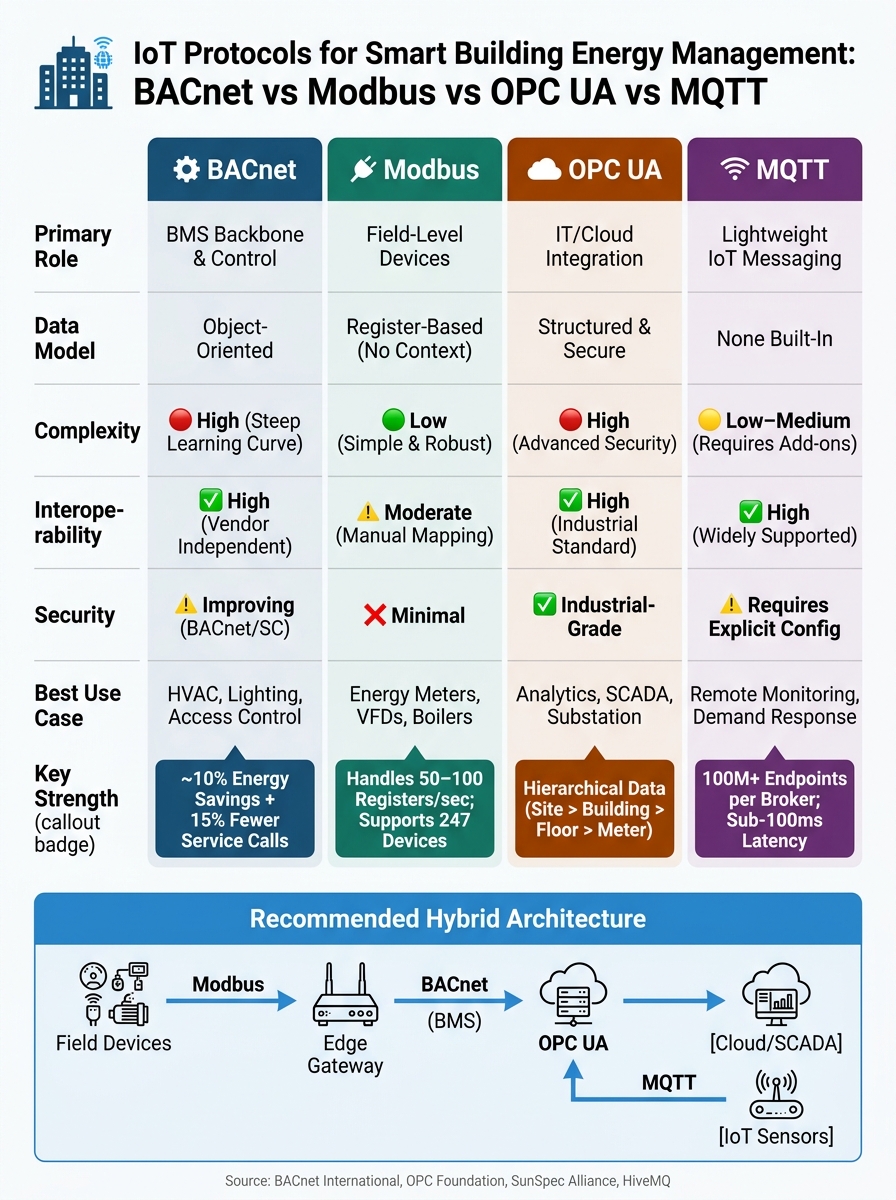
IoT Protocol Comparison for Smart Building Energy Management
This section breaks down the strengths and weaknesses of the main IoT standards to help clarify how each fits into a smart building's energy management system.
BACnet serves as the backbone for building management systems (BMS), offering an object-oriented data model that's critical for large-scale energy monitoring. However, its complexity is a major drawback - the BACnet standard spans over 1,200 pages. Deployments across multiple subnets require additional infrastructure like a BACnet Broadcast Management Device (BBMD) to maintain device discovery across network boundaries. While BTL certification ensures interoperability between vendors, the protocol has a steep learning curve compared to simpler alternatives.
Modbus is a straightforward and time-tested option, making it ideal for field-level devices like energy meters, variable frequency drives (VFDs), and boilers. Its simplicity comes with a trade-off: it lacks semantic context. Every register map must be manually documented and mapped, and even minor addressing mistakes can lead to persistent and hard-to-troubleshoot data mismatches.
OPC UA is a strong choice for transferring data to enterprise IT systems or cloud-based analytics platforms. Its structured data model and robust security features make it an excellent fit for SCADA systems and IEC 61850 substation automation. However, its complexity makes it less practical for direct communication with field-level devices.
MQTT shines in scalability and low overhead, making it a go-to for lightweight IoT messaging. However, it lacks a built-in data model, which means additional layers are needed to define data structure. Without this, information arriving at a broker may lack the context necessary for seamless integration. Security also requires explicit configuration, including SSL/TLS and machine-to-machine authentication.
Here’s a quick comparison of these standards:
| Feature | BACnet | Modbus | OPC UA | MQTT |
|---|---|---|---|---|
| Primary Role | BMS backbone & control | Field-level devices | IT/cloud integration | Lightweight IoT messaging |
| Data Model | Object-oriented | Register-based (no context) | Structured & secure | None built-in |
| Interoperability | High (vendor independent) | Moderate (manual mapping) | High (industrial standard) | High (widely supported) |
| Complexity | High (steep learning curve) | Low (simple & robust) | High (advanced security/structure) | Low–Medium (requires add-ons) |
| Security | Improving (BACnet/SC) | Minimal | Industrial-grade | Requires explicit configuration |
| Best Use Case | HVAC, lighting, access control | Energy meters, VFDs, boilers | Analytics, SCADA, substation | Remote monitoring, demand response |
In reality, no single standard can handle every need perfectly. Many modern buildings use a hybrid approach. For example, BACnet might serve as the backbone for BMS, Modbus could handle technical components, OPC UA might integrate with IT systems, and MQTT could manage real-time IoT data flows. Knowing where each protocol fits best allows facility teams to design energy systems that are both cohesive and efficient, taking full advantage of what each standard has to offer.
Conclusion
No single IoT protocol is perfect for every scenario. BACnet serves as the foundation for commercial building automation in North America, Modbus remains a go-to for legacy field devices - though it often needs middleware for modern integration - OPC UA is ideal for industrial automation and cloud analytics, and MQTT shines in lightweight, scalable real-time IoT data transfers.
Each protocol has its niche, and trying to impose one standard across all layers often leads to integration issues. A better approach is to leverage each protocol's strengths. This strategy not only improves system performance but can also result in noticeable energy and cost savings.
For practical implementation, consider using BACnet as your primary protocol, connecting specialized subsystems with gateways, and wrapping older Modbus hardware in middleware to enable compatibility with modern analytics platforms. As your system evolves, adopting semantic frameworks like Brick or ASHRAE 223P can add the contextual data that raw protocols lack, making energy data much more actionable over time.
When it comes to sourcing electrical components like breakers, transformers, and power distribution equipment to support these integrations, Electrical Trader offers a one-stop shop for both new and used equipment. This can help you manage upfront costs, especially since IoT integration typically accounts for around 15% of total project budgets. By unifying data exchange through these standards, you can significantly enhance system efficiency and integration.
FAQs
Which IoT protocol should I start with for my building?
BACnet is a well-established open protocol specifically created for building automation. It's widely recognized for its ability to provide dependable integration options, making it a solid choice for managing energy in smart buildings. One of its key strengths is its compatibility with a variety of systems, which allows for smooth data exchange and ensures flexibility for future upgrades or changes.
How do I integrate legacy Modbus devices without replacing them?
To bring legacy Modbus devices into modern IoT ecosystems, you can use a Modbus retrofit solution or a protocol gateway. These tools allow older devices to communicate securely without requiring a full infrastructure overhaul.
- Install a gateway: Connect the gateway to the device using RS-485 to read data and forward it securely.
- Configure settings: Adjust the gateway to align with the device's settings and map the necessary registers.
- Enable encryption: Protect communication by applying encryption protocols.
- Monitor performance: Regularly check for compatibility issues and ensure the system remains secure.
This approach ensures your legacy devices stay functional while integrating with modern systems.
What adds data context to MQTT so energy data is usable?
Adding meaning and relationships to energy data using a semantic data model like NGSI-LD, combined with a Context Broker, makes data shared through MQTT more practical. This approach enhances how energy data is exchanged and simplifies its integration into energy management systems, leading to smoother and more efficient operations.