EMS Scalability vs. Customization: Key Differences
Choosing the right Energy Management System (EMS) requires understanding two critical factors: scalability and customization. Here's the core difference:
- Scalability ensures the EMS can grow with your operations, like adding more meters, sensors, or sites without overhauling the system. It's ideal for businesses planning expansion or managing multiple locations.
- Customization focuses on tailoring the EMS to fit your specific needs, such as integrating with proprietary hardware, unique workflows, or specialized reporting requirements.
Both approaches have distinct benefits and challenges. Scalability offers faster deployment and cost-efficient growth, while customization delivers precision for unique setups but often comes with higher upfront costs and longer implementation times.
Quick Overview:
- Scalability: Modular design, cloud-based architecture, open standards for flexibility, ideal for growth.
- Customization: User-specific dashboards, custom reporting, integration with legacy systems, suited for unique workflows.
Key takeaway: If you're expanding or need a fast setup, scalability is your go-to. For specialized needs, customization is the better choice. Balancing both can future-proof your EMS while addressing current demands.
What Is Scalability in Energy Management Systems
Scalability Definition
Scalability in Energy Management Systems (EMS) refers to the system's ability to expand and adjust as your energy needs, connected devices, and compliance requirements evolve. For example, a scalable EMS might begin with just one solar array and later grow to include battery storage, EV charging stations, or even additional facilities - all without the need to replace its core infrastructure. This adaptability ensures your investment stays relevant and continues to perform effectively as your operations change.
One of the biggest benefits is maintaining consistent performance. As you connect more meters, sensors, and monitoring tools across your facilities, a scalable EMS can handle the increased flow of real-time data without slowing down or becoming unreliable. This capability is especially important when managing multiple locations and avoiding fragmented information.
Core Features of Scalability
To achieve this adaptability, scalable EMS platforms include several essential features that allow them to grow efficiently alongside your operations.
Modular design is a cornerstone of scalable EMS. Rather than relying on a rigid, one-size-fits-all system, modular platforms let you add specific features - like advanced analytics, automated reporting, or demand-response tools - as your needs evolve. For instance, PowerFlex X demonstrated this in April 2025 by allowing facilities to start with solar and later integrate battery storage or EV charging from different manufacturers without a complete system overhaul.
Cloud-based architecture plays a critical role by enabling flexible resource allocation. Cloud-based EMS can dynamically adjust computing power to handle varying workloads and data volumes, making them ideal for organizations with multiple sites. For example, British Land used Facilio’s cloud platform in July 2025 to unify separate systems into a centralized dashboard, streamlining portfolio-wide management and advancing their net-zero goals. Additionally, cloud solutions significantly reduce deployment times - some systems can be implemented across entire portfolios in just 2 to 12 weeks.
Interoperability through open standards ensures that your EMS can integrate with a wide range of hardware and third-party applications. By using open standards like Modbus, OPC UA, and RESTful APIs, these systems avoid vendor lock-in and make it easier to incorporate new equipment as needed. MyEMS highlighted this in March 2026 by scaling from small setups to enterprise-level operations. Its modular design supported both horizontal expansion (adding more data collectors) and vertical expansion (boosting server processing power).
These features demonstrate how scalability ensures an EMS can grow and adapt efficiently, setting the stage for further customization to meet specific operational demands.
sbb-itb-501186b
What Is Customization in Energy Management Systems
Customization Definition
Customization in Energy Management Systems (EMS) means modifying the software to match your organization’s specific infrastructure, operational workflows, and energy goals. Unlike generic, off-the-shelf solutions, a customized EMS is built to address unique challenges - whether that involves integrating proprietary hardware, implementing specialized energy analysis methods, or creating tailor-made reporting tools.
The distinction from scalability lies in the focus: scalability is about expanding the system’s capacity, like adding more meters or sites, while customization is about fine-tuning the system to meet particular business needs. For example, GF Automotive in Austria used a customized EMS to optimize its die-casting processes, saving 4,500 m³ of compressed air per weekend and cutting CO₂ emissions by 10%. This shows how tailored solutions can address specific operational challenges. Let’s explore the features that make such customization possible.
Core Features of Customization
User-specific dashboards:
These dashboards are designed to provide role-based, real-time data views. For instance, facility managers can track details like EV charger speeds, while executives can access high-level portfolio summaries across multiple sites. This tailored approach enhances team adoption and streamlines operations.
Custom reporting:
Custom reporting tools can generate detailed insights on carbon emissions (Scope 1, 2, and 3), compliance with standards like ISO 50001, and performance trends over time. A great example is the University of California San Diego, which used EnergyCAP for utility bill management. This helped them uncover a $1 million billing error and cut billing-related labor by over 95%. These reports can also be tailored to meet state rebate requirements or federal tax credit criteria.
System integration:
A customized EMS can integrate seamlessly with existing systems like Building Management Systems (BMS), SCADA, or ERP platforms such as Salesforce or Microsoft. For example, PowerFlex X supports open-industry standards, enabling organizations to centralize data from various meters, sensors, and legacy devices without being locked into a single vendor.
Advanced systems can even incorporate machine learning to enhance efficiency. For example, they can predict energy usage patterns and store surplus solar energy during the afternoon to offset high-cost evening demand. This level of optimization relies on the system’s ability to adapt to unique consumption behaviors and operational needs.
Scalability vs. Customization: Main Differences
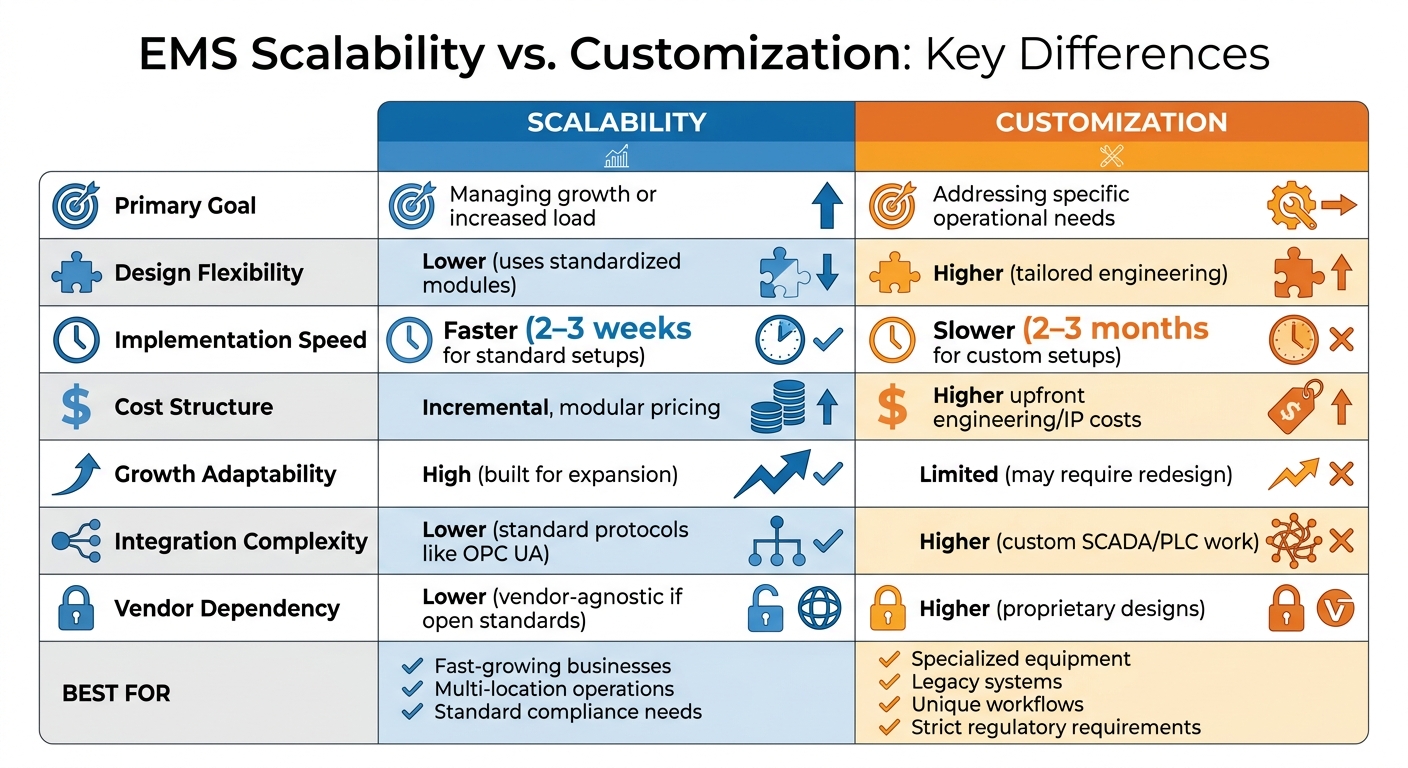
EMS Scalability vs Customization: Feature Comparison Guide
Scalability and customization address different operational needs. Scalability is all about managing growth - whether it’s scaling from one facility to ten or increasing data processing from 10,000 to 100,000 writes per minute. Meanwhile, customization focuses on tailoring systems to fit specific operational demands, such as unique load profiles, specialized equipment, or regulatory requirements.
The way these two approaches are designed also sets them apart. Scalable systems often use modular, standardized components that can be added or upgraded with minimal disruption. On the flip side, customized systems require specialized engineering. For instance, integrating proprietary hardware might stretch implementation timelines from the usual 2–3 weeks in standard setups to 2–3 months.
Cost structures also vary. Scalability typically follows a pay-as-you-grow model, where horizontal scaling (adding more nodes) is generally more budget-friendly than vertical scaling (upgrading existing hardware). Customization, however, demands a higher upfront investment, often involving intellectual property considerations that could influence long-term costs.
Another key difference lies in vendor dependency. Scalable systems that leverage open standards like OPC UA or Modbus TCP make it easier to swap out hardware and maintain flexibility for future upgrades. In contrast, customized solutions often lead to greater vendor lock-in due to proprietary designs and complex integrations.
Comparison Table: Scalability vs. Customization
| Feature | Scalability | Customization |
|---|---|---|
| Primary Goal | Managing growth or increased load | Addressing specific operational needs |
| Design Flexibility | Lower (uses standardized modules) | Higher (tailored engineering) |
| Implementation Speed | Faster (2–3 weeks for standard setups) | Slower (2–3 months for custom setups) |
| Cost Structure | Incremental, modular pricing | Higher upfront engineering/IP costs |
| Growth Adaptability | High (built for expansion) | Limited (may require redesign) |
| Integration Complexity | Lower (standard protocols like OPC UA) | Higher (custom SCADA/PLC work) |
| Vendor Dependency | Lower (vendor-agnostic if open standards) | Higher (proprietary designs) |
These differences play a critical role in choosing the right Energy Management System (EMS) for facility power management.
Scalability: Benefits and Drawbacks
Benefits of Scalability
Scalable EMS platforms let facilities start small and expand their capabilities over time without the need to replace the entire system. This flexibility allows organizations to add features like reporting, analytics, or load management as their needs evolve, avoiding large upfront investments in tools that might not be immediately necessary.
Cost efficiency improves during growth because modular systems enable facilities to scale functionality as needed. For instance, a multinational manufacturing company using the MyEMS scalable architecture reduced energy costs by 18% through real-time global monitoring. Similarly, a retail chain expanded to thousands of locations and achieved a 20% reduction in its carbon footprint using the same system. Delta Electronics in China also reported impressive results, cutting power consumption by 10.51 million kWh, which translated to savings of around $1.2 million and a reduction of 10.2 thousand tons of carbon emissions.
Another advantage is the ability to centralize data from multiple locations into a single dashboard, eliminating the inefficiencies caused by data silos. For example, British Land utilized Facilio's cloud-based platform to monitor energy use across its portfolio from one centralized interface, aligning with its goal of achieving net-zero operations. Additionally, cloud-native platforms integrate smoothly with SCADA, ERP, and IoT sensors. Some systems can even be deployed across an entire portfolio in under two weeks, cutting standard deployment times by two-thirds.
While these benefits make scalability attractive, it’s not without its challenges.
Drawbacks of Scalability
The initial costs for hardware, licenses, and system integration can be high. For large-scale projects exceeding 100 MWh, the cost of control equipment, programming, and cybersecurity should ideally stay below 1% of the total project budget. However, even with these benchmarks, upfront expenses require careful financial planning.
Phased rollouts in cloud-based systems can also lead to temporary function limitations during transitions. Hybrid architectures, which combine on-premises and cloud elements, offer flexibility but add a layer of complexity requiring skilled IT management. As systems expand and integrate with more third-party equipment, the risk of cybersecurity vulnerabilities grows, necessitating compliance with standards like NERC CIP or ISO 27001. Additionally, upgrading or retrofitting systems for scalability can result in operational downtime, with outages potentially lasting up to two weeks.
Customization: Benefits and Drawbacks
Benefits of Customization
Custom EMS solutions are designed to align perfectly with an organization's infrastructure, workflows, and specific goals. This tailored approach ensures the system integrates seamlessly with legacy setups, industrial control systems like SCADA, and proprietary hardware - areas where standard options often fall short.
A custom EMS can be designed to perfectly align with an organization's unique infrastructure, specific operational workflows, and distinct sustainability goals.
One of the standout advantages is the ability to address challenges that generic platforms might overlook. For example, organizations can implement specialized energy analysis methods, meet niche regulatory reporting requirements, or develop dashboards tailored to specific user roles. These customizations not only improve operational efficiency but also encourage employee adoption by creating user-friendly tools.
Security is another key benefit. Custom solutions give organizations more control over security protocols, allowing them to meet internal compliance standards. Additionally, these systems can be built with future growth in mind, ensuring they can adapt to new meters, sites, or evolving processes over time.
While these benefits are compelling, customization isn't without its challenges.
Drawbacks of Customization
The most obvious drawback is cost. Custom EMS solutions often require a significant upfront investment compared to ready-made alternatives. On top of that, the implementation process can be lengthy and resource-intensive. While cloud-based platforms may take just a few weeks - anywhere from 2 to 12 - to deploy, customized systems frequently take much longer.
Another issue is dependency. Organizations often rely heavily on their software development partner for updates, maintenance, and future enhancements. This dependency can lead to "vendor lock-in", where businesses are tied to proprietary hardware ecosystems like meters, PLCs, or switchgear. This not only limits flexibility but also increases long-term costs.
Vendor lock-in deserves more scrutiny than most buyers give it. Platforms tied exclusively to proprietary hardware ecosystems - meters, PLCs, switchgear - limit future flexibility and inflate lifecycle costs.
Lastly, custom solutions can sometimes result in siloed systems if not designed with a unified approach. This fragmentation can make portfolio management and data analysis more labor-intensive, reducing overall efficiency.
Despite these challenges, organizations can mitigate risks by carefully weighing the level of customization against other EMS priorities. Balancing flexibility with practicality is key to achieving the best outcomes.
When to Choose Scalability Over Customization
Scalability becomes a priority when your business is on a growth trajectory or managing operations across multiple locations. If you're planning to add more meters, sensors, or even entire sites, a scalable system can handle these expansions without requiring a complete overhaul of your infrastructure. This is especially critical for industries like retail chains, multinational corporations, or any organization with a widespread presence.
As Wirtek puts it:
"The EMS should be able to grow with your business and support increases in meters, sites, or buildings easily."
Another advantage of scalable systems is their faster deployment. Thanks to modern cloud-based Energy Management Systems (EMS), implementation can take as little as 2 to 12 weeks. This is a stark contrast to custom solutions, which often take months or even years to fully develop and deploy. These quicker rollouts mean businesses can start reaping benefits much sooner.
For example, standardized scalable EMS platforms have demonstrated measurable environmental improvements. They’re particularly useful for organizations dealing with increasing data complexity. As operations expand, the ability to process near real-time data from multiple sources and support a growing number of users becomes a necessity. Multinational corporations, in particular, have achieved significant energy cost savings through real-time global monitoring - something that would be far harder to replicate with fragmented, custom-built solutions.
Cost is another major factor that tips the scale in favor of scalability. Scalable systems generally require a lower upfront investment compared to custom-built alternatives. Additionally, they help reduce manual processes and eliminate data inconsistencies, which can arise when managing multiple customized systems across different sites. If your goal is to meet standard regulatory requirements like ISO 50001 or the GHG Protocol, an off-the-shelf scalable system can help you achieve compliance faster and more affordably than building a custom solution from the ground up.
For businesses focused on growth and efficiency, scalable EMS solutions offer a practical and cost-effective path to managing dynamic operations while staying aligned with regulatory standards.
When to Choose Customization Over Scalability
After examining when scalability might take priority, it’s equally important to consider situations where a customized Energy Management System (EMS) delivers greater benefits. While scalability supports growth and adaptability, customization shines when your operations demand tailored solutions that off-the-shelf systems simply can’t meet.
Customization is critical when dealing with specialized equipment, legacy systems, or unique workflows. For example, industrial plants with intricate machinery, production lines, and high-voltage systems often require custom EMS solutions to minimize downtime and optimize energy use during peak production times. Industries such as oil & gas, healthcare, and medical equipment manufacturing also face highly specific operational needs that call for tailored systems.
As Wirtek aptly puts it:
"Just as a tailored suit offers a superior fit compared to an off-the-rack option, a custom EMS can be designed to perfectly align with an organization's unique infrastructure, specific operational workflows, and distinct sustainability goals."
Integration challenges are another key reason to consider customization. Facilities relying on proprietary hardware, legacy systems like SCADA, or unique sensors that don’t work with standard APIs need a custom-built EMS. For instance, large commercial properties such as hospitals or shopping malls often require custom solutions to integrate HVAC, lighting, and elevator systems with existing Building Management Systems (BMS).
Organizations with strict regulatory or sustainability requirements may also benefit from a custom approach. Take Delta Electronics in China, for example. By adopting the ISO 50001 energy management standard and implementing a custom system, they reduced power consumption by 10.51 million kWh, saving about $1.2 million. Whether it’s precise carbon tracking or automated tenant billing across multiple currencies and languages, customized systems can address these specific demands seamlessly.
Ultimately, the decision comes down to fit versus flexibility. If your operations rely on industry-specific metrics - like "energy consumption per ton of product" in chemical plants - or require real-time control loops that adjust equipment dynamically, customization offers capabilities that generic scalable systems often lack. While the upfront costs may be higher, the long-term payoff is a system that aligns perfectly with your business, eliminating the need to compromise your processes to fit generic software.
Identifying these unique operational needs lays the groundwork for exploring hybrid solutions that combine the strengths of both scalability and customization.
Combining Scalability and Customization
Modern Energy Management Systems (EMS) are designed to balance scalability with customization, addressing both current and future energy challenges in a single framework.
To achieve this, it’s essential to adopt an integration strategy that unites various third-party tools and legacy hardware into one cohesive data structure. By doing so, you eliminate data silos while retaining the flexibility to scale operations across your portfolio. For instance, you might integrate proprietary SCADA systems or older sensors (customization) while managing energy data from hundreds of locations through a single dashboard (scalability).
Open APIs play a key role here, enabling tailored integrations with ERP and CRM systems without compromising the scalability of cloud-based solutions. A hybrid EMS model combines the power of cloud analytics with on-premises controls, ensuring both growth and compliance needs are met.
Reid Gustin, Director of Software Sales at PowerFlex, encapsulates this approach:
"Our goal is to deliver a system that meets your needs today while future-proofing your property for your energy needs of tomorrow."
This strategy allows for an EMS that addresses today’s requirements while being adaptable for future expansions, such as adding solar panels, battery storage, or EV chargers. For example, PowerFlex's Adaptive Load Management (ALM) algorithms have been shown to reduce implementation costs by over 60%, avoiding costly electrical service upgrades.
Examples of Combined Solutions
The technical integration of scalability and customization enables swift and tailored EMS deployments. Take retail chains, for example - they require scalability to manage thousands of locations from a centralized system, while also needing customization for local utility rates, varying building structures, and site-specific sustainability goals.
Similarly, industrial manufacturing facilities benefit from solutions that co-optimize diverse assets. A well-designed EMS can intelligently manage equipment such as EV chargers, solar arrays, or high-voltage machinery while maintaining a scalable framework for future additions. This approach has led to energy cost savings of 15% in small offices and up to 18% in large multinational manufacturing facilities.
The backbone of these solutions lies in modular architecture. Using technologies like microservices, containerization, and serverless computing allows an EMS to scale horizontally while remaining flexible for custom updates. Hardware independence is equally important - choosing a platform that can collect data from any meter or sensor ensures compatibility with your existing infrastructure and supports growth.
Modern platforms also streamline deployment, cutting rollout times by up to two-thirds. Some systems can be implemented across entire portfolios in as little as two weeks. Additionally, automated compliance reporting can save up to 65% of the time typically spent on manual regulatory tasks. Role-specific dashboards further enhance usability, enabling diverse teams to interact with a unified, scalable data set.
Conclusion
Understanding the distinction between scalability and customization in an Energy Management System (EMS) is crucial for aligning with your facility's unique objectives. Scalability supports growth across multiple locations and increased data loads, while customization ensures the EMS fits your specific workflows, integrates with legacy hardware, and meets reporting needs for ESG, finance, or operations teams.
When selecting an EMS, consider your primary focus. For a fast-growing retail chain, a scalable, cloud-based system might be the best fit. On the other hand, a complex industrial facility with proprietary equipment may benefit more from a customizable EMS that works seamlessly with SCADA systems and specialized controls. For example, scalable platforms have helped organizations achieve notable energy savings by integrating data across enterprise systems.
That said, the best results often come from balancing scalability and customization. Modern modular EMS platforms offer this flexibility, preventing over-investment while avoiding data silos. These platforms ensure that diverse teams can access tailored data views within a unified system. Companies that strike this balance have reported impressive outcomes - from 15% reductions in small office energy costs to 30% annual electricity savings in energy-intensive operations.
Start by defining your top priorities, whether they are cost savings, compliance, or sustainability. Evaluate your current infrastructure to determine whether standardized protocols like Modbus or OPC UA will suffice or if custom integrations are necessary. Include centralized data management and integrated dashboards as part of your decision-making process. By aligning your EMS selection with your facility’s operational needs and growth plans, you can achieve both immediate benefits and long-term flexibility.
FAQs
How do I tell if my EMS needs scalability or customization first?
To determine whether your Energy Management System (EMS) should emphasize scalability or customization, start by clarifying your priorities. If your focus is on creating tailored control strategies, integrating specialized hardware, or addressing unique energy management requirements, customization should take center stage. On the other hand, if you're planning to expand capacity, integrate new energy sources, or support growth with minimal interruptions, scalability becomes the key factor. Ideally, you’ll want to balance both aspects to ensure your EMS not only meets today’s demands but also remains flexible enough to handle future growth.
What’s the easiest way to avoid vendor lock-in with an EMS?
To steer clear of vendor lock-in when selecting an Energy Management System (EMS), prioritize systems with an open, modular architecture. These systems are designed to support devices from multiple brands and work seamlessly with standard communication protocols.
Why does this matter? Proprietary systems often restrict your options, making it harder to adapt or expand as your needs evolve. On the other hand, open systems provide greater scalability and interoperability, allowing you to integrate a variety of devices and technologies without being tied to a single vendor.
By choosing an EMS built on open standards, you ensure long-term flexibility and reduce the risk of over-reliance on one provider. This approach not only future-proofs your investment but also gives you the freedom to adapt as technology and requirements change.
Can I customize an EMS without slowing down future expansion?
Absolutely. A custom Energy Management System (EMS) can be tailored to your specific needs while still leaving room for future expansion. The key lies in designing the system with flexible architecture and modular components.
This approach allows for seamless upgrades and scaling as your facility's demands change over time. When implemented correctly, a custom EMS provides both efficiency and the ability to evolve without sacrificing performance or functionality.