

How IoT Optimizes Solar-Wind Hybrid Systems
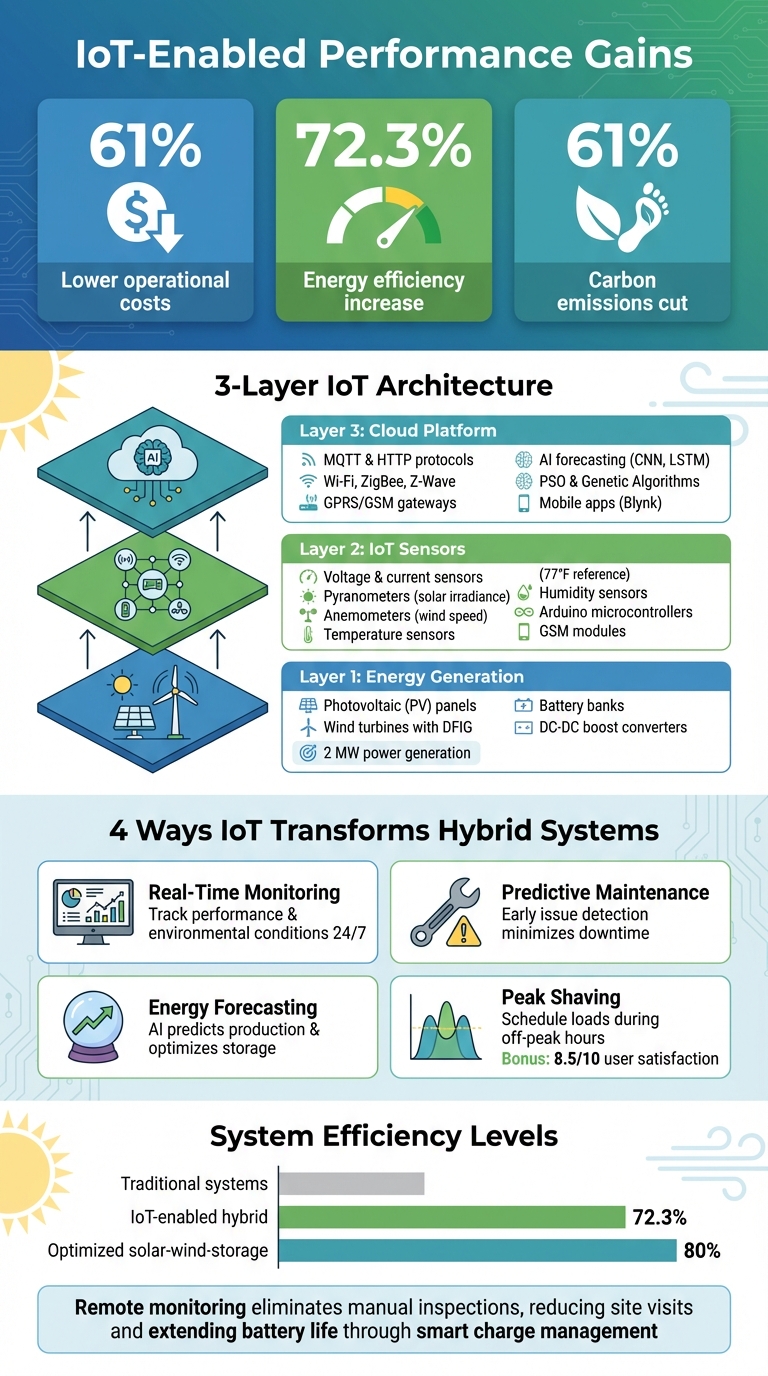
IoT is transforming solar-wind hybrid energy systems by enabling smarter monitoring, predictive maintenance, and real-time energy management. These systems combine solar panels and wind turbines to provide a reliable power supply, even in remote locations. IoT sensors track key parameters like voltage, current, temperature, and wind speed in real-time, reducing costs by up to 61% and improving efficiency by 72.3%. Paired with AI, these systems forecast energy production, balance loads, and extend battery life, cutting CO₂ emissions by over 61%.
Key takeaways:
- Real-time monitoring: Sensors track performance and environmental conditions, ensuring consistent energy output.
- Predictive maintenance: Early detection of issues minimizes downtime and reduces technician visits.
- Energy forecasting: AI predicts energy trends, optimizing production and storage.
- Cost savings: Automated monitoring and load balancing lower operational expenses.
IoT integration makes these hybrid systems smarter, more reliable, and cost-effective, supporting cleaner energy solutions.
IoT Impact on Solar-Wind Hybrid Systems: Efficiency and Cost Savings
HVS-2766. Design and implementation of MPPT for hybrid Solar, Wind Energy system with IoT thingspeak

sbb-itb-501186b
Core Components of IoT-Optimized Hybrid Systems
IoT-enabled hybrid systems blend hardware and software to improve renewable energy efficiency. By breaking down their key elements, we can better understand how these systems achieve such impressive performance. Here's a closer look at the essential components driving these advanced setups.
Energy Generation: Solar and Wind Components
Electricity generation starts with photovoltaic (PV) panels and wind turbines. A standout feature in wind energy systems is the use of Doubly Fed Induction Generators (DFIG), which allow for independent control of active and reactive power. This adaptability makes them highly efficient, even when wind speeds fluctuate.
Power electronics also play a crucial role. DC-to-DC boost converters adjust the voltage from solar panels to fit system requirements, while back-to-back (B2B) converters - which include Rotor-Side Converters (RSC) and Grid-Side Converters (GSC) - help regulate wind turbine output. These components are essential for integrating sensor feedback and enabling real-time system adjustments. Research targeting 2 MW of power generation at rated wind speeds highlights how these technologies scale for commercial use. Additionally, battery banks store surplus energy, and DC link capacitors stabilize voltage across the system's various stages.
IoT Sensors for Real-Time Monitoring
A network of sensors continuously tracks power output, environmental conditions, and maintenance needs. These include voltage and current sensors, pyranometers (for solar irradiance), anemometers (for wind speed), and temperature and humidity sensors. For instance, temperature sensors are critical for protecting batteries from overheating - a key consideration since standard PV systems use a reference temperature of 77°F (25°C) to calculate optimal performance.
Microcontrollers like Arduino handle local data processing, while GSM modules or dedicated IP addresses allow remote data transmission. This shift to cloud-based monitoring has made it easier to manage systems in remote locations. It also enables global data access and even remote fault resolution, marking a significant leap from traditional local data logging methods.
Cloud-Based Platforms for Data Processing
While sensors collect data on-site, cloud platforms handle the heavy lifting of processing and optimizing it. These platforms rely on MQTT (Message Queuing Telemetry Transport) for efficient device-to-gateway communication and HTTP for analytics. Local networking is supported by wireless technologies like Wi-Fi, ZigBee, and Z-Wave, while GPRS/GSM gateways ensure connectivity in remote areas.
Applications like Blynk make real-time monitoring of system parameters accessible via mobile devices. Behind the scenes, cloud systems use AI-driven forecasting and machine learning models to predict energy generation trends and optimize load distribution. Algorithms such as Particle Swarm Optimization (PSO) and Genetic Algorithms tackle complex tasks like cost minimization and load balancing. This layered approach - combining immediate local adjustments with broader cloud-based analysis - ensures the system operates efficiently and adapts to real-time demands.
Real-Time Monitoring and Predictive Maintenance
Data Collection and Analysis
IoT has transformed how we gather and analyze data. In the past, technicians had to physically retrieve data using memory cards or local PCs, often traveling to remote locations to access critical information. Now, with GPRS/GSM modules and dedicated IP addresses, data is transmitted directly to cloud platforms or mobile apps like Blynk. This shift means system statistics are available anytime, anywhere.
The collected data is grouped into three key categories:
- Electrical performance metrics: Includes details like voltage, current, and the power output of individual solar panels and wind turbines.
- Environmental sensors: Tracks real-time conditions such as solar irradiance, wind speed, ambient temperature, and humidity.
- System health indicators: Monitors factors like battery charge/discharge cycles, DC link voltage stability, and rotor speed in wind turbines.
This level of monitoring makes it easier for operators to spot problems quickly, like a drop in panel efficiency or unusual battery temperatures. Beyond identifying issues, this real-time data is the foundation for predictive maintenance.
Predictive Maintenance Benefits
By analyzing this data, predictive maintenance strategies can address potential issues before they escalate. IoT sensors are especially effective at identifying small problems early, minimizing technician visits and cutting costs. For example, if a temperature sensor detects unsafe battery levels, the system can send an alert for remote troubleshooting or adjust charging settings automatically - avoiding the need for on-site intervention.
The financial impact is hard to ignore. IoT-based energy management systems significantly reduce costs while improving efficiency. Remote fault resolution allows operators to address minor issues from a central location, saving the expense of deploying technicians to distant sites. Additionally, continuous monitoring of battery charge cycles and internal temperatures helps prevent overcharging or deep discharging, extending battery life and delaying expensive replacements.
Energy Optimization through IoT and AI
Forecasting and Demand Prediction
IoT sensors have revolutionized energy forecasting by enabling AI to predict energy trends with precision. These sensors continuously gather environmental data - like solar irradiance, wind speed, temperature, and humidity - and feed it into AI systems. Using deep learning models such as Convolutional Neural Networks (CNNs) and Long Short-Term Memory (LSTM) networks, AI identifies patterns and predicts energy generation for hours or even days in advance. The accuracy of these forecasts is enhanced by analyzing historical weather data, seasonal changes, and time-of-day patterns.
What sets these predictions apart is the integration of hybrid forecasting models. These models combine AI's data-driven insights with physics-based principles, such as solar position algorithms and turbine power curves, to address the variability of renewable energy sources. As Al-Ahmad Sharif highlights:
The integration of renewable energy sources (RES) into smart grids presents significant challenges due to the intermittent and unpredictable nature of solar and wind energy.
This combination delivers more reliable forecasts than either method could achieve on its own.
On the demand side, AI leverages historical usage data and real-time input from IoT-connected devices to predict energy needs at both household and grid levels. This two-way insight - understanding both energy production and consumption - enables operators to fine-tune energy storage and distribution strategies. The impact is clear: IoT-powered hybrid systems have shown energy efficiency improvements of up to 72.3%, with optimized setups reaching efficiency levels as high as 80%. These predictive capabilities allow for real-time adjustments in energy management.
Dynamic Load Balancing
With accurate forecasts in place, IoT systems handle real-time energy distribution seamlessly. Smart meters and sensors monitor production and consumption continuously, feeding this data into algorithms that make instant, automated decisions. For example, during midday when solar panels produce excess energy, the system automatically redirects it to charge batteries or powers flexible loads like HVAC systems and water heaters.
This strategy, often referred to as peak shaving, reduces reliance on costly grid power during high-demand periods. IoT controllers can reschedule non-urgent tasks to align with peak renewable energy production, maximizing efficiency and lowering costs. When renewable output drops - such as on a cloudy afternoon - the system taps into stored energy or draws from the grid, ensuring a steady supply without waste. These AI-driven optimizations have been shown to cut energy costs by as much as 61%.
Optimization algorithms play a crucial role in balancing cost and reliability. By using adaptive parameter controls, these algorithms avoid getting stuck in "local optimal solutions", ensuring continuous improvement. Dynamic load balancing not only prevents system overloads but also distributes energy usage evenly, reducing waste and maintaining peak system performance.
Impact of IoT on System Performance and Sustainability
Efficiency and Cost Metrics
IoT-enabled hybrid renewable systems bring substantial energy cost savings - up to 61% compared to traditional setups. These systems, equipped with IoT sensors and controllers, show efficiency gains of 72.3%, with solar–wind–storage configurations achieving efficiency levels as high as 80%. These savings stem from streamlined hardware, reduced operational expenses, and smarter energy management.
For example, integrating solar PV systems directly into the wind turbine converter's DC link significantly lowers inverter costs while simplifying the overall system design. As one study highlights:
It is cost-effective, as one inverter is reduced.
Remote IoT monitoring further reduces costs by minimizing the need for on-site technician visits. This approach cuts down on manpower requirements, fuel consumption, and time spent on maintenance.
Additionally, continuous battery monitoring prevents overcharging and deep discharging, which helps extend the lifespan of energy storage systems. Features like peak shaving reschedule flexible loads - such as HVAC systems and water heaters - to operate during off-peak hours, optimizing energy use. Notably, users of smart home systems with IoT-based hybrid energy management report satisfaction levels averaging 8.5 out of 10.
These efficiency improvements not only reduce costs but also contribute to environmental goals.
Reduced Carbon Emissions
The cost savings and intelligent energy management offered by IoT-enabled systems also translate into substantial environmental benefits. By maximizing renewable energy use and reducing reliance on fossil fuels, these systems can cut CO₂ emissions by over 61% compared to conventional energy setups.
Remote monitoring plays a key role in reducing the carbon footprint by eliminating unnecessary maintenance trips. As noted by IEEE:
The efficiency of time, energy and financial can be achieved by implementing this technology for the operation of this hybrid power system.
Real-time optimization ensures that energy generated by solar panels and wind turbines is utilized efficiently, reducing waste and minimizing the need for backup power from non-renewable sources. Additionally, grid synchronization through GPRS/GSM gateways enhances system performance by enabling seamless energy export and import. This ensures a reliable power supply while lowering dependency on carbon-intensive grid electricity.
Conclusion and Key Takeaways
IoT takes solar-wind hybrid systems to the next level, turning them into smart, efficient energy networks. With a reported 72.3% improvement in efficiency and a reduction in energy costs and CO₂ emissions by over 61% compared to traditional setups, the benefits are hard to ignore. These gains come from features like real-time monitoring, predictive maintenance, and smart load balancing that ensure every watt is used effectively.
Remote management powered by IoT eliminates the need for manual inspections. Sensors continuously track system performance, cutting down on expensive site visits and reducing manpower needs. This allows for quicker responses to potential issues, keeping the system running smoothly.
Battery health also gets a boost with IoT. Smart algorithms monitor charge cycles and temperature, extending battery life while maintaining top performance. Additionally, peak shaving technology shifts energy loads to off-peak hours, which has led to customer satisfaction ratings of 8.5/10 in smart home applications.
Beyond operational improvements, the environmental impact is significant. Grid synchronization using GPRS/GSM gateways allows for exporting surplus energy and importing it when required, reducing the dependency on fossil fuels. This, in turn, lowers CO₂ emissions. As an IEEE study highlights:
The efficiency of time, energy and financial can be achieved by implementing this technology for the operation of this hybrid power system.
These advancements bring practical benefits to businesses and homeowners alike. For anyone investing in renewable energy, IoT integration offers a clear route to energy independence. While upfront costs might seem steep, the long-term savings are substantial due to automated monitoring, better energy distribution, and lower maintenance expenses. The result? A scalable system that evolves with energy needs while contributing to global sustainability efforts.
For those looking to make the leap, Electrical Trader provides the components needed to build efficient hybrid systems.
FAQs
Which IoT sensors do I need for a solar-wind hybrid system?
IoT sensors play a crucial role in managing and monitoring solar-wind hybrid systems in real time. These systems rely on various sensors to track environmental conditions and equipment performance.
Key sensors include those that measure light intensity, wind speed, and ambient energy levels. Additionally, sensors monitor the performance of solar panels and wind turbines by tracking voltage, current, temperature, and power output.
By providing this data, IoT sensors help improve energy harvesting, streamline system performance, and enable predictive maintenance, ensuring the system operates efficiently.
How does IoT predict failures before they happen?
IoT leverages advanced monitoring tools like sensors, edge computing, cloud analytics, and machine learning to anticipate equipment failures. These systems process real-time data from sources such as solar panels and wind turbines, identifying unusual patterns that may indicate potential issues. By catching early warning signs, IoT supports predictive maintenance, which can slash downtime by up to 37.8% and lower maintenance expenses by 29.4%, ensuring problems are addressed before they escalate into costly breakdowns.
What connectivity works best for remote hybrid sites in the U.S.?
Cellular connectivity, especially 4G LTE, is a great fit for remote solar-wind hybrid sites across the U.S. It ensures dependable coverage, stable connections, and seamlessly supports IoT-based monitoring and control systems. Devices like the A7672S 4G LTE GNSS module work with major cellular networks and deliver strong performance, making them ideal for managing remote energy installations.