

WELL Certification: Energy and Health Standards
Buildings influence health and energy use. Americans spend over 90% of their time indoors, making indoor spaces critical for well-being. The WELL Building Standard focuses on health through seven key areas: air, water, nourishment, light, fitness, comfort, and mind. It complements energy codes like ASHRAE 90.1 and IECC, which prioritize energy efficiency and carbon reduction.
Key Highlights:
- WELL Certification: Focuses on occupant health; features include demand-controlled ventilation, radiant systems, and circadian lighting.
- Energy Codes (ASHRAE 90.1 & IECC): Set minimum energy performance standards; recent updates emphasize carbon tracking and renewable energy.
- Costs: WELL involves higher initial and ongoing expenses ($68,000–$360,000+), while energy codes are integrated into baseline construction costs.
- Compliance: WELL requires regular recertification; energy codes are a one-time compliance effort.
Quick Comparison:
| Factor | WELL Certification | ASHRAE 90.1 / IECC |
|---|---|---|
| Primary Focus | Health and well-being | Energy efficiency |
| Cost | $68K–$360K+; ongoing costs | Built into construction |
| Compliance | Performance-based; recurring | One-time or annual data |
| Energy Impact | Encourages efficient systems | Enforces minimum standards |
Conclusion: Combine energy codes for efficiency with select WELL features for health benefits, balancing costs and outcomes.
1. WELL Building Standard

Health and Wellness Focus
The WELL Building Standard prioritizes occupant health by addressing seven core concepts that support key physiological systems like cardiovascular, respiratory, immune, and nervous systems.
Its features are divided into two main categories: Preconditions, which are mandatory, and Optimizations, which are optional but allow projects to achieve higher certification levels. To attain the prestigious Platinum level, a project must meet 100% of Preconditions and 80% of Optimizations.
Energy Efficiency Goals
Although WELL primarily emphasizes health, it naturally aligns with energy efficiency strategies. For example, demand-controlled ventilation (DCV) systems adjust outdoor airflow based on real-time CO₂ levels, ensuring concentrations stay at or below 800 ppm. Similarly, radiant heating and cooling systems, recognized by the U.S. Department of Energy, are not only energy-efficient but also reduce the spread of allergens compared to traditional forced-air systems. WELL also requires task-specific lighting and automated controls that support circadian rhythms while minimizing energy waste. These measures illustrate how WELL can complement existing U.S. energy codes.
Implementation and Compliance
Achieving WELL certification involves more than just design - it requires thorough documentation and on-site verification. Compliance is verified through Letters of Assurance (often prepared by MEP engineers), annotated project documents, and assessments conducted by an approved WELL Assessor.
To streamline the process, engaging a WELL Accredited Professional (WELL AP) early in the project is highly recommended. Registering the project on WELL Online from the outset ensures that wellness strategies are incorporated during the design phase rather than being added later. Certification must also be renewed every three years to maintain compliance with WELL's standards.
Impact on Electrical Systems
Meeting WELL requirements often demands a robust and carefully planned electrical system. For instance, CO₂ sensors that control DCV systems, automated lighting controls, and UV germicidal irradiation (UVGI) units for air purification all depend on reliable electrical infrastructure. Additionally, HVAC systems equipped with MERV 13+ filters require fan motors capable of handling increased resistance, emphasizing the need for properly sized components.
For projects needing electrical components like sensors, control panels, or power distribution equipment, platforms such as Electrical Trader provide access to both new and used options. This can help manage costs while maintaining the quality required for WELL compliance.
sbb-itb-501186b
2. Standard Energy Codes (ASHRAE 90.1 and IECC)
Health and Wellness Focus
ASHRAE 90.1 and IECC, the leading energy codes in the U.S., are designed to combine energy efficiency with occupant health. For instance, the 2022 edition of ASHRAE 90.1 introduced a power exception specifically for germicidal lighting, allowing buildings to use additional energy for UV pathogen-reduction systems without penalties. It also updated demand-controlled ventilation requirements to match ASHRAE 62.1 airflow rates and introduced metrics tailored to indoor horticultural lighting. Stricter building envelope standards, like mandatory air leakage testing for structures under 25,000 square feet (targeting 0.35 cfm/sq. ft. at 75 Pascals) and improved thermal bridging calculations, aim to minimize drafts and moisture infiltration. These changes enhance indoor air quality and occupant comfort.
Energy Efficiency Goals
The 2022 edition of ASHRAE 90.1 marks a shift in priorities, moving from a traditional focus on energy costs to emphasizing carbon emissions as a key metric.
"The 2022 edition arrived in January 2023 with... a fundamental shift from tracking energy costs to tracking carbon emissions." - Better Building Docs
This version is projected to achieve 14% energy savings and 19% cost savings compared to the 2019 edition, which translates to a 48% improvement over the 2004 version. Considering the energy consumption of buildings nationwide, these updates are impactful. A standout feature is the prescriptive requirement for on-site renewable energy - buildings must now generate at least 0.5 watts per square foot of gross floor area on the first three floors. This is no longer an optional credit but a baseline standard, reflecting an integrated approach that aligns with the WELL Standard's emphasis on balancing energy efficiency with occupant health.
Implementation and Compliance
Both ASHRAE 90.1 and IECC offer two main compliance options:
- Prescriptive Path: Requires adherence to specific component-level standards.
- Performance Path: Allows modeling the building's overall performance against a baseline.
The Performance Path is particularly advantageous for WELL projects, as it enables designers to offset energy-intensive health features - like advanced air filtration or higher ventilation rates - by exceeding standards in other areas, such as lighting or envelope performance.
ASHRAE 90.1-2022 also introduces Section 11 Energy Credits, requiring 42 to 50 credits from 33 measures to achieve roughly 5% additional energy savings. Tools like COMcheck can help designers calculate these credits and document HVAC upgrades during compliance. Adoption varies by state: Oregon, for example, has directly adopted ASHRAE 90.1-2022, while Illinois and New York have embraced IECC 2024 or modified versions that accept 90.1-2022 as an alternative compliance option.
Impact on Electrical Systems
The evolution of energy codes is reshaping electrical system design. ASHRAE 90.1-2022 requires features like occupancy sensors, daylight-responsive dimming, and automatic switching of 50% of 120V duplex receptacles in offices and computer classrooms to reduce plug loads. The Total System Performance Ratio (TSPR) now evaluates HVAC efficiency at the system level, considering fans, pumps, and cooling components. This directly influences how engineers size and specify mechanical systems for offices, retail spaces, schools, and multifamily housing.
Additionally, the phase-out of high-GWP refrigerants (per EPA rules effective in 2025/2026) will affect peak load calculations and procurement schedules. These updates align with the broader goal of creating safer, healthier buildings. Similar to WELL's focus on robust electrical infrastructure, these standards emphasize health, safety, and efficiency. For sourcing the necessary components to meet these evolving requirements, professionals can turn to resources like Electrical Trader, which offers a range of up-to-date solutions.
What is a WELL-Certified Building? Simple Guide to Healthier Workspaces #shorts
Pros and Cons
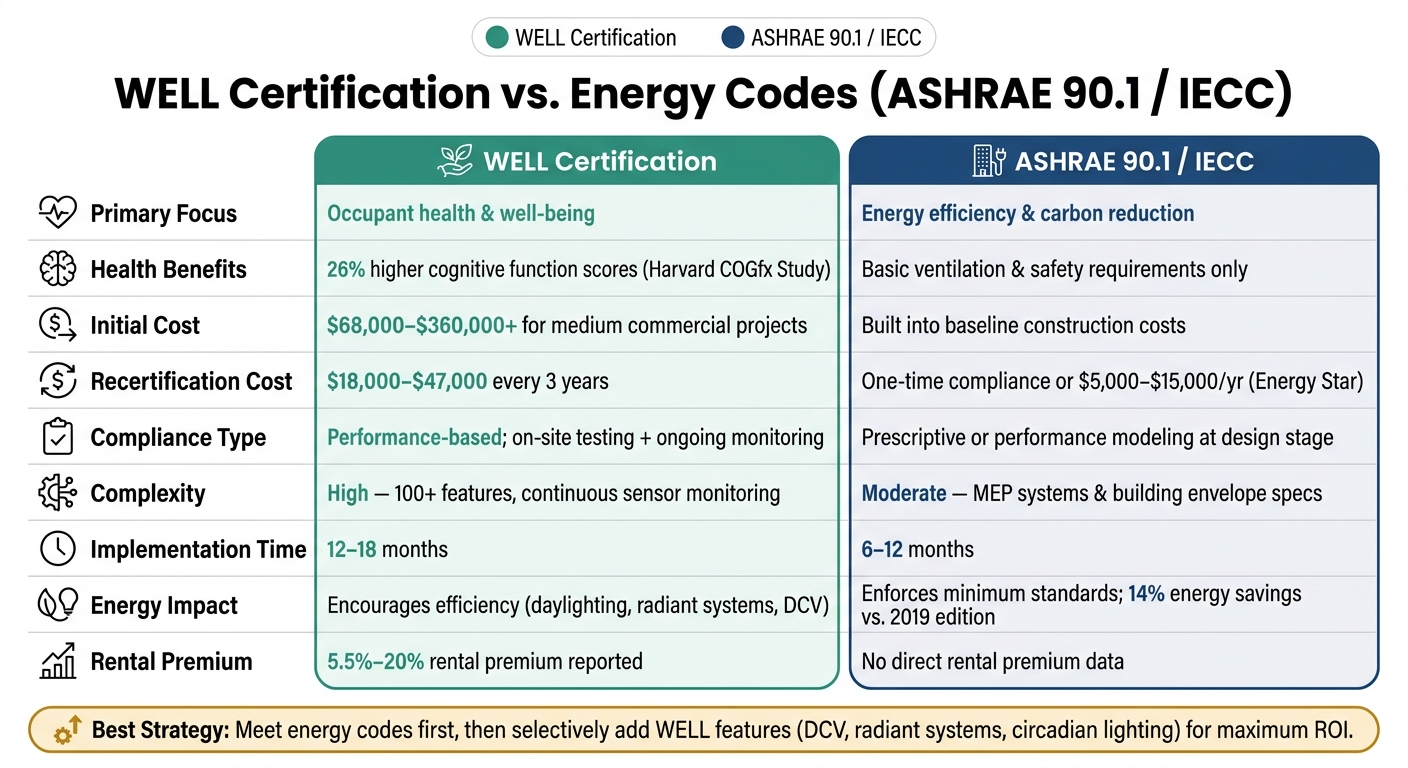
WELL Certification vs. Energy Codes: Cost, Compliance & Health Impact
When comparing WELL Certification with standard energy codes, it's clear that each offers unique benefits and challenges. These differences highlight how each approach aligns with specific project goals, whether prioritizing occupant well-being or energy efficiency.
WELL Certification stands out for its comprehensive scope. It goes beyond energy consumption to address air quality, lighting, fitness, and even mental health. This focus directly benefits building occupants. For example, the Harvard COGfx Study revealed that individuals in WELL-certified spaces scored 26% higher on cognitive function tests. Additionally, WELL-certified buildings have seen rental premiums ranging from 5.5% to 20%, offering financial returns beyond just utility savings.
However, this comes with significant costs and operational demands. For a medium commercial project, initial WELL certification can cost between $68,000 and over $360,000, covering registration, consulting, performance testing, and necessary upgrades. Beyond that, maintaining certification requires recertification every three years, which adds another $18,000 to $47,000 per cycle. Unlike standard energy codes, WELL demands ongoing operational monitoring, including calibrated sensors, documented maintenance, and annual air quality reports.
"The design and construction phase gets the plaque on the wall. The operations phase either maintains the performance the plaque claims or quietly lets it degrade until the recertification audit reveals a building that no longer meets the standard." - Dr. Nadia Osei-Bonsu, PhD, WELL AP, BREEAM Assessor, LEED AP
In contrast, standard energy codes like ASHRAE 90.1 or IECC are more straightforward and cost-effective. Compliance is typically a one-time effort during the design and permitting stages, with Energy Star benchmarking costing $5,000 to $15,000 in the first year. These codes focus on mandatory energy performance standards, offering a practical baseline for efficiency without the ongoing operational demands of WELL.
Key Differences at a Glance
| Factor | WELL Certification | ASHRAE 90.1 / IECC |
|---|---|---|
| Primary Focus | Occupant health and well-being | Energy efficiency and carbon reduction |
| Health Benefits | Measurable cognitive and wellness improvements | Limited to basic ventilation and safety requirements |
| Energy Impact | Encourages efficiency through features like daylighting and radiant systems | Enforces minimum energy performance standards |
| Compliance Type | Performance-based; requires on-site testing | Prescriptive or performance modeling during design |
| Complexity | High - over 100 features, continuous monitoring | Moderate - focuses on MEP systems and building envelope specs |
| Initial Cost | $68,000–$360,000+ for medium commercial projects | Built into baseline construction costs |
| Recertification | Every 3 years; $18,000–$47,000 per cycle | One-time compliance (codes) or annual data submission (Energy Star) |
| Implementation Time | 12–18 months | 6–12 months |
Standard energy codes serve as a practical foundation - mandatory, cost-effective, and focused on measurable efficiency. On the other hand, WELL is more ambitious, voluntary, and resource-intensive but offers proven benefits for occupants. Many projects find success by meeting energy codes first, then incorporating select WELL features that deliver clear returns, such as improved ventilation, daylighting, or better acoustics.
Conclusion
WELL Certification and energy codes like ASHRAE 90.1 and IECC work hand in hand: energy codes establish efficiency benchmarks, while WELL focuses on improving health outcomes for building occupants.
To create spaces that are both energy-efficient and health-conscious, the best strategy is to first meet energy code requirements and then selectively incorporate WELL features that provide overlapping advantages. Here are some practical examples:
- Demand Controlled Ventilation (DCV): Installing CO₂ sensors at a height of 4–6 feet ensures ventilation activates only when necessary, keeping CO₂ levels below 800 ppm in spaces of 500 ft² or larger. This approach aligns with WELL's air quality standards and ASHRAE 62.1 ventilation guidelines, all while cutting unnecessary HVAC energy consumption.
- Radiant Heating and Cooling Systems: Recognized by the Department of Energy as more efficient than forced-air systems, radiant heating and cooling improve comfort without circulating allergens. Covering at least 50% of regularly occupied floor areas with radiant systems supports energy efficiency and occupant wellness simultaneously.
Another efficient approach is combining LEED and WELL certifications. Using the LEED + WELL crosswalk, facility teams can repurpose energy documentation already prepared for ASHRAE 90.1 compliance, reducing the burden of additional paperwork.
For buildings with recirculated air systems serving more than 10 occupants, adding UV Germicidal Irradiation (UVGI) or activated carbon filtration can further enhance air quality. Routine annual maintenance ensures continued performance and compliance.
By adopting WELL features like DCV, radiant systems, and leveraging tools like the LEED + WELL crosswalk, facilities can create healthier indoor environments without compromising energy efficiency. This balanced approach ensures buildings remain cost-effective, energy-efficient, and supportive of occupant well-being. Facility managers and engineers can use these strategies to meet modern demands for energy and health optimization.
For electrical components to support these upgrades, check out Electrical Trader.
FAQs
Is WELL worth the extra cost?
WELL certification can be a smart investment when you consider the potential benefits. Buildings with this certification often see rental premiums of 4–7%, which can significantly boost revenue. Additionally, it helps with better tenant retention, reducing turnover costs. It’s also linked to increased productivity among occupants and operational savings over time. These perks often outweigh the initial costs, especially when factoring in the improvements to health and wellness for those using the space.
Do WELL features make energy code compliance harder?
WELL features generally align smoothly with energy code compliance. Their primary focus is on promoting occupant health and well-being rather than drastically altering energy use. The more energy-demanding aspects tend to involve systems such as air quality, water quality, lighting, and thermal comfort. These systems are crafted to improve building performance while staying in harmony with existing energy regulations.
What equipment upgrades do WELL and ASHRAE 90.1 usually require?
WELL and ASHRAE 90.1 standards often recommend improvements such as upgraded HVAC systems, enhanced airtightness, optimized glazing ratios, natural ventilation, advanced air purification technologies, and energy-efficient lighting and thermal systems. These updates are designed to create a balance between reducing energy consumption and promoting healthier indoor spaces.