

ENERGY STAR Certification: Steps for Regional Facilities
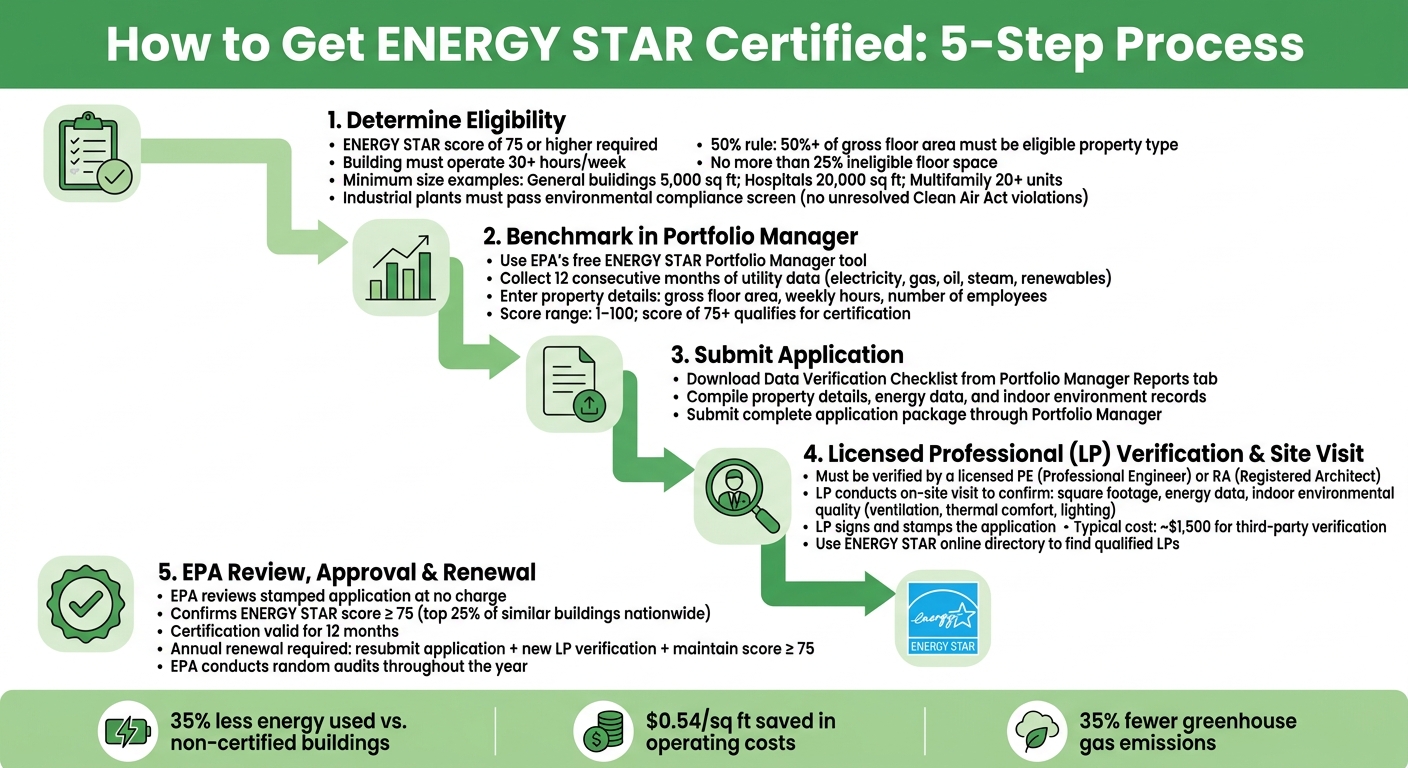
ENERGY STAR certification is a trusted way for facilities to cut energy costs and show leadership in energy efficiency. Buildings need a score of 75 or higher on the EPA’s Portfolio Manager tool to qualify. Certification lasts 12 months and involves benchmarking energy use, third-party verification, and EPA review. Here's a quick summary of the process:
- Eligibility: Confirm your building type qualifies and meets minimum size, use, and energy data requirements.
- Benchmarking: Use the Portfolio Manager tool with 12 months of utility data to calculate your ENERGY STAR score.
- Verification: A licensed professional (PE or RA) inspects your facility to confirm data accuracy and compliance.
- Application: Submit your verified application through Portfolio Manager for EPA review.
- Renewal: Certification is valid for one year; reapply annually to maintain it.
Certified buildings use 35% less energy and save $0.54 per square foot in operating costs. The process costs around $1,500 for third-party verification but has long-term savings and credibility benefits. Start with benchmarking to determine your score and take steps to improve if needed.
ENERGY STAR Certification Process: 5 Steps to Get Certified
How to Apply for Energy Star Certification
sbb-itb-501186b
Step 1: Determining Eligibility for ENERGY STAR Certification
Before diving into the certification process, it's essential to confirm that your facility meets the necessary qualifications. Eligibility requirements differ depending on the type of building, with specific criteria related to size, usage, and energy data. Here's what you need to know to ensure your facility qualifies.
Key Eligibility Criteria
To qualify, your facility must achieve an ENERGY STAR score of 75 or higher, which indicates strong energy performance. However, this score is only possible if your building complies with certain structural eligibility rules.
One common hurdle for mixed-use facilities is the EPA's "50% rule". This rule states that more than 50% of a building’s gross floor area (excluding parking) must fall under an eligible property type to qualify for a score. Additionally, no more than 25% of the total floor space can consist of ineligible property types, and parking areas - whether enclosed or open - cannot exceed the building’s total gross floor area.
Most facilities must also operate for at least 30 hours per week and have at least one on-site worker during the main shift. Below are the minimum size requirements for different property types:
| Property Type | Minimum Size/Requirement |
|---|---|
| General Buildings | 5,000 sq. ft. (1,000 sq. ft. for offices, warehouses, K-12 schools) |
| Hospitals | 20,000 sq. ft. and at least 1 staffed bed |
| Multifamily Housing | At least 20 units |
| Religious Worship Facilities | 25 to 4,000 seats |
| Wastewater Treatment Plants | Average daily flow > 0.6 million gallons per day |
| Data Centers | No square-foot minimum |
For industrial plants, eligibility is determined using Energy Performance Indicators (EPIs) and compliance with environmental regulations. Facilities must pass an environmental compliance screen, which means no unresolved high-priority Clean Air Act violations or criminal convictions under the Clean Air Act within the past five years.
Regional Considerations
The EPA adjusts ENERGY STAR scores to account for regional weather differences, ensuring fair comparisons across various climates and operational conditions. Certain facility types, such as auto assembly plants, cement plants, and commercial bakeries, are eligible for certification in both the U.S. and Canada. This dual eligibility can make compliance planning easier for facilities near the border or those with cross-border operations.
Step 2: Benchmarking in ENERGY STAR Portfolio Manager
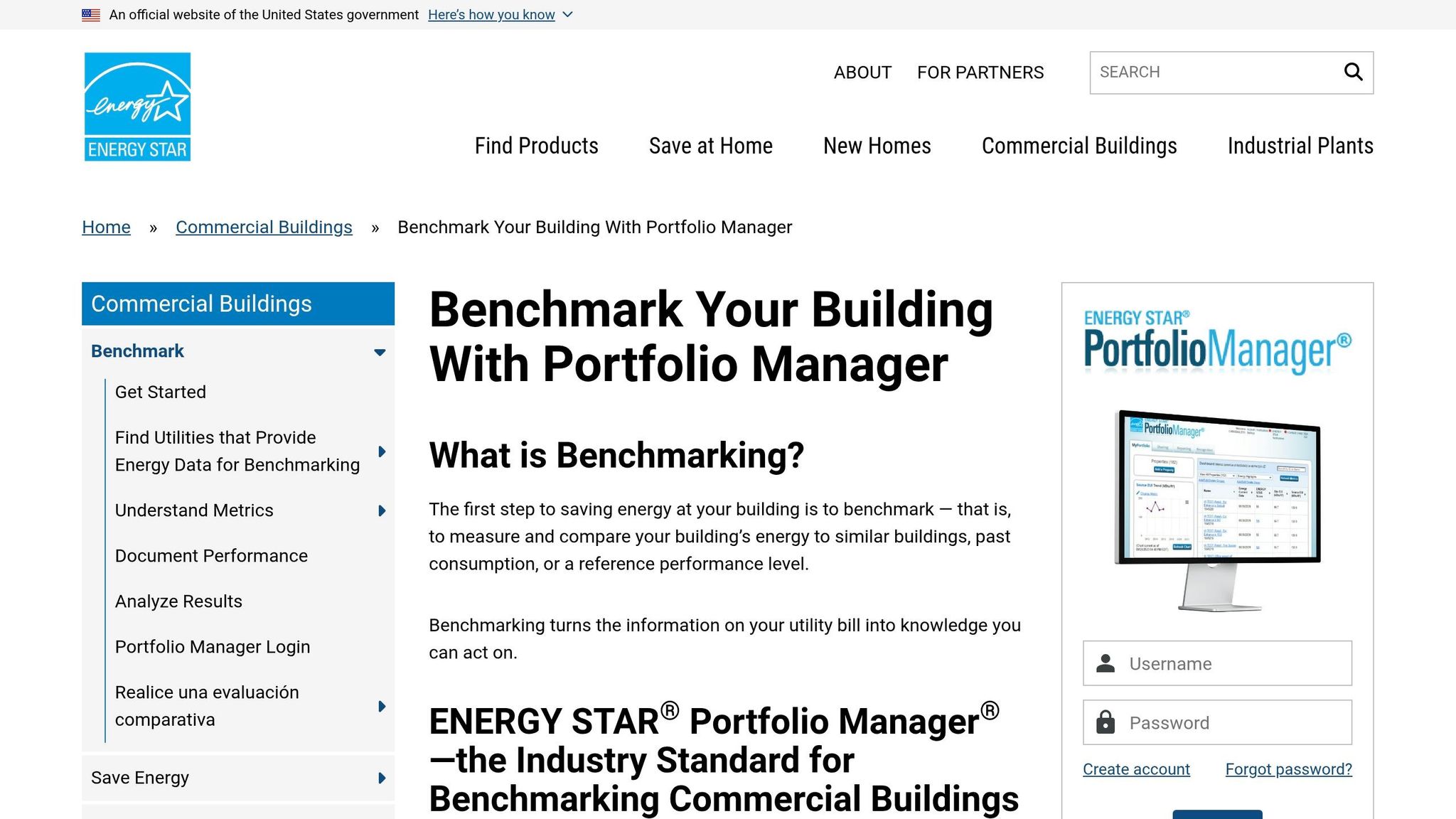
Once you've confirmed your facility's eligibility, the next step is to benchmark its energy performance using the ENERGY STAR Portfolio Manager. This free online tool from the EPA helps track and compare energy use across buildings. Your benchmark score is critical - it determines if your facility qualifies for certification - so accuracy is key.
Gathering Required Data
Before diving into the tool, start by collecting your data offline. The EPA provides a Portfolio Manager Data Collection Worksheet that outlines exactly what you'll need based on your property type. Downloading this worksheet can save time and help you stay organized.
"Use this tool to look up the data needed to benchmark your property in Portfolio Manager. Additionally, you can create a PDF with this information that you can use as a data collection worksheet." - ENERGY STAR
At a minimum, you'll need 12 consecutive months of utility bills for all fuel types used in the building - electricity, natural gas, oil, steam, and any onsite renewable energy. Incomplete or partial data won't cut it. It's also essential to account for the entire building's energy consumption, even if different entities pay the bills.
In addition to energy usage, gather key property use details like the building's gross floor area (in square feet), weekly operating hours, and the number of employees on the main shift. These inputs are crucial, as they directly influence your benchmark score.
Once everything is ready, you can start entering the data into Portfolio Manager.
Inputting Data into Portfolio Manager
Begin by creating a free account on Portfolio Manager and adding your property. Start with property use details, then move on to setting up individual energy meters for each fuel type. For facilities on a shared campus with multiple buildings, the EPA offers a "How to Benchmark a Campus" guide. This resource explains how to handle shared metering and building-level associations - a necessary step to ensure accurate benchmarking for campus-style setups.
For those managing larger portfolios, spreadsheet upload templates are available. These templates allow you to input property and energy data in bulk, which not only saves time but also minimizes manual entry errors.
Once all the data is entered, Portfolio Manager calculates your ENERGY STAR score, ranging from 1 to 100. A score of 75 or higher means your facility is eligible to proceed with the certification application.
Step 3: Application and Verification Process
Once your facility achieves an ENERGY STAR score of 75 or higher, it’s time to move forward with the formal application process. Building on the benchmarking results from Step 2, this phase includes submitting your application through the ENERGY STAR Portfolio Manager and having it verified by a licensed professional.
Submitting the Application in Portfolio Manager
The ENERGY STAR Portfolio Manager is where you’ll compile and submit your application. This platform organizes your property details, energy consumption data, and other relevant information into a complete application package. Before involving a licensed professional, download the Data Verification Checklist from the Reports tab in Portfolio Manager. This checklist helps you pinpoint any missing or inconsistent data, ensuring everything is in order. The information you gathered during benchmarking will be reviewed again here.
Once your application is submitted, the next step is verification by a licensed professional.
Role of a Licensed Professional
Every ENERGY STAR application must be reviewed, signed, and stamped by a Licensed Professional (LP), which can be a Professional Engineer (PE) or a Registered Architect (RA) licensed in the U.S. or Canada.
"You'll need to get your application verified and stamped by a licensed Professional Engineer (PE) or Registered Architect (RA). This means they'll need to sign off on a few things in your application: your property use characteristics (including square footage of the building), your energy data, and whether each of the indoor environment criteria has been met." - ENERGY STAR
The LP’s role is more than just signing off on your application. It involves conducting an on-site visit to inspect the facility, verify square footage, confirm energy data, and ensure that indoor environment standards are met. They also need to be familiar with ASHRAE Standards 55 and 62.1, as well as the IESNA Lighting Handbook.
The cost for third-party LP verification is typically around $1,500. However, if your organization has an in-house PE or RA, you can use them to save on expenses. Alternatively, you can use the ENERGY STAR online directory to find LPs in your area with experience in certification.
"The credibility and integrity of ENERGY STAR rests on the validation that licensed professionals provide." - ENERGY STAR
Step 4: Site Visit and Documentation
This step ensures that the information submitted in Portfolio Manager matches the actual conditions of your building. With your application submitted and a Licensed Professional (LP) on board, the next step involves a physical site visit to verify the data you’ve provided.
On-Site Verification Requirements
During the site visit, your LP - either a Professional Engineer (PE) or a Registered Architect (RA) - will confirm key aspects of your building, including property use, total energy consumption, and adherence to indoor environmental quality (IEQ) standards.
The LP will ensure that all energy sources - like electricity and natural gas - are fully accounted for to verify total energy use.
Indoor environmental quality is another critical focus. The LP will check that your building meets standards for outdoor air ventilation, thermal comfort, and lighting levels. If any of these requirements are not met, the certification process may be delayed. Addressing ventilation and lighting issues ahead of time can help avoid setbacks.
For industrial plants, there’s an additional requirement: the PE must complete a Professional Engineer Checklist and stamp the Statement of Energy Performance. Additionally, plants must have no unresolved high-priority violations of the Clean Air Act to remain eligible.
After completing these checks, the LP will stamp your application, allowing it to move forward to EPA review.
Supporting Documentation Checklist
Once the on-site data has been verified, you’ll need to prepare the following materials for the EPA review process:
| Documentation Category | Key Items to Prepare |
|---|---|
| Property Use Details | Gross floor area, weekly operating hours, and number of workers |
| Energy Consumption | Utility bills covering 12 consecutive months for all energy sources |
| Indoor Environment | Records confirming compliance with ventilation, thermal comfort, and lighting standards |
| Verification Records | A signed and stamped application by a licensed PE or RA |
Once your LP stamps the application, it’s ready to move on to Step 5: EPA review.
Step 5: Approval, Certification Period, and Renewal
EPA Review and Approval Process
Once your Licensed Professional stamps the application, the EPA takes over for the final review. During this stage, the EPA ensures that your ENERGY STAR score is at least 75, demonstrating that your facility operates more efficiently than 75% of comparable buildings in the U.S..
"To earn the ENERGY STAR, eligible commercial buildings must earn a 1–100 ENERGY STAR score of 75 or higher - indicating that they operate more efficiently than at least 75% of similar buildings nationwide." – ENERGY STAR
For industrial plants, the process includes an environmental compliance screen. To qualify, industrial plants must meet the following conditions:
- No unresolved Clean Air Act violations.
- No CAA Consent Decrees in the past year.
- No criminal environmental convictions in the past five years.
Before submitting your application, it's a good idea to confirm your compliance status directly with the EPA by emailing certifiedplants@energystar.gov. Doing so can prevent delays or issues later on.
There’s no fee for EPA certification. However, you’ll need to plan for the cost of Licensed Professional verification, which typically costs around $1,500 for an average commercial building.
Once the EPA approves your application, the focus shifts to maintaining your certification during the active period.
Maintaining Certification
After receiving EPA approval, it’s important to know that certification is valid for 12 months.
"Assuming the building checks out, then it becomes ENERGY STAR certified for a period of 12 months. After the 12-month period, if a facility wants to retain its certification, it must go through the scoring and application process again to demonstrate that it has sustained top performance." – ENERGY STAR
To remain certified, your facility must reapply annually, complete another third-party verification by a Licensed Professional, and maintain a score of 75 or higher. The EPA also conducts random audits of certified buildings throughout the year, so keeping your documentation well-organized is crucial.
Treat the annual renewal as an opportunity to review your facility’s performance. It’s a chance to catch potential issues like billing errors or data discrepancies while ensuring that your operations remain efficient. To avoid any certification lapses, schedule the Licensed Professional visit well in advance of your certification's expiration date.
Using ENERGY STAR Certification to Improve Long-Term Efficiency
ENERGY STAR certification isn’t just a one-time achievement - it’s an invitation to keep improving. Once certified, facilities can enter a cycle of continuous upgrades, leading to operational savings that grow over time. This is especially impactful for larger facilities with hefty energy demands. A smart way to build on these savings? Focus on upgrading key equipment.
Sourcing Energy-Efficient Equipment
Protecting your ENERGY STAR score between renewals often starts with upgrading energy-intensive systems. The EPA suggests a clear sequence for these upgrades: begin with retrocommissioning existing systems, then move on to lighting, supplemental loads, air distribution, and, finally, heating and cooling equipment. This step-by-step approach allows facilities to reinvest their early savings into subsequent upgrades instead of shouldering all costs upfront.
For facilities working within tighter budgets, sourcing both new and pre-owned electrical components - like transformers, breakers, and power distribution equipment - can help stretch resources further. Platforms like Electrical Trader offer a marketplace for buying and selling these components, making it easier to access energy-efficient equipment without committing to the cost of brand-new hardware.
Sustainability and Brand Value
ENERGY STAR certification does more than reduce energy bills - it enhances your facility’s market appeal. Certified buildings often see higher rental and occupancy rates compared to their non-certified peers, giving facility owners a clear competitive edge.
"ENERGY STAR certified buildings save energy, save money, and help protect the environment." – ENERGY STAR
This certification sends a strong message to tenants, investors, and the community: your facility is serious about environmental responsibility. In some cases, maintaining ENERGY STAR certification is even a legal requirement for leasing space to federal agencies. Whether it’s about meeting regulations or boosting your brand’s reputation, the certification offers a trusted, third-party endorsement of your commitment to sustainability.
Conclusion: Next Steps Toward ENERGY STAR Certification
To achieve ENERGY STAR certification, follow these key steps: benchmark your energy use, aim for a score of 75 or higher, complete the licensed professional (LP) verification, and submit your application. The best part? The EPA doesn't charge an application fee, and while third-party verification typically costs around $1,500, it's a small price for the long-term benefits in energy savings and operational efficiency.
Each step - from confirming eligibility to securing site verification - lays the groundwork for meaningful improvements. Why aim for ENERGY STAR certification? Certified office buildings consume 35% less energy, produce 35% fewer greenhouse gas emissions, and save $0.54 per square foot in operational costs compared to non-certified buildings. These savings can quickly add up, particularly for larger facilities. Keep in mind, certification is awarded on an annual basis, so reapplying each year ensures ongoing recognition and sustained performance.
The journey starts with accurate benchmarking. If your score is below 75, don't worry - the EPA offers "save energy" resources to help you improve. Many buildings can cut energy use by up to 30% by following the EPA's five-stage approach. The sooner you begin tracking your energy use, the sooner you'll have the insights needed to take the next step toward certification.
FAQs
What if my building scores below 75?
If your building scores below 75 on the ENERGY STAR scale, it doesn’t qualify for certification just yet. To boost your score, start by reviewing your energy data, property use details, and how your building stacks up regionally. Look for areas where efficiency can be improved. Implement strategies to reduce energy use and benchmark your building’s performance over time. Once you’ve made progress, you can reapply for certification.
How do I handle shared meters or multiple tenants?
The information provided doesn’t outline specific steps for handling shared meters or multiple tenants during the ENERGY STAR certification process. For tailored advice, it’s best to consult official ENERGY STAR resources or reach out to a licensed professional with experience in certification. They can offer guidance on navigating unique scenarios, such as shared utilities or tenant-related arrangements.
What does the PE/RA verify during the site visit?
During the site visit, the PE/RA checks property details, evaluates indoor environmental standards, and confirms how the property is being used. They also conduct a detailed review of the building's energy consumption to confirm it meets the requirements for ENERGY STAR certification.