

CEM vs. ISO 50001 Certification: Key Differences
CEM (Certified Energy Manager) and ISO 50001 certification are two distinct paths in energy management. Here’s the key takeaway: CEM focuses on individuals, validating expertise in energy auditing, technical analysis, and energy systems. Meanwhile, ISO 50001 is for organizations, offering a framework to improve energy performance systematically. Choosing between them depends on whether you’re advancing your career or optimizing an organization’s energy use.
Key Points:
-
CEM Certification:
- For professionals like energy managers, engineers, and consultants.
- Requires education, experience, a training course, and an exam.
- Offers career growth, higher salaries (median: $100,000–$150,000), and leadership opportunities.
- Focuses on individual skills in energy audits, HVAC systems, and financial analysis.
-
ISO 50001 Certification:
- For organizations of any size aiming to reduce energy costs and emissions.
- Uses the Plan-Do-Check-Act (PDCA) cycle to improve energy systems.
- Requires developing an Energy Management System (EnMS) and third-party audits.
- Helps achieve measurable energy savings (10% or more) and aligns with sustainability goals.
Quick Comparison:
| Feature | CEM (Certified Energy Manager) | ISO 50001 Certification |
|---|---|---|
| Target Audience | Individual professionals | Organizations and facilities |
| Focus | Technical expertise | Systematic energy management |
| Outcome | Career growth, higher earning potential | Reduced energy costs, improved systems |
| Process | Training, exam, certification | Develop EnMS, third-party audit |
| Cost | $2,500–$5,500 (training + exam fees) | Varies based on organization size |
Both certifications can complement each other. CEMs often lead ISO 50001 implementation in organizations, combining technical skills with systemic energy management. Whether you’re an individual or part of an organization, understanding these certifications can guide your energy management goals.
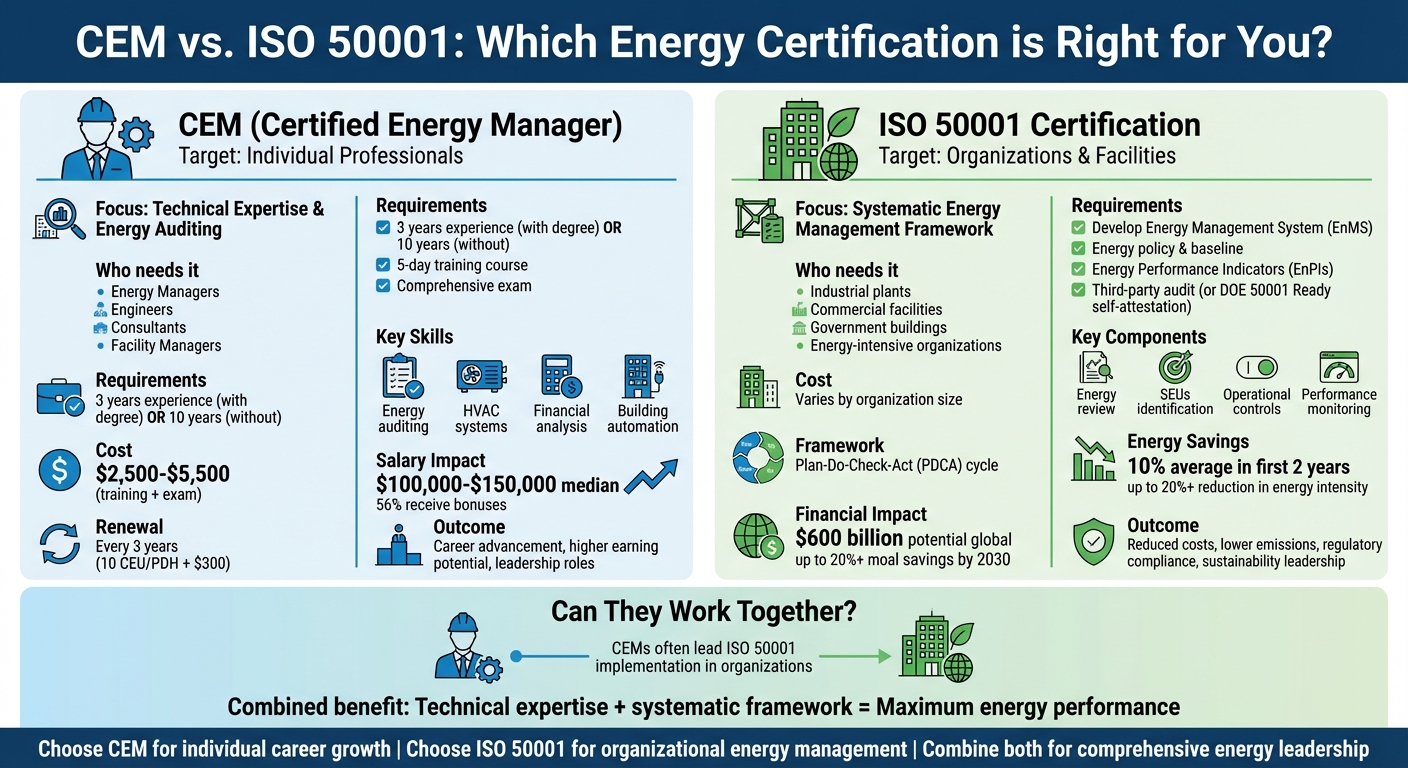
CEM vs ISO 50001 Certification Comparison Chart
What is CEM Certification?
Definition and Purpose
The Certified Energy Manager (CEM) certification, issued by the Association of Energy Engineers (AEE), is a credential that demonstrates expertise in improving energy performance for facilities, buildings, and industrial plants. It is widely regarded as a benchmark for energy management professionals.
"The Certified Energy Manager (CEM) is the industry's most respected certification, empowering professionals to cost-effectively progress on sustainability goals and help organizations become more cost competitive." - Association of Energy Engineers (AEE)
This certification is accredited under the ANSI/ISO/IEC Standard 17024 for personnel certification. It is often a requirement for various government programs and licenses, such as the U.S. Navy's energy manager standards and Kenya's Energy Auditor License. Additionally, the U.S. Department of Energy recognizes CEM-certified professionals as "Energy Skilled" for areas like Multifamily Home Energy Audits.
Core Areas of Expertise
CEM professionals focus on comprehensive systems analysis across electrical, mechanical, process, and building infrastructure to deliver cost-effective energy solutions. Their expertise spans several key areas:
- Energy Auditing: Using instrumentation and Level I protocols.
- Building Systems: Optimizing HVAC and lighting systems.
- Industrial Systems: Managing boilers, steam processes, and other machinery.
- Electrical Power Systems: Including motors and grid integration.
- Sustainability Practices: Addressing decarbonization and renewable energy integration.
- Financial Analysis: Covering energy accounting, life cycle costing, and ROI calculations.
CEMs are equipped with both practical skills, like conducting audits, and advanced knowledge in technologies such as building automation and AI. They also analyze energy rates and tariffs, calculate Net Present Value (NPV), and design strategies for energy storage and renewable energy systems. This broad skill set allows them to uncover energy-saving opportunities across an organization’s operations.
Who Should Pursue CEM?
The CEM certification is tailored for professionals like energy managers, facility managers, energy engineers, sustainability consultants, building owners, and project developers. Eligibility requirements vary based on educational background:
- Those with a four-year engineering or architectural degree (or a Professional Engineer/Registered Architect license) need at least three years of relevant experience.
- Professionals without a degree must have 10 or more years of related work experience.
Candidates must complete a five-day preparatory course, which costs between $2,000 and $5,000, pass a comprehensive exam, and pay a $500 fee (with a $250 fee for retakes). To keep the certification active, holders must renew every three years by earning 10 Continuing Education Units (CEU) or Professional Development Hours (PDH) and paying a $300 renewal fee.
In some regions, the CEM certification is legally required. For example, Kenya’s Energy Act of 2012 mandates the CEM for those applying to become licensed Energy Auditors. Similarly, Philadelphia’s Building Energy Performance Policy requires large non-residential buildings to employ a "qualified tune-up specialist", which includes Certified Energy Managers.
Having outlined the individual expertise validated by CEM, the next focus shifts to ISO 50001 certification, which centers on organizational energy management systems.
sbb-itb-501186b
What is ISO 50001 Certification?
Definition and Scope
ISO 50001:2018 is an international standard designed to help organizations establish, implement, maintain, and improve an Energy Management System (EnMS). Unlike CEM certification, which focuses on validating individual expertise, ISO 50001 is all about creating effective systems within organizations. An EnMS, as defined by ISO 50001, is a framework of processes that enables organizations to use data to enhance energy performance - covering areas like energy efficiency, usage, and consumption.
One standout feature of ISO 50001 is its emphasis on actual energy performance improvement, not just upgrading management systems. The standard is technology-neutral, meaning organizations can set their own energy performance goals while working within its framework. It also follows a High Level Structure (HLS), making it compatible with other standards like ISO 9001 and ISO 14001.
Key Features of ISO 50001
ISO 50001 is built around the Plan-Do-Check-Act (PDCA) cycle, which drives continuous improvement. Here's how the cycle works:
- Plan: Conduct an energy review, pinpoint major energy uses, and establish performance baselines and indicators.
- Do: Implement action plans and operational controls.
- Check: Monitor energy performance to ensure progress.
- Act: Use results to make corrective adjustments and refine the system.
"An energy management system is a series of processes that enables people of varied responsibilities across an organization to use data and information to maintain and improve energy performance, while improving operational efficiencies, decreasing energy intensity, and reducing environmental impacts." - U.S. Department of Energy
Another key requirement of ISO 50001 is the development of Energy Performance Indicators (EnPIs). These indicators help organizations track progress against their energy performance baselines, ensuring improvements are measurable and verifiable. The 2018 version of the standard is structured around 10 main components, including Scope, Leadership, Planning, and Performance Evaluation. Top management plays a crucial role in aligning the EnMS with the organization’s broader strategic goals.
This structured approach makes ISO 50001 flexible enough to meet the needs of a wide variety of organizations.
Who Should Implement ISO 50001?
ISO 50001 is designed for any organization, regardless of size, sector, or location. However, it’s particularly beneficial for energy-intensive industries, where energy costs account for a significant portion of expenses. Examples of suitable organizations include industrial plants, commercial facilities, government buildings, and utility companies.
Real-world examples highlight its effectiveness. For instance, Delta Electronics in China implemented ISO 50001 in 2011, reducing power consumption by 10.51 million kWh in one year. This led to a reduction of 10,200 tons of carbon emissions and saved the company $1.2 million. Similarly, Sheffield Hallam University in the UK cut carbon emissions by 11%, saving over $160,700 annually. In India, the Dahanu Thermal Power Station in Maharashtra is projected to save $1.7 million annually by improving energy efficiency.
Organizations aiming to achieve sustainability goals, lower greenhouse gas emissions, comply with regulations, and control rising energy costs can benefit greatly from ISO 50001. By early 2012, just months after the standard's launch, around 100 organizations across 26 countries had already achieved certification.
What is ISO 50001 Certification? | Energy Management System, Benefits & Process
Focus Areas: CEM vs. ISO 50001
This section highlights the distinct focus areas of CEM and ISO 50001, showing how they differ yet complement one another. While the Certified Energy Manager (CEM) certification emphasizes individual technical expertise, ISO 50001 provides a framework for managing energy at an organizational level.
A Certified Energy Manager is skilled in energy auditing, technical analysis, and engineering solutions, particularly in industrial environments. These professionals play a pivotal role in energy initiatives, performing in-depth assessments and proposing technical improvements. On the other hand, ISO 50001 focuses on organizational energy management, using the Plan-Do-Check-Act (PDCA) cycle. This framework involves creating energy policies, setting baselines, identifying Significant Energy Users (SEUs), and developing Energy Performance Indicators (EnPIs) to measure and track progress across the organization.
In practice, these two approaches work hand in hand. CEMs often act as technical experts or "Energy Officers", leading the implementation of ISO 50001 within their organizations. They bring the specialized skills needed to handle the rigorous documentation and audits required by ISO 50001, while the framework ensures energy management becomes a core part of the organization's operations.
"ISO 50001 is based on the common ISO standard theme of continuous improvement that is based on the Plan Do Check Act (PDCA) model." - Advanced Energy
The scope of their impact also differs. A CEM can deliver improvements through specific projects and audits, while ISO 50001 drives systemic change. Organizations adopting ISO 50001 report an average of 10% energy savings within the first two years. On a global scale, ISO 50001 has the potential to reduce energy consumption by 62 exajoules by 2030, translating to over $600 billion in energy cost savings and avoiding 6,500 megatonnes of CO2 emissions.
Here's a quick comparison of their key differences:
Comparison Table
| Feature | CEM (Certified Energy Manager) | ISO 50001 Certification |
|---|---|---|
| Target Audience | Individual professionals (engineers, managers, consultants) | Organizations, facilities, and institutions |
| Primary Goal | Validate individual technical competency and professional skill | Establish a systematic framework for organizational energy performance |
| Core Framework | Professional knowledge and auditing skills | Plan-Do-Check-Act (PDCA) continuous improvement model |
| Key Components | Energy auditing, technical analysis, manufacturing expertise | Energy policy, baselines, SEUs, and EnPIs |
| Documentation | Personal credentials and exam-based certification | Formal EnMS documentation, records, and internal audit reports |
| Outcome | Career advancement and recognized expertise | Reduced organizational energy costs and GHG emissions |
| Implementation Role | Individual applies knowledge to specific projects | Leadership and employees collaborate on system-wide changes |
This breakdown of focus areas lays the groundwork for exploring the certification processes that help achieve these outcomes.
Certification Requirements and Processes
The paths to CEM certification and ISO 50001 certification are fundamentally different because one focuses on individuals while the other focuses on organizations. Knowing these distinctions can help professionals and businesses determine the best fit for their energy management objectives.
CEM Certification Process
To earn the CEM credential, candidates must meet specific education and experience requirements. Those with a four-year degree in engineering or architecture (or holding a PE/RA license) need at least three years of relevant experience. For individuals without a degree, a minimum of 10 years of professional experience is required. This ensures inclusivity for professionals from various backgrounds.
The certification process includes a mandatory five-day preparatory training course, followed by an exam. Training costs typically range between $2,000 and $5,000, with an additional $500 fee for the application and exam. Once certified, professionals are required to renew their credentials every three years by paying a $300 renewal fee and completing continuing education requirements. Since its inception in 1981, the program has certified over 40,000 professionals across more than 100 countries, showcasing its global reach.
"The CEM certification is recognized and respected by top companies, organizations, and peers worldwide." - Association of Energy Engineers
ISO 50001 Certification Process
Unlike CEM certification, ISO 50001 focuses on organizational systems rather than individual expertise. Organizations pursuing this certification must develop a robust energy management system (EnMS). The process begins with establishing the necessary infrastructure, which includes crafting an energy policy supported by top management, appointing a management representative, forming a cross-functional team, and defining the boundaries of the EnMS.
The technical steps involve conducting an energy review to pinpoint major energy uses, setting an energy baseline, and defining measurable energy performance indicators (EnPIs). Certification is granted after third-party audits conducted by ANAB-accredited bodies. Alternatively, the Department of Energy (DOE) offers the "50001 Ready" program, which allows organizations to implement the system at their own pace and self-attest without needing third-party audits. Costs for ISO 50001 certification depend on the certification body and the cost of purchasing the standard.
"ISO 50001 does require continual energy performance improvement but it does not include prescriptive energy performance improvement goals." - U.S. Department of Energy
Career and Business Benefits
Career Benefits of CEM
Earning a CEM certification can significantly increase both earning potential and career opportunities. In the U.S., the median salary for AEE-certified energy professionals ranges between $100,000 and $150,000, far surpassing the $80,060 median salary for environmental scientists and specialists as of May 2024 [21, 23]. Additionally, in 2019, 56% of certified energy professionals reported receiving performance bonuses.
This certification also opens doors to leadership positions like Sustainability Director or Facilities Director, as well as lucrative consulting roles. The field is poised for growth, with a projected 4% increase through 2034, translating to about 8,500 new jobs annually.
"Gaining a recognized certification helps you overcome barriers, whether that's expanding your knowledge, gaining customer trust, demonstrating competence, or leading future developments to save energy."
- Association of Energy Engineers (AEE)
Beyond individual career advancements, certifications like CEM also contribute to organizational success.
Business Benefits of ISO 50001
For businesses, ISO 50001 certification delivers measurable operational improvements. Companies with structured Energy Management Systems (EnMS) have reported energy intensity reductions exceeding 20%. A striking example is the 3M Canada Brockville plant, which achieved 25% greater energy savings and cut energy costs by $350,000 within two years of obtaining ISO 50001 certification in 2012.
This certification not only helps organizations meet regulatory requirements but also positions them as leaders in sustainability, appealing to stakeholders. Its compatibility with other ISO standards, such as ISO 9001 and ISO 14001, allows businesses to integrate energy management into existing processes seamlessly, avoiding the need for separate systems [24, 1].
"The value of certification will be driven by market forces within supply chains, potential utility incentive programs requiring ISO 50001, and the standard's relation to future carbon mitigation policies."
- U.S. Department of Energy
Together, these certifications highlight how professional credentials and structured frameworks can drive both career growth and business performance.
Benefits Comparison Table
| Feature | CEM Certification | ISO 50001 Certification |
|---|---|---|
| Primary Target | Individual Professionals | Organizations/Facilities |
| Core Benefit | Higher salary and career mobility | Operational efficiency and cost savings |
| Financial Impact | $100,000–$150,000 median U.S. salary | 20%+ reduction in energy costs |
| Career Impact | Enables leadership and consulting roles | Supports compliance and auditing roles |
| Focus Area | Technical systems and energy auditing | Management frameworks and data reporting |
| Typical Roles | Energy Manager, Sustainability Director | EnMS Lead, Internal Auditor, CEO/COO |
Conclusion
This article has highlighted the importance of both personal credentials and structured frameworks in the field of energy management. Deciding between CEM certification and ISO 50001 depends on whether your focus is on personal career growth or implementing organizational change. The CEM certification validates expertise in energy management, auditing, and facility optimization, making it a key credential for professionals such as Energy Managers, Sustainability Directors, and consultants. On the other hand, ISO 50001 provides a structured framework that helps organizations reduce energy costs, lower emissions, and embed efficiency into their daily operations.
For individuals, earning a CEM certification can lead to career advancement, higher salaries, and recognition in areas like technical energy analysis and project management. While personal credentials elevate individual expertise, ISO 50001 drives systemic improvements within organizations. Companies adopting ISO 50001 often report energy performance improvements of about 10% and significant cost savings.
"ISO 50001 provides a framework for organizations to make positive contributions toward reducing depletion of energy resources and mitigating worldwide effects of energy use... while improving the efficiency of organizational operations."
- U.S. Department of Energy
Combining CEM certification with an ISO 50001 Lead Auditor certificate can create a well-rounded profile for those pursuing advanced energy management roles. For organizations not ready for full third-party audits, the "50001 Ready" program offers a self-paced approach to implementing the ISO 50001 framework. Both certifications have demonstrated significant impact, with energy savings reaching up to 30% in industrial settings and 40% in commercial buildings.
FAQs
Which certification should I pursue first: CEM or ISO 50001?
The ISO 50001 certification is a great starting point. It offers a structured approach to energy management, helping organizations cut costs and boost efficiency. Gaining this certification first can also lay the groundwork, making it simpler to pursue the CEM credential down the road.
How long does it take to get CEM certified or achieve ISO 50001 certification?
The time required to earn a CEM certification largely depends on how prepared you are. Generally, it involves completing a training course and passing the exam - this process can take a few months. On the other hand, earning ISO 50001 certification depends on an organization's level of readiness and the steps needed for implementation. This can take anywhere from several months to over a year.
Can a small business implement ISO 50001 without a full-time energy team?
ISO 50001 is structured to be practical for businesses of any size, including small ones. It can be incorporated into existing management systems with the help of available tools and guidance. Plus, there’s no need for a dedicated, full-time energy team, which makes it a feasible choice for organizations with fewer resources or staff.