

How to Meet IEC 60068 Compliance
The IEC 60068 standard ensures that electrical and electronic components perform reliably under tough conditions like temperature changes, vibration, and humidity. For U.S. industries like power distribution and manufacturing, meeting these standards helps reduce risks, improve product reliability, and access global markets.
Here’s a quick breakdown of IEC 60068:
- Part 1: General principles for testing, including standard conditions and procedures.
- Part 2: 85 specific tests for stresses like temperature, vibration, and salt mist.
- Part 3: Guides for selecting tests, interpreting results, and verifying equipment.
Key steps for compliance:
- Prepare and mount test specimens properly.
- Calibrate equipment to ISO 17025 standards.
- Document every stage of testing, including conditions and results.
Recent updates (2023 and 2025) emphasize risk-based testing, allowing tests to focus on specific product risks instead of generic conditions. This makes compliance more precise and practical.
For sourcing IEC 60068-compliant components, platforms like Electrical Trader offer verified parts with detailed test reports.
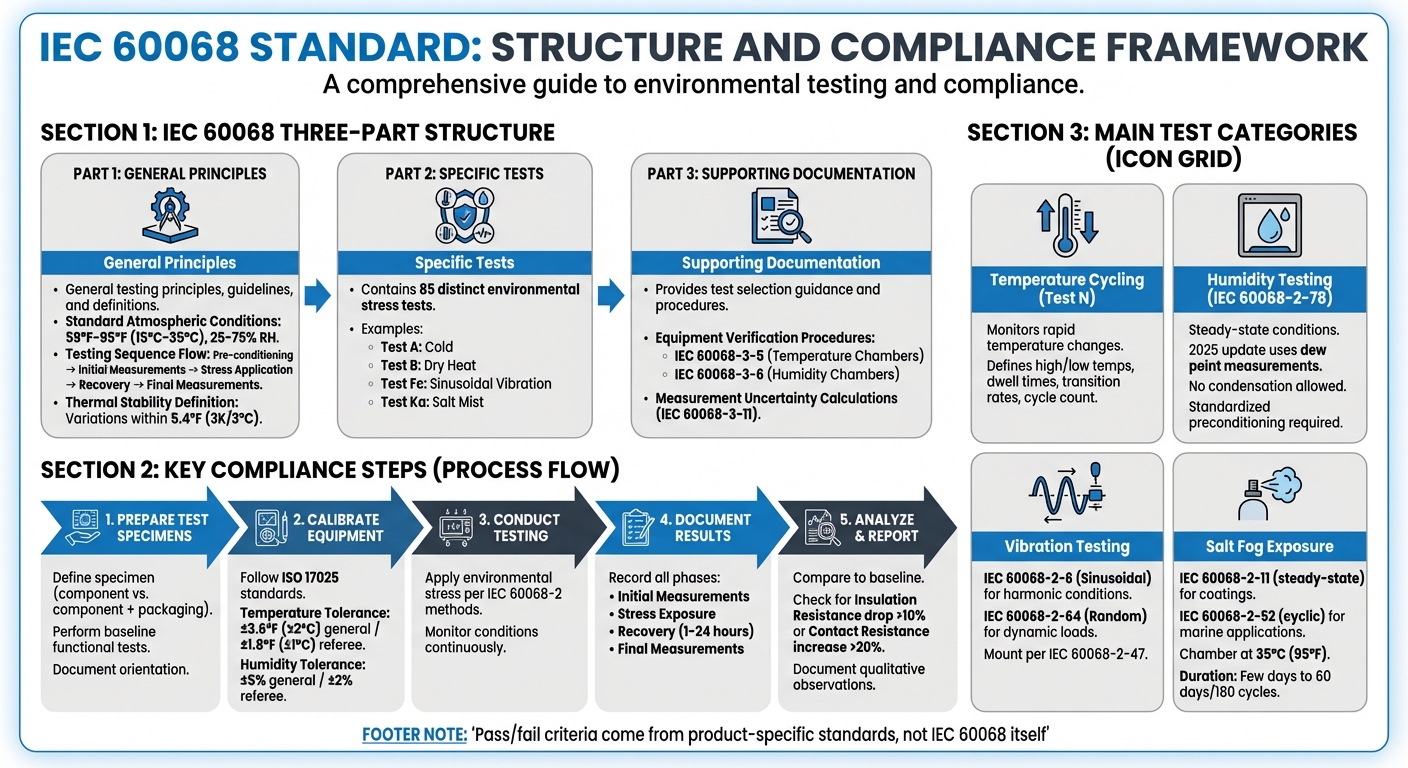
IEC 60068 Standard Structure and Testing Framework Overview
IEC 60068-2-11 Salt Mist Testing Services | Ensuring Electronics Reliability in Harsh Environments
IEC 60068 Structure and Sections
The IEC 60068 framework is divided into three main parts: Part 1 establishes the foundation, Part 2 outlines specific test procedures, and Part 3 provides technical tools to aid in selecting and interpreting tests. Each section plays a distinct role, but it’s important to remember that the criteria for passing or failing a test come from product-specific standards, not from IEC 60068 itself. This separation ensures clarity and targeted guidance for testing processes.
IEC 60068-1: General Guidelines
IEC 60068-1 acts as the core standard, laying out the structure for environmental testing. It specifies the standard atmospheric conditions previously mentioned and defines the testing sequence: pre-conditioning, initial measurements, stress application, recovery, and final measurements. Annex C introduces a process for tailoring tests to reflect specific lifecycle risks. Additionally, this section defines thermal stability - a state where temperature fluctuations remain within 5.4°F (3 K) over a set period.
IEC 60068-2: Specific Test Methods
IEC 60068-2 is the most extensive section, covering 85 distinct environmental stress tests. It includes detailed procedures for tests such as Test A (Cold), Test B (Dry Heat), Test Fc (Sinusoidal Vibration), and Test Ka (Salt Mist). While these methods specify test conditions, the actual pass/fail criteria are determined by the relevant product standards. A key distinction in this section is between heat-dissipating specimens (those with surface temperatures exceeding 9°F above ambient) and non-heat-dissipating specimens, as cooling requirements differ significantly.
IEC 60068-3: Supporting Documentation
IEC 60068-3 offers support for selecting and interpreting test methods. For instance, when choosing between sinusoidal, random, or mixed-mode vibration tests, IEC 60068-3-8 provides guidance to align the test with the product's real-world dynamic environment. This section also includes procedures for verifying the performance of temperature and humidity chambers before starting compliance tests, as outlined in IEC 60068-3-5 and 60068-3-6. Moreover, it details methods for calculating measurement uncertainty in climatic chambers (IEC 60068-3-11), ensuring consistent and reliable results across different laboratories. Together, these documents create a robust framework for accurate compliance testing.
How to Prepare for IEC 60068 Testing
Getting ready for IEC 60068 testing is all about precision and following the required steps. The process involves several key stages: preparing and mounting the test specimen, taking initial measurements under standard conditions, exposing the specimen to environmental stress, allowing a recovery period, and conducting final measurements. Skipping any of these steps can compromise test validity, so attention to detail is critical for compliance.
Selecting and Documenting Test Specimens
Start by clearly defining the test specimen. In some cases, you’ll test just the component; in others, you’ll need to include the component along with its packaging. This distinction determines how the specimen will be mounted and exposed during the testing process.
Perform baseline functional and resonance tests before starting. These initial tests establish the specimen’s condition and serve as a benchmark for identifying any changes or degradation after testing. For items sensitive to orientation - like mercury tilt switches - make sure to test them in their normal service position as outlined in the relevant specification.
Document the test severity levels, including frequency range, duration, and amplitude, based on the specimen’s operational and transport conditions. Additionally, record how the specimen is mounted, following the guidelines in IEC 60068-2-47. To ensure stability, pre-equalize the setup using low-level excitation.
Calibrating Test Equipment
Calibration is a non-negotiable part of the process. All instruments and chambers must be calibrated according to ISO 17025 standards to ensure accuracy and meet the required tolerances. Place sensors in positions that reflect the specimen’s immediate environment. For temperature chambers, refer to IEC 60068-3-5 for guidance, and for temperature/humidity chambers, consult IEC 60068-3-6.
General measurement tolerances include a ±3.6°F (±2°C) margin for temperature and ±5% for relative humidity. For more precise "referee" measurements, these tolerances tighten to ±1.8°F (±1°C) for temperature and ±2% for humidity. Be sure to include all calibration details in your test report. To calculate measurement uncertainties in climatic chambers, use the methods outlined in IEC 60068-3-11.
IEC 60068-2 Tests: Step-by-Step Procedures
IEC 60068-2 outlines tests designed to simulate conditions that products might face in the real world. These tests include temperature cycling, humidity exposure, vibration, and salt fog. Each test follows specific procedures with clearly defined parameters to ensure compliance.
Temperature Cycling Tests (IEC 60068-2-14)
Temperature cycling, also known as Test N, examines how components handle rapid temperature changes rather than prolonged exposure to extreme heat or cold. This is especially important for equipment that moves between indoor and outdoor environments, experiences sudden cooling (like from rain), or operates in unheated spaces like aircraft cargo holds.
Key steps include defining high and low temperatures, dwell times, transition rates, and the number of cycles. Monitoring the specimen's surface or core temperature ensures it meets the required rate of change. For reference, electronics generally operate safely up to 95°F, but even temperatures below overheating thresholds can significantly increase failure rates.
Material properties, such as thermal conductivity, play a critical role in heat transfer and should be factored into the test setup. Once temperature cycling is complete, humidity testing evaluates the impact of moisture on the specimen.
Humidity Testing (IEC 60068-2-78)
Steady-state humidity tests assess how components perform in high-humidity conditions at a constant temperature, ensuring no condensation forms on the specimen. The August 2025 update introduced stricter requirements, replacing "tolerances" with "limits" and incorporating dew point measurements into test severities.
This test is suitable for both small components and large equipment, regardless of whether they generate heat during operation. Before starting, identify whether the specimen dissipates heat, as this affects how temperature and humidity are maintained.
The revised standard also requires a standardized preconditioning procedure to ensure consistent starting conditions. Throughout the test, monitor dew point temperatures closely to avoid condensation, as this is now part of the severity criteria. Post-test inspections focus on detecting moisture ingress, corrosion, and any degradation of protective coatings. Updated reporting requirements ensure consistent documentation of results.
Next, vibration testing addresses mechanical stress caused by movement and transport.
Vibration Testing
Vibration tests replicate the mechanical stresses products face during transport, operation of rotating machinery, or exposure to oscillating forces. Depending on the type of vibration, you can choose between Sinusoidal Vibration (IEC 60068-2-6) for steady harmonic conditions or Broadband Random Vibration (IEC 60068-2-64) for dynamic loads like those experienced during shipping.
"The purpose of this test is to determine any mechanical weakness and/or degradation in the specified performance of specimens."
- IEC 60068-2-6 Standard Description
When setting up, define parameters such as duration, frequency range, and cycle count. Specimens should be mounted according to IEC 60068-2-47 to avoid artificial damping or resonance effects that could skew results. While most tests are conducted on unpackaged specimens to evaluate structural integrity, products can also be tested in their packaging if the packaging is integral to the product.
To ensure reliability, include an additional margin to account for uncertainties in measurements and test conditions. Following this, salt fog tests evaluate resistance to corrosive environments.
Salt Fog Exposure Tests
Salt fog tests measure how well components and protective coatings withstand corrosive conditions typical of salt-heavy environments. There are two main methods: steady-state salt mist (IEC 60068-2-11) for coatings and cyclic salt mist (IEC 60068-2-52) for products exposed to marine or salt-laden air.
For marine applications, IEC 60068-2-52 Method #8 uses an acidified salt solution, which is more severe than standard neutral salt solutions. During the spray phase, maintain the test chamber at 35°C to ensure consistent corrosion rates. This cyclic test also includes a three-day storage period at 21°C to 25°C with relative humidity between 45% and 55% following the salt and humidity cycles. Test durations vary based on severity, ranging from a few days to as long as 60 days (or 180 cycles).
After testing, examine protective coatings for rust and evaluate the condition of joints and internal components, as these are common failure points.
sbb-itb-501186b
How to Document Results and Achieve Certification
Good documentation is the backbone of any compliance effort. Without it, even the most rigorous testing can fail an audit. To stay on track, record every step of the process: specimen preparation, initial measurements, stress exposure, recovery, and final measurements. This structured approach ensures that other laboratories can verify your results and replicate your methods. These records also serve as the foundation for detailed analysis in later stages.
Recording Test Conditions
Start by noting the specifications of your test chamber. Include details like the chamber's volume (which should be at least five times the specimen's size) and the exact placement of sensors. Be specific about how the specimen was positioned - whether vertically or in its typical service orientation - as this can influence how external stresses affect it.
Log all relevant environmental factors, including temperature, humidity, air pressure, and dwell times, for each phase of the test. For general measurements, standard atmospheric conditions should fall between 59°F and 95°F, with relative humidity between 25% and 75%. If these conditions deviate, make sure to document and explain the reasons in your final report.
Thermal stability is another critical factor. Verify that temperature variations stay within a range of 5.4°F. For post-test recovery conditions, maintain relative humidity between 73% and 77% and ensure absolute humidity doesn’t exceed 22 g/m³. This helps prevent condensation, which could distort your data. Also, confirm that all sensors are calibrated according to ISO 17025 standards to ensure accuracy.
Once these conditions are thoroughly documented, you’ll have the groundwork to analyze how the specimen performed under stress.
Analyzing and Reporting Results
Break your analysis into three key phases: initial measurements, post-exposure results, and recovery data. This phased approach helps identify whether performance issues arose during stress testing or whether the specimen recovered once the stress was removed.
Compare post-test data to the initial baseline to determine compliance. Watch for specific changes, such as insulation resistance dropping by more than 10% or contact resistance increasing by over 20%. Include qualitative observations like softening, cracking, oxidation, leakage, or corrosion, as these can highlight failures that raw data might not fully capture.
Follow the guidelines in IEC 60068-3 for interpreting results and structuring your reports. This standard outlines how to analyze data and ensures your findings are useful and comparable across different industries. Be sure to include detailed descriptions of your apparatus setup, sensor placement, conditioning systems, and any deviations from standard procedures. This level of detail not only verifies compliance but also reinforces the credibility and reproducibility of your test certifications.
Where to Source IEC 60068-Compliant Components
After completing testing, the next step is sourcing components that meet IEC 60068 standards. Using verified parts can save time and reduce risks, especially when deadlines are tight or compliance needs to be addressed immediately.
Why Choose Verified Components?
IEC 60068-compliant components are built to withstand demanding conditions. These components are thoroughly tested to ensure they maintain performance and structural integrity under extreme stresses like temperature fluctuations, high humidity, mechanical shocks, and vibrations. As Envitestlab explains, "By providing a standardized method to evaluate the environmental resilience of electrotechnical products, IEC 60068 enables both manufacturers and consumers to place greater trust in product performance and safety".
The testing process also helps uncover potential design weaknesses during development, reducing the chances of failure once the product is in use. This is especially critical for sectors like aerospace, automotive, and industrial applications, where reliability is non-negotiable. Additionally, compliance ensures that components can endure every phase of their life cycle - from transportation and storage to installation and operation. These assurances make sourcing compliant parts an essential step in the process.
Electrical Trader: A Reliable Sourcing Option

If you’re looking for a quick and reliable way to source verified components, Electrical Trader (https://electricaltrader.com) is a great option. This platform serves as a centralized marketplace for both new and used electrical equipment, offering everything from breakers and transformers to low- and high-voltage tools and power generation equipment. Many of the products available have been tested to meet IEC 60068 standards.
When sourcing, check that type test reports explicitly reference the IEC methods passed. These reports should include details like the testing setup, procedural steps, and measurements taken before and after exposure. Electrical Trader’s extensive selection makes it easier to compare specifications and documentation across multiple manufacturers, streamlining the procurement process.
Conclusion
Complying with IEC 60068 isn't just about ticking boxes - it’s about ensuring your electrical components can withstand the challenges of real-world conditions, from storage and transport to years of operation. The standard's three-part structure offers a roadmap: general guidance to tailor tests for your product's risks, over 85 specific test methods to evaluate environmental stresses, and detailed documentation requirements to demonstrate compliance.
Achieving compliance demands precision at every step. For example, maintain thermal stability with variations within 5.4°F (3 K) and allow a recovery period of 1–24 hours, carefully recording each test phase.
The most recent updates to the standard, including the 2025 revisions to cold and dry heat testing, address emerging environmental challenges and advancements in technology. A shift toward risk-based testing allows for a more targeted approach, focusing on the specific stresses your product will encounter instead of applying uniform test severities. These updates make it easier to ensure your components are prepared for their intended environments.
When you're ready to move forward, sourcing IEC 60068-compliant components can simplify the process. Electrical Trader (https://electricaltrader.com) offers a marketplace of components with documented test reports, helping you identify the relevant IEC 60068‑2 tests, calibrate your equipment, and meticulously document each step. By following these practices, you’ll not only meet the IEC 60068 standards but also ensure the reliability and durability of your products.
FAQs
What are the latest updates to the IEC 60068 environmental testing standard for 2023 and 2025?
The IEC 60068 standard has rolled out several updates aimed at refining how electrical components are tested under different environmental conditions. These changes touch on multiple areas:
- Part 1: General and guidance has been revised to provide clearer instructions and updated recommendations.
- Part 2-30: Damp heat, cyclic tests now includes improved procedures for testing components under humid conditions.
- Part 3-4: Supporting documentation for damp heat tests has been enhanced to offer better resources and documentation practices.
In addition to these revisions, the standard introduces new methodologies for conducting temperature change cycles and combined climatic and dynamic tests. These methodologies are designed to deliver more precise and dependable results, ensuring that components can handle real-world environmental stresses.
These updates not only improve testing accuracy but also assist manufacturers in meeting compliance requirements with greater ease.
What is the difference between risk-based testing and traditional testing in IEC 60068 compliance?
Risk-based testing in IEC 60068 compliance zeroes in on pinpointing and prioritizing the specific risks and potential failure modes tied to the equipment being evaluated. Instead of sticking to uniform testing for all scenarios, this method focuses resources where they matter most - on the equipment's most critical vulnerabilities.
By tailoring the testing process to the unique demands of each component, this approach not only boosts reliability but also helps streamline efforts, cutting down on both time and costs.
What are the key steps to properly document IEC 60068 compliance?
To document compliance with IEC 60068 effectively, start by keeping detailed test records. These should include all environmental conditions applied during testing, such as temperature, humidity, shock, and vibration. Make sure to also record specifics like test setups, the equipment used, test durations, and severity levels. This helps demonstrate that the testing aligns with the standard's requirements.
Another critical step is maintaining calibration and maintenance records for all testing equipment. This ensures the accuracy and reliability of your results. Additionally, create clear, comprehensive test reports that summarize the conditions, results, and conclusions of each test.
Finally, store all your documentation securely and make it easily accessible for audits or regulatory reviews. Proper record-keeping not only ensures compliance but also reinforces your overall quality assurance efforts.