




SiC vs. GaN: Thermal Performance Compared
Silicon carbide (SiC) and gallium nitride (GaN) are transforming power electronics, offering better efficiency, higher voltage handling, and improved thermal management compared to silicon. Here's a quick breakdown of their thermal performance:
- SiC: Best for high-power, high-voltage applications (e.g., EV inverters, grid converters). It has excellent heat dissipation with thermal conductivity of 330–490 W/m·K and operates reliably above 200°C, reducing cooling needs.
- GaN: Ideal for high-frequency, compact designs (e.g., fast chargers, data centers). While its thermal conductivity (~130 W/m·K) is lower, its fast switching reduces heat generation, making it efficient in medium-power systems.
Both materials outperform silicon in extreme conditions, but their applications differ based on thermal and electrical properties.
Quick Comparison
| Feature | Silicon Carbide (SiC) | Gallium Nitride (GaN) |
|---|---|---|
| Thermal Conductivity | 330–490 W/m·K | ~130 W/m·K |
| Max Operating Temp | >200°C (392°F) | >200°C (392°F) |
| Best Use Case | High-power, high-voltage | High-frequency, compact |
| Switching Energy | Higher | >50% lower than SiC |
SiC is suited for demanding environments requiring robust heat management, while GaN excels in energy-efficient, space-saving designs. Both materials are shaping the future of power electronics.
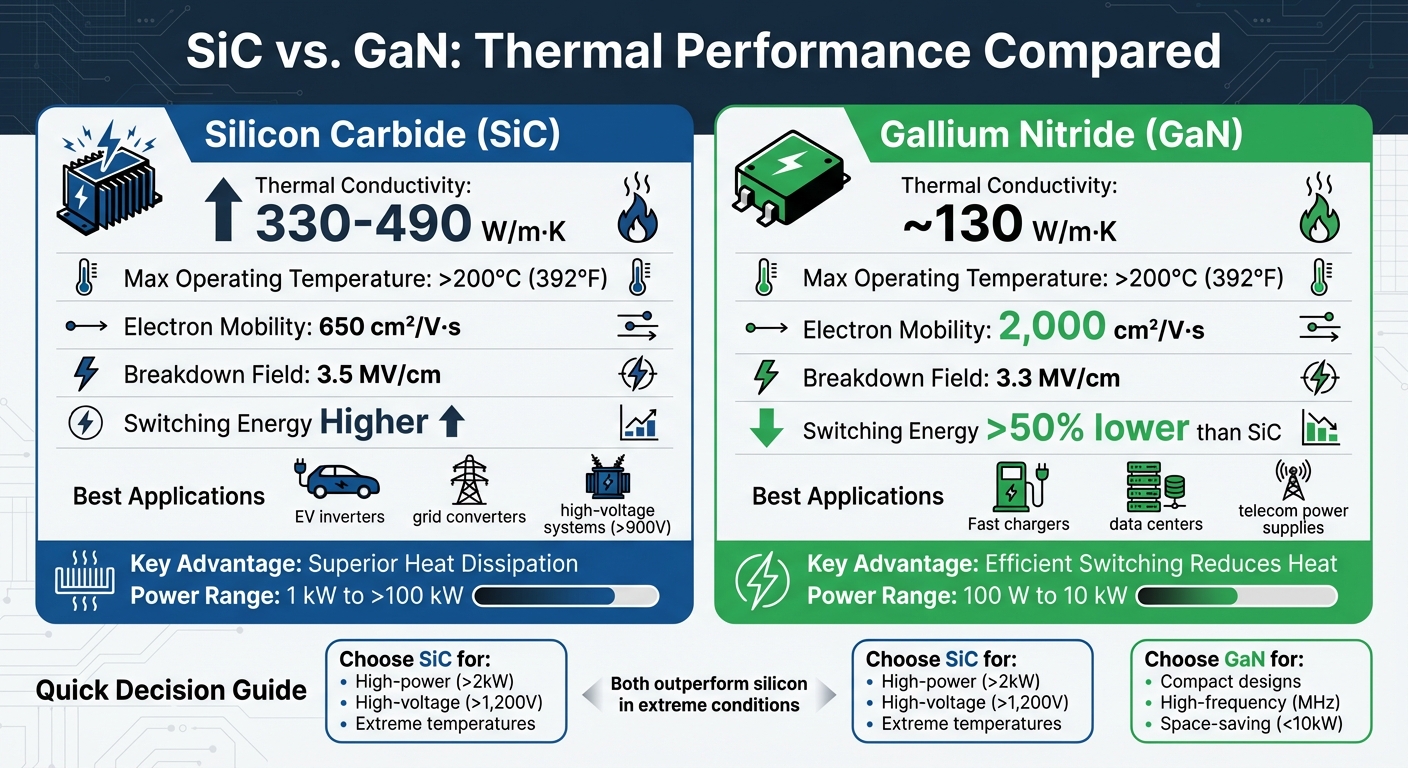
SiC vs GaN Thermal Performance Comparison Chart
SiC Thermal Performance
Thermal Properties of SiC
Silicon carbide (SiC) stands out for its exceptional ability to handle heat, with a thermal conductivity ranging from 330 to 490 W/m·K. To put that into perspective, that's about three times greater than silicon's 150 W/m·K. This high thermal conductivity helps dissipate heat efficiently, preventing hotspots that could lead to device failure. SiC's wide bandgap of 3.2–3.4 eV further enhances its performance, allowing it to operate at higher voltages and temperatures, where silicon-based devices often falter above 150°C (302°F).
"SiC exhibits high thermal conductivity (3.3–4.9 W cm−1 K−1; approximately 330–490 W m−1 K−1), enabling superior heat removal."
- Gyuyeon Han, Department of Electrical Engineering, Soongsil University
Another key feature of SiC is its critical field strength, which is approximately 3.5 MV/cm - nearly ten times that of silicon's 0.3 MV/cm. This allows for thinner drift layers with lower resistance, reducing both conduction losses and heat generation. Additionally, modern packaging methods, such as embedded designs and double-sided cooling, enhance SiC's thermal performance. These techniques can lower junction temperatures by about 50°C (122°F) and reduce thermal resistance by roughly 20%, further optimizing its efficiency.
These attributes make SiC a go-to material for high-performance applications, especially in environments where extreme heat management is essential.
SiC in High-Temperature Environments
Thanks to its thermal properties, SiC thrives in high-temperature settings. It can reliably function at temperatures exceeding 200°C (392°F), making it ideal for demanding applications like EV traction inverters, industrial power grids, and large-scale solar installations. This ability to maintain performance at elevated temperatures gives it a significant edge over silicon, which would fail under similar conditions.
One of SiC's major advantages is its ability to reduce the need for bulky cooling systems. Its efficient heat dissipation often eliminates the necessity for large heat sinks or fans, which not only increases power density but also reduces overall system weight. This is particularly beneficial in applications like locomotive traction inverters and three-phase grid converters operating at voltages above 1.2 kV.
Thermal stress accounts for about 60% of primary failures in power semiconductors. SiC's capacity to handle extreme heat significantly extends the lifespan and reliability of these devices. In environments with rapid temperature fluctuations - such as automotive engines or industrial machinery - SiC maintains its electrical properties without degradation, a level of durability that silicon simply cannot achieve.
GaN Thermal Performance
Thermal Properties of GaN
Gallium nitride (GaN) handles heat in a way that sets it apart from silicon carbide (SiC). With a thermal conductivity of about 130 W/m·K, GaN falls short compared to silicon's 150 W/m·K and SiC's impressive 330–490 W/m·K. However, what GaN lacks in thermal conductivity, it makes up for with its high electron mobility (1,500–2,000 cm²/V·s), enabling efficient MHz-level switching with minimal energy loss.
"GaN faces challenges in thermal dissipation and reliability due to its lower thermal conductivity and heterojunction architecture."
- Gyuyeon Han et al., Electronics 2025
The unique structure of GaN means heat tends to concentrate in its ultra-thin two-dimensional electron gas (2DEG) channel, which is only tens of nanometers thick. While GaN generates less total heat - boasting over 50% lower switching energy compared to SiC - this concentrated heat requires careful management. Another hurdle is the thermal boundary resistance at the interface between GaN and its substrate, particularly when paired with silicon or SiC, which can limit performance.
Even with these challenges, GaN's wide bandgap of 3.4 eV allows it to operate at temperatures exceeding 200°C. However, its thermal conductivity decreases as temperatures rise, making advanced cooling solutions critical for demanding environments. Techniques like surface-activated bonding (SAB) help address these issues by achieving thermal boundary conductance values near 230 MW/m²·K, reducing the impact of interface resistance. These advancements underscore the importance of innovative cooling approaches in ensuring GaN's reliability in high-stress applications.
GaN in High-Frequency Operations
GaN's thermal properties directly support its standout performance in high-frequency applications. Its excellent electron mobility enables GaN devices to operate at MHz-range switching speeds, significantly reducing heat generation. For instance, GaN devices with integrated gate drivers can achieve switching speeds of up to 150 V/ns, cutting losses by 82% compared to SiC. This efficiency not only minimizes heat production but also simplifies cooling requirements, despite GaN's lower thermal conductivity.
"GaN's switching energy is more than 50% lower than SiC, which directly translates to lower losses in the PFC stage."
- Masoud Beheshti, GaN Applications and Marketing Director, Texas Instruments
In practical terms, GaN-based 48V architectures in data centers can reach around 98% efficiency, outperforming silicon-based systems, which typically achieve 94%. This higher efficiency means less wasted energy is converted into heat, enabling more compact and efficient designs. Additionally, high-frequency operation allows for smaller magnetic components, which improve heat dissipation pathways and further aid in thermal management.
For applications under 10 kW that prioritize high frequency and power density, GaN's thermal profile is particularly well-suited. Advances in packaging, such as double-sided cooling that reduces thermal resistance by approximately 20% and embedded microchannels that cut it by up to 43%, have significantly improved thermal performance. These innovations can lower junction temperatures by as much as 50°C, making GaN an excellent choice for compact, high-frequency designs.
Thermal Properties Comparison
Thermal Metrics Side-by-Side
When comparing thermal performance, the contrast between Silicon Carbide (SiC) and Gallium Nitride (GaN) becomes clear. SiC conducts heat nearly three times more efficiently than GaN, a critical factor for high-power systems.
| Metric | Silicon Carbide (SiC) | Gallium Nitride (GaN) |
|---|---|---|
| Thermal Conductivity | 330–490 W/m·K | ~130 W/m·K |
| Max Operating Temperature (Die) | >200°C | >200°C |
| Electron Mobility | 650 cm²/V·s | 2,000 cm²/V·s |
| Breakdown Field | 3.5 MV/cm | 3.3 MV/cm |
| Switching Energy | Higher | >50% lower than SiC |
Both materials are capable of handling junction temperatures exceeding 200°C. However, their thermal behaviors differ significantly. SiC maintains consistent electrical properties under high temperatures, with on-resistance increasing by only about 20% between 77°F (25°C) and 302°F (150°C). In comparison, silicon-based devices can experience a much steeper rise of 200–300%. GaN, on the other hand, faces challenges with heat dissipation at substrate interfaces. Its ultra-thin two-dimensional electron gas (2DEG) channel can trap heat due to interfacial defects and buffer layers.
"Silicon carbide boasts a thermal conductivity of 5 W/cmK, making it nearly three times better at transferring thermal loads. This feature makes silicon carbide highly advantageous in high-power, high-temperature applications."
This data underscores the importance of understanding how these materials handle heat in real-world scenarios.
Heat Dissipation vs. Switching Efficiency
Thermal management at the system level reveals key differences between SiC and GaN. SiC focuses on heat dissipation, making it ideal for high-power applications where managing large thermal loads is essential. Its vertical transistor design ensures efficient heat conduction, supporting systems with voltages of 1,200V and higher, such as traction inverters.
GaN, in contrast, prioritizes reducing heat generation through its efficient switching capabilities. This makes it a strong choice for high-frequency applications, where rapid switching reduces energy losses. However, GaN’s lateral HEMT structure concentrates heat in a thin surface layer, requiring advanced packaging techniques like double-sided cooling to handle junction temperatures effectively.
"SiC excels over Si as a semiconductor material in 600 V and higher-rated breakdown voltage devices... [it offers] higher thermal conductivity, and higher temperature operation capability."
- Sam Davis, Electronic Design
Thermal stress is a leading cause of failure in power semiconductors, accounting for about 60% of primary failures. SiC’s ability to dissipate heat makes it more resilient in harsh environments, while GaN’s efficiency-driven design is better suited for applications focused on minimizing heat production.
These distinctions highlight why SiC is often the go-to for high-power, high-temperature systems, whereas GaN shines in high-frequency, energy-efficient designs.
sbb-itb-501186b
Session 1: Silicon Carbide (SiC) vs GaN vs Silicon
Application-Specific Performance
SiC and GaN technologies bring distinct advantages to specific power applications, thanks to their unique thermal properties and performance characteristics.
High-Voltage and High-Power Systems
SiC shines in applications requiring voltages above 1,200V and power levels exceeding 2 kW. With a thermal conductivity of 3.7–5 W/cmK, SiC effectively manages the intense heat generated in demanding setups like traction inverters, solar farms, and industrial grid converters - often without the need for overly complex cooling systems.
For example, EV traction inverters, which operate at voltages up to 1,700V and continuous currents over 100A, rely on SiC's ability to perform reliably at temperatures exceeding 392°F (200°C). This makes it ideal for the harsh conditions of automotive environments.
"SiC devices offer voltage levels as high as 1,200 V with high current-carrying capabilities. This makes them a good fit for applications such as automotive and locomotive traction inverters, high-power solar farms and large three-phase grid converters."
- Masoud Beheshti, GaN Applications and Marketing Director, Texas Instruments
A notable example comes from UnitedSiC (now Qorvo), which demonstrated a 1.5 kW bridgeless totem-pole PFC circuit in July 2018. Using UJC06505K SiC cascode devices, the system achieved a peak efficiency of 99.4% at 230VAC-line. This efficiency was made possible by SiC's superior thermal and recovery characteristics, operating in continuous conduction mode.
On the other hand, when compact designs and high-frequency operation are critical, GaN takes the spotlight.
Compact and High-Frequency Designs
GaN is the go-to choice for sub-1 kW applications where space-saving and fast switching are essential. With an electron mobility of 2,000 cm²/V·s, GaN enables MHz-level switching, which minimizes heat generation and allows for power densities 3–5 times higher than traditional silicon solutions.
Applications like USB Type-C chargers, telecom power supplies, and server power systems benefit from GaN's ability to reduce heat through efficient switching rather than dissipating it. A 2022 comparison by Texas Instruments highlighted this advantage: a multilevel grid converter using 600V GaN FETs achieved a power density of 211 W/in³ and an efficiency of 99.2% at 140 kHz. In contrast, a similar system using 1,200V SiC devices reached 170 W/in³ and 98.9% efficiency at 100 kHz.
Future Electronics also showcased GaN's potential with the GaNdalf II, a 2 kW PFC system employing Infineon CoolGaN power switches in a bridgeless totem-pole topology. The system achieved peak efficiency above 99% and a power factor exceeding 0.99, highlighting GaN's high-frequency capabilities. These examples underline GaN's strength in applications where compactness and fast switching are critical.
Conclusion
Silicon carbide (SiC) stands out with its impressive thermal conductivity of 490 W/m·K and its ability to operate beyond 392°F (200°C). These qualities make it a go-to choice for high-voltage applications (over 900 V) and high-power systems (ranging from 1 kW to over 100 kW). Its resilience in extreme conditions makes it especially suited for demanding environments like EV traction inverters and industrial grid converters.
Gallium nitride (GaN), on the other hand, takes a different approach by focusing on heat reduction through exceptional switching efficiency. With switching energy over 50% lower than SiC and the ability to operate at MHz frequencies, GaN shines in compact, high-frequency designs. It’s ideal for applications ranging from 100 W to 10 kW, including USB Type-C chargers, telecom power supplies, and data center systems.
"The fundamental laws of physics explain GaN's and SiC's dominance... where silicon hits hard limits, these wide-bandgap materials unlock new performance frontiers."
When choosing between the two, SiC is the better choice for applications requiring voltages above 900 V and robust thermal management, while GaN is perfect for designs that demand high power density and fast switching. Although both materials come with higher upfront costs - SiC being 3–5 times and GaN 2–3 times more expensive than silicon - they can reduce overall system expenses by 10–20% through savings on cooling and passive components. Together, SiC and GaN are redefining thermal performance standards in modern power electronics.
For those looking to integrate these cutting-edge technologies, Electrical Trader provides access to high-quality SiC and GaN components, making the transition from traditional silicon to wide-bandgap materials more seamless.
FAQs
What are the key benefits of SiC over GaN in high-power applications?
Silicon carbide (SiC) stands out in high-power applications, especially when compared to gallium nitride (GaN). One of its standout features is thermal conductivity, which ranges from 3.7 to 4.9 W/cm·K. That’s significantly better than GaN’s range of 1.3 to 2.0 W/cm·K. This means SiC can manage heat dissipation much more efficiently, making it a solid choice for high-demand, power-intensive environments.
Another area where SiC shines is high-voltage performance. It typically handles voltage ranges from 900V to an impressive 10kV, with current ratings often surpassing 100A. These capabilities make it a go-to option for systems that need to perform reliably under extreme conditions.
How does GaN's thermal conductivity impact its performance in high-frequency applications?
Gallium nitride (GaN) doesn’t conduct heat as well as silicon carbide (SiC), which means it can lead to higher junction temperatures during operation. In high-frequency applications, this can impact both performance and reliability if the heat isn’t managed effectively.
To keep things running smoothly, it’s crucial to focus on thermal design. This includes using efficient heat sinks, quality thermal interface materials, and even advanced cooling techniques when dealing with demanding conditions. With the right approach to thermal management, GaN can still perform impressively in high-frequency applications.
Why is SiC often chosen over GaN for applications above 1,200 volts?
Silicon carbide (SiC) stands out for applications requiring over 1,200 volts due to its high voltage capacity and excellent thermal performance in tough environments. Its resilience under extreme temperatures and ability to remain stable make it a go-to choice for power systems like industrial machinery and high-voltage power distribution networks.
What sets SiC apart is its lower thermal resistance, which improves heat dissipation. This ensures dependable performance in conditions where gallium nitride (GaN) might face challenges in maintaining efficiency.