

12V vs. 24V vs. 48V: Solar Voltage Comparison
Choosing the right solar system voltage - 12V, 24V, or 48V - depends on your energy needs, budget, and future plans. Higher voltages improve efficiency, reduce wiring costs, and handle larger power loads, but they come with higher initial costs and complexity. Here's a quick breakdown:
- 12V Systems: Best for small setups like RVs and boats (<1,000W). Affordable and easy to install, but limited scalability and higher energy losses.
- 24V Systems: Ideal for medium-sized setups (1,000W–5,000W). Balanced efficiency and cost, suitable for cabins and larger RVs.
- 48V Systems: Designed for large installations (>5,000W). High efficiency, lower wiring costs, and excellent for whole-home or commercial setups.
Quick Comparison
| Feature | 12V System | 24V System | 48V System |
|---|---|---|---|
| Best For | RVs, Boats | Cabins, Larger RVs | Homes, Businesses |
| Power Range | <1,000W | 1,000W–5,000W | >5,000W |
| Efficiency | Low | Moderate | High |
| Wiring Costs | High | Moderate | Low |
| Scalability | Limited | Good | Excellent |
| Safety Risk | Low | Moderate | Higher |
For smaller, portable setups, stick with 12V. If you need more power and plan to expand, go for 24V or 48V. Higher voltages save money on wiring and improve performance over time, especially for larger systems.
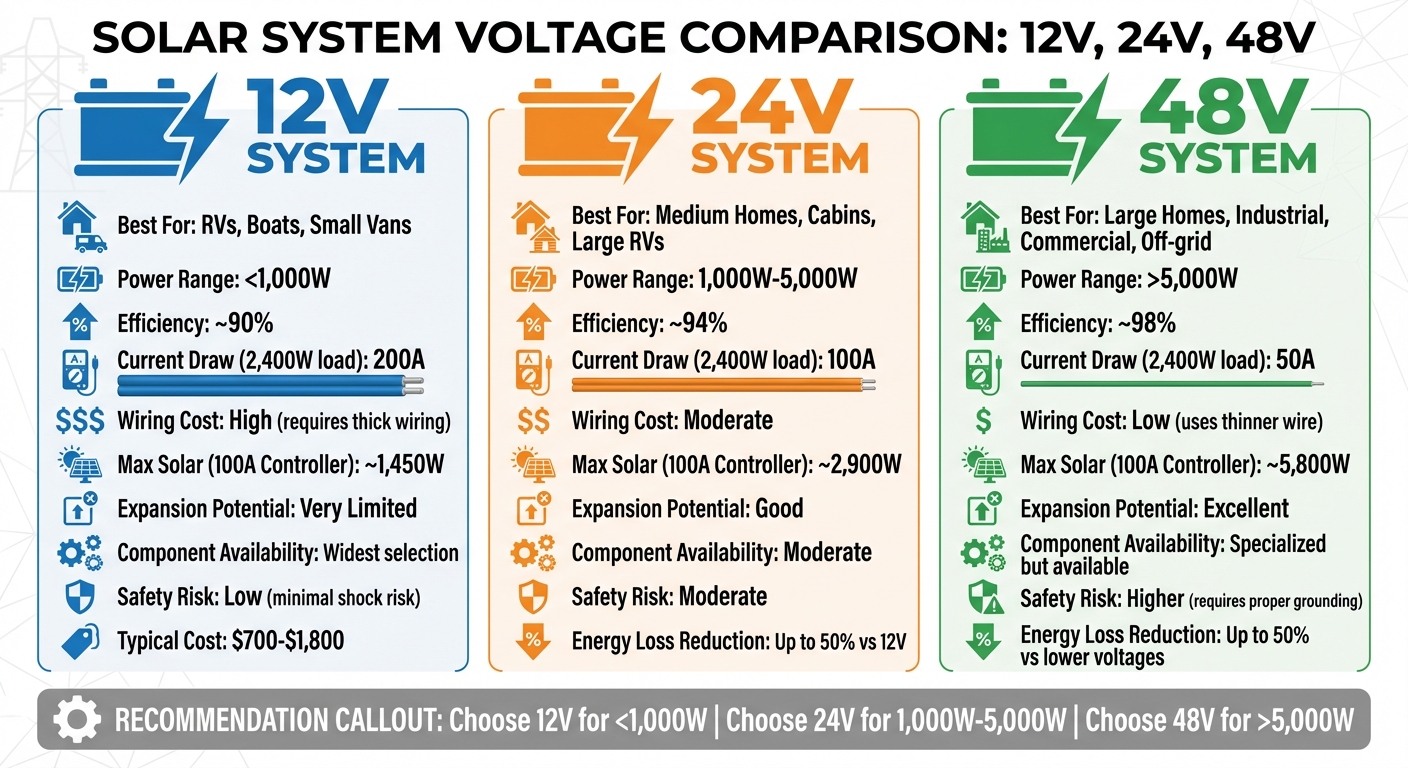
12V vs 24V vs 48V Solar System Comparison Chart
12V Solar Systems
Main Features of 12V Systems
12V solar systems run on 12V DC and typically use panels containing 36 photovoltaic cells. These systems usually generate between 300 and 1,000 watt-hours of energy daily. A standard 12V solar panel delivers an open circuit voltage of around 20V, with an optimal operating voltage near 18V - ideal for charging 12V battery banks efficiently.
These systems are best suited for solar arrays under 1,000W, making them a great choice for mobile and portable setups. One of their biggest perks is compatibility. Since 12V is the standard for automotive and marine applications, components like inverters, fuses, and batteries are widely available and budget-friendly. For example, a basic 200W 12V system typically costs $700–$900, while a medium 500W setup ranges from $1,200–$1,800.
However, the low voltage of 12V systems means they require higher amperage to deliver equivalent power compared to higher-voltage systems. This necessitates heavier cabling. For instance, a 1,200W device would draw about 100A on a 12V system but only 50A on a 24V system. To keep efficiency losses below 3%, it’s important to use short cable runs and heavy-gauge wire. With these technical details in mind, let’s dive into the practical advantages and limitations of 12V systems.
Benefits and Drawbacks of 12V Systems
The main draw of 12V systems lies in their affordability and ease of use. They’re simple to install and DIY-friendly, with minimal risk of electrical shock even if wires are exposed. Many DC appliances - like lights, fans, portable fridges, and phone chargers - can run directly on 12V, eliminating the need for an inverter and boosting overall efficiency. Standard 12V deep-cycle lead-acid batteries (100Ah) are relatively affordable, costing between $80 and $200, while lithium (LiFePO4) versions are pricier at $700 to $1,000.
"12V solar panels and battery solutions... are your answer to off-grid power requirements, whether you're on a camping trip, traveling, or simply seeking a reliable energy source."
– Microtek
That said, scalability is a major limitation. Systems larger than 4,000W are generally unavailable in 12V configurations, and expanding beyond 3,000W becomes impractical due to the high amperage required. Additionally, the high current draw places extra strain on batteries, which can shorten their lifespan.
| Advantages | Disadvantages |
|---|---|
| Low upfront cost; widely available components | High transmission losses due to higher current |
| Easy to install; works with automotive/marine parts | Requires costly, heavy-gauge copper wires |
| Safe to handle; low risk of electrical shock | Limited scalability (maxes out at ~3,000W) |
| Directly powers 12V appliances without an inverter | High current draw reduces battery longevity |
sbb-itb-501186b
Which is Best? - 12 vs 24 vs 48 Volt Solar Batteries Explained
24V Solar Systems
24V solar setups fill the gap between smaller 12V systems and more robust 48V options, making them a solid choice for medium-scale installations. These systems are typically designed to handle setups ranging from 1,000W to 2,000W, making them ideal for larger RVs, small off-grid homes, and medium-sized cabins. They efficiently manage loads between 800W and 3,600W, offering a balance between the simplicity of 12V systems and the power capacity of 48V setups. Each configuration comes with its own trade-offs in terms of efficiency, wiring, and scalability.
One of the standout features of a 24V system is its reduced amperage. For example, a 24V system drawing 1,200W only requires 50A. This lower current translates into significant savings on wiring costs since thinner cables can be used. To put it in perspective, a 60A charge controller can support around 720W on a 12V system but doubles that capacity to 1,440W on a 24V system.
"24V systems... provide more power without the hassle of using super-thick wires."
– Vantom Power
Building a 24V battery bank is straightforward - connect two 12V batteries in series. This eliminates the need for parallel wiring, which is common in larger 12V setups. However, some lithium (LiFePO4) batteries are not designed for series connections and must be purchased as native 24V units. If you need to run 12V appliances like fans or lights, a 24V-to-12V DC-DC step-down converter is necessary, though it typically causes a 5% to 8% energy loss. Despite these considerations, 24V systems strike a good balance between power output and wiring simplicity.
Benefits of 24V Systems
One of the main advantages of 24V systems is their efficiency. Compared to 12V setups, they can reduce energy waste by up to 50%. Lower amperage not only minimizes heat loss but also improves performance over longer cable runs - especially useful when solar panels are located far from the battery bank.
Another benefit is their ability to scale up. For instance, if you start with a 1,500W system and later want to expand to 3,000W or even 5,000W, a 24V configuration can accommodate this growth without requiring a complete system overhaul. Additionally, charge controllers perform better with higher voltage systems. A 20A controller that supports about 260W on a 12V system can handle over 500W on a 24V system. While these systems offer plenty of advantages, they also come with some challenges.
Limitations of 24V Systems
The biggest downside is the higher upfront cost. While 24V panels and inverters are readily available online, they are generally more expensive than their 12V counterparts. However, the savings on thinner wiring often offset these higher initial costs, particularly for medium-sized installations.
Another challenge is the increased complexity of installation. Unlike the plug-and-play nature of 12V systems, 24V setups require careful wiring of batteries in series, precise matching of inverter voltage to the battery bank, and possibly the addition of DC-DC converters for 12V appliances. This level of planning can be daunting for beginners.
"Cost saving alone does not justify a 24V system!"
– Antoine, Engineer and Founder, FarOutRide
For mobile applications, there’s an additional hurdle: 24V systems cannot be directly charged from a standard 12V vehicle alternator without extra equipment. Furthermore, specific 24V appliances, such as water pumps, tend to be more expensive - a 24V water pump might cost $120 more than its 12V equivalent. Lastly, while 24V systems work well for setups up to 5,000W, larger systems may require upgrading to a 48V configuration.
12V vs. 24V Comparison Table
Here’s a quick overview of how 12V and 24V systems compare:
| Feature | 12V System | 24V System |
|---|---|---|
| Ideal Load Size | < 1,500W | 1,500W – 5,000W |
| Current Draw (1,200W load) | 100A | 50A |
| Wiring Cost | High (thick cables required) | Moderate (thinner cables) |
| Efficiency | Lower (higher heat loss) | Moderate to High |
| Installation Complexity | Simple (plug-and-play) | Moderate (series wiring needed) |
| Expansion Potential | Limited (maxes out ~3,000W) | Excellent (up to 5,000W) |
| Component Availability | Widely available in stores | Available online |
| Common Applications | Small RVs, boats, vans | Medium cabins, tiny homes, large RVs |
48V Solar Systems
When it comes to large-scale solar installations, 48V systems are the standard choice. They’re ideal for powering everything from off-grid homes to commercial buildings and industrial setups. These systems shine when power demands exceed 2,000W and can easily handle loads above 5,000W. This makes them perfect for running energy-intensive appliances like air conditioners, electric heaters, and large refrigerators. A key advantage of 48V systems is their ability to drastically cut current draw - by up to 75% compared to 12V systems. For example, a 5,000W load on a 48V system uses only a quarter of the current required for the same load on a 12V system. This reduction minimizes heat and wiring losses, boosting overall efficiency.
The lower current also means thinner, less expensive wiring. Instead of heavy-duty 4/0 gauge cables, you can use lighter 1/0 or even 10-gauge copper wires. Additionally, lower current reduces I²R losses (heat generated in wires), improving efficiency by as much as 50%. Another perk? 48V systems can handle longer cable runs with minimal voltage drop. These factors make them a practical and efficient choice for larger setups.
Main Features of 48V Systems
One of the standout features of 48V systems is scalability. For instance, a single 100A charge controller can manage up to 5,800W of solar input at 48V, compared to just 1,450W at 12V. Similarly, a 200Ah battery bank at 48V holds 9,600Wh of energy - four times the capacity of a 200Ah 12V battery bank. This makes 48V systems particularly appealing for homeowners who want to power an entire house, including HVAC systems and electric vehicle chargers.
Another significant advantage is how these systems treat batteries. They draw less current, which slows down discharge rates and can extend battery life. For example, 48V Lithium Iron Phosphate (LiFePO4) batteries are often rated for up to 4,500 cycles, which is 6 to 9 times longer than traditional AGM or Gel batteries. However, it’s essential to pair your battery bank with a matching 48V inverter. If you need to run 12V DC appliances like lights or fans, you’ll also need a 48V-to-12V step-down converter.
Benefits and Drawbacks of 48V Systems
The efficiency and scalability of 48V systems make them a top choice for larger installations. By reducing the need for heavy-gauge wiring and multiple charge controllers, these systems can offset their higher upfront costs over time. However, there are trade-offs. Components like inverters and battery management systems for 48V setups tend to be more expensive than those for 12V or 24V systems. Installation can also be more complex, often requiring professional expertise for proper grounding and insulation.
"Understanding the differences between solar system voltages is crucial for optimizing performance. By selecting the appropriate voltage based on your specific energy requirements and future growth plans, you can ensure a more efficient and cost-effective solar setup." – Industry Expert, Redway Power
Safety is another factor to consider. A fully charged 48V LiFePO4 battery can exceed 50V, which poses a shock hazard if not handled correctly. To mitigate risks, always include essential safety features like proper insulation, breakers, grounding, and a disconnect switch between the solar panels and the system.
Here’s a quick look at the key benefits and drawbacks:
| Benefits | Drawbacks |
|---|---|
| High efficiency with minimal heat loss | Higher upfront component costs |
| Lower wiring costs thanks to thinner cables | More complex installation, often requiring professionals |
| Excellent scalability, supporting up to 5,800W per controller | Increased safety risks due to voltages exceeding 50V |
| Reduced current draw, which is easier on batteries | Requires a step-down converter for 12V appliances |
Next, we’ll explore how to choose the right voltage system for your specific energy needs.
How to Choose the Right System Voltage
Choosing the right voltage for your solar setup depends on three key factors: how much power you need, where the system will be installed, and your future plans. With some straightforward guidelines, you can make an informed decision.
Power Requirements and Load Size
The amount of power your system will handle largely determines the best voltage. For smaller loads under 1,000W - think RV lights, fans, or small electronics - a 12V system works well. If your power needs fall between 1,000W and 2,000W, such as a large RV with a microwave or a small off-grid cabin, a 24V system is a better fit. For loads exceeding 2,000W, like whole-home setups with air conditioning, electric heating, or EV chargers, a 48V system is the way to go.
Higher voltage systems have an added benefit: they reduce current draw. For example, a 5,000W load requires about 417A at 12V but only 104A at 48V.
"The greater your energy demand and the more powerful your appliances... the greater the current (amperage) flowing through your wiring." – Shari Galiardi and David Hutchison, Renogy
By understanding your energy needs, you can choose a voltage that not only suits your current setup but also supports future growth.
Planning for System Expansion
If you think you'll expand your system later - by adding more solar panels or appliances - it’s smart to plan ahead. A single 100-amp charge controller can handle around 1,450W at 12V, 2,900W at 24V, and 5,800W at 48V. Starting with a 24V or 48V system can make future upgrades much easier. For instance, a 200Ah battery bank at 48V stores 9,600Wh of energy, compared to just 2,400Wh at 12V for the same capacity.
Planning for expansion now can save you time and money later while ensuring your system remains efficient and scalable.
Balancing Cost and Efficiency
At first glance, 12V systems may seem more affordable due to the wide availability of components. But when you look at long-term costs, higher voltage systems often come out ahead. For example, a 1,200W system at 12V might require heavy, 100-amp-rated cabling, while 24V or 48V systems can use lighter, less expensive wire. Additionally, inverter efficiency improves with higher voltages, climbing from about 90% at 12V to as much as 98% at 48V. This efficiency can cut energy waste by up to 50% in 48V systems compared to lower voltage setups.
For mobile systems with shorter wiring runs, a 12V setup keeps things simple. But for stationary installations like cabins or homes, opting for a 24V or 48V system can lower wiring costs and improve overall efficiency.
Final Comparison and Recommendations
When deciding on the right voltage for your solar setup, it all boils down to your energy needs and how you plan to use the system. For smaller setups like RVs or boats with power requirements under 1,000W, a 12V system is straightforward and works seamlessly with most 12V appliances. If your energy demands fall between 1,000W and 2,000W - such as for larger RVs or small off-grid cabins - a 24V system strikes a good balance between efficiency and capacity. For installations exceeding 2,000W, like whole-home or commercial setups, 48V systems shine with up to 98% inverter efficiency compared to 90% for 12V systems.
Complete Comparison Table
Here’s a quick breakdown to help you compare the options:
| Feature | 12V System | 24V System | 48V System |
|---|---|---|---|
| Best Use Case | RVs, Boats, Small Vans | Medium Homes, Small Business | Large Homes, Industrial, Off-grid |
| Efficiency | ~90% | ~94% | ~98% |
| Current Draw (2,400W) | 200A | 100A | 50A |
| Wiring Cost | High – requires thick wiring | Moderate | Low – uses thinner wire |
| Max Solar (100A Controller) | ~1,450W | ~2,900W | ~5,800W |
| Expansion Potential | Very Limited | Good | Excellent |
| Component Availability | Widest selection | Moderate | Specialized but available |
| Safety Risk | Low – minimal shock risk | Moderate | Higher – requires proper grounding |
This table can help you quickly match your needs to the right system.
Choosing the Right System for Your Needs
Start by calculating your total wattage and considering future expansion. If your needs are minimal - like powering lights, fans, or small electronics in an RV - a 12V system is cost-effective and easy to set up. For slightly larger setups, such as a cabin with a microwave, refrigerator, and power tools, a 24V system offers better efficiency without breaking the bank. For energy-intensive uses like air conditioning, electric heating, or EV charging, a 48V system is the way to go. Higher voltage systems reduce wiring costs and energy loss, with systems above 24V cutting energy loss by as much as 50%.
"Understanding the differences between solar system voltages is crucial for optimizing performance. By selecting the appropriate voltage based on your specific energy requirements and future growth plans, you can ensure a more efficient and cost-effective solar setup."
- Redway Expert Insight
If you’re planning to expand your system in the future, it’s smarter to start with a 24V or 48V system. These setups are far better suited for growth, saving you from expensive upgrades down the road.
FAQs
Can I mix 12V, 24V, and 48V parts in one solar system?
Mixing 12V, 24V, and 48V components in a solar system is generally a bad idea. These voltage levels don’t work together directly and require additional conversion equipment to function properly. Without such equipment, you’ll likely face problems with efficiency, safety, and overall system compatibility. If you absolutely must combine different voltages, you’ll need tools like DC-DC converters or inverters, but keep in mind that this will make your setup more complicated and expensive. For the best results, stick to a single voltage level when designing your system.
How do I know when it’s worth upgrading from 12V to 24V or 48V?
Upgrading your solar system voltage - whether to 24V or 48V - depends largely on your energy requirements and the size of your setup. A 12V system is ideal for smaller setups, such as RVs or boats, where energy demands are modest. However, as current increases, these systems can become less efficient, requiring thicker and more expensive wiring.
For larger setups, switching to a 24V or 48V system offers several advantages. These higher-voltage systems are more efficient, experience less power loss, and use thinner, more affordable wiring. This makes them a smarter choice for setups with high energy demands or those requiring longer cable runs.
What extra safety gear do I need for a 48V solar system?
While OSHA doesn't mandate extra safety gear for systems under 50V, it's still smart to take some precautions. Use safety glasses, work with insulated tools, and stick to basic safety practices when handling a 48V solar system. Staying cautious helps ensure a safer setup and maintenance experience.