

Types of Solar Cables for PV Systems
Solar cables are critical for transferring electricity within photovoltaic (PV) systems. Choosing the correct type ensures efficiency, safety, and longevity. Here's a breakdown of the four main types of solar cables and their key features:
- PV Wire: Designed for outdoor use with excellent UV, moisture, and temperature resistance. Ideal for connecting solar panels, it works in both grounded and ungrounded systems and lasts over 25 years.
- USE-2 Wire: Best for underground installations. It resists moisture and soil conditions but is limited to grounded arrays and lacks flame propagation testing.
- RHW-2 Wire: Suitable for wet and dry locations, offering strong moisture resistance and moderate UV protection. Common for DC-side wiring and some direct burial applications.
- THHN Wire: Primarily for indoor use, this lower-cost option works inside conduits but lacks durability for outdoor exposure.
Quick Comparison
| Cable Type | Temperature Range (Dry/Wet) | UV Resistance | Typical Use | Cost |
|---|---|---|---|---|
| PV Wire | 302°F / 194°F | High | Outdoor panel connections | High |
| USE-2 | 194°F / 194°F | Moderate | Underground, direct burial | Moderate |
| RHW-2 | 194°F / 194°F | Moderate | Wet locations, conduit, some direct burial | Moderate |
| THHN | 194°F (Dry) / 167°F (Wet) | Low | Indoor conduit runs | Low |
Each cable type serves specific needs, so matching the cable to your system's requirements is key. For outdoor setups, PV wire is the most durable. USE-2 is ideal for underground runs, while THHN suits indoor applications. Proper installation and periodic inspection ensure optimal performance and safety.
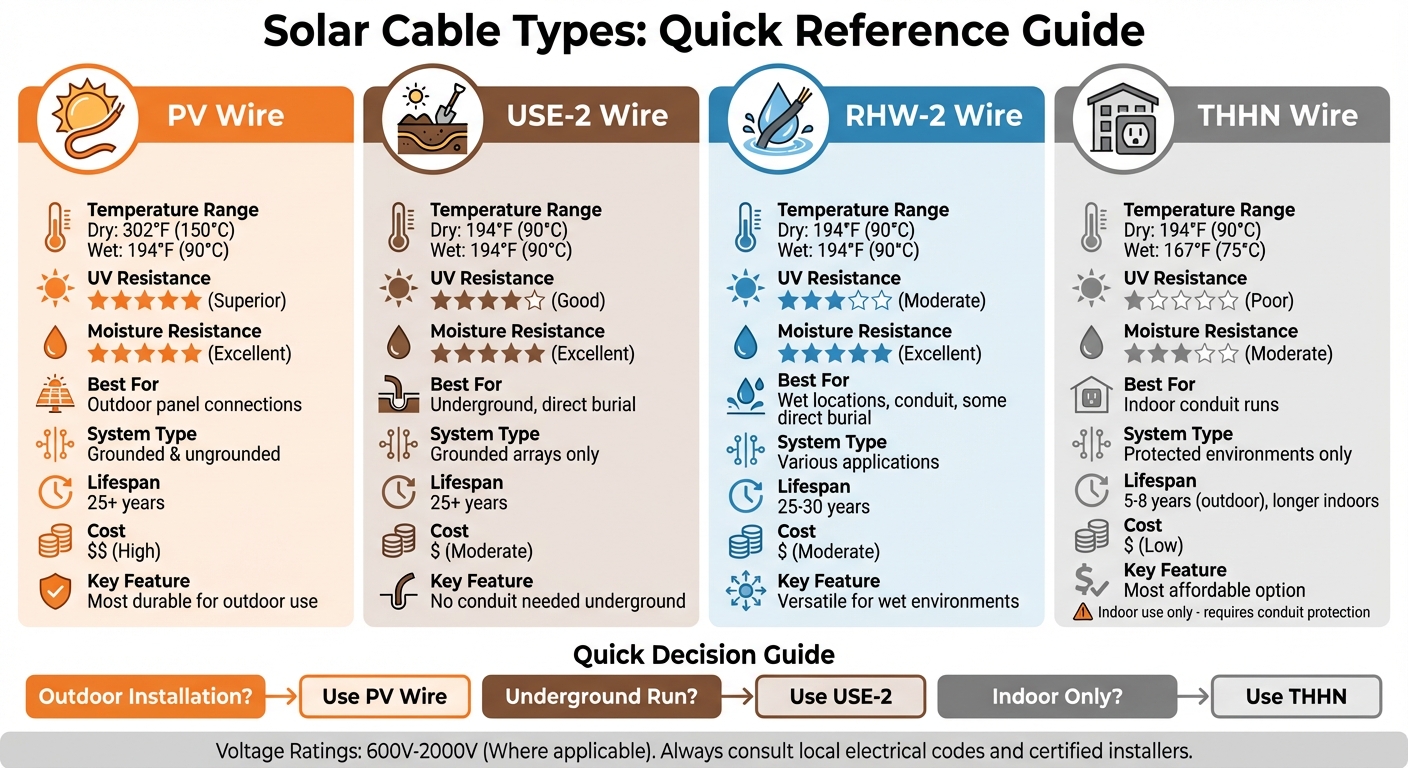
Solar Cable Types Comparison Chart for PV Systems
Choosing Solar Cables
sbb-itb-501186b
1. PV Wire
PV wire is the go-to choice for solar installations, offering a reliable mix of durability and performance. Built with XLPE or XLPO insulation and tinned copper conductors, it’s designed to handle extreme temperatures. It performs well in wet conditions up to 90°C (194°F) and in dry environments between 120°C and 150°C (248°F to 302°F). Even in freezing temperatures as low as -40°C (-40°F), PV wire remains flexible, making it ideal for both rooftop and field installations.
Environmental Resistance
Tinned copper conductors in PV wire are highly resistant to oxidation and corrosion, even in humid or salty environments. The XLPE insulation adds another layer of protection, shielding the wire from UV radiation, ozone, and moisture. These features are crucial for solar setups exposed to intense sunlight and fluctuating weather across the U.S. According to ZW Cable, "PV wire is designed for high voltage applications and is available from 600V to 2000V. Flexibility to meet different photovoltaic system requirements." Thanks to this robust construction, PV wire typically offers a service life of 25 years or more. This longevity ensures dependable performance in standard solar systems.
Applications
PV wire excels in connecting solar modules and linking arrays to inverters or combiner boxes. Unlike USE-2 wire, which is generally restricted to grounded systems, PV wire works in both grounded and ungrounded arrays. For systems with current outputs up to 30A, a 10 AWG copper PV wire is often recommended. Its thick insulation also makes it suitable for direct burial applications, adding to its versatility.
Cost
While PV wire might come with a higher upfront price compared to standard building wire, its durability often leads to lower maintenance and replacement costs over time. Single-core PV cables, in particular, are usually more affordable than multi-core options and offer better heat dissipation, making them a practical choice for straightforward installations.
2. USE-2 Wire
USE-2 wire is specifically designed for underground solar installations, setting it apart from wires meant for above-ground use. Short for "Underground Service Entrance", USE-2 wire is built for direct burial and thrives in challenging underground conditions. The "-2" designation signifies its ability to maintain a steady 90°C rating in both wet and dry environments. Typically, it features insulation made from XLPE (cross-linked polyethylene) or CPE (rubber) to endure the harshness of soil environments.
Temperature Ratings
One of USE-2 wire's standout features is its consistent 90°C rating, whether in wet or dry conditions. This is a step up from standard building wires like THHN, which drop to 75°C in wet environments. The wire's operating temperature range, from -40°C to 90°C (-40°F to 194°F), makes it suitable for various climates across the U.S. These stable ratings ensure reliable performance in underground settings.
Environmental Resistance
"USE-2 solar cable is rated for direct burial in the ground without conduit or raceway", explains WesBell Electronics.
The cable's insulation is designed to resist moisture, UV radiation, oil, gas, and ozone. These qualities are essential for underground applications, where exposure to soil moisture and chemicals is unavoidable.
Applications
Thanks to its durable insulation, USE-2 wire is a go-to choice for underground solar installations. It is commonly used to connect solar panels to combiner boxes, combiner boxes to inverters, and inverters to transformers. With a voltage rating of 600V, it fits systems operating within this range. However, since it lacks flame propagation testing, USE-2 is not suitable for indoor use. When the wire needs to enter a building, flame-rated alternatives like THHN or PV wire should be used instead.
Cost
When it comes to cost, aluminum USE-2 wire is more economical than its copper equivalent, though it requires a larger gauge to offset aluminum's lower conductivity (e.g., using 1/0 AWG aluminum instead of 2 AWG copper). While USE-2 wire is generally pricier than standard building wires like THHN, it compensates by eliminating the need for conduit, which can lead to overall savings in underground installations.
3. RHW-2 Wire
RHW-2 wire is insulated with either rubber or cross-linked polyethylene (XLPE), offering excellent resistance to heat and water. It's rated for use at 90°C (194°F) and includes flame-retardant properties. Unlike the original RHW wire, which is limited to 75°C (167°F), RHW-2 maintains its 90°C rating in both wet and dry environments. The XLPE insulation also provides strong protection against chemicals, oils, crushing, and abrasion.
Temperature Ratings
RHW-2 wire is designed to operate continuously at temperatures up to 90°C (194°F). During short-term overloads, it can handle temperatures as high as 130°C (266°F), giving it added reliability during peak demand. It also performs exceptionally well across a wide range of dry temperatures, from -40°C (-40°F) to 105°C (221°F), and retains flexibility down to -25°C (-13°F). These features make it a dependable choice for challenging conditions.
Environmental Resistance
The "W" in RHW-2 signifies its strong resistance to moisture, making it suitable for damp environments and even submersion. As Performance Wire and Cable notes:
"The 'W' label even suggests that the cables can be submerged in water if needed".
The XLPE insulation minimizes water absorption and protects against ozone and common chemicals found in photovoltaic systems. While RHW-2 offers moderate UV resistance, black versions perform better in sunlight. For areas with intense UV exposure, additional protection, such as conduit, may be necessary. These qualities make RHW-2 a reliable option for a variety of solar installations.
Applications
RHW-2 is widely used in photovoltaic systems, particularly for DC-side wiring between inverters and distribution panels. It's also popular in utility-scale solar projects where moisture resistance and cost efficiency are crucial. This cable can be installed in conduits, cable trays, or aerially, and is suitable for direct burial if it also meets USE-2 standards. With voltage ratings between 600V and 2,000V, RHW-2 is compatible with most commercial and utility-scale solar setups.
Cost
RHW-2 wire is more expensive than standard RHW due to its enhanced temperature rating and flame-retardant features. However, in utility-scale solar projects, it is often seen as more economical than XHHW-2 while delivering similar performance. The higher initial cost is balanced by its durability - XLPE-insulated wires like RHW-2 are built to last the 25- to 30-year lifespan of a solar panel, far surpassing the 5- to 8-year lifespan of standard DC cables with PVC insulation.
4. THHN Wire
While PV, USE-2, and RHW-2 cables are the go-to options for outdoor and high-performance solar setups, THHN wire carves out its role in indoor environments. THHN stands for Thermoplastic High Heat-resistant Nylon-coated wire. It's a common choice for building wiring, though its use in solar applications is more limited. This wire features PVC insulation and a thin nylon jacket, offering added mechanical strength and smoother installation in conduits.
Temperature Ratings
THHN wire performs well in dry or damp settings, with a maximum temperature rating of 90°C (194°F). When dual-rated as THWN for wet environments, the temperature limit decreases to 75°C (167°F). If consistent performance at 90°C is required in both wet and dry conditions, THWN-2 wire is a better option. Additionally, THHN is typically rated for voltages up to 600V. These characteristics make it essential to use THHN carefully indoors to ensure reliable performance.
Environmental Resistance
Unlike PV wire, which is built to last 25–30 years, THHN lacks UV resistance, making it unsuitable for direct outdoor exposure. As JZD Cable points out:
"Standard THHN/PVC wire in DC applications may require replacement every 5-8 years when exposed to the elements".
To avoid this issue, THHN must always be installed inside conduits or cable trays. Without such protection, the PVC insulation can degrade quickly under sunlight.
Applications
THHN is most commonly used for indoor solar wiring, especially on the AC side of a solar system. It works well for connecting inverters, charge controllers, batteries, and breaker panels in protected environments. It’s also a viable option for battery bank connections in off-grid systems, as long as the area is dry and shielded. However, THHN is not suitable for direct connections between solar panels, where the durability of PV wire is essential. Its strengths lie in indoor setups with limited space.
Cost
One of THHN's main advantages is its affordability and widespread availability. While its lower upfront cost is appealing, using it in outdoor settings without proper protection can lead to frequent replacements - sometimes as often as every 5 to 8 years - resulting in higher long-term costs. For properly protected indoor applications, however, THHN provides a budget-friendly solution without compromising performance.
5. DC vs AC Solar Cables
DC and AC solar cables play different roles in photovoltaic systems. DC cables carry the power generated by solar panels, connecting the modules to each other and to the inverter. On the other hand, AC cables transmit the converted power from the inverter to your electrical panel or the utility grid, making them essential for delivering usable electricity to your home or business.
Because of these distinct roles, their construction varies significantly. DC solar cables are built with tinned copper conductors, which resist oxidation in outdoor environments. They also feature dual-layer insulation made from materials like cross-linked polyethylene (XLPE) or cross-linked polyolefin (XLPO), ensuring they can endure harsh outdoor conditions. In contrast, AC cables typically use bare copper or aluminum conductors and single-layer PVC insulation, which is suitable for indoor use but deteriorates quickly when exposed to the elements.
The core configuration also reflects their specific applications. DC cables are single-core, which enhances safety in the system. AC cables, however, are multi-core - three-core for single-phase inverters or five-core for three-phase systems - combining live, neutral, and ground wires in one cable. This difference aligns with their electrical behavior: DC cables carry a steady, unidirectional current, while AC cables are designed to handle alternating current with its voltage reversals and potential interference.
DC cables are built to last. They can operate in extreme temperatures ranging from –40°F to 248°F (–40°C to 120°C) and maintain performance for over 25 years, even in challenging outdoor environments. Standard AC cables, however, are best suited for controlled indoor conditions since they lack the robust weather resistance of DC cables. While DC cables are more expensive due to their tinned copper and specialized insulation, their durability and lower maintenance costs often justify the higher upfront investment.
For installation, there are specific guidelines to ensure safety and efficiency. Keep DC cables with opposite polarities physically separated to avoid potential safety issues. When setting up AC connections from the inverter to the load, aim for a voltage drop below 2% to maintain efficiency. Additionally, select DC cables with a rated current at least 1.56 times the maximum continuous current to account for factors like heat buildup. These differences in construction and performance directly influence installation practices and the overall efficiency of the system, which will be explored further in the next section.
Advantages and Disadvantages
Choosing the right cable for your solar installation involves weighing the pros and cons of each option. Every cable type has distinct features that impact both performance and cost, making it essential to match the cable to the specific needs of your system.
PV Wire stands out for its durability and ability to handle tough outdoor conditions. Its XLPE insulation is resistant to UV rays and extreme temperatures, making it perfect for connecting solar panels in outdoor setups. With a dry temperature rating of up to 150°C (302°F) and a wet rating of 90°C (194°F), it’s built to last in harsh environments. However, its sturdy tinned copper construction and thick insulation come with a higher price tag.
USE-2 Wire is an excellent choice for underground or direct burial installations, thanks to its strong moisture resistance. That said, it’s only suitable for grounded solar arrays and operates consistently at 90°C in both wet and dry conditions. Its limitations make it less ideal for outdoor runs where heat buildup might occur.
RHW-2 Wire offers versatility for wet locations and general-purpose setups. Like USE-2, it operates at 90°C in both wet and dry conditions. It works well in conduit systems and some direct burial applications. However, its UV resistance is moderate, so it needs protection from long-term sun exposure. Pricing for RHW-2 is generally moderate, similar to USE-2.
THHN Wire is the most budget-friendly option, designed for indoor conduit runs between the inverter and the electrical panel. While it has a suitable temperature rating for indoor use, its wet rating drops to 75°C (167°F), and it offers poor UV resistance. These factors limit its use to protected indoor environments, as outdoor exposure could lead to failure and increased replacement costs.
Here’s a quick comparison of these cables:
| Cable Type | Temperature Rating (Dry/Wet) | UV Resistance | Moisture Resistance | Typical Use | Relative Cost |
|---|---|---|---|---|---|
| PV Wire | 302°F / 194°F | Superior | Excellent | Outdoor panel connections; suitable for both grounded and ungrounded arrays | High |
| USE-2 | 194°F / 194°F | Good | Excellent | Underground, direct burial; restricted to grounded arrays | Moderate |
| RHW-2 | 194°F / 194°F | Moderate | Excellent | Wet locations; used in conduit and some direct burial applications | Moderate |
| THHN | 194°F (Dry) / 167°F (Wet) | Poor | Moderate | Indoor conduit runs; protected environments only | Low |
Conclusion
Choosing the right cable boils down to matching its features with your specific installation needs. For outdoor use, PV wire is the go-to choice thanks to its high UV resistance and ability to withstand temperatures up to 150°C (302°F). As Solar Permit Solutions explains:
"PV wire is specifically designed for outdoor solar panel connections, offering superior UV resistance and weather protection".
When it comes to underground installations, USE-2 wire stands out for its excellent moisture resistance and suitability for direct burial without conduit. However, it’s typically used for grounded arrays. On the other hand, THHN wire is better suited for indoor environments or runs protected by conduit, offering a cost-effective solution while maintaining safety in controlled conditions.
Beyond selecting the right cable, proper installation practices are key to optimizing performance. Keep cable runs short - longer than 10 feet may require a voltage drop calculator to ensure losses stay under 3%. This helps maintain your system’s efficiency and reliability.
For budget-conscious projects, you can mix cable types strategically. Use PV wire for sections exposed to sunlight, USE-2 for underground runs, and THHN for indoor wiring. Additionally, in coastal or high-moisture environments, opt for tinned copper conductors to prevent oxidation and extend the cable’s lifespan, which is typically around 25 years.
Don’t overlook maintenance. Inspect cables every six months, especially in high-UV areas, to catch issues like cracking, discoloration, or rodent damage early. These steps together ensure your system remains efficient and cost-effective.
For a wide selection of products and expert advice, visit Electrical Trader at https://electricaltrader.com.
FAQs
How do I pick the right solar cable for my install?
When selecting a solar cable, it's essential to consider where it will be installed. For outdoor setups, PV wire is your go-to option. If the cable needs to run underground, you'll want USE-2. For indoor or conduit installations, THHN/THWN works best.
Make sure the cable's voltage rating aligns with your solar system, which can go up to 1500V DC. The insulation material should also be able to withstand harsh conditions, including UV exposure, extreme temperatures (from -40°F to 194°F), and moisture. Look for additional features like flame resistance for added safety. Lastly, choose a cable size that can handle the system's current and reduce voltage drop, especially for longer runs.
Can I use THHN wire outdoors if it’s in conduit?
Yes, THHN wire can be used outdoors, but only if it's installed in a conduit. While this wire is primarily designed for dry, indoor use, it can handle wet outdoor conditions as long as it's enclosed in a conduit for adequate protection.
What wire gauge do I need to limit voltage drop?
When choosing the right wire gauge for a solar system, you’ll need to consider key factors like circuit length, current load, and the acceptable voltage drop percentage. For DC circuits, it's generally recommended to aim for a 2% voltage drop to maintain efficiency.
If your system involves longer cable runs or higher current loads, you’ll need thicker wires (which correspond to lower gauge numbers). While common wire sizes like 10 AWG or 8 AWG are often used, the exact gauge should be calculated based on the specifics of your setup to ensure optimal performance.