

Primary vs Secondary Injection Testing
If you need end-to-end proof, use primary injection. If you need a fast relay or trip-unit check, use secondary injection.
I’d sum it up this way: primary injection tests the whole protection path, while secondary injection tests the relay or trip unit from its input terminals forward. That means primary injection can catch CT ratio or polarity problems, CT wiring mistakes, and breaker trip issues that secondary testing can miss. But it also takes more setup, more outage time, and heavier gear.
Here’s the short version:
-
Primary injection
- Pushes high current through the breaker’s primary path
- Checks conductors, CTs, wiring, trip path, and breaker action
- Often used for commissioning, major changes, and NEC 230.95(C) ground-fault testing
- Low-voltage test sets often supply about 1,200 to 2,000 A
- Test gear can cost around $100,000
-
Secondary injection
- Sends test signals right into relay or trip-unit inputs
- Checks settings, timing, outputs, and LSIG functions
- Does not check CT behavior, CT wiring, or the breaker’s primary current path
- Common for routine maintenance because it needs less time and a smaller crew
-
Rule of thumb
- Use primary injection after installation, rewiring, upgrades, or when you need to prove the full chain
- Use secondary injection for scheduled checks of relay logic and trip settings
One more point: these methods are not replacements for each other. They serve different goals.
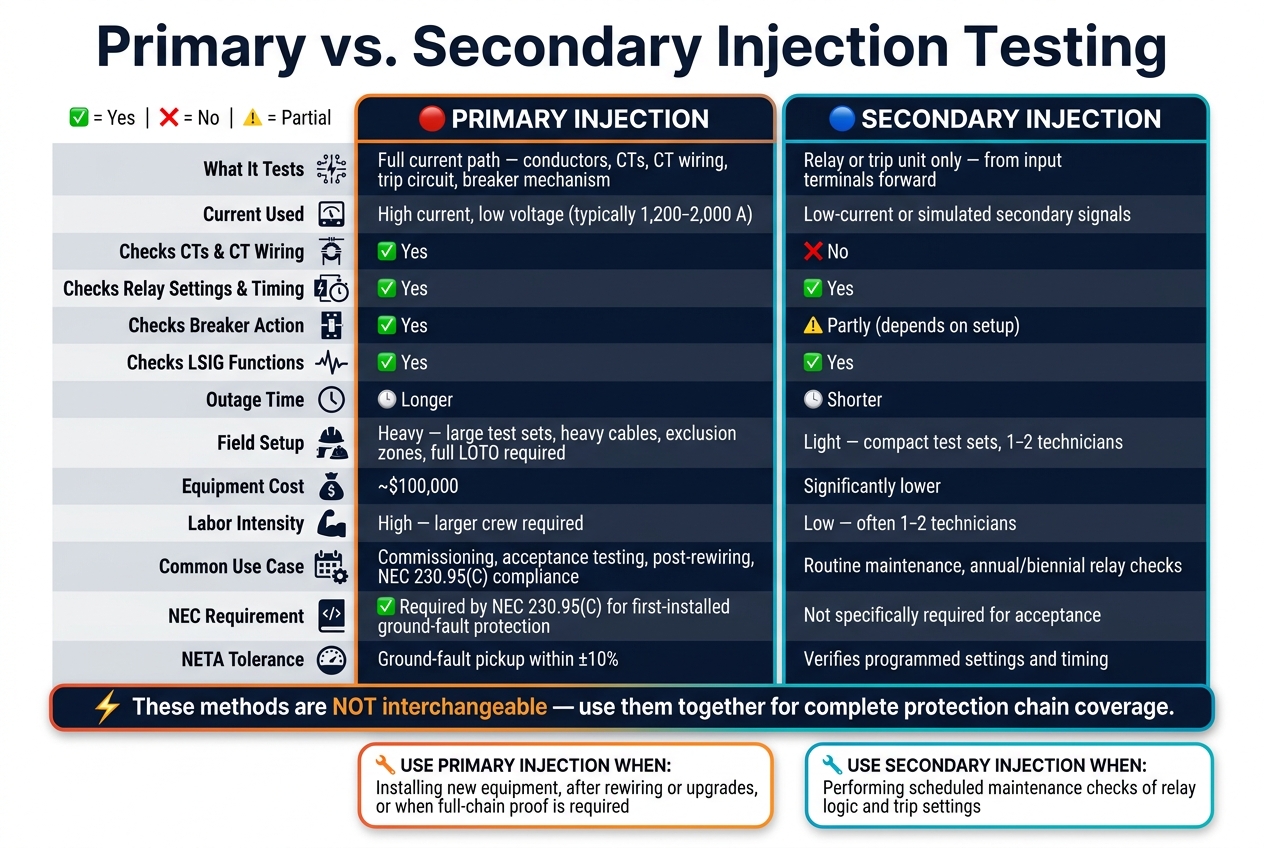
Primary vs Secondary Injection Testing: Full Comparison Guide
Primary Injection Low Voltage Circuit Breakers What, When, and How
sbb-itb-501186b
Quick Comparison
| Item | Primary Injection | Secondary Injection |
|---|---|---|
| What I’m testing | Whole current path | Relay or trip unit |
| Current used | High current, low voltage | Low-current or simulated signals |
| Checks CTs and CT wiring | Yes | No |
| Checks relay settings and timing | Yes | Yes |
| Checks breaker action | Yes | Partly, depending on setup |
| Outage time | Longer | Shorter |
| Field setup | Heavier | Lighter |
| Common use | Commissioning, acceptance, post-change checks | Routine maintenance |
So if I only want to confirm trip logic and timing, secondary injection is often enough. If I want to prove the entire protection chain under current flow, primary injection is the better fit.
Primary injection testing for circuit breakers
Primary injection pushes high current at low voltage through the breaker’s primary path to mimic fault current. Low-voltage test sets can usually supply about 1,200 to 2,000 A for de-energized testing. That makes it the strongest way to prove the entire breaker path works when fault current is flowing.
What primary injection testing verifies
Primary injection checks the full current path, not just one piece of it. Since current moves through the whole primary circuit, the test checks CT ratio and polarity, CT wiring, the trip circuit, and the breaker’s mechanical operation.
So if a CT is wired backward, has the wrong ratio, or has a loose secondary lead, primary injection can bring that to light. A secondary-only test may miss those installation problems.
NETA guidance says ground-fault pickup should stay within ±10%, and clearing time should meet the stated limits. There’s a downside, though: this test adds wear. Full testing can mean many breaker operations, so it makes sense to plan for that extra wear.
That broad check is why primary injection is usually saved for higher-stakes field work.
Where primary injection fits in field work
Primary injection is a good fit for:
- Commissioning
- Major replacements
- CT rewiring
- Relay upgrades
NEC 230.95(C) also requires on-site primary current injection for first-installed ground-fault protection, along with a written record for the AHJ.
The setup isn’t light work. The system has to be de-energized, isolated, and under full lockout/tagout. The equipment is also expensive, often around $100,000 to buy. That’s why most testing programs save it for commissioning, major changes, or required acceptance tests instead of using it during every routine inspection cycle.
That bigger scope is also why primary injection is slower and more disruptive than secondary injection. The tradeoff is the extra time and setup, which is where secondary injection becomes the faster option for maintenance.
Secondary injection testing of trip units and relays
Primary injection checks the full current path. Secondary injection does something narrower: it isolates the relay or trip unit.
Instead of sending current through the breaker’s primary conductors, CTs, and contacts, secondary injection skips that whole path and connects a portable test set right to the relay or trip unit input terminals.
So what are you checking here? You’re verifying the protection scheme from the relay input terminals onward. In plain English, that means making sure the relay or trip unit responds as expected and sends the right alarm or trip output.
What secondary injection testing verifies
Secondary injection confirms that the relay or trip unit works at its programmed settings. That includes checking pickup and timing at key multiples of pickup for overcurrent elements, then confirming that output contacts energize the correct trip coil, alarm, or communication flag.
For electronic trip units, it checks LSIG functions and trip timing at the programmed settings.
Just as important, secondary injection has clear blind spots. It does not verify:
- CT ratio, polarity, or saturation
- PT wiring
- Breaker contact condition
- Mechanical performance under actual fault current
Those items sit outside the test’s scope.
That narrower scope is also its limit.
Why secondary injection is common in maintenance programs
Secondary injection is the standard choice for scheduled relay and trip unit checks because it’s faster to set up, needs fewer workers, and cuts outage time compared with primary injection.
That matters in plants and buildings where outage windows are tight. In those cases, teams can check protection logic during a short maintenance window instead of stretching the work into a longer shutdown.
Put simply, secondary injection is the faster option for maintenance. It just isn’t the full-system check.
Primary vs. secondary injection: scope, limits, time, and cost
Once both methods are on the table, the comparison gets pretty straightforward: primary injection gives you more complete proof, while secondary injection gives you faster, lower-cost testing.
| Aspect | Primary Injection | Secondary Injection |
|---|---|---|
| Scope | Full-chain verification: primary conductors, CTs, wiring, trip unit, trip coil, and breaker mechanism | Trip-unit and relay logic; limited CT and breaker mechanism coverage |
| Current level | High current, low voltage | Low-current or simulated secondary signals |
| Equipment required | High-current test sets, heavy cables, and auxiliary measurement devices | Compact relay test sets with lighter leads |
| Typical downtime | Longer outages and higher downtime cost | Shorter outages and lower downtime impact |
| Labor intensity | Higher - usually requires more crew and setup time | Lower - often manageable by one or two technicians |
Technical scope and blind spots
This is where the gap between the two methods shows up most clearly.
Primary injection runs current through the full path. That means issues like CT ratio errors, polarity mistakes, extra burden, and miswiring can show up during the test. In plain terms, it checks more of the chain, not just the decision-making inside the trip unit.
Secondary injection, by contrast, checks trip-unit logic, timing, and calibration at service settings. That’s useful, but it does not prove the current sensors, primary wiring, or breaker current-handling parts. So if something is wrong upstream of the relay logic, secondary testing may not catch it.
Field practicality, downtime, and cost
Primary injection also asks for more work in the field. You’re dealing with heavy test leads, exclusion zones, lockout/tagout, and close coordination before current is applied. That added setup usually means longer outages and higher labor cost. On critical feeders, where every hour offline can hit hard, that matters.
Secondary injection is much easier to move and set up. Compact test sets can connect to terminal blocks or dedicated test ports, and one or two technicians can often test several devices in a single day. The outage window is shorter, the crew is smaller, and the setup is lighter.
There’s also a wear issue to think about. Frequent primary injection adds wear, so many programs save it for major tests.
Those tradeoffs set up the commissioning-versus-maintenance choice covered in the next section.
Choosing the right method for acceptance testing and routine maintenance
Given those tradeoffs, the choice usually comes down to the stage of the project: primary injection for commissioning and secondary injection for routine maintenance.
Best fit for commissioning and acceptance testing
When a new switchgear lineup is placed into service, or when protection wiring has been changed, primary injection is usually the better pick. NEC Section 230.95(C) says ground-fault protection systems on service equipment must be performance tested with primary current injection when first installed, and a written record has to be kept for the authority having jurisdiction (AHJ).
NETA ATS and many owner specs also call for primary injection on main and feeder breakers during commissioning. Here’s why that matters: if CT polarity is reversed or there’s a wiring mistake, secondary injection might miss it. Primary injection won’t.
Best fit for scheduled maintenance programs
Once acceptance testing is done, routine checks usually move to secondary injection. After commissioning, secondary injection becomes the standard maintenance test. It checks trip-unit settings and relay logic with less setup and less outage time.
That’s why many facilities use secondary injection for annual or every-two-year maintenance cycles. They then save primary injection for acceptance testing, checks after changes, or cases where CT and wiring integrity is in doubt.
Conclusion: Primary and secondary injection testing serve different purposes
After looking at scope, downtime, and cost, the main point is pretty simple: these two tests do different jobs.
Primary and secondary injection testing work best together, not as substitutes. Primary injection checks the entire current path. Secondary injection checks the relay or trip unit only.
Primary injection gives a broader check, but it takes more time and more effort. Secondary injection is faster and causes less disruption, but it won't catch CT wiring errors, contact wear, or other faults on the primary side. Use primary injection when you need end-to-end proof, especially after installation or major changes. Use secondary injection during routine maintenance when the goal is to verify settings, timing, and trip logic.
Used together, they give maintenance teams solid coverage without extra outage time.
FAQs
Which test should I use after a breaker upgrade?
After a breaker upgrade, primary injection testing is the test to use. It checks the full current path, including current sensors, internal wiring, contact condition, and the trip unit. That matters because it shows whether the breaker will trip the way it should under actual fault conditions.
Secondary injection is faster, and it works well for checking electronic trip-unit logic. But if you need to confirm the breaker as a complete system after installation or repair, primary injection is the main check. Before the breaker goes back into service, compare the test results with the manufacturer’s specs.
Can secondary injection miss wiring or CT problems?
Yes. Secondary injection tests only the trip unit logic by feeding signals straight into it, so it bypasses the primary current path.
That means it does not test the current transformers (CTs) or the wiring between them and the trip unit. If there's a problem in either spot, secondary injection can miss it. Primary injection checks the full protection chain instead.
How often should primary injection be done?
Primary injection testing frequency depends on how critical the system is and the conditions around it.
For critical circuits, like those in hospitals, data centers, and emergency systems, annual testing is common. In standard commercial buildings, testing is often done every 3 to 5 years. In harsher industrial settings, where heat, dust, vibration, or moisture can take a toll, testing may be needed every 6 months to 3 years.
It should also be done during initial commissioning and after any major maintenance work to confirm the full protection chain is working as intended.