What Is Secondary Injection Testing?
Secondary injection testing checks a relay or electronic trip unit by feeding low-level current or voltage into its secondary terminals. It tells me if the device picks up at the right setting, trips in the right time, and sends the trip signal as expected - without energizing the primary power path.
Here’s the short version:
- What it tests: relay or trip-unit settings, logic, pickup, timing, and output
- What it does not test: CTs, primary conductors, breaker contacts, CT polarity/ratio, or CT-to-relay wiring
- Where it’s used: commissioning, routine maintenance, and relay troubleshooting
- Typical checks: points near 1.5–2× pickup, 4–6× pickup, plus one high-range point
- Common limits: about ±3% to ±5% for pickup and ±5% or ±50 ms for timing
- Best fit: when I want to confirm the device itself
- Not enough by itself: when I need proof of the full installed protection path
If you only remember one thing, make it this: secondary injection proves the relay or trip unit, not the whole power circuit. That’s why teams often use it for maintenance, then use primary injection when they need to check CT circuits, wiring, and the breaker path too.
Quick comparison:
| Check | Secondary Injection | Primary Injection |
|---|---|---|
| Tests relay/trip unit behavior | Yes | Yes |
| Verifies CT circuit | No | Yes |
| Verifies CT-to-relay wiring | No | Yes |
| Uses high current on primary conductors | No | Yes |
| Common for routine maintenance | Yes | No |
So if you’re asking, “What does this test actually prove?” the answer is simple: it proves the protection device’s response on the secondary side - and no more than that.
Secondary Injection Testing
sbb-itb-501186b
Understanding Secondary Injection Testing
Unlike primary injection, this test stays on the secondary side. Secondary injection sends controlled signals into a relay or trip unit’s secondary inputs to check pickup, timing, and trip action under controlled conditions. So the next step is pretty straightforward: what does it actually prove?
What Secondary Injection Actually Tests
Secondary injection focuses on the device itself. For trip units, that means checking LSIG functions. For relays, it covers common protection elements like overcurrent, ground-fault, undervoltage, and directional functions.
It also does more than confirm basic pickup. The test checks whether the device follows the expected time-current characteristic curve. A common field method is to verify at least three points on that curve:
- near pickup, around 1.5–2× pickup
- a mid-range point, around 4–6× pickup
- one high-range point
Typical acceptance limits are ±3% to ±5% for pickup and ±5% or ±50 ms for timing, whichever is greater.
Secondary injection can also check internal relay logic. That includes blocking inputs, output contacts, alarm signals, trip circuit continuity, and trip output.
What Secondary Injection Does Not Test
This is the part that trips people up. Secondary injection proves the device, but not the entire protection path.
It does not verify the primary current path through the buswork and breaker poles, the physical state of breaker contacts, the CT ratio and polarity on the primary side, or the wiring between the CT and the relay input terminals. If one of those pieces has a fault, secondary injection alone will not catch it.
Accepted test limits come from standards, manufacturer data, and site procedures.
Standards and Accepted Guidance
In the U.S., ANSI/NEMA AB 4 accepts secondary injection for inverse-time overcurrent testing in molded-case breakers. NETA MTS and manufacturer manuals set the detailed limits used for field acceptance and maintenance intervals. Where it applies, site rules such as NERC PRC-005 govern how testing is scheduled and documented for utility protection systems.
Secondary Injection vs. Primary Injection Testing
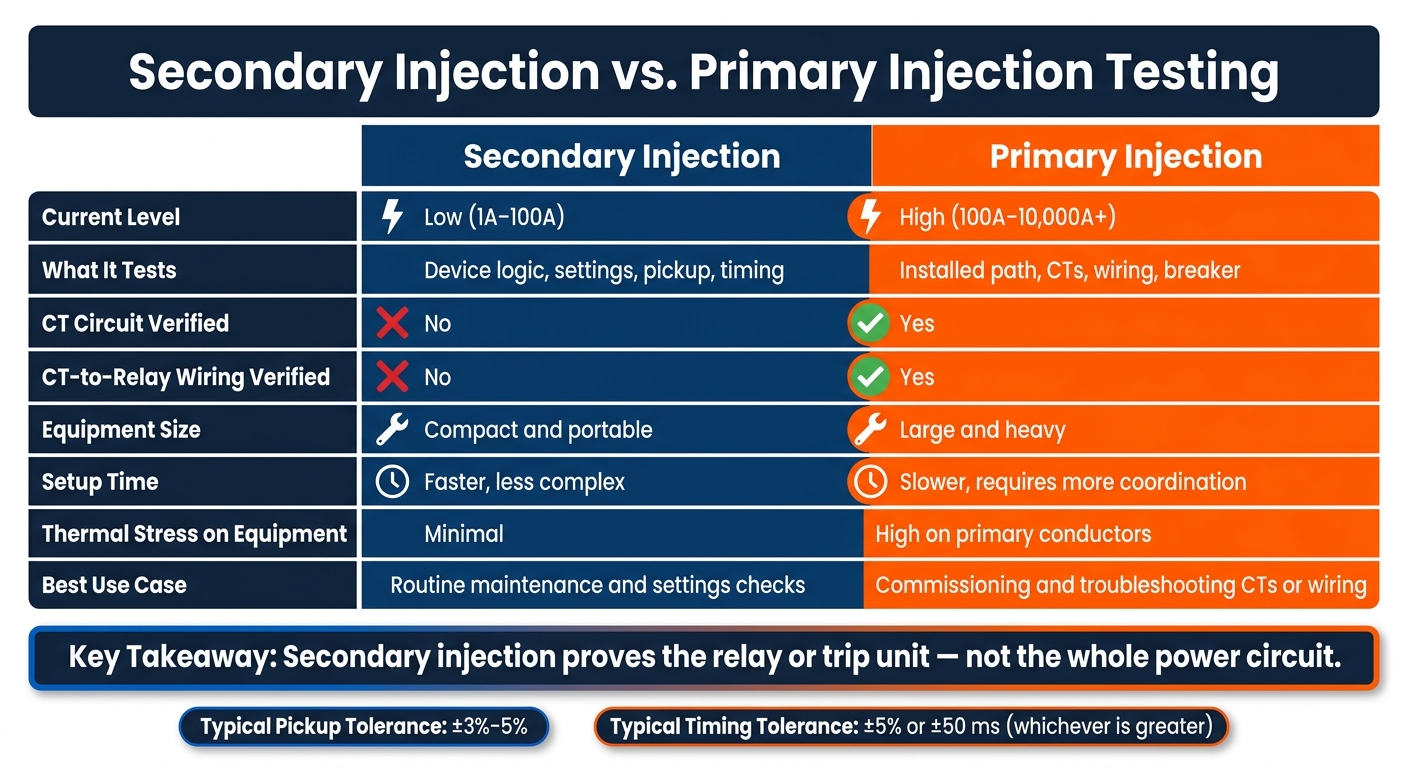
Secondary Injection vs. Primary Injection Testing: Key Differences
Secondary injection checks the relay or trip unit. Primary injection checks the installed protection path. In maintenance work, that difference matters a lot because teams need to know what they're proving: the device itself or the full protection path.
The big split comes down to scope. Secondary injection tests the device. Primary injection tests the full circuit.
| Aspect | Secondary Injection | Primary Injection |
|---|---|---|
| Current level | Low (1A–100A) | High (100A–10,000A+) |
| What it tests | Device logic, settings, pickup, timing | Installed path, CTs, wiring, breaker |
| CT circuit verified | No | Yes |
| CT-to-relay wiring verified | No | Yes |
| Equipment size | Compact and portable | Large and heavy |
| Setup time | Faster and less complex | Slower and requires more coordination |
| Thermal stress on equipment | Minimal | High on primary conductors |
| Best use case | Routine maintenance and settings checks | Commissioning and troubleshooting CTs or wiring |
Advantages of Secondary Injection in Field Work
For routine maintenance, secondary injection is usually the practical pick. The primary circuit stays de-energized, setup takes less time, and the test avoids the heat load that comes with primary current testing. That helps teams work within shorter outage windows.
In plain terms, it's a good fit for preventive maintenance. The goal is to confirm relay settings and trip curves, not to prove the whole installation again.
When Primary Injection Is Still Necessary
Sometimes the relay passes its test, but the system still misoperates in the field. When that happens, the issue is often outside the relay. If secondary testing passes but field performance still fails, primary injection becomes the next step. A passing secondary test paired with failed field operation usually points to a CT, wiring, or a primary connection problem.
Primary injection also has a clear place during new switchgear commissioning and after major modifications. In those cases, teams need to prove the physical installation end-to-end. In the field, troubleshooting often starts with secondary injection, then shifts to primary injection only when the relay-side test checks out.
How Secondary Injection Testing Applies to Protective Relays and Breakers
Protective Relays in Commissioning and Maintenance
In actual field work, secondary injection is used mostly during commissioning and maintenance.
During commissioning, it checks relay settings and timing before the system is energized. Technicians run tests at several curve points through test blocks or plugs that isolate the relay. That lets them confirm the relay follows the expected curve.
The usual tolerances are ±3% for pickup and ±5% or ±50 ms for timing, whichever is greater. Those numbers matter because they show whether the relay lines up with the coordination study.
For maintenance, the test serves as a periodic check to make sure the relay still operates as intended over time. Common maintenance intervals are:
- 3–6 years for numerical relays
- 1–3 years for electromechanical relays
Electronic Trip Units in Molded-Case and Power Breakers
The same idea applies to breaker trip units.
For molded-case and power circuit breakers with electronic trip units, secondary injection is used to verify the LSIG functions: long-time, short-time, instantaneous, and ground-fault. The test set sends signals straight into the trip unit terminals. That allows technicians to check pickup, timing, and trip logic without energizing the primary conductors.
That’s an important distinction: this test confirms the behavior of the trip unit itself, not the entire primary current path. If the device falls outside tolerance, it should not go back into service until the issue is fixed.
Equipment Sourcing and Replacement Planning
When a device tests outside tolerance, replacement planning comes next.
If the results drift beyond the allowed range, document the device model, settings, and ratings before ordering a replacement.
How the Test Is Performed, Its Benefits, and Its Limits
Typical Test Workflow and Safety Prerequisites
After laying out what secondary injection does not prove, the next step is the test process itself.
Before you start, review the manufacturer's manual, relay settings, and time-current curves. That gives you the baseline for comparison.
Safety comes first. Isolate the primary circuit, apply LOTO, and install CT shorting links before opening test blocks or inserting test plugs. If you skip that step, you can leave CT secondary terminals open-circuited, which may generate dangerously high voltages.
Once the relay is isolated through test blocks or plugs, connect the secondary injection test set to the relay's CT/VT input terminals. Then apply controlled current or voltage signals to simulate fault conditions. From there, check pickup, timing, reset, and logic outputs. Compare each measured result with manufacturer tolerances before restoring connections.
Because the test stays on the secondary side, it checks the device itself, not the full primary circuit. For electromechanical relays, use a current-source tester. A voltage-source output can skew timing.
That narrow scope is also why the test is so quick. It keeps the job simple, but it also draws a clear line around what the test can and cannot show.
Benefits and Limits in a Maintenance Program
Secondary injection is efficient and portable, which makes it a solid fit for routine maintenance and settings checks.
It’s also focused by design. The test confirms relay and trip-unit behavior, but it does not verify CTs, wiring, breaker mechanics, or insulation. It also can’t stand in for mechanical inspections, contact resistance testing, or insulation testing. What it confirms is logic and timing.
In practice, that makes it a good tool for checking whether the relay responds the way it should - without turning it into a stand-in for every other maintenance task.
Conclusion: When to Use Secondary Injection Testing
Secondary injection is the field check for relay and trip-unit performance. Use it during commissioning checks and periodic maintenance to confirm pickup values, timing curves, and trip logic without needing high primary currents or large test equipment. Pair it with primary injection, mechanical inspections, and insulation testing when you need end-to-end confidence in the full protection chain.
FAQs
When should I use secondary injection instead of primary injection?
Use secondary injection to check relay settings, logic, and performance during routine maintenance, factory acceptance, or troubleshooting.
It’s usually faster and safer, and it keeps the focus on the relay itself without the need for high current or full-system testing.
Can secondary injection find CT or wiring problems?
Secondary injection testing mainly checks relay operation and the wiring that runs from the relay to the trip circuit.
What it doesn't do is fully spot problems in the primary circuit wiring. That includes wiring mistakes involving the CT or other parts of the primary side.
How often should protective relays and trip units be tested?
Protective relays and trip units are usually checked during periodic maintenance.
As a rule of thumb, test numerical relays every 3 to 6 years and electromechanical relays every 1 to 3 years.