OSHA vs NFPA 70E: Shock PPE Rules
If you need the short answer, here it is: OSHA is the law, and NFPA 70E is the guide many teams use to pick the right shock PPE for energized work.
From 2014 to 2023, 1,474 U.S. workers died from electrical causes, and 74% were in non-electrical jobs. So this is not just an electrician issue. If you work near exposed energized parts, you need to know what OSHA requires, where OSHA stops, and how NFPA 70E helps fill that gap.
Here’s the article in plain terms:
- OSHA sets the minimum legal rule for electrical PPE, hazard assessment, worker training, and equipment care.
- NFPA 70E adds task-based guidance tied to voltage, approach distance, and which body parts are exposed.
- OSHA requires PPE to be provided and maintained, but it does not give task-by-task PPE tables.
- NFPA 70E uses limited and restricted approach boundaries to help decide when gloves, sleeves, insulated tools, and other shock protection are needed.
- Both frameworks start with the same idea: if you can de-energize, do that first.
- For energized work, teams should check glove class, leather protectors, sleeves, inspection steps, and test dates before the job starts.
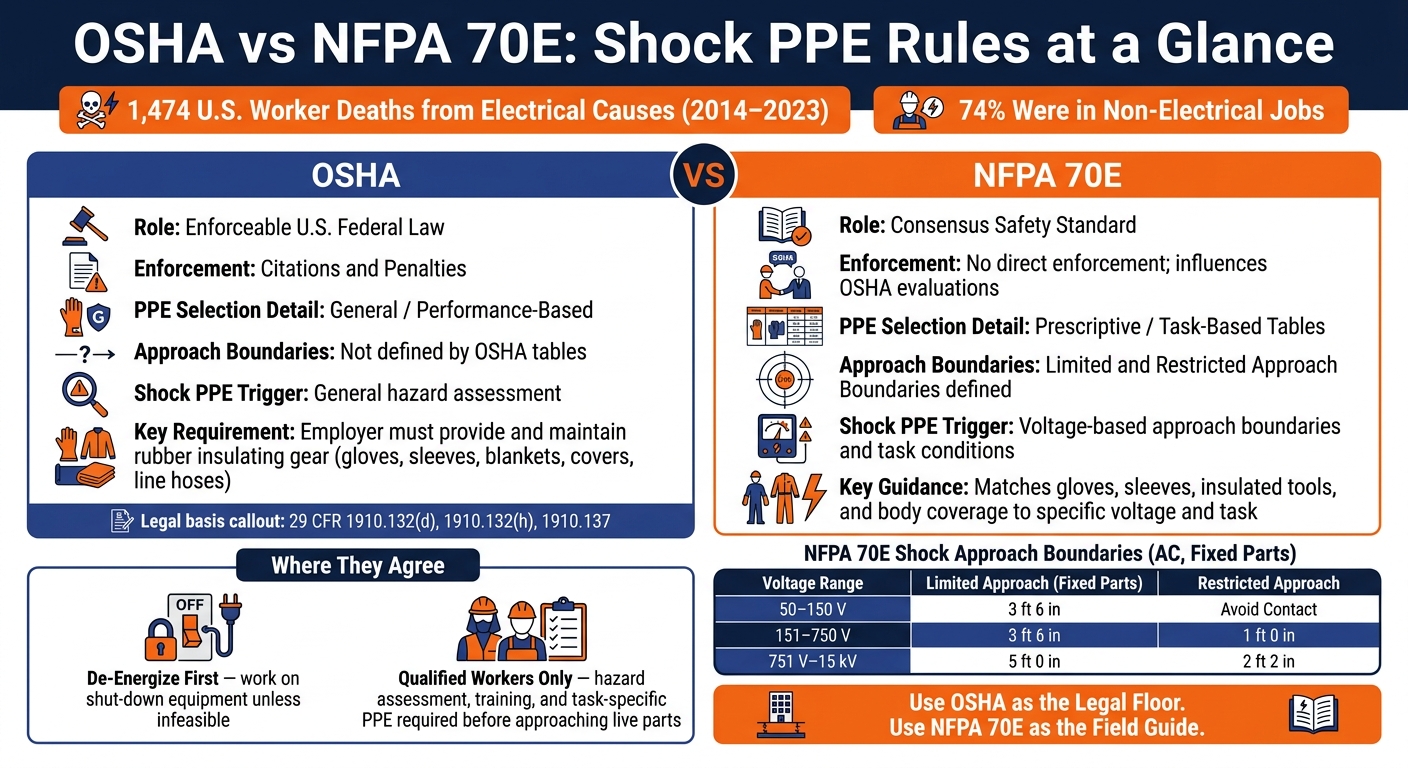
OSHA vs NFPA 70E: Shock PPE Rules at a Glance
NFPA 70E Ties to OSHA
sbb-itb-501186b
Quick Comparison
| Topic | OSHA | NFPA 70E |
|---|---|---|
| Role | Enforceable U.S. law | Consensus safety standard |
| Main focus | Employer duties and minimum PPE rules | Task-based PPE selection |
| PPE selection detail | General | More detailed |
| Approach boundaries | Not defined by OSHA tables | Limited and restricted boundaries |
| Energized work | Strict limits, hazard control required | Adds written justification and work planning |
| PPE examples | Rubber insulating gear must be provided and maintained | Helps match gloves, sleeves, tools, and coverage to the task |
My takeaway: use OSHA as the legal floor and NFPA 70E as the field guide for shock PPE selection. That gives you a clear way to plan energized tasks without guessing.
OSHA Shock PPE Baseline
OSHA sets the legal minimum for shock PPE on U.S. jobsites. NFPA 70E then helps employers pick the right shock PPE for the exact task. The starting point is simple: assess the hazard, supply the equipment, and keep it in good shape.
What OSHA Requires Employers to Provide and Maintain
Under 29 CFR 1910.132(d), employers must assess the workplace to identify electrical hazards that call for PPE. Under 1910.132(h), employers must provide required electrical protective equipment at no cost to the employee. That includes rubber insulating gloves, sleeves, blankets, covers, and line hoses, and all of them must meet the design and manufacturing specifications in 1910.137.
That gear also has to be checked before each use and after any event that could have damaged it. The inspection should look for cracks, cuts, tears, or ozone damage. Workers should air-test rubber insulating gloves for leaks and check the stamped issue or test date to make sure the item is still current.
OSHA also requires employers to train workers on:
- when PPE is needed
- what to wear
- how to wear it
- how to maintain it
Leather protectors go over rubber insulating gloves. The reason is straightforward: the rubber insulates, and the leather helps resist cuts and punctures.
These rules spell out what employers must provide. But they do not say which PPE fits each energized task. So while OSHA sets the floor, it still leaves the exact PPE choice to the employer’s hazard analysis.
Where OSHA Falls Short on Task-by-Task PPE Selection
OSHA requires PPE that matches the body part and the task, but it does not provide task-level PPE selection tables. OSHA may also rely on the General Duty Clause when employers ignore recognized safeguards such as NFPA 70E. That’s the gap NFPA 70E fills: it adds the task-level detail OSHA does not provide.
NFPA 70E Shock PPE Details
NFPA 70E takes OSHA’s baseline rules and turns them into task-level shock PPE decisions. It links PPE to voltage, task type, which body parts are exposed, and how close someone gets to energized parts.
How Approach Boundaries Drive Shock PPE Decisions
NFPA 70E uses two shock protection boundaries to show when added shock controls are needed near exposed energized conductors or circuit parts.
The limited approach boundary is the outer line. Once a worker crosses it, shock exposure starts. Unqualified workers can cross only with qualified supervision and a hazard briefing. The restricted approach boundary is closer to the energized parts. Inside that line, only qualified workers may enter - and only with documented justification, an energized work permit unless a testing exception applies, shock PPE, and insulated tools.
Those distances decide when gloves, sleeves, and insulated tools go from optional to required. For fixed parts, common AC boundaries are:
| Voltage Range | Limited Approach (Fixed Parts) | Restricted Approach |
|---|---|---|
| 50–150 V | 3 ft 6 in | Avoid contact |
| 151–750 V | 3 ft 6 in | 1 ft 0 in |
| 751 V–15 kV | 5 ft 0 in | 2 ft 2 in |
Shock PPE Items NFPA 70E Addresses
Inside the restricted approach boundary, NFPA 70E gets very specific about what workers need. Rubber insulating gloves with leather protectors are the main hand protection, and they must be rated for the system voltage.
If a task puts the forearms or upper arms near energized parts, rubber insulating sleeves come into play. NFPA 70E extends that protection to any exposed arm, hand, or other body part. In plain terms, if part of the body could get too close, it needs protection.
Dielectric or other protective footwear is used when the feet could complete a shock path, especially on conductive floors or wet surfaces. NFPA 70E also requires workers to remove or control conductive items like rings, watches, necklaces, and uninsulated metal tools. Those items may seem harmless, but in a tight workspace they can bridge energized parts fast.
That task-level guidance is where NFPA 70E fills the gap OSHA leaves.
Where OSHA and NFPA 70E Align and Where They Differ
Shared Principles: De-Energize When Possible and Protect Exposed Workers
OSHA and NFPA 70E start from the same place: de-energize first. Work should be done on equipment that’s shut down unless de-energizing creates an added hazard or isn’t feasible. NFPA 70E then adds one more step: a documented justification for energized work.
They also put qualified workers at the center of the process. Those workers must be able to spot shock hazards, use the right PPE, and follow approach boundaries. Put simply, no one should get near live equipment until the hazard assessment, training, and task-specific PPE are in place.
Key Differences in Legal Status and PPE Selection Detail
That shared de-energize-first rule is where the two line up. The bigger difference is how much detail each one gives crews about PPE selection.
OSHA sets the legal floor. NFPA 70E shows teams how to apply that rule on the job. OSHA is federal law, backed by citations and penalties. NFPA 70E is a consensus standard that OSHA and courts often treat as a recognized benchmark for an electrical safety program. So while missing NFPA 70E does not automatically equal an OSHA violation, it can make it much harder for an employer to prove they used a recognized and effective way to control shock hazards.
The PPE gap is hard to miss. OSHA says employers must provide proper electrical protective equipment, but it does not spell out the exact gloves, tools, or approach distances tied to each voltage. NFPA 70E fills in those blanks with approach boundaries, voltage ranges, and task-based PPE guidance. That makes shock protection easier to measure, review, and check in day-to-day work.
| Topic | OSHA | NFPA 70E |
|---|---|---|
| Legal status | Federal workplace law, enforceable by OSHA | Consensus standard widely used to meet OSHA expectations |
| Enforcement | Citations and penalties | No direct enforcement; influences OSHA evaluations |
| Level of detail | Performance-based; sets outcomes, not methods | Prescriptive; provides tables, boundaries, and task-level PPE guidance |
| Shock PPE trigger | General hazard assessment | Voltage-based approach boundaries and task conditions |
| Approach boundaries | NFPA 70E defines approach boundaries; OSHA does not | Explicit limited and restricted approach boundary tables for AC and DC systems |
That divide is what turns broad compliance rules into a job-specific PPE plan. And that’s exactly why the next step is a simple work-planning workflow.
How Contractors and Facility Teams Should Use Both
A Simple Workflow for Planning Energized Work
Use OSHA's baseline and NFPA 70E's approach boundaries to shape the work plan. Start with the exposed energized parts and the highest voltage present. Then match the glove class to that highest voltage. Before anyone starts, make sure the gear is in good shape and still within its test date.
After that, look at body coverage. Are all exposed body parts protected? If a worker's arms will cross into the restricted approach boundary, add insulating sleeves. That's a small check that can prevent a big problem.
Before work begins, inspect every piece of rubber insulating equipment:
- Visual inspection - look for punctures, cuts, tears, ozone checking, or chemical deterioration.
- Air test - air-test the gloves for leaks.
- Test date check - verify the retest date is current.
Use leather protectors over rubber gloves. That keeps PPE selection tied to voltage, coverage, and equipment condition.
Conclusion: Use OSHA as the Legal Floor and NFPA 70E as the Selection Guide
OSHA sets the legal floor. NFPA 70E gives the selection method.
FAQs
When does OSHA require shock PPE?
OSHA requires shock PPE when workers face electrical shock hazards that standard installation practices don’t fully address. Under 29 CFR 1910.332, this applies to qualified workers who work near exposed live parts of 50 volts or more.
OSHA uses performance-based rules for appropriate protection and often leans on NFPA 70E for the technical details. Employers must assess hazards under 29 CFR 1910.132 and provide PPE that fits the voltage and the conditions at the job site.
How do I choose the right glove class?
Match the rubber insulating glove class to the highest AC or DC voltage on the system you're working on. The classes start at Class 00, which is rated for up to 500V AC, and go all the way to Class 4, which is rated for up to 36,000V AC.
Wear leather protectors over rubber gloves to help prevent mechanical damage. Also, make sure the gloves are tested every six months.
When are insulating sleeves required?
Insulating sleeves are required for direct body protection against electrical shock when working on or near exposed energized parts.
Under OSHA 29 CFR 1910.137, they must be checked for damage or defects before each use and kept in good condition. They also need periodic testing to stay compliant and help prevent gaps in protection between garments and gloves.