

How Neural Networks Predict Power Flow in Grids
Neural networks are reshaping how power grids are managed, offering faster and more accurate power flow predictions compared to older methods. Here's why they matter:
- Speed: Neural networks deliver results in milliseconds, outperforming older solvers like Newton-Raphson, which can be up to 5,000 times slower.
- Accuracy: With voltage prediction errors under 1% in large grids, these models ensure reliable outcomes.
- Flexibility: Advanced designs like Graph Neural Networks (GNNs) and Physics-Informed Neural Networks (PINNs) handle complex grid structures and physical constraints effectively.
- Scalability: Models like Microsoft's GridSFM and Argonne's LUMINA are designed to handle large-scale grids with thousands of buses.
Neural networks learn from historical data, making them ideal for real-time grid control, equipment planning, and managing renewable energy variability. However, challenges like ensuring safety, handling unseen conditions, and scaling to national grids are being addressed through hybrid models and new architectures. These advancements are making power grid operations faster, safer, and more efficient.
How Neural Networks Model Power Flow
Supervised Learning Models
Supervised learning models, like MLPs and feed-forward networks, are commonly used as non-linear tools to map power injections at each bus to the resulting voltage magnitudes and phase angles. Some of these models use double-head architectures to predict both real and imaginary voltage components, offering a more detailed output. Interestingly, even shallow networks with just two hidden layers can perform effectively when input features are carefully selected and engineered.
The training process typically involves creating thousands of labeled examples using traditional solvers like Newton-Raphson. By minimizing the discrepancy between the model's predictions and these reference solutions, these networks learn to approximate power flow accurately. For example, the PowerModel-AI framework was trained using 12,000 AC power flow scenarios for synthetic grids, showcasing the scale and depth of data required.
"NNs [Neural Networks] can address the challenges... by leveraging the availability of massive measurements and/or augmented data, learning complex input-output relationships that are often difficult or even impossible for conventional iterative numerical methods to comprehend." - Zeynab Kaseb et al., Delft University of Technology
In addition to supervised models, other architectures take advantage of grid topology to improve prediction accuracy.
Graph Neural Networks (GNNs)
Since power grids naturally form a graph structure - with buses acting as nodes and transmission lines as edges - Graph Neural Networks (GNNs) are a natural fit for power flow prediction. GNNs employ message passing, which allows information to flow between neighboring nodes. This approach effectively captures how changes at one bus can impact connected elements. More advanced models, like GATv2, use attention mechanisms to identify long-range dependencies, which are critical for predicting voltage angles in large networks.
One study demonstrated the effectiveness of a Physics-Informed Graph Attention Network (PI-GAT) on a 14-node AC microgrid. Tested in September 2025, the model showed a 46.9% improvement in Mean Squared Error (MSE) and a 14.08% improvement in Mean Absolute Error (MAE) compared to older methods. An added advantage of GNNs is their ability to adapt to topology changes, such as line outages, making them more flexible than fixed-architecture feed-forward networks.
"While Fully Connected Neural Networks (FNNs) are the most widely used architecture in the literature, they struggle to adapt to topology changes." - Olayiwola Arowolo and Jochen L. Cremer, Delft University of Technology
Physics-Informed Neural Networks (PINNs)
When predictions risk violating physical laws, Physics-Informed Neural Networks (PINNs) come into play. Unlike purely data-driven models, PINNs incorporate physical constraints - like Kirchhoff's laws and AC power balance equations - directly into their training process through specialized loss functions. Some architectures go a step further by embedding hard constraints into the network design to ensure adherence to operational limits, such as voltage magnitude boundaries.
The results of using PINNs are impressive. For instance, the PIGNN-Attn-LS model, introduced in February 2026, was tested on European high-voltage grids with up to 3,232 buses. It achieved a 99.5% improvement in voltage accuracy while operating 2–5 times faster than traditional Newton-Raphson solvers. Another hybrid approach, combining a PINN with the Implicit Z-Bus Recursive (IZR) solver, reduced the prediction failure rate for 7,500 stressed scenarios in the IEEE 33-bus system from 13.11% to 0.00%.
sbb-itb-501186b
Spyros Chatzivasileiadis: Physics-Informed Graph Neural Networks for Power Systems
Measuring Neural Network Performance in Power Flow Tasks
Neural Networks vs Traditional Solvers: Power Grid Performance Benchmarks
Accuracy Metrics and Benchmark Systems
Neural networks in power flow tasks rely on specific metrics to evaluate their effectiveness. Metrics such as Mean Absolute Error (MAE), L1 loss, and power mismatch are used to measure how well these models predict voltage magnitudes, phase angles, and ensure they adhere to physical laws like Kirchhoff's laws. For instance, while MAE measures the closeness of predictions to actual values, power mismatch evaluates compliance with physical laws, with anything exceeding 0.1 p.u. signaling a failure.
To standardize comparisons across grids of different sizes, researchers use loss per node, expressed in MVA, which averages power balance residuals across all buses. Testing is conducted on widely recognized systems like IEEE test grids (14, 33, 57, 118, and 300-bus), Texas A&M synthetic grids, and datasets such as SimBench for time-series analysis. Beyond accuracy, computation speed is another critical measure, as discussed in the next section.
Computation Speed Compared to Classical Solvers
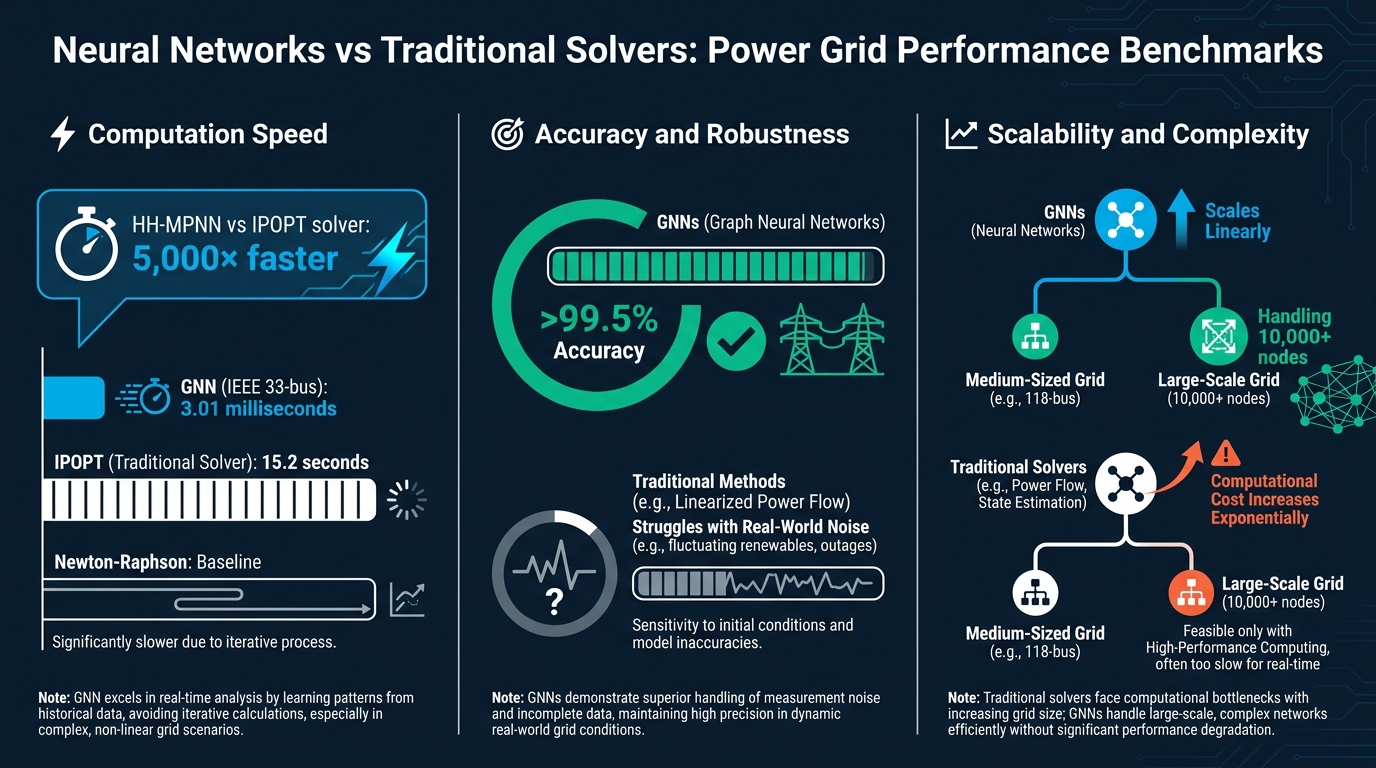
One standout advantage of neural networks is their speed. Traditional solvers like Newton-Raphson rely on iterative processes, which become increasingly slower as grid sizes grow. In contrast, Graph Neural Networks (GNNs) maintain constant computation times, regardless of grid size. For example, GNNs achieved a median solution time of just 3.01 milliseconds on the IEEE 33-bus system, enabling operators to process thousands of contingency scenarios per minute.
"Reducing solution time from tens of milliseconds to under four milliseconds can enable operators to analyze thousands more contingency scenarios per minute, drastically improving situational awareness." - Mohamed Shamseldein, Ain Shams University
A major milestone came in April 2026 when researchers Olayiwola Arowolo and Jochen L. Cremer introduced the HH-MPNN architecture. Tested on datasets like PGLearn and GridFM-DataKit across grids ranging from 14 to 2,000 buses, this model achieved an optimality gap of less than 1% while delivering an astonishing 5,000x speedup compared to the IPOPT interior point solver.
Handling Grid Variations and Unseen Conditions
Speed alone isn't enough; neural networks must also adapt to unexpected grid changes to remain practical. For example, events like line outages or sudden load spikes can challenge these models. A test on a stressed IEEE 33-bus system revealed that a purely data-driven GNN failed in 98.72% of cases, highlighting the importance of hybrid frameworks that combine GNN efficiency with the reliability of physics-based solvers.
The GNN-IZR hybrid framework tackles this issue by introducing a "robustness trigger." This mechanism monitors power mismatch thresholds to identify unreliable predictions. When triggered, the system delegates the task to a fallback solver. This approach reduced standalone GNN failure rates from 13.11% to 0.00% over 7,500 scenarios.
"The hybrid framework identified all potential failures, delegating them to the IZR solver to achieve a 0.00% failure rate, empirically matching the 100% success rate of the analytical solver." - Mohamed Shamseldein, Ain Shams University
Another innovative strategy is "on-the-fly" learning, as seen in the PowerModel-AI framework. This system continuously monitors its predictions and triggers retraining when new scenarios fall outside its training scope. For instance, if demand spikes to levels five times higher than those in the training data, the model adapts in real time to maintain accuracy.
Uses in Grid Operations and Equipment Planning
Real-Time Grid Control and Optimization
Neural networks, known for their speed and precision, are playing a key role in making real-time decisions to stabilize grids under ever-changing conditions. One effective method involves using neural network predictions as "warm starts" for traditional solvers. Instead of starting calculations from scratch, solvers begin with a near-accurate estimate, significantly reducing the time needed to reach a solution. For example, in May 2026, Microsoft Research introduced GridSFM, a tool capable of delivering bus voltages, generator dispatch, and branch power flows in mere milliseconds. This makes it ideal for applications requiring real-time warm starts.
These real-time capabilities not only enhance grid control but also provide critical insights for equipment-related decisions.
Equipment Use and Procurement
Accurate predictions of power flow are essential for making informed decisions about grid equipment. Neural networks help utilities pinpoint areas of congestion or identify where infrastructure, such as transformers and lines, is being pushed beyond its limits. This data-driven approach helps prioritize investments more effectively.
"Power flow calculations are necessary for grid planning to identify and check possible grid expansion measures to eliminate grid congestion." - Luis Böttcher et al., RWTH Aachen University
Additionally, neural networks can simulate extreme stress scenarios to evaluate how current equipment might perform before any physical modifications are made. This is particularly useful for accommodating distributed energy resources (DERs) and EV charging stations, which often introduce unpredictable load patterns and bidirectional power flows. By quickly analyzing the effects on branch currents and power losses, neural networks guide decisions on upgrading or adding protective components like breakers. For sourcing replacement or new equipment, platforms like Electrical Trader provide access to a variety of components, such as transformers and high-voltage breakers, tailored to the specific needs identified through these analyses.
These insights depend on reliable and well-structured data to ensure accuracy.
Data and Infrastructure Requirements
For neural networks to function effectively in grid operations, they require a strong data foundation. At the node level, models rely on four key variables per bus: active power (P), reactive power (Q), voltage magnitude (V), and voltage angle (θ). The grid's structure is typically represented as a graph using an adjacency matrix that maps the connections between buses and transmission lines.
Data for training these models comes from sources like Phasor Measurement Units (PMUs), smart meters, and SCADA systems. When real-world data is unavailable, synthetic datasets from tools such as SimBench or OpenStreetMap (OSM) fill the gaps. For instance, researchers at RWTH Aachen University used OSM data in 2023 to create synthetic distribution grids for training Graph Neural Networks (GNNs). They then validated these models against real grid data from Schleswig-Holstein Netz AG, demonstrating the ability to generalize to unseen grid configurations. The quality of input data is critical, as it directly impacts the reliability of predictions for both grid control and equipment planning.
| Data Category | Data Points | Infrastructure Requirement |
|---|---|---|
| Nodal Features | P, Q, V, θ | SCADA, PMUs, Smart Meters |
| Grid Topology | Adjacency Matrix, Y-bus Matrix | GIS (Geographic Information Systems) |
| Physical Constraints | Kirchhoff's Laws, KKT Conditions | Physics-Informed Loss Functions |
| Training Data | Historical load profiles, SimBench | High-Performance Computing (HPC) |
On the computational side, GNNs excel because they are highly parallelizable on GPUs. This gives them a major performance advantage over traditional CPU-based solvers, especially for large-scale grid applications. Effective deployment also requires robust data pipelines to normalize inputs, address missing values, and reduce dimensionality.
Current Challenges and Future Directions
As neural network models continue to show impressive speed and accuracy, researchers are now focusing on addressing critical issues like safety, scalability, and seamless integration into grid operations.
Safety Guarantees and Constraint Satisfaction
Speed and accuracy are important, but they mean little if the outputs of a model can't be trusted in real-world grid operations. The challenge lies in the fact that standard neural networks often produce outputs that fail to respect essential physical laws, such as Kirchhoff's laws, power balance requirements, and generator or line limits.
"Neural networks inherently produce unconstrained outputs. OPF solutions must satisfy numerous physical and operational constraints... which standard neural networks frequently violate." - IEEE
Unconstrained outputs not only create safety risks but also lead to inefficiencies in operations. Hybrid frameworks, which combine neural networks with physics-based fallback solvers, have shown promise in addressing these issues by ensuring outputs comply with physical laws.
Another challenge is the optimality gap: while neural networks may produce feasible solutions, these solutions are often more expensive than the true optimal result. Furthermore, the "black-box" nature of neural networks makes it difficult to audit or explain their predictions, which is a significant concern in safety-critical environments where accountability is essential.
These problems become even more pressing as models are scaled to handle national-level grid systems.
Scaling to Large Grids
Most research on neural network models uses smaller test grids, such as the IEEE 33-bus or 118-bus systems. However, the U.S. power grid operates on a vastly larger scale. For instance, the Eastern Interconnection includes tens of thousands of buses and hundreds of thousands of components. Scaling neural models to operate effectively at this level introduces major computational and architectural challenges.
One promising approach is the use of foundation models. In May 2026, Microsoft Research introduced GridSFM, a model trained on 200 grids and 500,000 scenarios. Its "Premier" version, featuring 100 million parameters, is designed to handle production-scale grids with tens of thousands of buses. Similarly, the LUMINA framework, developed by Argonne National Laboratory in March 2026, demonstrated that pre-training on smaller, diverse grids and fine-tuning for larger systems can cut optimization steps by 83.6% and reduce training time by 41.0% on 500-bus systems through mixed-precision training.
"A model that achieves strong average accuracy but occasionally violates power balance or thermal limits cannot be deployed in operational settings where such violations trigger protective equipment." - Yijiang Li et al., Argonne National Laboratory
Hybrid Models and New Architectures
To address both safety and scalability, researchers are increasingly turning to hybrid models that combine the speed of data-driven methods with the reliability of physics-based approaches. New frameworks are embedding physical constraints directly into neural network architectures. Techniques like LU factorization and projection operators ensure that outputs inherently satisfy equality constraints.
In June 2026, the GraphOPF framework was successfully tested on the Korean power system (Korea-4492), which includes 4,492 buses and 6,000 transmission lines. This framework achieved over 99% constraint satisfaction and was able to process topology changes in under one minute. On the architectural side, Hybrid Heterogeneous Message Passing Neural Networks (HH-MPNN) have emerged as a solution to the "locality bottleneck" in pure Graph Neural Networks (GNNs). By combining GNNs for local feature extraction with Transformers for global attention, this model delivered substantial computational speedups and kept the optimality gap below 1% on standard grid topologies.
"Achieving computational speedups of up to 5,000 times compared to interior point solvers, these results advance practical, generalizable machine learning for real-time power system operations." - Olayiwola Arowolo and Jochen L. Cremer
The path forward is clear: future systems will not rely solely on neural networks. Instead, they will integrate neural networks for their speed with physics-based methods or traditional solvers to ensure every output is safe and operationally sound.
Conclusion
Neural networks are transforming how power flow predictions are handled by engineers and grid operators. Unlike traditional solvers, which can take seconds or even minutes and sometimes fail to converge, neural networks provide results in milliseconds with consistent timing. This speed opens the door to real-time grid control.
The research highlights a progression from simple supervised models to advanced systems like Microsoft's GridSFM, showcasing the increasing integration of neural networks into grid management. These advancements are steadily moving the technology closer to large-scale, practical deployment.
Faster and more accurate predictions also have a ripple effect on equipment planning. Operators can better anticipate stress on key components like transformers, breakers, and transmission lines, leading to smarter purchasing decisions and targeted infrastructure upgrades. Tools such as Electrical Trader play a valuable role by connecting grid operators with the equipment they need for modernization efforts.
Challenges like ensuring constraint adherence and scaling are actively being worked on. The future likely lies in hybrid approaches, where neural networks provide quick estimates, and physics-based methods ensure reliability in operations.
FAQs
How much training data do these grid models need?
The type and amount of training data required for neural network power flow models can differ based on the approach used. Traditional methods typically rely on large offline datasets to uncover patterns and relationships. On the other hand, modern physics-informed models minimize data demands by integrating physical grid laws directly into their loss functions.
Some cutting-edge systems go a step further with on-the-fly learning. These systems only request new calculations when they come across data that falls outside their existing training range, making the process more efficient in terms of both time and resources.
What happens if the grid changes or hits unseen conditions?
When power grids encounter sudden changes - like topology shifts or unusual stress conditions - traditional neural networks often fall short. To address this, newer approaches leverage physics-informed neural networks, which integrate system constraints directly into the model. Additionally, some models adjust dynamically to new data or employ topology-aware designs to handle these challenges more effectively. As predictive technologies continue to evolve, Electrical Trader plays a key role in supporting grid reliability by offering essential power distribution equipment.
How are neural network predictions kept safe and constraint-compliant?
Neural networks are designed to make power flow predictions safer and more reliable by integrating physical laws directly into their structure and training process. Here's how this works:
- Incorporating power flow equations: By embedding these equations into the loss functions, neural networks can minimize inconsistencies during training.
- Using differentiable activation functions: This approach ensures that operational constraints are respected while maintaining smooth and effective learning.
- Feasibility restoration models: These models step in to correct predictions that don't align with valid operational parameters.
Together, these techniques help maintain grid stability and produce outputs that align with the physical realities of power systems.