IoT and AI for Power Plant Fuel Optimization
Fuel costs are a massive burden for power plants, making up 55–75% of operating expenses. Even small inefficiencies in energy use can cost millions annually. The solution? Combining IoT (Internet of Things) and AI (Artificial Intelligence) for smarter, more efficient operations. Here's the quick takeaway:
- IoT: Acts as the plant's sensory system, collecting real-time data like temperature and pressure.
- AI: Functions as the brain, analyzing data to improve energy efficiency and reduce costs.
- Together: IoT sensors feed data to AI systems, which adjust operations in real time for maximum savings.
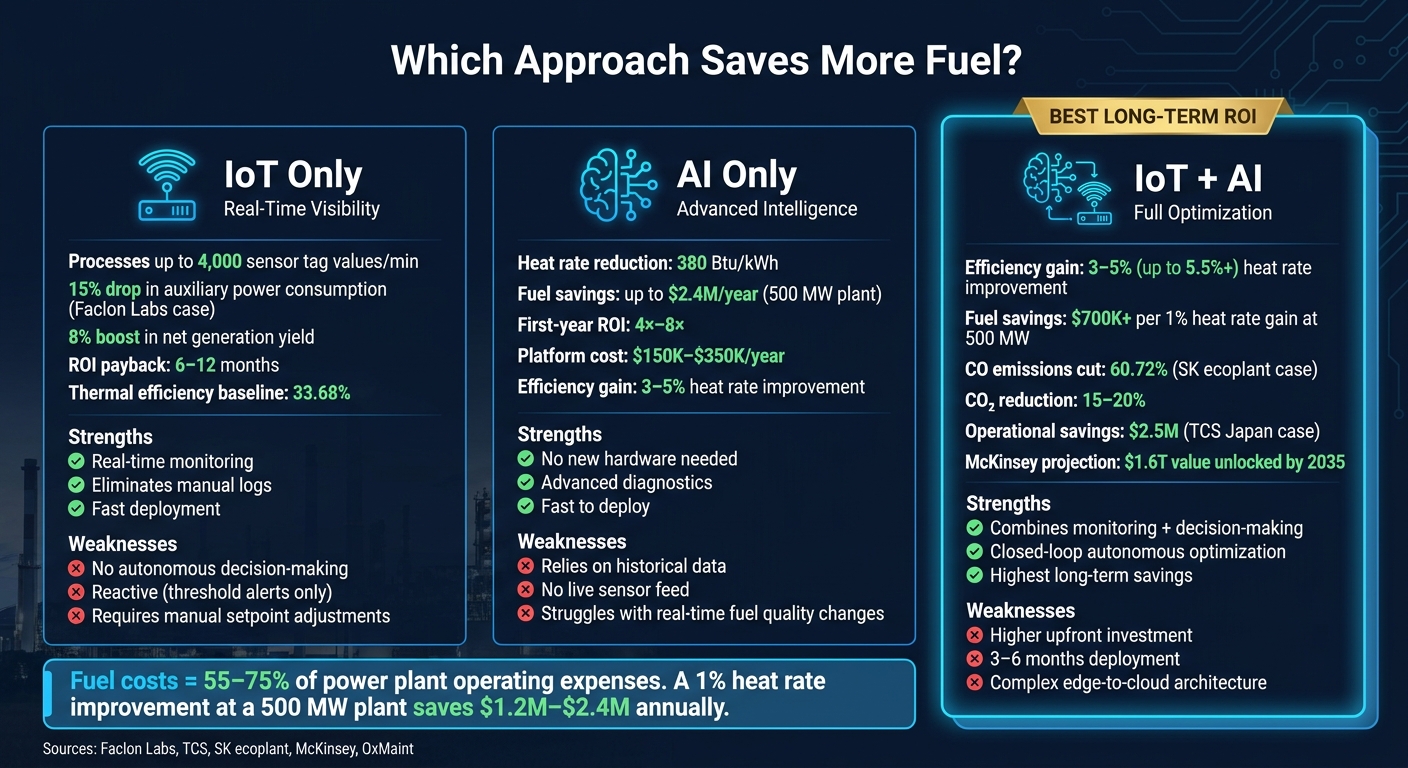
For example, a 500 MW plant can save $1.2–$2.4 million annually by improving its heat rate by just 1%. Fully integrated IoT and AI systems can boost efficiency by 3–5%, translating into even bigger savings and lower emissions.
Quick Comparison
| Approach | Strengths | Weaknesses |
|---|---|---|
| IoT-Only | Real-time monitoring; eliminates manual data logs | Limited decision-making capabilities |
| AI-Only | Advanced analysis; identifies inefficiencies | Relies on historical data; no live adjustments |
| IoT + AI | Combines monitoring and decision-making | Requires higher investment and setup effort |
The choice depends on your plant’s current setup and goals. IoT is great for visibility, AI excels at analysis, and combining both offers the best long-term gains. Ready to cut costs and boost efficiency? Let’s dive deeper.
IoT vs AI vs IoT+AI for Power Plant Fuel Optimization
Enhancing Energy Systems: Using AI for Power Plant Energy Management
sbb-itb-501186b
1. IoT-Only Approaches
IoT-only systems bring a game-changing shift to operations by enabling real-time monitoring. Instead of relying on manual data collection, smart sensors continuously track key parameters like temperature, pressure, flow, and vibration in turbines, boilers, and auxiliary equipment. These sensors transmit data through industrial gateways using protocols such as Modbus RS-485 and OPC-UA, creating live dashboards that give operators a real-time view of plant performance.
Consider the scale: a 600–900 MW unit can process up to 4,000 sensor tag values every minute. This massive data flow requires a layered setup where edge gateways filter information while cloud platforms store historical records. Without this infrastructure, much of the data remains untapped. Shockingly, fewer than 20% of industrial organizations have systems robust enough to turn raw IoT data into actionable insights.
Take the example of a Faclon Labs project from April 2026. A power utility with 1.8 GW of thermal capacity implemented the I/O Sense Platform with ST-54 IoT Gateways. This setup automated data collection for over 17 auxiliary systems, including cooling water and coal handling, completely eliminating manual reporting. The results? A 15% drop in auxiliary power consumption and an 8% boost in net generation yield.
"The lack of unified communication protocols, data formats, and interoperability frameworks limits seamless integration across heterogeneous industrial devices and systems." - Ishita Bhatnagar and Dr. Kamal Arora
This quote highlights a critical limitation of IoT-only systems. While they excel at providing real-time visibility and threshold-based alerts, they fall short in diagnosing root causes or suggesting corrective actions. Operators must manually make setpoint adjustments. Current control models that rely solely on IoT data deliver about 33.68% thermal efficiency - a solid baseline, but one that AI-enhanced systems can exceed. For facilities still transitioning from manual data collection, IoT-only setups offer a strong starting point, often delivering returns on investment within 6–12 months. Next, we’ll explore how AI-only systems address these gaps by adding deeper analytical capabilities.
2. AI-Only Approaches
While IoT-only systems excel at providing real-time data, AI-only methods take things a step further by addressing manual limitations and autonomously optimizing combustion. Using machine learning techniques like Random Forest (RF), Classification and Regression Trees (CART), and Deep Reinforcement Learning (DRL), these systems analyze variables such as fuel composition, flow rates, calorific values, and pressure in real time to determine the best combustion settings.
Take the case of Boiler #8 at Pohang Iron and Steel Company (POSCO) in South Korea. Operators managed to keep oxygen levels within the optimal 1–2% range only 36% of the time. The remaining 64% of measurements fell outside this range, leading to inefficient fuel usage.
The potential savings from improved efficiency are massive. For example, a 500 MW coal plant that improves its heat rate by just 1% can save between $700,000 and $2.4 million annually on fuel costs. AI-only systems match IoT setups in terms of quick payback but go further by offering advanced diagnostics that manual methods can't achieve. These platforms typically cost between $150,000 and $350,000 per year, with payback periods of 6–12 months and a first-year return on investment (ROI) ranging from 4× to 8×.
One real-world example comes from a 500 MW coal-fired plant in the American Midwest, which adopted AI-driven heat rate optimization in March 2026. By leveraging existing data, the system identified 14 controllable inefficiencies within 90 days and reduced the heat rate by 380 Btu/kWh. This resulted in $2.4 million in fuel savings during the first year - without requiring any hardware upgrades.
"AI finds improvements that human operators and static control systems physically cannot see - because the optimization space has 200+ interacting variables changing every second." - Larry Eilson
However, AI-only systems face a key roadblock: data quality. Most Distributed Control Systems (DCS) and plant historians record data as hourly or daily averages, which lack the granularity needed for real-time combustion decisions. Additionally, many DCS platforms are "closed" systems, making it challenging to stream live data into external AI models. When real-time data isn't accessible, offline reinforcement learning is often used instead, but this approach can struggle with distributional shifts when the model encounters conditions not included in its training data.
"AI studies face difficulties in direct application to actual industrial sites due to the closed nature of the DCS." - Dongmin Shin, SKecoplant Co., Ltd.
Despite these challenges, well-executed AI-only projects consistently deliver measurable improvements in fuel savings and plant efficiency. For instance, the POSCO ABCCM project achieved a 0.86% increase in combustion efficiency and a 1.7% boost in power generation efficiency, saving roughly $89,600 annually on a single boiler. On a larger scale, DRL-based systems using Proximal Policy Optimization have improved plant efficiency from 33.68% to 35.72%, reducing heat rates from approximately 13,300 Btu/kWh to 10,400–11,400 Btu/kWh. This translates to an expected 15–20% reduction in CO₂ emissions.
These results underscore the importance of investing in high-frequency data pipelines to enable real-time optimization. With these AI-driven advancements in mind, the next section delves into how combining AI and IoT can further enhance fuel optimization.
3. IoT Plus AI Integration
When IoT and AI operate on their own, they face clear limitations. IoT excels at monitoring but lacks the ability to make decisions, while AI depends on real-time data to make optimal choices. Combining the two creates a continuous feedback system: IoT sensors supply high-frequency data to AI models, which then send real-time adjustments back to control systems. This integration bridges the gap between monitoring and decision-making, driving operational improvements.
For example, integrated systems have shown efficiency gains of 2% to 5%. To put this into perspective, even a 1% heat rate improvement at a 500 MW plant can translate into $1.2 million to $2.4 million in annual fuel savings. In January 2024, SK ecoplant implemented an Intelligent Combustion Control (ICC) system at the "G" Waste-to-Energy facility in Gyeonggi Province, South Korea. Over four days of fan optimization, the facility achieved a 2.41% boost in steam flow rate, a 3.09% increase in power generation, and a 60.72% cut in CO emissions, with only a 0.12% data loss rate. Similarly, TCS deployed its Intelligent Power Plant solution on AWS for a 1,000 MW thermal station in Japan, generating $2.5 million in operational savings. This was made possible by combining AWS IoT Core for data ingestion with Amazon SageMaker for machine learning, showcasing how cloud-native tools can amplify the value of real-time sensor data.
"Unlike traditional thermodynamic models, these twins are real-time, cost-effective, and self-adjusting to changing operational conditions." - TCS
To enable real-time adjustments, a robust system architecture is essential. A production-ready IoT and AI integration typically follows a six-layer pipeline:
- Edge Sensors: Responsible for raw data collection.
- IoT Gateways: Convert legacy OT protocols (e.g., Modbus or HART) into IT-compatible formats.
- Message Bus: Stream high-throughput data using tools like Apache Kafka.
- Storage: Use time-series databases for real-time queries and data lakes for historical analysis.
- AI Engine: Handles inference and predictive analytics.
- Integration: Connects outputs to Distributed Control Systems (DCS) or maintenance platforms like SAP S/4HANA.
To secure this architecture, a DMZ with one-way data diodes is recommended to block incoming commands. For most medium-sized plants, building such a system takes about 3 to 6 months.
The financial benefits of this approach are undeniable. In April 2026, Faclon Labs introduced its I/O Sense Platform with ST-54 IoT gateways at a 1.8 GW thermal plant. Without replacing any core equipment, they monitored 17 auxiliary systems, achieving a 15% drop in auxiliary power consumption and an 8% increase in net generation yield. Compared to physical hardware upgrades, digital solutions like these typically offer quicker payback periods and lower long-term risks.
"Digital transformation in energy could unlock $1.6 trillion of value by 2035, delivering 20–30% reduction in operating costs and up to 5% decrease in carbon emissions." - McKinsey
For optimal results, plants should establish a 6–12 month heat rate baseline using historical DCS data before deploying AI models. Additionally, standardizing sensor tag naming conventions is crucial for scalability, especially when expanding to multiple sites.
Pros and Cons of Each Approach
When deciding on a solution, it’s important to weigh the trade-offs. The best choice will depend on your plant’s current infrastructure, budget, and long-term goals.
IoT-only systems excel at eliminating manual data collection and can handle high-frequency data ingestion - up to 4,000 sensor tag values per minute. But their scope is limited to providing visibility. Without an intelligence layer, operators must rely on their own judgment to make adjustments, which can lead to inconsistent performance across shifts. Additionally, IoT-only systems are primarily reactive, sending alerts only after thresholds are crossed rather than anticipating potential issues.
AI-only systems, on the other hand, take a different approach. They operate as a software layer on top of existing Distributed Control Systems (DCS), meaning no new hardware is required. This makes them faster to deploy and easier on the budget upfront. As noted in Section 2, well-implemented AI-only solutions have achieved heat rate reductions of 380 Btu/kWh and first-year fuel savings exceeding $2.4 million. However, these systems rely heavily on historical or DCS historian data. Without live sensor feeds, they may not capture real-time changes in fuel quality or load conditions.
"The gap between knowing about an efficiency deviation and doing something about it is where fuel costs accumulate." - OxMaint
The table below compares how each approach measures up in key areas relevant to fuel optimization:
| Dimension | IoT-Only | AI-Only | IoT + AI Integration |
|---|---|---|---|
| Data Use | Real-time collection and visualization; replaces manual logs | Historical or DCS historian data; limited real-time feedback | Combines live data with historical records |
| Fuel Efficiency | Low; relies on manual setpoint adjustments | Moderate; 3–5% heat rate improvement possible | High; up to 5.5%+ heat rate improvement |
| Deployment Complexity | Moderate; requires hardware gateways and protocol integration | Low to moderate; software-centric | High; requires a full edge-to-cloud architecture |
| Cost-Effectiveness | High for monitoring; low for actual fuel savings | High short-term ROI with low capital expenditure | Highest long-term ROI; saves $700,000+ per 1% heat rate gain |
This comparison highlights that while each approach has its strengths, integrating IoT and AI provides the most comprehensive solution for long-term fuel optimization. It does require significant investment in both infrastructure and time, but the returns are unmatched. For plants not yet ready to commit to full integration, an AI-only system offers a practical stepping stone. It delivers measurable fuel savings using existing infrastructure while laying the groundwork for a future transition to a combined IoT and AI architecture.
Conclusion
A single approach won’t cut it - combining IoT and AI is the key to achieving lasting results. IoT-only solutions offer visibility, while AI-only systems bring intelligence. But true impact happens when these two work together, creating systems that deliver measurable, real-time improvements automatically.
Consider this: fuel costs make up 55–75% of operating expenses at most U.S. thermal plants. A modest 1% improvement in heat rate can save over $700,000 annually at a 500 MW facility. Integrated IoT and AI platforms consistently deliver 3–5% heat rate improvements, translating to savings that grow year after year.
The best approach depends on your plant’s current setup. If full integration isn’t immediately possible, starting with AI-only solutions can still provide significant fuel savings by leveraging existing DCS historian data - no new hardware required. From there, adding IoT sensors and edge gateways unlocks the full potential of closed-loop, autonomous optimization. As these operational benefits build over time, ensuring system security becomes increasingly critical.
With greater optimization comes a growing need for cybersecurity. As plants adopt connected, cloud-based systems, the risk of cyberattacks increases. To mitigate this, secure protocols like OPC-UA and MQTT, along with private cloud solutions for sensitive operations, are essential for both compliance and safety.
"The shift toward an integrated AI forecasting with sensors system is not an option, but a necessity for maintaining competitiveness in a sustainable manner." - Scientific Reports
The technology is proven, the ROI is clear, and the tools are more accessible than ever. The question now is: how quickly will operators embrace integrated IoT and AI systems to optimize fuel use and secure their competitive edge?
FAQs
What data does AI need to optimize fuel use in real time?
AI systems depend on high-frequency sensor data to fine-tune fuel usage in real time. Critical metrics include ambient temperature, load levels, steam pressures, valve positions, and fuel flow rates. With these inputs, the system can make precise adjustments, improving efficiency and cutting down on waste.
How long does it take to deploy an IoT + AI system in a power plant?
Deploying an IoT and AI system in a power plant typically takes 6 to 12 months. The exact timeline can vary based on factors like the size of the project and how complex it is to integrate the new system with the plant's existing infrastructure.
How can plants connect IoT and AI to the DCS without cybersecurity risk?
Plants can safely integrate IoT and AI with their Distributed Control Systems (DCS) by implementing reliable architectures that prioritize security. This involves using secure gateways, firewalls, and encrypted communication channels to protect data and systems.
Some essential strategies include:
- Protocol converters: These help connect legacy systems to modern IoT and AI technologies.
- Edge computing: Processing data locally at the edge reduces latency and enhances security.
- Secure data diodes: These ensure a one-way data flow, preventing potential cyberattacks.
Adhering to IEC 62443 standards is another critical step. These standards promote proper network segmentation and enforce strict access controls, significantly lowering cyber risks. At the same time, they support smooth integration and enable real-time data analysis.