Meter Selection Guide: CT vs Direct Connect
If the feeder stays within the meter’s amp rating, I’d use direct connect. If the load moves past that range - or the conductors get too large for the terminals - I’d use CT metering.
That’s the short answer. In most cases, direct connect fits smaller feeders such as 100 A to 200 A setups. CT metering is more common once service size moves into the 200 A to 400 A range, and it is often the standard choice at 400 A and above. A 400:5 CT, for example, lets a meter read 400 A on the primary side through a 5 A secondary circuit.
Here’s what matters most:
- Direct connect meters carry the full load current through the meter
- CT-operated meters read current through external current transformers
- Direct connect usually costs less up front
- CT metering takes more parts and labor, but it gives better access for service
- Utility rules often decide the cutoff, especially on main services
- For billing use, CTs often need 0.3 accuracy class or better
- One safety rule stands out: never open a live CT secondary
If I were narrowing the choice fast, I’d check these items first:
- Feeder amps
- Voltage and phase
- Conductor size and terminal fit
- Room in the gear
- Service access
- Utility metering rules
- Installed cost
Direct Connected or CT Operated Metering, what do you need and what are the differences?
Quick Comparison
| Criteria | Direct Connect | CT-Operated |
|---|---|---|
| How it measures | Full load current goes through meter | Meter reads CT secondary current |
| Common use range | Smaller feeders, often up to 100–200 A | Larger feeders, often 200 A+ |
| Common utility use | Small tenant and branch metering | Main service and larger tenant loads |
| Upfront cost | Lower | Higher |
| Install work | Simpler | More setup, wiring, and testing |
| Meter service access | At or near feeder terminations | Meter can be mounted away from primary conductors |
| Safety during meter work | Full-load current at meter terminals | Work is on low-current secondary side |
| Main watch-out | Terminal rating and conductor fit | CT ratio, polarity, burden, and secondary safety |
So if you want the simple rule, here it is: use direct connect for smaller, clean-fit feeders; use CT metering for higher-current services, larger conductors, or jobs where meter access matters more.
Direct Connect Meters: When to Use Them on Smaller Feeders
Use a direct connect meter when the feeder current stays within the meter's terminal rating and the conductors physically fit the enclosure. Once current goes up, or the wire size starts making installation awkward, CT-operated metering is usually the better path.
Current Ratings, Wiring, and Panel Space
Direct connect meters are often used on feeders up to about 100 A, but conductor size and terminal fit can be the real limit. In plain terms, amp rating by itself doesn't tell the whole story.
Large or stiff conductors can turn terminal landing and bend radius into the main issue. That's why it's smart to check the meter's terminal conductor range and available wire-bending space before you lock in a direct connect setup. A design can look fine on paper and still become a headache in the field if the conductors don't land cleanly.
There is a cost upside here too. Fewer parts usually means less labor. But there's a catch: with direct connect metering, the meter terminals carry the full feeder current, which increases installation exposure.
Cost, Safety Exposure, and Typical Applications
Direct connect meters usually cost less up front because they remove the need for CTs, extra wiring, and added labor. That's the main reason they show up so often on smaller jobs.
The tradeoff is safety exposure during installation. Since the full feeder current passes through the meter terminals, lockout/tagout, conductor landing, and torque checks are mandatory.
You'll usually see direct connect meters on:
- Small tenant panels
- Lighting panels
- Other low-current feeders
When the feeder moves beyond that range, CT metering tends to make more sense.
sbb-itb-501186b
CT-Operated Meters: Built for Higher Current and Easier Service Access
Use CT metering when feeder current goes past direct-connect limits, or when the service setup makes a remote, low-current meter circuit the better fit. Many U.S. utilities require CT metering somewhere above 200–400 A, depending on the utility. At that point, the choice is less about meter terminal limits and more about CT ratio, physical layout, and service access.
CT Ratios, Secondary Current, and Installation Layout
A CT ratio needs to match the feeder current. The meter reads the secondary output, then converts that reading to line current. For example, a 400:5 CT delivers 5 A on the secondary when 400 A is flowing on the primary, so the CT ratio should fit the feeder it serves.
Placement matters just as much as ratio. Each CT goes around a phase conductor or busbar on the load side of the main disconnect, with polarity lined up so the meter reads the load the right way. In a switchboard, that often means a separate metering compartment with enough room for the CTs, mounting hardware, shorting blocks, and secondary wiring. Secondary runs should stay short to limit burden and keep the reading accurate. That extra space and hardware are a big reason CT metering costs more to install.
Higher Upfront Cost, Reduced Secondary-Side Exposure, and Common Applications
CT-operated metering has a higher upfront cost because it adds CTs, secondary wiring, and commissioning. The upside is simpler service access.
Technicians work on low-current secondary circuits, which cuts exposure on the meter side. But one rule is non-negotiable: never open a live CT secondary. In some setups, technicians can test or replace the meter without shutting down the feeder. For critical loads, that's a big deal.
CT-operated meters are the standard choice for:
- Main service entrances
- Large HVAC and process loads
- Revenue-grade submetering
For revenue billing, use CTs with the required accuracy class. ANSI standards call for 0.3 accuracy class or better, checked at both 10% and 100% of rated current. It also helps to size CT ratios to the actual expected load, not just the largest breaker on paper, so low-load readings stay accurate.
CT vs. Direct Connect: Side-by-Side Selection Criteria
Once you know how each meter type works, the next step is simple: pick the one that fits the job. The tables below compare direct connect and CT-operated metering based on current, space, cost, safety, and service access.
Comparison Table: Current Limit, Installation, Space, Cost, Safety, and Service Access
| Factor | Direct Connect | CT-Operated |
|---|---|---|
| Current limit | Typically up to about 200 A | Commonly used for 200–400 A feeders and standard at 400 A and above |
| Install method | Full-load conductors land directly on the meter terminals or socket | External CTs feed a remote meter |
| Panel/wall space | Meter sits in or directly next to the panel, which can crowd small rooms with multiple points | CTs stay in the switchboard section, while the meter can mount separately on a wall or in a meter room |
| Hardware cost | Lower - meter, socket, and standard wiring only; basic self-contained submetering is about $74–$93, and self-contained commercial meters are roughly $195–$450 | Higher - adds CTs, CT cabinet, secondary wiring, and commissioning; transformer-rated commercial meters typically run $1,200–$3,500+ |
| Install complexity | Straightforward: land conductors, torque terminals, and test | More involved: CT mounting, polarity verification, lead routing, and commissioning add time and skill requirements |
| Safety exposure during service | Full-load current is present at the meter terminals, so de-energizing is required for safe service work | Routine meter work is on low-current CT secondary circuits, while the primary conductors stay enclosed in the CT cabinet or switchboard section |
| Service access | Meter location is tied to the panel, so servicing means working near high-current terminations | Meter can be mounted remotely for easier service |
Use-Case Table: Branch Circuits, Tenant Submetering, Main Service, and Large Equipment Feeders
| Metering Point | Typical Current Range | Recommended Type | Notes |
|---|---|---|---|
| Branch circuits | Up to 150 A | Direct connect | Simple, low-cost, and self-contained |
| Tenant submetering - small | 100–200 A | Direct connect | Best for small offices and retail bays |
| Tenant submetering - large or multi-tenant | 200–400 A | CT-operated | Best above 200 A or where centralized reads matter |
| Main service entrance | Three-phase over 200 A; single-phase over 400 A | CT-operated | Common utility requirement |
| Large equipment feeders (chillers, large HVAC, industrial machinery) | 200 A and above | CT-operated | Improves access and keeps metering off the main conductor path |
Use these project types as a starting point. Then check the final pick against the meter's rating and the utility's rules. These current ranges help narrow the choice before moving to the selection steps below.
How to Select the Right Meter for Your Project
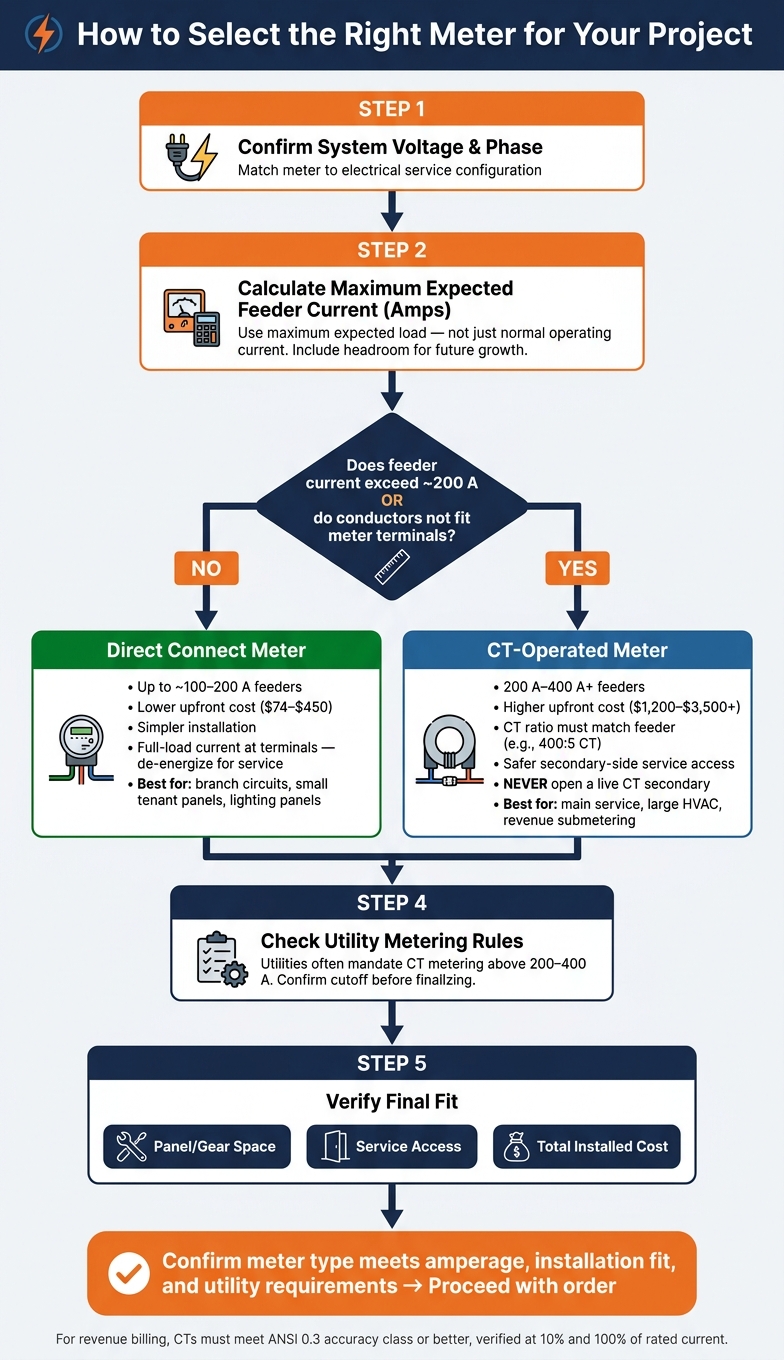
How to Select CT vs Direct Connect Meter: Step-by-Step Guide
Step-by-Step Meter Selection for Commercial Projects
Start with the basics: confirm your system voltage and phase. The meter has to match the electrical service configuration, so this is the first screen in the selection process.
Next, calculate the expected feeder current in amps based on the load. Use the maximum expected current, not just the normal operating load. Then compare that number to the meter's current rating, and leave some room for future growth.
After that, check the utility's current-limit rules before you size the meter. Use the meter's rated current along with the utility limits to decide between direct connect and CT metering.
Once you've confirmed the meter type, look at three more items before placing the order:
- Space inside the existing gear
- Service access
- The total installed cost, utility-required hardware, and working-clearance requirements
That last review matters. A meter can be correct on paper and still be a poor fit once you look at the gear, access, and install conditions.
Conclusion: Direct Connect for Simplicity, CT Metering for Capacity and Access
At that point, the choice is usually pretty straightforward. Direct connect meters make sense when the load is small, the conductors land cleanly at the terminals, and keeping costs down is the main goal.
CT-operated metering fits better for higher-current feeders, main service monitoring, large equipment feeders, and commercial submetering where putting the meter away from the primary conductors improves safety and serviceability. The higher upfront cost buys more capacity, safer access, and room for future growth.
Choose based on amperage, installation fit, and utility requirements.
FAQs
How do I know if my feeder is too large for direct connect?
Your feeder is too large for direct connect when the electrical load, or the feeder ampacity, goes past the meter’s maximum rated current. A direct connect meter can only handle so much current because of how it’s built.
When that happens, you need a CT-operated meter. It uses current transformers to step the current down to a level the meter can measure safely.
When do utility rules require CT metering?
Utility rules usually require CT-operated metering when electrical load goes beyond what a direct connect meter can handle. You’ll see this a lot in higher-capacity commercial and industrial service setups. In those cases, CTs step primary current down to a standard 1 A or 5 A so the meter can read usage correctly.
Always check your serving utility’s technical specs and approved device list. Those documents spell out the required metering class and the exact equipment allowed at your connection point.
What CT ratio should I choose for my load?
Choose a CT ratio that fits the load you expect to measure. For example, a 200:5 CT ratio works for loads up to 200 amperes.
That ratio choice matters more than it might seem. If the CT is too small, it can saturate during fault conditions. If it’s too large, you may lose accuracy at lower loads. You’ll also want to confirm that the transformer’s burden rating and ratio meet ANSI C12.1 requirements, which are typically 2.5 VA or 5 VA.