

How to Ensure Compliance with Metering Standards
Ensuring compliance with metering standards is essential for accurate energy billing, legal validity, and avoiding financial risks. Non-compliance can lead to penalties, billing disputes, and even federal offenses for tampering. Here's a quick breakdown of what you need to know:
- Key Standards: Follow NIST Handbook 44 for measuring device specifications, ANSI C12 for metering accuracy, and FCC Part 15 for electromagnetic compatibility.
- Equipment Selection: Revenue-grade meters must meet ANSI C12.20 standards with accuracy classes of 0.2% or 0.5%. Sub-meters should comply with state-specific rules, maintaining ±2% accuracy for tenant billing.
- Testing: Conduct pre-compliance and witness testing to verify accuracy, prevent errors, and meet regulatory requirements.
- Documentation: Maintain calibration reports, test records, and compliance certificates traceable to NIST standards.
- Tamper-Proof Measures: Protect utility seals to comply with federal laws and prevent tampering.
Ensuring Meter Compliance Best Practices for the Functional Evaluation of DLMS Meters
sbb-itb-501186b
Key US Metering Standards You Need to Know
Before purchasing or installing metering equipment in the United States, it's crucial to understand the regulatory framework that ensures measurement accuracy, performance, and electromagnetic compatibility. Three key standards govern metering compliance in the US, each addressing specific aspects of these requirements.
NIST Handbook 44
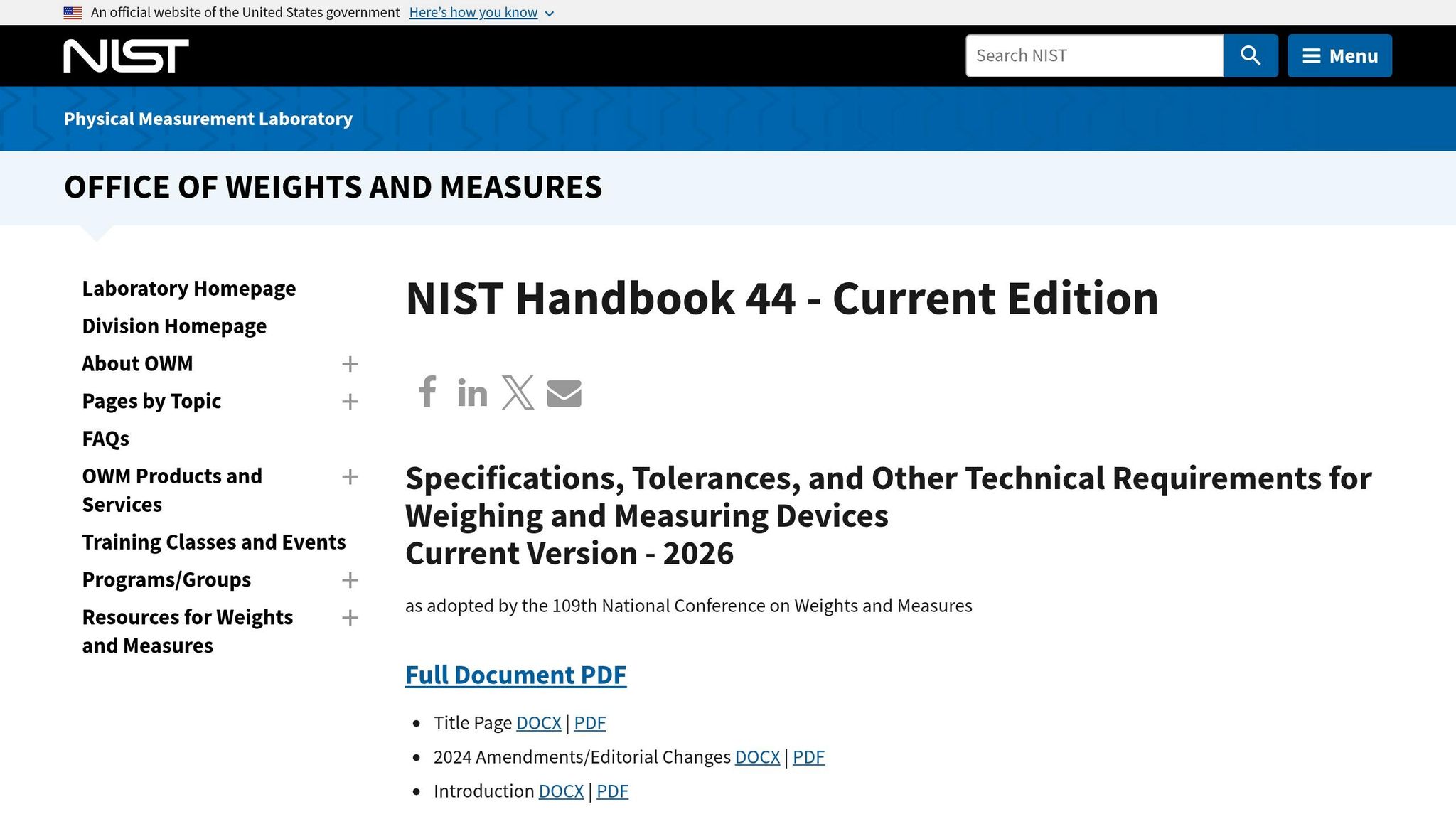
NIST Handbook 44 outlines the specifications, tolerances, and requirements for measuring devices. It’s adopted annually by the National Conference on Weights and Measures (NCWM) and serves as the nationwide standard for state and local weights and measures officials. The latest version, the 2026 edition, was adopted during the 109th NCWM meeting and includes updated guidelines.
The handbook’s General Code (Section 1.10) applies to all types of weighing and measuring devices. It specifies how measurement data should be displayed, recorded, and safeguarded against tampering. Additionally, HB 44 contains codes for specialized measuring systems, so it’s important to determine which sections are relevant to your application. Always start with the General Code and confirm which version of HB 44 is enforced in your state.
While NIST provides baseline standards, ANSI standards take a closer look at performance and accuracy.
ANSI C12 Standards
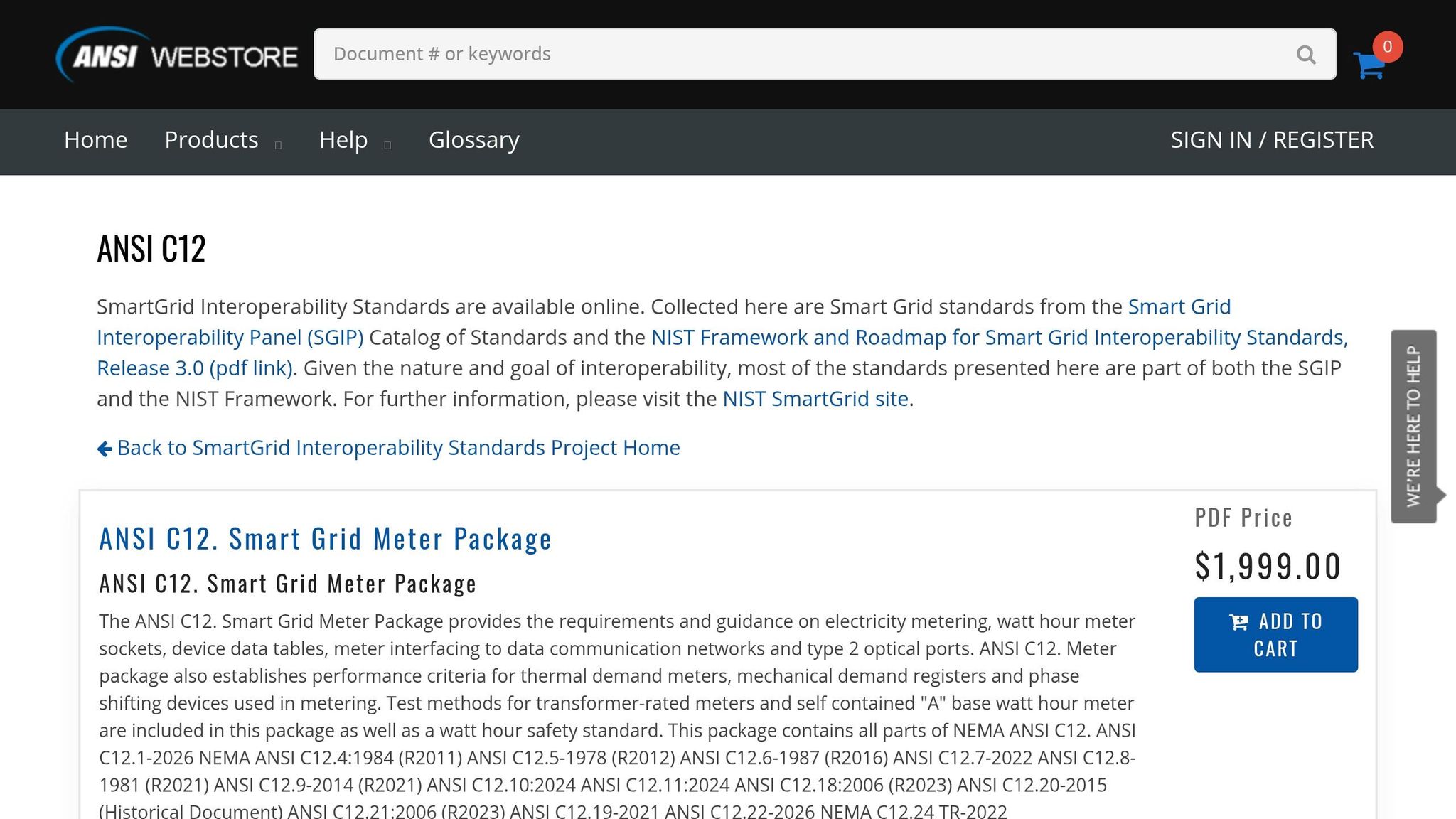
The ANSI C12 standards are essential for electricity metering. ANSI C12.1-2026, known as the Code for Electricity Metering, sets uniform performance criteria for new meters, ensuring they meet industry expectations. For revenue-grade applications, ANSI C12.20 defines high-accuracy classes - 0.1%, 0.2%, and 0.5% error rates - to ensure precise billing. When choosing equipment for revenue-related use, verify that both the meter and its components comply with these standards.
While accuracy and performance are priorities, electromagnetic compatibility is equally important. This is where FCC Part 15 regulations come into play.
FCC Part 15 Regulations
FCC Part 15 governs radio frequency (RF) devices that operate without individual licenses, ensuring they meet technical standards to avoid harmful interference. Compliance with these rules is mandatory for marketing, selling, or importing devices in the US. Non-compliance can lead to fines and removal from the market.
For metering equipment that functions as digital transmitters or internal radiators, FCC Part 15 establishes technical standards to prevent interference. As stated in 47 CFR § 15.5:
"The operator of a radio frequency device shall be required to cease operating the device upon notification by a Commission representative that the device is causing harmful interference."
All FCC certification tests must be conducted by accredited laboratories. Devices classified as intentional radiators require formal certification through a Telecommunications Certification Body (TCB). Additionally, new applicants must pay a $45 processing fee to obtain a Grantee Code.
These three standards - NIST Handbook 44, ANSI C12, and FCC Part 15 - provide a comprehensive framework for selecting and certifying metering equipment that meets US compliance requirements.
How to Select Compliant Metering Equipment
Choosing the right metering equipment is a crucial step in achieving regulatory compliance. Your selection should align with the specific needs of your application. For revenue-grade meters, ensure they meet ANSI C12.20 standards with an accuracy of 0.2% or 0.5%. Sub-meters used for tenant billing must maintain an accuracy of ±2%, as required by state utility commissions. If you're using meters for internal cost allocation instead of direct utility billing, check your state's regulations - currently, at least 15 states have established sub-metering rules through their utility commissions.
Accuracy and Performance Requirements
Accuracy is a cornerstone for both compliance and precise billing. Revenue meters must adhere to ANSI C12.1 and ANSI C12.20 standards, with factory calibration traceable to NIST reference standards and tamper-evident utility seals. This is especially important because demand charges can make up 30% to 70% of a commercial electricity bill, highlighting the need for high-accuracy interval data to manage costs effectively.
Matching instrument transformers to the load is equally essential. The ratio of the Current Transformer (CT) should correspond to the expected load range. For instance, a 200:5 CT is ideal for loads up to 200 amperes. As the Electrical Trade Network explains:
"Undersized CTs saturate under fault conditions; oversized CTs reduce accuracy at low loads"
To avoid issues, steer clear of undersized CTs, which can saturate during faults, and oversized CTs, which compromise accuracy at lower loads. ANSI C12.1 also specifies burden limits for metering-class CTs, typically 2.5 VA or 5 VA. Beyond accuracy, using pre-certified components can further streamline compliance efforts.
Using Pre-Certified Components
Pre-certified communication modules - such as NB-IoT, LoRaWAN, ZigBee, or Bluetooth - can simplify the compliance process. These modules leverage existing test data to meet FCC Part 15 and UL requirements, reducing the need for redundant testing and ensuring adherence to complex radio regulations across different regions. Maurice Mergler from NMi-Certin Netherlands advises:
"It pays off to invest in better quality adapters from a trusted manufacturer. Requesting a test report from the manufacturer is always a good idea"
Before making a purchase, confirm component certifications using UL Product iQ to ensure compliance with safety standards like UL 2735 and IEC 62052-31. Opt for components with built-in shielding and low-EMI profiles to enhance immunity to electromagnetic disturbances. This proactive approach minimizes the likelihood of costly redesigns during formal certification.
Testing and Certification Steps
Once you've chosen components that meet compliance standards, the next step is to thoroughly test your metering equipment to ensure it aligns with regulatory requirements. Start with pre-compliance testing to establish baseline accuracy before moving on to formal verification.
Pre-Compliance Testing
Begin by comparing your equipment's accuracy against a certified standard, making adjustments to minimize errors as much as possible. For watt-hour meters, conduct tests at 100% and 10% of test currents with a 1.0 power factor, and at 100% current with a 0.5 power factor. Also, check for creep - this should not exceed one revolution in five minutes when voltage is applied without a load.
For block interval demand meters, ensure testing is performed at a minimum of 50% full scale, confirming time interval accuracy within 0.5%. Additionally, secondary test standards must be calibrated annually at NIST or an accredited lab, with a signed calibration certificate as proof. Billing transformers should be tested according to ANSI C57.13 standards.
Witness Testing Procedures
After completing pre-compliance adjustments, witness testing provides independent validation. This step involves a weights and measures official who verifies the equipment's accuracy using test standards and tools supplied by the owner. This process is particularly common for large-scale metering systems.
The official oversees all aspects of the testing process, including the selection and validity of test standards, the type and number of accuracy tests, and the specific procedures followed. Under NIST Handbook 44 General Code G-UR.4.4, device owners are responsible for supplying any special equipment or labor required for testing. For instance, a large volumetric prover - often used in metering systems - can cost over $75,000 and may require specialized transportation.
Before deploying the equipment for service, owners must secure witness testing to confirm compliance with NIST Handbook 44. The official also verifies the calibration and validity of the owner's test standards as part of the process.
Documentation Requirements for Compliance
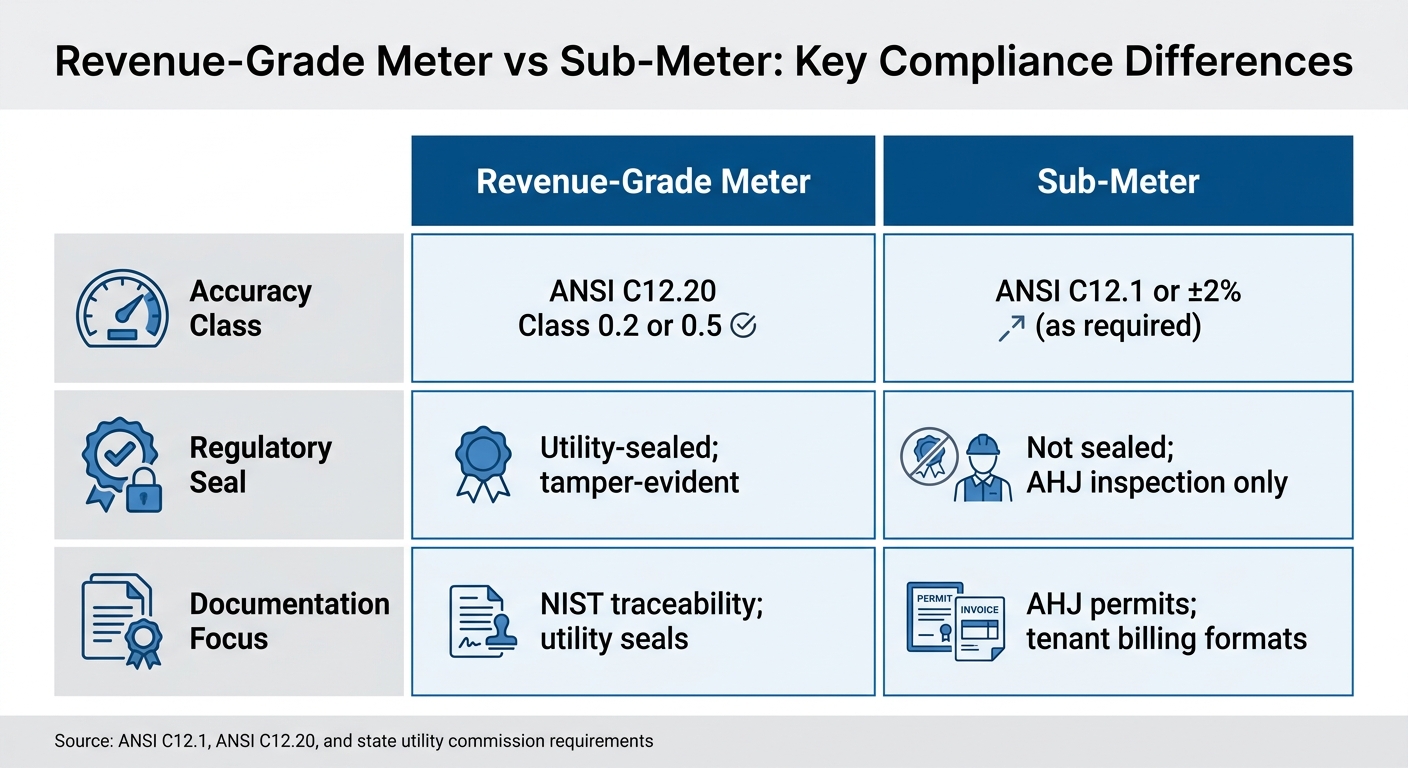
Revenue-Grade Meters vs Sub-Meters: Compliance Requirements Comparison
After completing testing and certification, keeping thorough documentation is crucial to demonstrate compliance. Detailed records help prove metering compliance and protect your business during inspections by authorities having jurisdiction (AHJ) or utility commissions.
Technical Files and Test Reports
Your technical files should include factory calibration reports that are traceable to NIST reference standards. Be sure to document CT/VT ratios and burden ratings that align with ANSI C12.1 limits, typically 2.5 VA or 5 VA. Also, include evidence showing that CT ratios and burden ratings meet the expected load requirements, ensuring there’s no risk of saturation or reduced accuracy.
Keep AHJ permits and inspection reports, particularly for any modifications to meter sockets or sub-panels. For revenue-grade meters, retain documentation proving the presence and integrity of utility seals. These seals act as legal evidence against tampering under federal and state laws. If you’re operating sub-meters for tenant billing in any of the 15 or more U.S. states with specific sub-metering regulations, maintain organized files showing state commission registrations and approved billing statement formats.
Revenue Metering Accuracy
Revenue-grade meters are required to meet ANSI C12.20 accuracy classes - either Class 0.5 (±0.5%) or Class 0.2 (±0.2%). Record the accuracy as a percentage true error using the formula:
E = ((R ÷ T) - 1) × 100%, where R is the indicated value and T is the true value. Ensure errors are recorded to at least one decimal place (e.g., 0.1%) to maintain metrological reliability.
For commercial setups, where demand charges can contribute to 30% to 70% of your electricity bill, document 15-minute demand intervals. These records are essential for load scheduling and conducting power factor correction audits. Additionally, clearly record meter multipliers, which are the factors used to calculate the correct magnitude of measured quantities, to avoid billing errors. Make sure to note the "reverification due year" by adding the verification period to the current year to stay on top of recalibration deadlines.
| Factor | Revenue-Grade Meter | Sub-Meter |
|---|---|---|
| Accuracy Class | ANSI C12.20 Class 0.2 or 0.5 | ANSI C12.1 or ±2% (as required) |
| Regulatory Seal | Utility-sealed; tamper-evident | Not sealed; AHJ inspection only |
| Documentation Focus | NIST traceability; utility seals | AHJ permits; tenant billing formats |
Maintaining these records not only ensures compliance but also simplifies future audits and inspections.
Where to Source Compliant Metering Equipment
Once you’ve nailed down compliance and testing procedures, the next step is finding the right equipment to meet regulatory requirements.
What Electrical Trader Offers
Electrical Trader (https://electricaltrader.com) is a go-to platform for sourcing metering equipment that meets ANSI C12.1, ANSI C12.20, and NIST Handbook 44 standards. Acting as a centralized marketplace, it connects buyers with a wide range of new and used electrical components. These include pre-certified meters, current transformers, and power distribution equipment. Beyond just equipment, the platform also provides access to licensed electrical contractors who are well-versed in local regulations and AHJ (Authority Having Jurisdiction) requirements. This is especially helpful in states like California, New York, and Texas, where sub-metering regulations are more complex. By offering both equipment and expertise, Electrical Trader simplifies the entire process - from selection to procurement.
Simplifying Equipment Procurement
Electrical Trader makes finding compliant equipment easier by allowing users to filter products based on specific criteria. For example, you can search for meters that meet ANSI accuracy classes, such as Class 0.2 (±0.2%) for revenue-grade applications or Class 0.5 (±0.5%) for sub-metering. You can also ensure compatibility with your load’s CT ratios and ANSI burden limits (2.5 VA or 5 VA). For revenue-grade uses, look for meters that include NIST-traceable factory calibration reports, which are crucial for passing utility commission inspections and supporting financial transactions.
The platform offers equipment from top manufacturers like Eaton. Eaton’s PXM series, for instance, includes models such as the PXM 1000, 2000, 3000, and 4000/6000/8000 series, all pre-certified as Class 0.2. The PXM 350, on the other hand, is certified as Class 0.5. By providing easy access to compliant equipment, Electrical Trader plays a key role in helping businesses manage costs effectively while staying within regulatory guidelines.
Conclusion
Achieving compliance involves following a structured approach: understand the relevant standards, choose equipment that meets those standards, conduct thorough testing, and maintain detailed documentation. This process lays the groundwork for making informed decisions at every step.
When selecting equipment, prioritize components that meet required accuracy and performance standards. Pay close attention to CT ratios and burden limits to avoid issues like CT saturation or reduced accuracy under low loads. Opting for pre-certified components can simplify this step and save time.
However, compliance doesn’t end with equipment. Comprehensive documentation is critical for validating compliance. Keep well-organized technical files, calibration reports traceable to NIST, and testing records to ensure you're prepared for inspections or audits by utility commissions. Also, remember that tampering with a utility-sealed revenue meter is a federal offense under 18 U.S.C. § 1366. Protect utility seals and perform regular inspections to stay on the right side of the law.
FAQs
Which metering standard applies to my project?
The metering standard you need to follow depends heavily on the purpose of your project and its location. For energy billing in the U.S., the ANSI C12.1-2024 standard ensures meter accuracy and compliance. Meanwhile, in Europe, the MID (Measuring Instruments Directive 2014/32/EU) is the go-to standard, particularly for billing applications.
In addition to these overarching standards, local regulations can come into play. For instance, in New York, the Public Service Department may require calibration traceability to NIST (National Institute of Standards and Technology). Always verify the specific regional requirements to ensure your project aligns with applicable regulations.
Do I need a revenue-grade meter or a sub-meter?
When deciding, it all comes down to the purpose. If you're dealing with billing or financial transactions - like utility billing - you'll need a revenue-grade meter. These meters are built to meet strict accuracy requirements and comply with ANSI C12 standards.
On the other hand, for monitoring energy use within a building, such as dividing costs among tenants, a sub-meter is a better fit. Just make sure that if you need billing-level accuracy, the sub-meter also meets revenue-grade criteria.
What documents should I keep for an audit?
For metering compliance audits, it's crucial to maintain thorough records that demonstrate adherence to established standards. Key documents to keep on hand include meter calibration and accuracy test results, installation and connection details, data transmission logs, and tamper detection records. Additionally, ensure you have certification documents like type approval certificates and certification life records. These records not only confirm compliance but also make the audit process much more efficient.