Understanding NETA Standards for Electrical Testing
NETA standards ensure the safety and reliability of electrical systems through rigorous testing, inspection, and technician certification. These standards are developed by the InterNational Electrical Testing Association (NETA) and include:
- ANSI/NETA ATS-2025: Focuses on testing new equipment before it's energized, ensuring proper installation and operational readiness.
- ANSI/NETA MTS-2023: Covers maintenance testing for aging equipment to identify and address issues like insulation degradation and loose connections.
- ANSI/NETA ETT-2026: Sets minimum qualifications for electrical testing technicians, ensuring skilled professionals perform the work.
- ANSI/NETA ECS-2024: Outlines commissioning specifications for new or retrofitted systems before energization.
These standards help prevent costly downtime, improve system performance, and maintain safety. They also emphasize technician certification, regular calibration of testing instruments, and thorough documentation. Whether you're installing new systems or maintaining existing ones, following NETA standards ensures reliable and efficient electrical operations.
An Introduction to the ANSI/NETA Standards
sbb-itb-501186b
Main NETA Standards and How They're Used
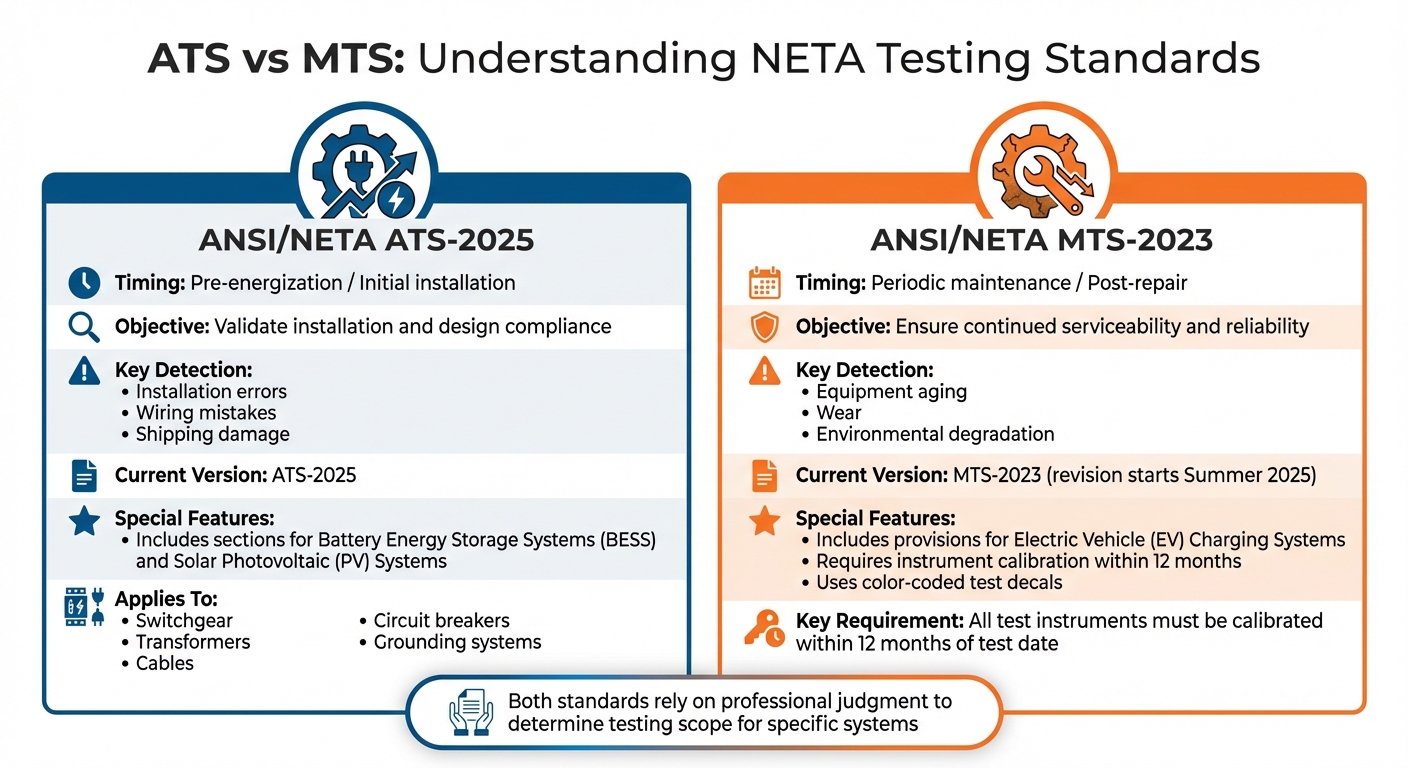
NETA ATS vs MTS Standards Comparison for Electrical Testing
Acceptance Testing Specifications (ATS)
The ANSI/NETA ATS focuses on testing new electrical power equipment and systems. Officially approved by the American National Standards Institute on February 20, 2025, the ATS-2025 edition is the latest version. This standard ensures that equipment is installed according to design requirements and operates within the manufacturer’s tolerances before being energized for the first time.
"ANSI/NETA ATS-2025 covers suggested field tests and inspections to assess the suitability for initial energization and final acceptance of electrical power equipment and systems." – ANSI Blog
The ATS-2025 update introduced sections specifically for Battery Energy Storage Systems (BESS) and Solar Photovoltaic (PV) Systems, reflecting the growing adoption of renewable energy technologies. The standard also applies to components like switchgear, transformers, cables, circuit breakers, and grounding systems. Essentially, ATS confirms that everything is installed correctly and ready to operate.
Maintenance Testing Specifications (MTS)
The ANSI/NETA MTS is tailored for testing existing and aging electrical equipment. The current version, MTS-2023, is set to be revised in Summer 2025. This standard focuses on ensuring equipment remains operational, minimizing downtime, and extending the lifespan of electrical systems.
"The NETA standard for maintenance testing specifications, ANSI/NETA MTS-2023, exists to assure that tested electrical equipment and systems are operational." – ANSI Blog
One of the key requirements in MTS-2023 is that all test instruments must be calibrated within 12 months of the test date to guarantee accuracy and dependability. The 2023 edition also added provisions for Electric Vehicle (EV) Charging Systems, addressing the rise of EV infrastructure. Another notable feature is the use of color-coded test decals on enclosures, which provide an immediate visual indication of testing status and dates.
How ATS and MTS Differ
The primary difference between these two standards lies in their timing and purpose. ATS applies to new equipment before it’s energized, while MTS is used for periodic maintenance or after repairs. ATS focuses on verifying installation quality and operational readiness, whereas MTS identifies issues that arise over time, such as insulation breakdown or loose connections.
| Feature | ANSI/NETA ATS | ANSI/NETA MTS |
|---|---|---|
| Primary Focus | New electrical equipment and systems | Existing/service-aged equipment |
| Timing | Pre-energization / Initial installation | Periodic maintenance / Post-repair |
| Objective | Validate installation and design compliance | Ensure continued serviceability and reliability |
| Key Detection | Installation errors, wiring mistakes, shipping damage | Equipment aging, wear, and environmental degradation |
| Standard Version | ATS-2025 (Current) | MTS-2023 (Current; revision starts Summer 2025) |
Both ATS and MTS rely on professional judgment to determine the scope of testing required for a specific system. Not every test in the standards needs to be applied universally. ATS establishes a baseline for performance in new equipment, while MTS uses follow-up testing to identify deviations from that baseline as systems age. In the next section, we’ll look at the testing and inspection procedures that bring these standards to life in practical applications.
Testing and Inspection Procedures
Building on the ATS and MTS frameworks, these testing and inspection procedures put NETA standards into action for day-to-day operations.
Visual and Mechanical Inspections
NETA standards categorize guidance based on inspection and testing types. Visual and mechanical inspections focus on spotting visible defects, identifying mechanical problems, and ensuring proper installation within manufacturer-specified tolerances. For equipment like switchgear, switchboards, and panelboard assemblies, a key task is confirming that all wiring connections are tight and secure.
"The guidance of an experienced testing professional should be sought when making decisions concerning the extent of testing. It is necessary to make an informed judgment for each particular system regarding how extensive a procedure is justified." – ANSI/NETA MTS-2023
Electrical Testing Methods
After visual checks, electrical tests are performed to confirm systems' functional performance and insulation integrity. One widely used method is insulation resistance (IR) testing. For low-voltage metal-enclosed busways, the minimum insulation resistance (in Megohms) is calculated by dividing 100 by the busway's length in feet. Importantly, dielectric withstand voltage tests should only be conducted after confirming that insulation-resistance levels meet or exceed the minimum required values.
Chapter 7 of the Maintenance Testing Specifications outlines a thorough set of tests for various equipment, including switchgear, transformers, circuit breakers, and rotating machinery. These tests range from winding ratio measurements and current injection to functional system assessments, ensuring equipment operates as intended.
Advanced Testing: Online Partial-Discharge Surveys and SFRA
Beyond standard methods, advanced diagnostic tests can detect hidden faults that might be overlooked during routine inspections. These tools are crucial for identifying issues like insulation breakdown or internal overheating. The ANSI/NETA MTS-2023 standard introduced online partial-discharge surveys for energized switchgear, switchboards, and panelboard assemblies, allowing technicians to spot insulation problems without requiring costly shutdowns. Additionally, the 2023 update expanded the use of these surveys to include dry-type, air-cooled transformers with windings rated above 600 volts.
Sweep Frequency Response Analysis (SFRA) is another advanced test, recommended for liquid-filled transformers. This method helps detect mechanical shifts or damage to windings, offering insights into the transformer's internal condition.
These advanced testing procedures are invaluable for identifying potential issues early - before they escalate into major failures, fires, or prolonged outages. They ensure that equipment operates within its designed tolerances and provide early warnings of wear or degradation.
Compliance and Technician Requirements
Building on thorough testing and inspection methods, compliance and technician requirements ensure that high standards are maintained through skilled execution and precise documentation.
Technicians from NETA Accredited Companies (NACs) play a critical role in NETA testing. The NETA compliance framework ensures that testing is carried out by qualified professionals who operate independently and follow strict documentation protocols. Together, these certified technicians and detailed reporting processes help maintain the reliability of electrical systems in accordance with NETA standards.
Technician Certification and Training
NETA certification involves both company and individual qualifications. To be eligible for a NETA certification exam, candidates must work for a NAC - an independent, third-party organization with no affiliations to manufacturers or clients. The ANSI/NETA ETT-2026 standard, approved on December 1, 2025, sets the minimum qualifications required for electrical testing technicians.
NETA recognizes four levels of technician competency, with Levels 2 through 4 requiring comprehensive written exams conducted through Pearson VUE. Technicians must advance through these levels sequentially, meaning they must pass the Level 2 exam before moving on to Level 3, and so forth.
"At the very heart of our industry are the electrical testing technicians who are trusted to carry out their work effectively, efficiently, and with the proper skillsets." – Lorne Gara, Chair, NETA's Standards Review Council
To maintain their certification, technicians are required to earn Continuing Technical Development (CTD) credits regularly. This ensures they stay up to date with evolving safety protocols and industry practices. Since 1975, NETA has been certifying electrical testing technicians to uphold these high standards.
Certification alone isn’t enough - technicians are also held to rigorous documentation standards to validate their work.
Documentation and Reporting Standards
In addition to technician expertise, accurate and consistent documentation is essential for verifying testing results. NETA standards mandate precise reporting to confirm that equipment meets manufacturer tolerances and design specifications.
The ANSI/NETA ATS-2025 and MTS-2023 standards require detailed field test and inspection reports. For newly installed or retrofitted electrical power equipment, the ANSI/NETA ECS-2024 standard outlines a structured process to document installation, operational readiness, and performance compliance before the equipment is energized.
These documentation practices ensure that every step of the process is transparent and aligns with industry expectations.
Conclusion
NETA standards ensure the safety and reliability of electrical systems from the moment they're installed and throughout their operational life. As discussed, thorough acceptance and maintenance testing form the backbone of these standards. By combining initial testing for new systems with regular maintenance checks, these protocols help identify issues before they escalate into costly downtime, fires, or even injuries. With third-party testing provided by NETA Accredited Companies and a structured certification program for technicians, only qualified professionals handle these critical tasks.
How NETA Standards Protect Electrical Systems
The ANSI/NETA ATS-2025 standard ensures that newly installed systems are properly wired and functioning as expected before being energized. For older equipment, the ANSI/NETA MTS-2023 standard addresses maintenance concerns, such as insulation degradation and loose connections, which can arise over time. As noted by the ANSI Blog:
"Maintenance testing can identify potential problem areas before their ill-effects can inexorably reach disastrous ends." – ANSI Blog
Accurate testing depends on regular instrument calibration, which ensures precise measurements. With the U.S. generating 4,243,000,000 kWh of electricity in 2022 and the average household using about 920 kWh monthly, dependable electrical systems are essential to daily life for millions of Americans.
To maximize these protections, it’s important to follow specific steps for implementing NETA standards in your operations.
How to Implement NETA Standards
Start by hiring a NETA Accredited Company for your testing needs. These independent, third-party firms ensure objectivity in their evaluations. Confirm that the field personnel are certified at the appropriate levels: Level 3 technicians lead crews and manage power switching, while Level 4 Senior Technicians bring over a decade of experience and 200 hours of focused training to the job.
For new installations, use ATS-2025 as a detailed checklist to confirm proper setup before energization. For existing systems, plan regular inspections using MTS-2023 to catch any developing issues early. Keep thorough records in line with Section 5.4 of the MTS standard, and use color-coded test decals on equipment enclosures for a quick visual reference of testing status.
FAQs
Do I need ATS or MTS for my equipment?
The choice between ATS (Acceptance Testing Specifications) and MTS (Maintenance Testing Specifications) hinges on the purpose of the testing.
- ATS is used for new or recently repaired equipment to confirm it meets performance standards before being put into service.
- MTS, on the other hand, is applied during routine maintenance to ensure the equipment remains reliable and safe throughout its operational life.
Always adhere to the appropriate NETA standards to ensure compliance and proper testing procedures.
How often should NETA maintenance testing be done?
NETA suggests conducting maintenance testing in line with the equipment manufacturer's instructions or through a detailed risk assessment. Generally, this testing is carried out annually or integrated into regular maintenance routines to maintain system reliability and ensure safety.
What should I look for in a NETA-certified testing technician?
A NETA-certified technician is someone who has successfully completed specific certification levels, such as Levels 2, 3, or 4, and continues to meet strict education and experience requirements. These certifications ensure technicians stay up-to-date with the latest practices and standards.
It's important to confirm that they adhere to current ANSI/NETA standards, like ANSI/NETA ETT-2026, which outlines the qualifications and training necessary for their role. Certification is a key indicator of their ability to perform safe and accurate testing while ensuring the reliability of electrical systems.