FERC Order 2222: What It Means for Load Management
FERC Order 2222, issued in 2020, allows small distributed energy resources (DERs) like rooftop solar, batteries, and EV chargers to participate in wholesale electricity markets by aggregating to meet a 100 kW minimum. This creates new revenue opportunities for businesses managing energy assets while supporting grid stability.
Key points include:
- Smaller DERs gain market access through aggregation, opening energy, capacity, and ancillary service markets.
- Metering and telemetry requirements ensure accurate tracking and prevent double compensation between retail and wholesale programs.
- Coordination with local utilities is essential to maintain grid reliability and meet compliance standards.
- Implementation timelines vary across regions, with CAISO completing its rollout in 2024 and SPP targeting 2030.
Order 2222 transforms energy load management by turning passive assets into active grid participants, enabling businesses to generate income while contributing to a stable and flexible energy system.
FERC Order 2222: Leveling the playing field for distributed energy storage & other DERs (12.10.20)
sbb-itb-501186b
Main Requirements of FERC Order 2222
FERC Order 2222 outlines three key requirements for RTOs and ISOs to follow, enabling DER aggregations to participate in wholesale markets. These rules focus on eligibility, measurement, and coordination with local utilities to maintain grid stability. Let’s break these down further.
Minimum Size Limits and Aggregation Rules
RTOs and ISOs must allow DER aggregations with a minimum size of 100 kW or less. This opens the door for smaller resources - like rooftop solar panels or battery storage systems - to participate by pooling together through third-party aggregators. These aggregators handle bidding into the market and distributing payments.
One of the standout features is the ability to combine different technologies into a single market unit. For example, a battery’s discharge capacity could pair with demand response from controllable loads, creating a complementary system that meets performance requirements. However, RTOs set geographic or electrical boundaries - often tied to specific transmission pricing nodes - within which resources can aggregate.
There’s an important limitation here: aggregations cannot include customers served by utilities producing 4 million MWh or less annually unless state regulators explicitly allow it.
Location and Metering Requirements
Accurate metering and telemetry are non-negotiable. Each RTO and ISO must develop standards to track DER output for both settlement and grid reliability. Aggregators are responsible for providing metering data to grid operators, often requiring high-frequency updates to monitor real-time performance.
To avoid double counting, metering rules ensure that the same megawatt-hour isn’t compensated in both retail programs (like net metering) and wholesale markets. Location rules differ across regions. For instance, CAISO and NYISO allow aggregations to span multiple transmission nodes, while PJM proposes restricting them to a single node.
Working with Distribution Utilities
Coordination with distribution utilities plays a central role. These utilities oversee interconnection and safety reviews for individual DERs joining an aggregation, typically completing these assessments within 60 days.
"Distribution utilities will be given the ability to override RTO/ISO dispatch of DER aggregations when such override is needed to maintain the reliable and safe operation of the distribution system", notes Van Ness Feldman.
RTOs must establish processes for regular data sharing among grid operators, aggregators, and utilities. This ensures wholesale market operations don’t clash with local grid limitations like voltage levels or line capacity. Some states, including Virginia, Wisconsin, and Indiana, are already crafting rules to handle these interactions. In some cases, centralized DER registries are being developed to track participation and prevent double counting.
How FERC Order 2222 Affects Load Management
FERC Order 2222 is changing the game for load management in modern electrical systems. By granting small Distributed Energy Resources (DERs) access to energy markets, the order allows businesses to aggregate assets like battery storage, EV chargers, and smart HVAC systems into market-ready units as small as 100 kW. This gives them the ability to actively participate in regional energy markets.
This shift turns businesses from passive energy consumers into active participants. They can now play a dual role: continuing as retail customers while also selling grid services through aggregators. With the rule covering resources ranging from 1 kW to 10,000 kW, even smaller installations can make an impact when grouped together.
"This rule enables DERs to participate alongside traditional resources in the regional organized wholesale markets through aggregations, opening U.S. organized wholesale markets to new sources of energy and grid services".
This new approach doesn't just unlock revenue opportunities - it also redefines the traditional models of demand response.
Demand Response and Energy Shifting Options
Order 2222 goes beyond managing peak demand. It allows businesses to inject, withdraw, and regulate energy, giving them more flexibility in how they engage with the grid. For example, facilities equipped with battery storage can discharge energy during times of high demand, while smart thermostats and HVAC systems can shift cooling loads to off-peak hours without compromising comfort.
Rather than relying on fixed utility incentives, compensation now comes from a share of wholesale market clearing prices through aggregators. This opens up multiple revenue streams, including energy sales, capacity commitments, and ancillary services like voltage regulation. However, the implementation of these changes varies by region. For instance, CAISO completed its rollout in November 2024, ISO-NE plans for November 1, 2026, PJM's energy market adjustments are set for February 1, 2028, and SPP expects full implementation by the second quarter of 2030.
Grid Stability and Balancing Benefits
The order also bolsters grid reliability by spreading generation and storage across the network instead of relying solely on centralized power plants. Aggregated DERs can provide essential services like operating reserves and frequency regulation, which are crucial for maintaining stability as renewable energy sources, like wind and solar, become more prevalent.
"The flexibility of these resources will help counterbalance supply uncertainties from large-scale integration of variable renewable generation".
Thermal storage systems, for example, can pre-cool buildings during off-peak hours, while EV chargers can adjust charging schedules or even supply power during emergencies. Together, these capabilities elevate load management from a simple cost-saving measure to a dynamic, revenue-generating service that strengthens the grid.
Compliance Models Used by ISOs and RTOs
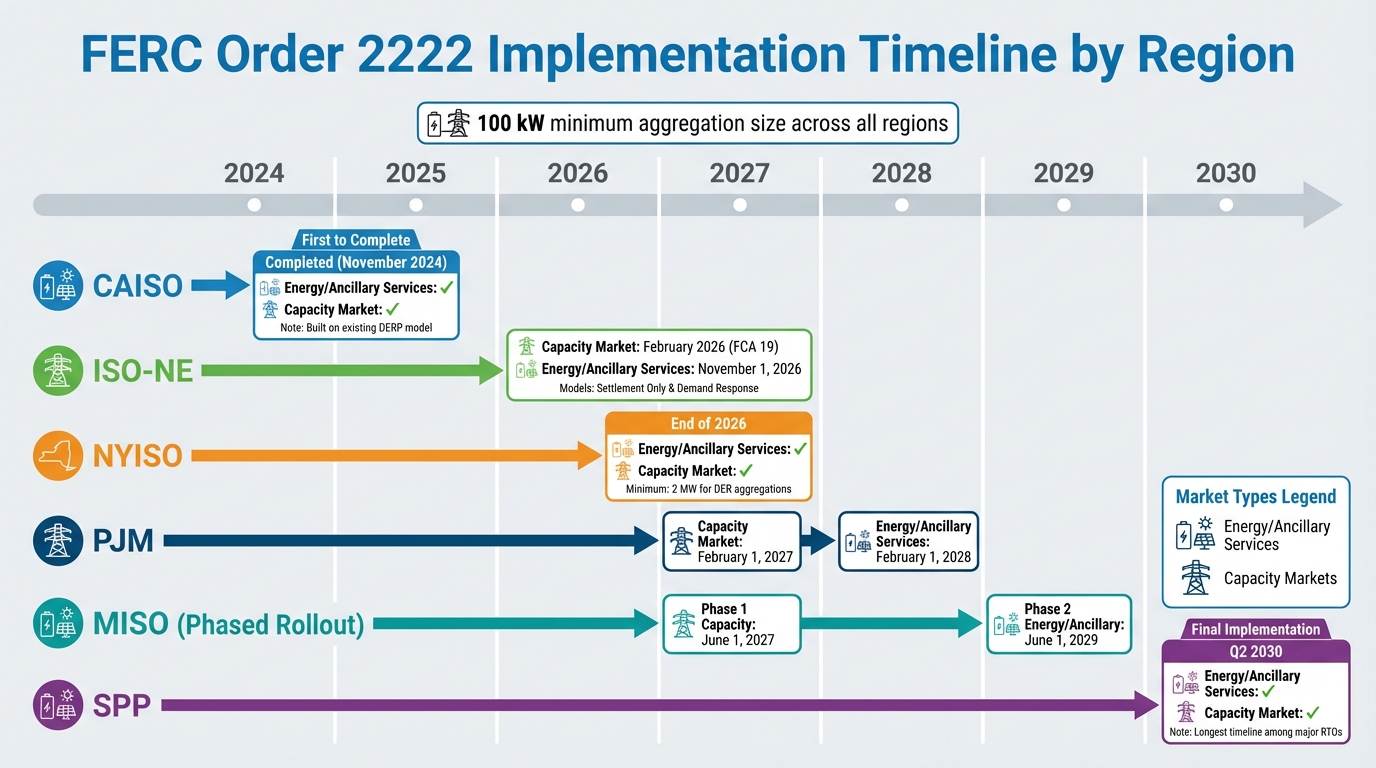
FERC Order 2222 Implementation Timeline by RTO and ISO (2024-2030)
Regional Transmission Organizations (RTOs) and Independent System Operators (ISOs) have taken different paths to implement FERC Order 2222. Their timelines and participation models vary by region, reflecting unique operational needs:
| RTO/ISO | Energy/Ancillary Implementation | Capacity Market Implementation | Key Model Features |
|---|---|---|---|
| CAISO | Completed (Nov 2024) | Completed (Nov 2024) | Built on its existing DER Provider (DERP) model; enhanced for utility coordination |
| ISO-NE | November 1, 2026 | February 2026 (FCA 19) | Offers Settlement Only and Demand Response models |
| NYISO | End of 2026 | End of 2026 | Requires a 2 MW minimum for DER aggregations; supports mixed-resource aggregations |
| PJM | February 1, 2028 | February 1, 2027 | Focuses on energy and ancillary services integration |
| MISO | June 1, 2029 (Phase 2) | June 1, 2027 (Phase 1) | Employs a phased rollout for grid integration |
| SPP | Q2 2030 | Q2 2030 | Features the longest timeline among major RTOs |
The California ISO (CAISO) led the way, completing its implementation in November 2024. It adapted its existing DER Provider (DERP) model, incorporating updates to align with Order 2222’s requirements for coordination and utility review. Similarly, the New York ISO (NYISO) introduced a 2 MW threshold for DER aggregations in its Installed Capacity (ICAP) market. This threshold necessitates interconnection studies for resources at or above this size. NYISO also supports diverse aggregations, enabling combinations of solar, storage, and demand response to deliver the full range of ancillary services they are capable of providing.
ISO-NE's Settlement Only and Demand Response Models
ISO New England (ISO-NE) has developed two distinct participation options tailored to different resource types. The Settlement Only model is suited for aggregations that aren’t directly dispatched by ISO-NE but are instead settled based on their actual energy output or performance. On the other hand, the Demand Response model is designed for dispatchable resources that can actively reduce their load in response to ISO instructions or price signals.
For capacity market participation, ISO-NE began with Forward Capacity Auction 19 (FCA 19) in February 2026. Its energy and ancillary services markets followed, launching on November 1, 2026.
Telemetry and Bidding Requirements
RTOs and ISOs have established specific rules for bidding and telemetry to ensure that distributed energy resources (DERs) are integrated effectively. Aggregators must provide detailed information about their resources, including capabilities, locations, and performance metrics, to support accurate market participation and maintain grid reliability.
Metering and telemetry rules have become more flexible, allowing for DER-level submetering instead of requiring costly utility-grade meters. This change has helped reduce compliance costs for aggregators. However, since these requirements differ by RTO, it’s essential for aggregators to familiarize themselves with the specific submetering rules early in the registration process.
Additionally, tariffs are designed to prevent DERs from receiving duplicate payments for the same service in both retail and wholesale markets. These measures form the foundation for the compliance processes covered in the next section.
How to Comply with FERC Order 2222
Evaluating DER Capabilities and Aggregation Potential
Start by categorizing your Distributed Energy Resources (DERs) to identify those that qualify under Order 2222. Eligible resources include technologies like electric battery storage, rooftop solar panels, smart thermostats for demand response, energy efficiency measures, thermal storage, and electric vehicles with charging infrastructure. To meet the Regional Transmission Organization's (RTO) minimum aggregation size of 100 kW or less, you can bundle smaller DERs, even those as small as 1 kW.
If your assets are outside the ERCOT region, it's essential to check local interconnection rules. Aggregated assets must be close enough to feed into the same node on the RTO grid, as local constraints could impact eligibility. With projections showing DER capacity reaching 387 GW by 2025 and 13% of U.S. homes expected to have solar systems by 2030, opportunities to aggregate and participate in wholesale markets are growing.
Since smaller DERs often participate indirectly, you might want to engage with third-party aggregators. For instance, aggregators in the CAISO market have historically operated under an 80/20 compensation split, keeping 20% of the revenue. Also, review your current involvement in retail programs like solar net metering or utility demand response. While Order 2222 allows participation in both wholesale and retail markets, it prohibits double compensation to avoid conflicts. These initial steps help ensure your assets are ready for integration and revenue generation.
Installing Compliant Metering and Systems
Once you've assessed your DER capabilities, the next step is to install metering systems that meet compliance standards. RTOs and ISOs require specific metering and telemetry systems to track DER performance and ensure accurate compensation. These systems often need to capture high-frequency data - every 1–2 seconds - via SCADA or Power Plant Controller (PPC) systems, especially for utility-scale generation.
Statistical metering is becoming more accepted in some markets. For example, PJM Interconnection has allowed statistical metering for over a decade, enabling businesses to meter only a portion of their portfolio and extrapolate the rest. This approach can significantly cut costs compared to installing utility-grade meters on every small asset. Additionally, certain markets require resources to follow Automatic Generator Control (AGC) signals from the ISO, which demands advanced control systems capable of real-time responses.
"Telemetry, or the metering of energy production or consumption, is vital for system operators to have visibility into the resources under their control and ascertain that they are delivering the service to the grid as expected." – Ruben Bäumer, Head of VPP Partnerships, Centrica Business Solutions
It's a good idea to coordinate early with your local Distribution System Operator to ensure that participating in wholesale markets doesn’t disrupt the local grid. Reviewing your RTO’s tariffs is also crucial, as these documents outline the specific rules for metering and telemetry. Partnering with aggregators who already have the necessary infrastructure in place can simplify the process. Once your metering is set up, the focus shifts to sourcing equipment that meets these standards.
Sourcing Equipment from Trusted Marketplaces
Compliance with Order 2222 often involves investing in advanced data management and communications technology. The equipment you choose must support standardized data formats, like IEC 61400-xx for wind energy, to ensure compatibility with grid operator systems. Additionally, metering and telemetry systems must meet specific standards set by RTOs and ISOs. Prioritize equipment and cloud solutions that adhere to SOC and NERC standards for data security.
As implementation deadlines approach - CAISO's full implementation is set for November 2024, and SPP is targeting Q2 2030 - it’s wise to consult with your utility or DER system supplier about your equipment needs. Platforms like Electrical Trader offer a wide range of industry-compliant components, including voltage equipment, transformers, and power generation tools. These resources can help businesses find compliant equipment while managing costs, which is especially important for smaller aggregations under Order 2222 that may only reach 100 kW.
Finally, ensure the equipment you choose is interoperable. Systems must handle complex data mapping to maintain consistent standards in the cloud. This is particularly important for solar assets, where data models can vary significantly by contractor. Your systems should also be capable of accurately tracking participation to avoid issues like double counting or double compensation between retail and wholesale programs.
Conclusion
FERC Order 2222 is reshaping the way load management works by opening wholesale energy markets to distributed energy resources (DERs) like battery storage, electric vehicles, and smart thermostats. The rule mandates that RTOs and ISOs accept DER aggregations as small as 100 kW, which allows even smaller facilities to participate in capacity, energy, and ancillary services markets. This change fosters competition, reduces costs, and gives grid operators the flexibility they need to manage the intermittency of renewable energy sources. However, this shift also demands strategic planning and operational adjustments.
To comply, businesses must focus on several critical areas: assessing the potential for aggregation, installing metering systems that meet regulatory requirements, and sourcing equipment aligned with RTO-specific standards. Since implementation timelines differ by region, businesses need to carefully review regional tariffs and work closely with distribution utilities. This ensures participation aligns with retail programs and avoids issues like double compensation. Proper compliance is crucial for businesses to tap into the revenue opportunities and contribute to grid stability.
Order 2222 also enables aggregated DERs to provide essential grid services like voltage support and frequency reserves, boosting overall grid reliability and resilience. These resources will become increasingly vital for maintaining stability, especially during peak demand periods. To unlock these benefits, businesses must prioritize investments in compliant infrastructure.
FAQs
Do my DERs qualify for Order 2222 participation?
Yes, your distributed energy resources (DERs) might be eligible to participate under Order 2222, provided they meet the necessary size and operational criteria. This order enables DERs to access organized wholesale markets through aggregation, creating new pathways for resource integration and broader market participation.
How do I avoid double payment between retail and wholesale programs?
To prevent the risk of double payments under FERC Order 2222, it's crucial to set up well-defined billing and metering protocols. These protocols should accurately track energy flows and participation in both retail and wholesale markets. Coordination between utilities, aggregators, and market operators is essential for ensuring everything runs smoothly.
Implementing advanced metering and telemetry systems is another key step. These tools help measure distributed energy resources (DERs) with precision, reducing errors and ensuring fair compensation. Alongside this, maintaining transparent communication, proper documentation, and strict adherence to compliance frameworks will help avoid payment overlaps and create a fair system for all parties involved.
What metering and telemetry do I need to be compliant?
To meet the requirements of FERC Order 2222, it's essential to implement metering and telemetry systems that can consistently and accurately monitor the performance, operation, and aggregation of distributed energy resources (DERs). These systems must deliver precise data to facilitate market participation and ensure effective grid management.