Low vs High Voltage: Arc Flash Risk
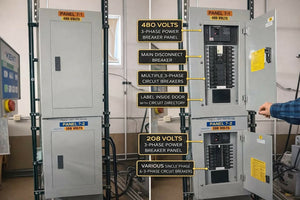
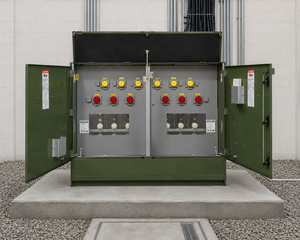
Voltage alone does not tell you which job is more dangerous. In many U.S. workplaces, 480 V equipment creates some of the most common arc-flash injuries, while medium-voltage gear above 600 V can bring more violent arc force and blast pressure once an arc starts.
If I had to sum up the whole article fast, I’d say this:
- Shock risk and arc-flash risk are not the same thing
- 480 V gear is often a high-exposure problem because people work on it more often
- Medium-voltage gear can hit harder because the arc is fed by very high fault energy
- Fault current, clearing time, working distance, and equipment design matter more than the voltage nameplate
- Old labels, wrong ratings, and poor coordination can make a bad event much worse
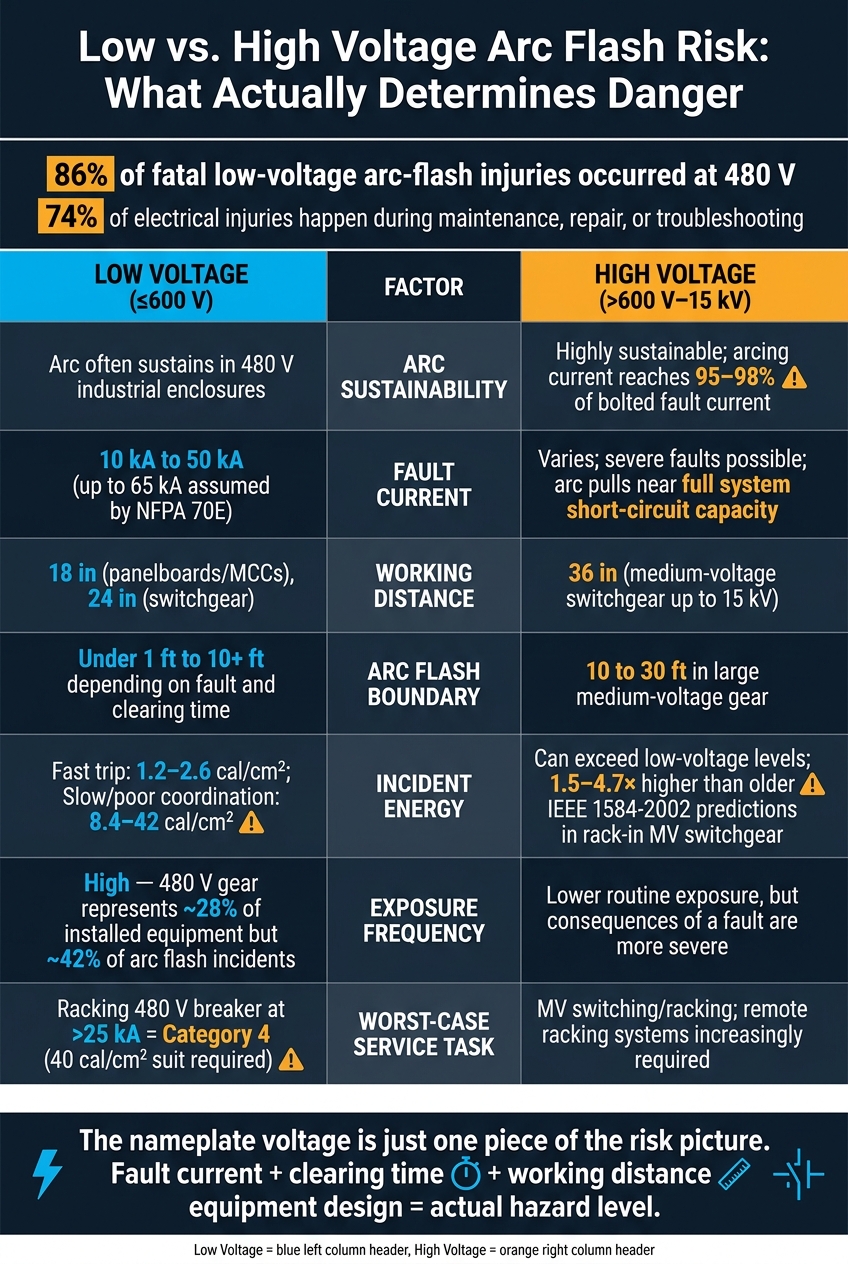
One stat says a lot: 86% of fatal low-voltage arc-flash injuries happened at 480 V. At the same time, 74% of job-related electrical injuries tied to arc flash and shock happen during maintenance, repair, or troubleshooting. So the main issue is not just system voltage. It’s what equipment you’re in, how close you are, and how fast the protective device clears the fault.
For a quick side-by-side view, here’s the short version:
| Voltage range | Main arc-flash pattern | Main shock pattern | What often drives risk |
|---|---|---|---|
| 120/208 V | Arc may not always keep going, but it can still happen | Serious shock hazard | Contact, fault path, enclosure, fault current |
| 277/480 V | Arc often sustains in industrial gear | Very high shock risk during service work | High fault current, slower clearing time, short working distance |
| Above 600 V to 15 kV | Arc can be much more violent once started | Extreme shock hazard | Strong source energy, blast pressure, relay clearing time, gear design |
Bottom line: if you want the plain answer, low voltage is not “safe,” and high voltage is not always the most likely task-level danger. I’d judge the risk by the study, the settings, the working distance, and the condition of the gear - not by the nameplate alone.
Low vs High Voltage Arc Flash Risk: Key Factors Compared
Arc Flash Incident Energy Explained (Why Voltage Doesn’t Matter)
sbb-itb-501186b
Arc flash severity and shock risk: low vs high voltage
Voltage shifts the mix between arc flash danger and shock danger. Here’s the quick version before we get into it.
| Voltage Range | Arc Sustainability | Shock Risk | Common Outcome |
|---|---|---|---|
| 120/208 V | Less likely; often self-extinguishes | High, but less frequent service exposure | Localized burns, possible fibrillation |
| 277/480 V | Often sustains readily in fault conditions | Very high; frequent industrial exposure | Serious burns, clothing ignition, blast injury |
| 4.16–15 kV (medium voltage) | Highly sustainable; arcing current close to bolted-fault current | Extreme, but lower routine exposure | Severe burns, major blast trauma, potentially fatal shock |
At 120/208 V, arcs can happen, but many systems won’t keep the arc going unless fault current and equipment geometry make that possible. IEEE 1584-2018 removed the old blanket low-voltage exception because sustained arcs can occur. Shock danger is still serious, and OSHA guidance says 120 V tasks can involve arc flash severe enough to hospitalize or kill a worker. The danger rises sharply when voltage, fault current, and access conditions all line up at 480 V gear.
Why 277/480 V equipment often produces serious arc flash exposure
At 277/480 V, a few bad factors come together at once. The voltage is high enough to keep a stable arc going in most industrial enclosures. On top of that, available fault current at 480 V MCCs and switchgear often falls in the 25 kA to 65 kA range, or even higher. One study found that 277/480 V systems account for about 42% of reported arc flash incidents while representing only about 28% of installed equipment.
Clearing time is often where the situation turns ugly. If protection clears the fault fast, incident energy may stay around 1.2–2.6 cal/cm². But slower clearing at main gear can push that number to 8.4–42 cal/cm², which lands squarely in PPE Category 3–4 range. About half of 480 V arc flash incidents lead to moderate injury or worse, which puts this voltage class firmly in high-risk PPE territory.
Put simply, 480 V gear sits in a rough middle ground: easy enough for an arc to sustain, and common enough in industry that workers run into it a lot.
At higher voltage, the arc can be harder to start, but once it starts, it can become much more violent.
Why higher voltage increases arc initiation and blast danger
Higher voltage reduces the gap to arc initiation. Once an arc forms in medium-voltage switchgear, from 4.16–15 kV, the arcing current often reaches 95% to 98% of the bolted fault current. That means the arc is being fed by almost the system’s full short-circuit capacity. The result is intense heat and strong pressure waves that can cause shrapnel injuries, lung damage, and damage to the equipment itself.
Working distance does help. Medium-voltage gear is often accessed at 36 inches, compared with the 18–24 inches that are common for 480 V equipment. Since incident energy drops fast with distance, that extra space matters. Even so, rack-in style MV switchgear can produce incident energies 1.5 to 4.7 times higher than older IEEE 1584-2002 predictions because of electrode orientation and enclosure effects. In other words, distance cuts worker exposure, but it does not reduce the arc’s raw force.
So the label on the equipment only tells part of the story. Fault current, clearing time, working distance, and enclosure design often decide how bad the outcome gets.
Fault current, working distance, and equipment design
Fault current, clearing time, and working distance shape arc-flash severity more than voltage alone. For buyers, these are the specs that often decide whether 480 V gear stays manageable or turns into a high-risk asset. They’re also the factors that can turn routine service work into a serious hazard.
How fault levels and clearing time affect incident energy
A typical 480 V switchboard fed by a large distribution transformer can see available bolted fault current in the 10 kA to 50 kA range. NFPA 70E's PPE tables for 277–600 V equipment assume up to 65 kA available fault current and a clearing time of no more than 0.03 seconds (2 cycles).
That 0.03-second clearing time matters a lot. If coordination delays clearing beyond that point, incident energy climbs fast. A 480 V switchboard with a fast-acting instantaneous trip can stay within manageable incident energy levels. The same board, if it’s protected by a slow or poorly coordinated upstream device, can become far more dangerous than many buyers expect. In plain terms, clearing time is often the line between a manageable event and a serious injury.
The same rule applies at higher voltages. Once a medium-voltage arc starts, it can pull heavily from the source. Even with larger clearances and more deliberate operating procedures, a fault in medium-voltage gear with slow relay response can lead to wide arc flash boundaries and severe incident energy.
How working distance and arc-resistant design reduce exposure
Incident energy drops fast as distance increases - roughly with the square of the distance from the arc source. That’s why standard U.S. working distances matter so much in practice:
- 18 in for low-voltage panelboards and MCCs
- 24 in for low-voltage switchgear
- 36 in for medium-voltage switchgear up to 15 kV
That change in distance can have a big effect. Moving from 18 in to 36 in can cut incident energy a lot and pull in the arc flash boundary.
| Factor | Low Voltage (≤ 600 V) | Higher Voltage (> 600 V–15 kV) |
|---|---|---|
| Fault current | Main switchboards can see 10 kA to 50 kA available bolted fault current. | Varies with source strength and protection; severe faults are still possible. |
| Working distance | 18 in for panelboards and MCCs, 24 in for low-voltage switchgear. | 36 in for medium-voltage switchgear. |
| Arc flash boundary range | Can range from under 1 ft to 10+ ft depending on fault and clearing time. | Can reach 10 to 30 ft in large medium-voltage gear. |
| Effect of arc-resistant design | Reduces exposure at the opening; does not reduce arc energy at the source. | Arc-resistant design reduces what reaches the worker, but not the arc energy itself. |
Arc-resistant switchgear, tested per IEEE C37.20.7, is built to vent hot gas and pressure away from the worker - usually upward or through set exhaust paths - when doors are closed. That doesn’t reduce the energy at the source, but it can sharply cut what reaches the person standing in front of the gear.
Compartmentalization adds another layer of protection. It helps keep a fault inside one section instead of letting it spread across the lineup. Arc detection relays and optical sensors can also shorten clearing time, which lowers incident energy before it reaches the worker.
The arc flash boundary is not fixed by voltage class. A small 120 V panelboard may have a boundary under 1 ft. A large medium-voltage switchgear lineup can push that boundary out to 10 to 30 ft. The deciding factors are fault current, clearing time, working distance, and enclosure type - not the nameplate voltage alone.
These conditions matter most during racking, testing, and troubleshooting, when workers are closest to energized gear. That’s where the gap between “safe on paper” and dangerous in the field often shows up first.
Service work exposure and common buying mistakes
Where workers face the most exposure during service tasks
Service work puts people closest to energized equipment. That’s why it carries the highest exposure.
Research shows that about 74% of job-related electrical injuries from arc flash and shock happen during maintenance, repair, or troubleshooting. Among electricians, that number climbs to 84%.
For low-voltage equipment, the most dangerous tasks usually include:
- opening energized panels
- troubleshooting energized control gear or MCCs
- taking live measurements inside energized enclosures
- racking breakers
Some of these jobs sound routine. They aren’t. In 480 V switchgear with fault current above 25 kA, racking a breaker is treated as a Category 4 task. That means a worker needs at least a 40 cal/cm² arc-rated suit. That is the top end of the standard PPE scale in gear many people still call “low voltage.”
High-voltage service work brings a different kind of danger. Tasks like switching, transformer maintenance, feeder testing, and energized access to medium-voltage switchgear may happen less often, but the downside of a mistake is much worse. In many facilities, energized high-voltage work is limited to qualified personnel working under formal switching procedures, with tighter access control and larger exclusion areas.
Remote racking systems are showing up more often in medium-voltage breaker work because they move the worker outside the arc flash boundary.
A lot of these field risks don’t start in the field at all. They start earlier, during purchasing, when someone picks equipment without checking fault ratings or whether it fits the job.
Buying errors that make arc flash risk worse
One of the worst low-voltage buying mistakes is under-rated interrupting capacity. NEC 110.9 requires overcurrent devices to have an interrupting rating at least equal to the available fault current at their terminals.
If that rule gets ignored - for example, if a breaker’s interrupting rating is lower than the available fault current - the device may rupture violently during a fault instead of clearing it safely. That’s not a paperwork issue. That’s a direct path to a much worse event.
At higher voltages, the parallel mistake is using equipment outside its intended voltage class. That can mean putting in a transformer, switch, or breaker with the wrong insulation level, basic insulation level (BIL), or voltage rating. Once the equipment is energized under load, that mismatch can lead to dielectric breakdown, internal arcing, or flashover.
Another common problem is relying on old arc flash labels. Labels stop being right after system changes, protective device replacements, or utility updates to available fault current. NFPA 70E task tables also assume certain conditions: doors closed, equipment properly installed and maintained, and no signs of impending failure.
Used gear adds one more layer of doubt if no one checks whether it has been modified, contaminated, or derated. On Electrical Trader, verify ratings, documentation, and application fit before installation.
| Mistake | Low Voltage (≤ 600 V) | High Voltage (> 600 V) | Safety Impact |
|---|---|---|---|
| Under-rated interrupting capacity | Breaker or fuse rated below available fault current; SCCR not verified against source fault level | Switchgear or fuse with insufficient interrupting rating | Violent rupture during fault; arc flash escalation |
| Voltage-class mismatch | Mismatched or retrofit breaker not certified for the cell | Transformer or switch with wrong BIL or insulation class | Dielectric failure, flashover, shock exposure |
| Outdated or misapplied arc flash labels | Label based on old fault current or protective device | Label doesn't reflect system changes or relay updates | PPE underestimated; worker exposed beyond safe level |
| Standard gear in occupied spaces | Standard MCC or switchboard in a personnel-occupied room | Standard metal-clad switchgear where arc-resistant is warranted | Arc blast directed at worker; greater exposure during service |
The pattern is pretty clear: service risk gets worse when worker exposure, fault level, and equipment selection all go in the wrong direction.
Conclusion: What actually determines low and high voltage risk
After fault levels, distance, and equipment design, voltage is just one piece of the risk picture. The things that set the actual risk are fault current, clearing time, working distance, and equipment design. For example, a 480 V switchgear lineup with 25 kA of available fault current and slow protection can hit about 12 cal/cm² at 18 inches, while a medium-voltage system with fast protection and arc-resistant construction may produce less incident energy at the worker's position.
Low voltage tends to mean more frequent service exposure. High voltage tends to mean a greater chance of arc initiation and more severe blast force. Put plainly, higher voltage can make fault outcomes harsher.
That’s why field risk has to come from a current study, not a nameplate. For U.S. buyers and maintenance teams, don’t pick equipment by voltage alone. Use an up-to-date IEEE 1584 study, current utility fault data, and verified protective-device settings to set labels, PPE, boundaries, and work rules.
Equipment selection shapes the next maintenance task, not just what happens on installation day. If you're buying new or used equipment from Electrical Trader, check interrupting ratings, voltage class, and coordination fit before installation.
The nameplate matters less than the system behind it.
FAQs
Why is 480 V equipment so often involved in arc-flash injuries?
480 V equipment often shows up in arc-flash injuries because these systems can carry very high fault currents. In large industrial facilities, fault current can exceed 85,000 A. If a phase-to-phase fault happens at that level, it can release extreme energy.
The risk also stays high for a simple reason: people often work on this equipment while it’s still energized. A common example is racking circuit breakers under load. That kind of task leaves less room for error and puts workers much closer to the hazard.
What matters more than voltage in judging arc-flash risk?
Incident energy matters more than voltage when judging arc-flash risk. Voltage by itself does not define the thermal hazard.
Incident energy is measured in cal/cm². It shows the actual thermal exposure a worker may face during an arc-flash event. In plain terms, it tells you how much heat can hit the body.
What drives that number? Mostly two things:
- The available fault current
- How fast protective devices clear the fault
That’s why two pieces of equipment with the same voltage can present very different arc-flash danger.
Before any work starts, check the equipment label for the calculated incident energy and the required arc-rated PPE.
When should arc-flash labels and settings be updated?
Review and update arc-flash labels and settings at least every five years.
Do it sooner after major system changes, such as replacing transformers, adding utility ties, changing feeders, increasing loads by more than 10%, or adjusting protective device settings. If the system or protective devices changed after the label was applied, the label is out of date and must be replaced.
Labels should stay legible and match the latest engineering studies.