

Medium-Voltage Arc Flash Hazards: Key Insights
Medium-voltage arc flash incidents (1–35 kV) pose severe risks to workers and equipment. These events generate extreme heat, intense light, and powerful blasts, often caused by equipment failures or live work. Recent studies reveal that modern medium-voltage switchgear can release far more energy than older standards estimated, highlighting the need for better protection strategies.
Key Takeaways:
- Arc flashes can release energy levels beyond earlier predictions, especially in medium-voltage switchgear with horizontal electrode configurations.
- Modern detection systems, like non-intrusive sensors and light-based detectors, can identify faults in milliseconds, reducing risks.
- Advanced protection technologies, such as ABB’s REA system and Siemens’ SIQuench, rapidly isolate faults to minimize damage.
- Current-limiting devices interrupt faults in less than half a cycle, significantly lowering incident energy.
Why It Matters:
Compliance with OSHA and NFPA regulations requires arc flash assessments and proper safety measures. Upgrading to advanced detection and protection systems ensures faster fault isolation, reducing hazards for workers and protecting equipment.
This article explores detection technologies, protection systems, and current-limiting solutions to address arc flash risks effectively.
Arc fault – Effects mitigation measures in air-insulated medium-voltage switchgear
Arc Flash Detection Technologies
Today's arc flash detection methods focus on moving from reactive responses to proactive, predictive monitoring. This section explores two key approaches: non-intrusive sensors that identify early warning signs and light-based systems that react instantly to an arc flash.
Non-Intrusive Sensors for Fault Prediction
Non-intrusive sensors are designed to detect the underlying causes of arc flashes, such as insulation aging, thermal stress, and poor electrical connections. These issues often leave behind subtle electromagnetic clues. For instance:
- D-dot sensors measure changes in the electric field (dE/dt). These compact devices - just 1.5 cm (0.59 inches) in diameter - can handle bandwidths up to 18 GHz.
- Rogowski coils, on the other hand, focus on detecting the rate of current change (di/dt). These hollow induction loops are typically installed on grounding conductors or cable sheaths to pick up high-frequency discharge pulses in standard currents.
"The two most common non-contact causes of arc flash events in medium voltage switchgear and motor control centers are insulation aging and thermal stress." - Technology Exchange, Minghan
However, one major challenge for these sensors is separating meaningful fault signals from the constant background noise in electromagnetic environments. To tackle this, the Discrete Wavelet Transform (DWT) is used to filter out white noise, interference, and reflections. This technique isolates fault signatures in the critical 5–30 MHz range, enabling precise detection. With this level of accuracy, operators can implement condition-based maintenance, often receiving weeks or even months of advance warning before a failure occurs.
Light-Based Detection Systems
When an arc flash begins, light-based systems provide the quickest response. These systems use fiber-optic sensors and point detectors to identify the intense light produced by an arc flash. By combining light detection with overcurrent protection, they can isolate faults in mere milliseconds.
This dual-criteria design - requiring both a sudden light surge and a high current spike - minimizes false alarms, ensuring that only genuine arc faults trigger a shutdown. This approach not only enhances reliability but also complements broader protection strategies that will be covered in later sections.
Arc Fault Protection Systems for Medium-Voltage Applications
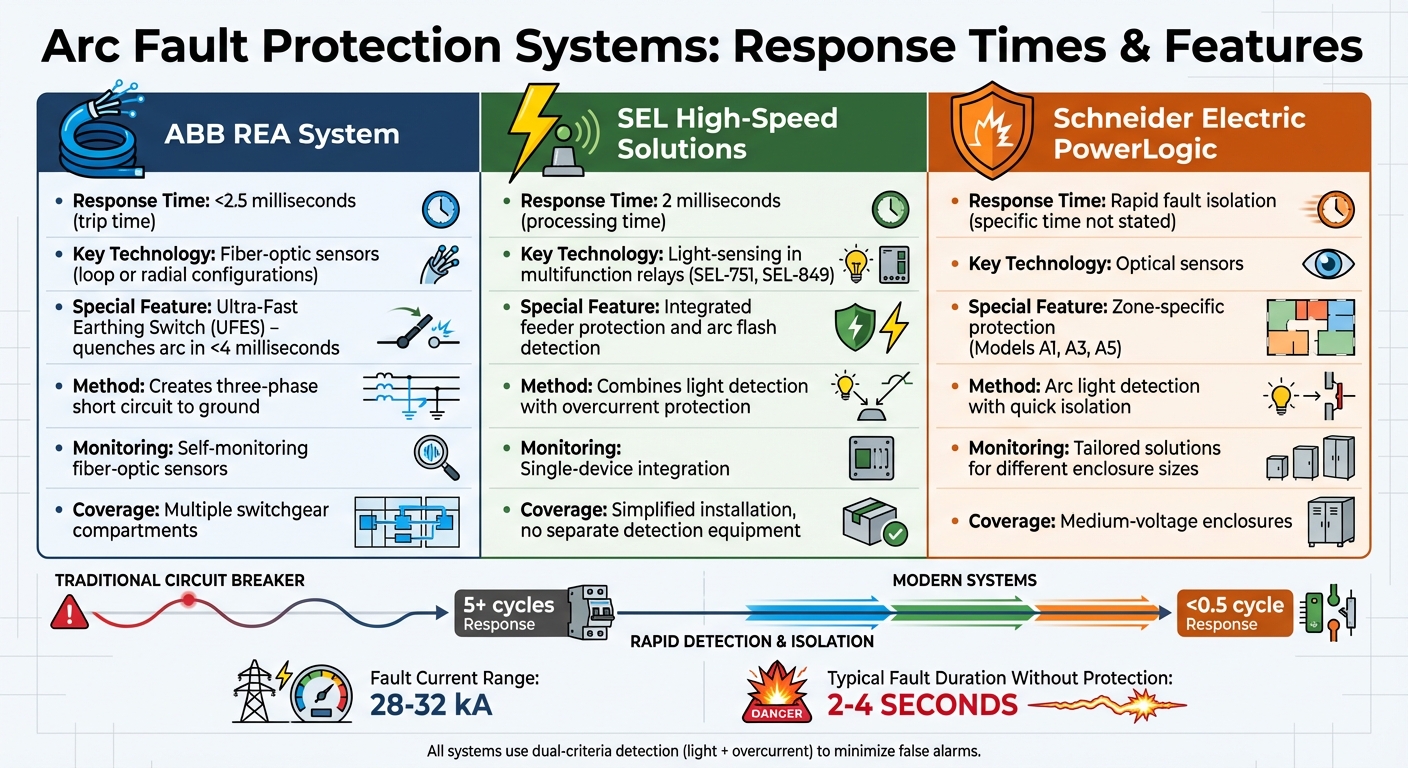
Arc Flash Protection Systems Response Times and Key Features Comparison
When an arc fault occurs, protection systems must respond immediately. In medium-voltage environments, these faults can last between 2 and 4 seconds, with currents reaching 28 kA to 32 kA. Such events can breach enclosures, leading to severe damage and safety hazards. Modern protection systems have revolutionized response times, cutting them down to milliseconds. This swift action significantly reduces incident energy and enhances safety for personnel. Below are some systems that demonstrate how rapid fault isolation is achieved.
ABB REA Arc Fault Detection System

ABB's REA system combines fiber-optic sensors with overcurrent integration to deliver fast and reliable arc fault detection. The fiber-optic sensors, available in loop or radial configurations, can monitor large areas, including multiple switchgear compartments. When an arc fault is detected, the REA system trips in under 2.5 milliseconds.
ABB also offers the Ultra-Fast Earthing Switch (UFES), which extinguishes arcs by creating a three-phase short circuit to the ground. This process provides a lower-impedance path than the arc itself, quenching it in less than 4 milliseconds. Additionally, the system features self-monitoring capabilities for the fiber-optic sensors, ensuring operators are alerted to any sensor issues and maintaining long-term reliability.
SEL High-Speed Light Sensing Solutions

SEL incorporates advanced light-sensing technology into multifunction protection relays like the SEL-751 and SEL-849. These relays combine high-speed light detection with overcurrent protection, processing arc faults in just 2 milliseconds. This rapid response dramatically reduces arc flash energy, improving safety. By integrating feeder protection and arc flash detection into a single device, SEL simplifies installation and eliminates the need for separate detection equipment.
Schneider Electric PowerLogic Arc Protection

Schneider Electric’s PowerLogic series offers tailored solutions for different enclosure sizes and complexities, with models A1, A3, and A5. These systems use optical sensors to detect arc light and isolate faults quickly within medium-voltage enclosures. Each model provides zone-specific protection, minimizing energy release and preventing extensive damage to switchgear components. By focusing on rapid fault isolation, PowerLogic systems help protect both equipment and personnel from serious harm.
sbb-itb-501186b
Current-Limiting Technologies
Current-limiting technologies are designed to reduce the magnitude and duration of fault currents by detecting arc initiation and quickly redirecting the current to a commutation circuit. This rapid response, occurring within a fraction of a cycle, prevents the release of excessive energy, which could otherwise lead to dangerous pressure spikes and thermal damage capable of breaching equipment enclosures.
Unlike traditional circuit breakers that can take five or more cycles to respond, current-limiting devices act in less than half a cycle. By interrupting the fault almost instantaneously, these technologies help significantly reduce incident energy, offering enhanced protection for both personnel and equipment. Such rapid action works hand-in-hand with early detection systems, immediately mitigating arc fault energy. Below, we’ll explore specific examples of these systems in action.
G&W Electric CLiP and CLiP-LV Solutions
The CLiP system from G&W Electric is a robust solution for medium-voltage applications, covering a range from 2.8 kV to 38 kV. This system combines a transformer, sensing and firing logic, and a parallel current-limiting fuse to eliminate faults swiftly. When a fault is detected, the CLiP system responds in under half a cycle, far outpacing the response time of traditional circuit breakers.
"Traditional circuit breakers can take up to five or more cycles to halt the fault currents that trigger arc flashes. CLiP® and CLiP®-LV can detect and eliminate faults in less than half of one cycle."
- G&W Electric
Beyond its rapid response, the CLiP system also manages current flow across the network, protecting lower-rated equipment and avoiding the need for expensive upgrades when integrating new power sources. Its compact, sealed design is adaptable for both indoor and outdoor installations, including pole-mounted or enclosed setups. Plus, its remote enabling and disabling capabilities add a layer of convenience and flexibility.
Siemens SIQuench Arc Protection System
The SIQuench system from Siemens takes a different approach by employing sub-cycle arc quenching. Instead of simply interrupting the fault current, it creates a low-impedance metallic short circuit to redirect arc energy away from the fault location. This strategy is often paired with arc-resistant switchgear, forming a comprehensive safety solution for medium-voltage installations.
Testing these high-speed systems can be complex, as their effectiveness relies on the seamless integration of multiple functions. Research underscores that the overall performance of the entire system is what truly determines its success in mitigating arc faults. Active current-limiting devices are increasingly seen as vital components of a broader protection strategy, working in tandem with passive measures like arc-resistant switchgear to reduce both the duration and intensity of arc flash incidents.
Performance Comparison of Detection and Protection Systems
When choosing arc flash protection for medium-voltage systems, one of the most important considerations is fault clearing time. The faster a fault is cleared, the lower the incident energy and associated hazards.
Key components like relays play a significant role in system performance. Modern microprocessor-based relays stand out for their speed and precision, surpassing older technologies. These advanced relays also allow for seamless switching between standard and maintenance modes, using lower instantaneous trip values during maintenance to minimize incident energy.
Detection system performance in medium-voltage setups largely hinges on the sensor technology used. For enclosed equipment operating in the 15 kV to 36 kV range - commonly seen in renewable energy collector systems - factors like reflectivity and the geometry of the enclosure (often referred to as the "box effect") can significantly impact detection efficiency. This highlights the critical need for high-speed detection to mitigate potential hazards effectively.
Modern protective relays also support remote operation, which increases the distance between workers and potential hazards. This feature not only enhances safety but also reflects the advancements in protective systems designed to address arc flash risks.
Conclusion
The move away from outdated models toward experimentally derived methods has significantly transformed how organizations approach arc flash hazards in medium-voltage systems. Modern technologies, like light-based sensors and microprocessor relays, can detect and interrupt faults much faster than older systems. This faster response directly lowers incident energy exposure, making workplaces safer for employees.
Compliance with regulations is non-negotiable. OSHA 1910.269 and NESC C2-2017 require employers to conduct arc flash assessments for exposures exceeding 2 cal/cm². As the NESC mandates, "Effective as of January 1, 2009, the employer shall ensure that an assessment is performed to determine potential exposure to an electric arc for employees who work on or near energized parts or equipment". Meeting these requirements involves precise risk evaluations and ensuring workers have the proper protective equipment.
One of the most effective ways to enhance safety is upgrading to modern microprocessor-based relays. These advanced relays reduce fault clearing times, offer maintenance mode settings with lower instantaneous trip values, and allow for remote operation - keeping workers at safer distances during switching tasks. For facilities lacking physical main breakers, a "virtual main" protection scheme using additional current transformers can help minimize incident energy on the secondary side. Such upgrades are essential for building a robust safety framework.
Platforms like Electrical Trader simplify the process of sourcing medium-voltage equipment. By offering a wide selection of new and used components, the platform helps facilities align procurement with both budget constraints and safety requirements. Access to these advanced components plays a crucial role in maintaining a strong arc flash protection strategy.
To ensure ongoing safety and compliance, facilities should conduct engineering studies every five years, as outlined in NFPA 70E-2018 Article 130.5. Combining accurate risk assessments with modern detection and protection technologies not only enhances workplace safety but also fulfills the obligation to provide a work environment free from recognized hazards.
FAQs
What are the best technologies to detect arc flashes in medium-voltage systems?
The most efficient tools for detecting arc flashes in medium-voltage systems are arc flash detection relays (AFRs) and advanced protective relays. AFRs rely on optical and current sensors to identify faults in just milliseconds. This rapid response cuts down arc duration, lowers incident energy, and reduces risks to both personnel and equipment. These systems perform particularly well when fault currents exceed roughly 20,000 amps, ensuring quick fault isolation.
Switching from older electromechanical or solid-state relays to microprocessor-based relays can take detection accuracy and system reliability to the next level. These updated relays often come with enhanced monitoring, communication, and automation features, allowing for faster and more precise reactions to arc events. Pairing these technologies with well-coordinated system setups can significantly boost safety while reducing arc flash hazards in medium-voltage settings.
How do current-limiting devices improve safety in medium-voltage systems?
Current-limiting devices are crucial for enhancing safety in medium-voltage systems by cutting down the energy released during arc flash incidents. These devices act fast to interrupt arc faults, which helps minimize the intense heat and pressure that could endanger workers or damage equipment.
With response times measured in milliseconds, technologies like arc flash detection relays and energy-reducing arc quenching systems significantly reduce the likelihood of severe burns, equipment failures, and costly downtime. They also align with important safety standards like NFPA 70E and OSHA regulations, making them a key component of today’s electrical safety practices.
Why should you upgrade to modern arc flash protection systems in medium-voltage setups?
Upgrading to modern arc flash protection systems plays a key role in improving safety, cutting risks, and staying aligned with regulatory requirements. With advanced technologies like high-speed detection relays, these systems can drastically reduce incident energy, lowering the chances of serious injuries and equipment damage.
Older systems, on the other hand, are more likely to fail, increasing the likelihood of arc flash hazards and leading to expensive downtime. Modern protection solutions not only enhance reliability but also take a forward-thinking approach to protecting both personnel and equipment in medium-voltage settings.