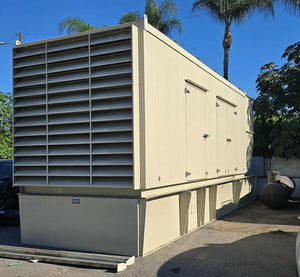


IEC 62040-4: Environmental Standards Explained
The IEC 62040-4:2013 standard, which focused on reporting the environmental impact of UPS (Uninterruptible Power Supply) systems throughout their lifecycle, was officially withdrawn on January 13, 2026. This leaves a gap for manufacturers and buyers looking for product-specific environmental data for UPS systems. Here's what you need to know:
- IEC 62040-4: Covered the entire lifecycle of UPS systems, from material sourcing to disposal, with standardized reporting for transparency. It was tailored specifically for UPS products but is no longer active.
- ENERGY STAR: Focuses on energy efficiency during the use phase but doesn’t consider production, materials, or disposal.
- ISO 14001: Provides a framework for organizational environmental management but lacks product-specific requirements.
For now, combining ENERGY STAR and ISO 14001 with the principles of the withdrawn IEC 62040-4 can help fill this gap. Manufacturers may also adopt life cycle assessments (LCA) and Environmental Product Declarations (EPD) to ensure transparency and better decision-making for UPS buyers.
1. IEC 62040-4
Life Cycle Focus
IEC 62040-4:2013 centers on evaluating the environmental impact of uninterruptible power systems (UPS) throughout their entire lifecycle. This includes everything from sourcing raw materials and manufacturing to the use phase and eventual disposal. By examining each stage, the standard encourages design decisions that aim to minimize environmental damage.
Environmental Impact Reporting
Manufacturers adhering to the standard must provide detailed environmental data. This includes:
- Information about the producer
- Descriptions of the product and its packaging
- Lists of regulated substances
- Energy consumption during use
- Recycling potential at the end of the product's life
This reporting aligns with IEC 62474, which focuses on material declarations in the electrotechnical industry.
"IEC 62040-4:2013 specifies the process and requirements to declare the environmental aspects concerning uninterruptible power systems (UPS), with the goal of promoting reduction of any adverse environmental impact during a complete UPS life cycle." - IEC Webstore
To ensure consistency, Annex A provides a standardized declaration format. This allows procurement teams to fairly compare the environmental performance of various UPS products without having to interpret differing formats or metrics. By setting clear reporting guidelines, the standard ensures transparency and clarity about the UPS systems it covers.
Scope of Application
This standard is specifically designed for UPS systems that are movable, stationary, or fixed and provide single- or three-phase AC output voltages up to 1,000 V. These systems typically include an energy storage component connected via a DC link. However, the standard does not apply to:
- Conventional AC or DC distribution boards
- Stand-alone static transfer systems
- Systems with outputs derived from rotating machines
This precise scope sets IEC 62040-4 apart from broader frameworks like ENERGY STAR, which focuses on energy efficiency, or ISO 14001, which deals with overall environmental management at an organizational level.
sbb-itb-501186b
2. ENERGY STAR UPS Benchmarks
Life Cycle Focus
ENERGY STAR benchmarks focus on how efficiently a UPS operates during its active use, offering a snapshot of performance. This contrasts with IEC 62040-4, which takes a broader view by considering the entire lifecycle of the product, including its environmental impact from production to disposal. As a result, two UPS systems could achieve similar ENERGY STAR ratings while having very different overall environmental impacts.
Environmental Impact Reporting
ENERGY STAR certification is based on whether a UPS meets specific operational efficiency standards. Unlike IEC 62040-4, which provides detailed reporting on environmental impacts across the product's lifecycle, ENERGY STAR zeroes in on performance during use. In short, IEC 62040-4 offers a more detailed environmental analysis, while ENERGY STAR ensures operational efficiency.
Scope of Application
ENERGY STAR UPS benchmarks are tailored for uninterruptible power supplies used in commercial and industrial environments across the United States. The program sets minimum efficiency requirements based on factors like active output power ratings and utilization levels. By focusing on operational efficiency, ENERGY STAR complements the broader lifecycle perspective of IEC 62040-4, while also aligning with other frameworks like ISO 14001 for environmental management in these settings.
3. ISO 14001 Environmental Management
Life Cycle Focus
ISO 14001 provides a framework for an Environmental Management System (EMS) that emphasizes ongoing improvement. Unlike IEC 62040-4, which zeroes in on the entire life cycle of a specific product like a UPS system, ISO 14001 takes a broader view, focusing on an organization's overall processes and responsibilities. While ISO 14001 addresses the environmental footprint of the entire organization, IEC 62040-4 narrows its focus to the technical aspects of UPS systems, from raw materials to disposal. This difference in scope also influences how each standard handles environmental reporting.
Environmental Impact Reporting
The two standards approach environmental reporting in distinct ways. ISO 14001 requires organizations to identify and manage environmental aspects but doesn't mandate specific formats or metrics for reporting. On the other hand, IEC 62040-4 sets clear guidelines by requiring a standardized declaration format. This format includes details on substance content, energy usage during the operational phase, and recycling at the end of the product's life. While ISO 14001 certification highlights an organization’s commitment to environmental responsibility, IEC 62040-4 compliance ensures consistent, product-specific environmental data for buyers and regulators.
Scope of Application
ISO 14001 is designed for use by any organization, regardless of industry or size. In contrast, IEC 62040-4 (which has been withdrawn and is awaiting future updates) was specifically tailored for UPS systems, whether movable, stationary, or fixed, with AC outputs of up to 1,000 V. Organizations can adopt ISO 14001 for comprehensive environmental management strategies while turning to IEC 62040-4 for detailed, product-specific declarations related to UPS systems.
Strengths and Weaknesses
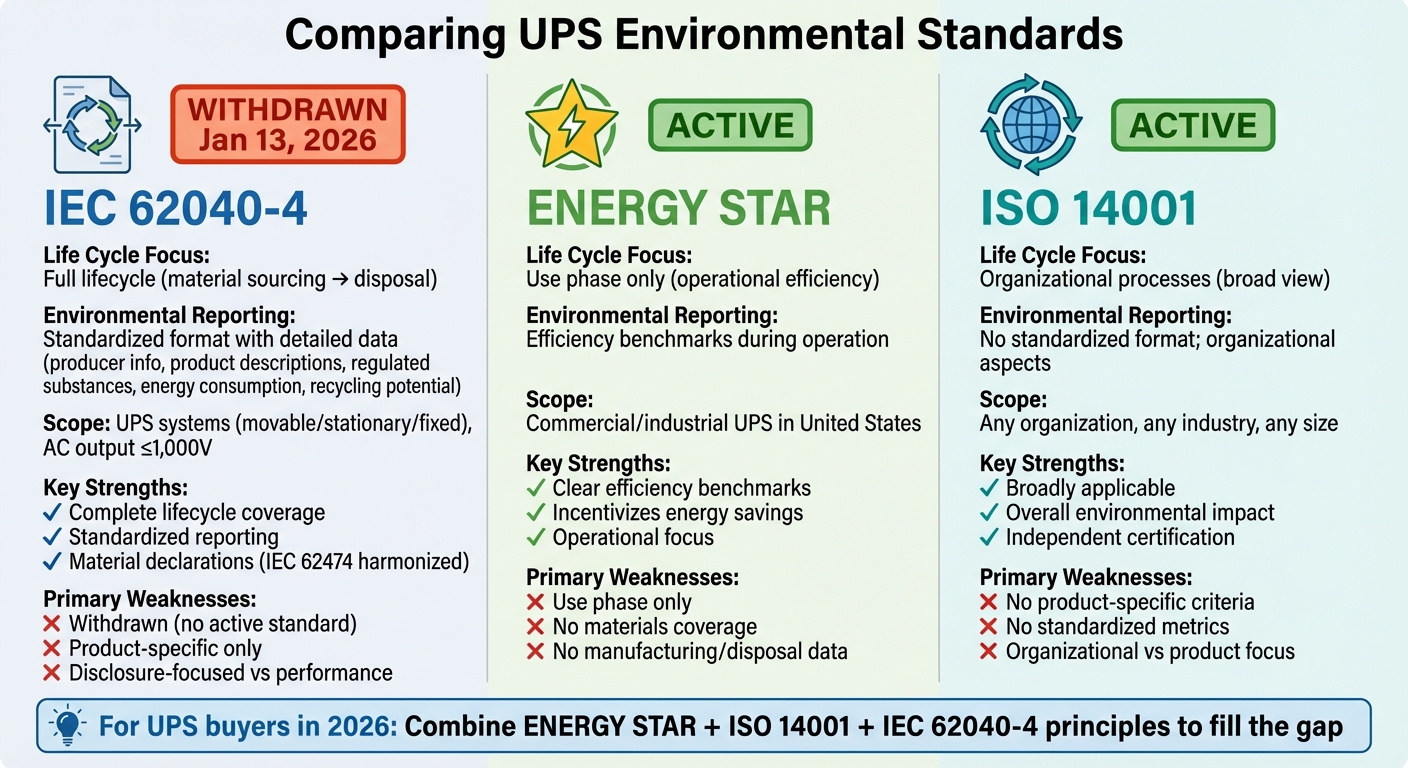
IEC 62040-4 vs ENERGY STAR vs ISO 14001: UPS Environmental Standards Comparison
Each standard brings its own advantages and limitations to the table. IEC 62040-4 stands out because it provides detailed, UPS-specific technical insights across the entire product life cycle. This makes it easier for buyers to directly compare products. However, the withdrawal of its 2013 edition on January 13, 2026, leaves no active product-specific environmental standard for UPS systems. This gap complicates evaluations of environmental performance for UPS buyers starting in April 2026.
While IEC 62040-4 emphasizes a comprehensive life cycle approach, ENERGY STAR shifts the focus to operational energy efficiency. By setting clear benchmarks for energy use during the operational phase, it helps reduce immediate power consumption. But this standard doesn’t address other critical aspects, such as materials, manufacturing processes, or end-of-life disposal, all of which IEC 62040-4 covered in detail.
On the other hand, ISO 14001 takes a broader approach. It serves as a framework for environmental management at the organizational level and can be adopted by any company. Its flexibility and wide applicability are its strengths. However, it doesn’t cater to product-specific technical needs, which are often critical for UPS buyers. Unlike IEC 62040-4, it doesn’t require standardized reporting formats or detailed metrics, focusing instead on overarching environmental processes.
Here’s a quick comparison of the three standards:
| Standard | Key Strengths | Primary Weaknesses |
|---|---|---|
| IEC 62040-4 | Covers the entire UPS life cycle; standardized reporting; material declarations harmonized with IEC 62474 | Withdrawn as of January 13, 2026; product-specific focus; emphasizes disclosure over performance |
| ENERGY STAR | Sets clear benchmarks for operational efficiency; incentivizes energy savings | Limited to the operational phase; excludes materials, manufacturing, and disposal |
| ISO 14001 | Broadly applicable to any organization; focuses on overall environmental impact; independent certification | No product-specific criteria; lacks standardized reporting metrics; organizational rather than product focus |
For UPS buyers in April 2026, the absence of IEC 62040-4 means they’ll need to rely on ENERGY STAR’s operational efficiency ratings and ISO 14001’s organizational certifications to assess environmental performance. This highlights the importance of balancing product-specific and organizational standards when choosing sustainable UPS solutions.
Conclusion
The withdrawal of IEC 62040-4 on January 13, 2026, leaves a noticeable void in product-specific environmental standards for uninterruptible power systems (UPS). Despite its withdrawal, the standard's life cycle approach remains highly relevant for aligning UPS systems with global sustainability objectives. As the International Electrotechnical Commission (IEC) outlined, the standard "specifies the process and requirements for declaring the environmental aspects of uninterruptible power systems (UPSs), with the aim of promoting the reduction of any negative environmental impact during the complete life cycle of UPSs". This framework addressed every stage, from material sourcing to end-of-life processes, aiding efforts to meet United Nations Sustainable Development Goals related to sustainable ecosystems and biodiversity preservation.
For manufacturers and procurement teams, the challenge now lies in integrating multiple standards to fill this gap. ENERGY STAR benchmarks can guide operational efficiency evaluations, ISO 14001 certifications provide a framework for environmental management systems, and the life cycle principles of IEC 62040-4 remain a valuable reference. Ecodesign plays a crucial role here - as Legrand emphasizes, "Efficiency also means ecodesign: this implies that the UPS is designed to be easily repaired, maintained and it's easy to separate its components". This approach not only supports higher recycling rates but also extends the lifespan of products.
Practical strategies for advancing sustainability include adopting standardized environmental declarations based on the structure of IEC 62040-4, aligning material declarations with IEC 62474, and leveraging digital diagnostic tools to optimize maintenance schedules. Conducting Life Cycle Assessments (LCA) can help evaluate environmental impacts across the entire product life span, while Environmental Product Declarations (EPD) based on ISO 14025 offer transparent insights into environmental performance.
Industry professionals should also keep an eye on the revised edition of IEC 62040-4 currently in development. In the meantime, applying the principles of the withdrawn standard alongside existing certifications provides a well-rounded approach to sustainable UPS manufacturing and procurement. By integrating these frameworks, stakeholders can embrace circular economy practices through green procurement, innovative material use, and component reuse in production cycles.
FAQs
What replaced IEC 62040-4 after it was withdrawn?
The IEC 62040-4 standard has been withdrawn and replaced by IEC 62040-3. This updated standard defines the performance and testing requirements for uninterruptible power systems (UPS), aligning with the latest guidelines to ensure both reliability and functionality.
How can I compare UPS environmental impact beyond ENERGY STAR?
To fully assess a UPS system’s environmental impact, it's essential to look beyond ENERGY STAR certification. One key benchmark is compliance with IEC 62040-4, a standard that provides guidelines for evaluating and reporting environmental aspects throughout a UPS system's life cycle. This standard emphasizes reducing harmful environmental effects at every stage.
For additional insights, you can also refer to regional standards like BS EN 62040-4:2013, which offers detailed practices for environmental performance assessment and reporting. These standards help ensure a more comprehensive understanding of a UPS system's environmental footprint.
Should UPS vendors provide an LCA or an EPD now?
UPS vendors are now required to provide an Environmental Product Declaration (EPD). This document offers a standardized way to detail a product’s impact on the environment across its entire lifecycle. It aligns with the standards set by IEC 62040-4:2013, which specifically addresses the environmental considerations of UPS systems.