

Guide to Cybersecurity in Power Distribution Systems
Cybersecurity in power distribution systems is more urgent than ever. Modern grids, now interconnected and digital, face rising cyber threats, with attacks on utilities up by over 200% in 2023. These systems are critical for essential services like hospitals and water infrastructure, making their protection a top priority.
Key takeaways:
- Common threats include ransomware, phishing, and advanced persistent threats (APTs).
- Vulnerabilities often stem from outdated systems, weak remote access controls, and expanding attack surfaces like smart meters and home batteries.
- Key solutions involve layered security, regular monitoring, secure remote access, and robust workforce training.
This guide explains the challenges, threats, and practical steps to secure power grids, ensuring stability and resilience in the face of evolving risks.
Power Grid Under Attack? How Experts Stop Chaos in Seconds ⚡ | Guardians of the Grid
sbb-itb-501186b
Understanding the Threat Landscape
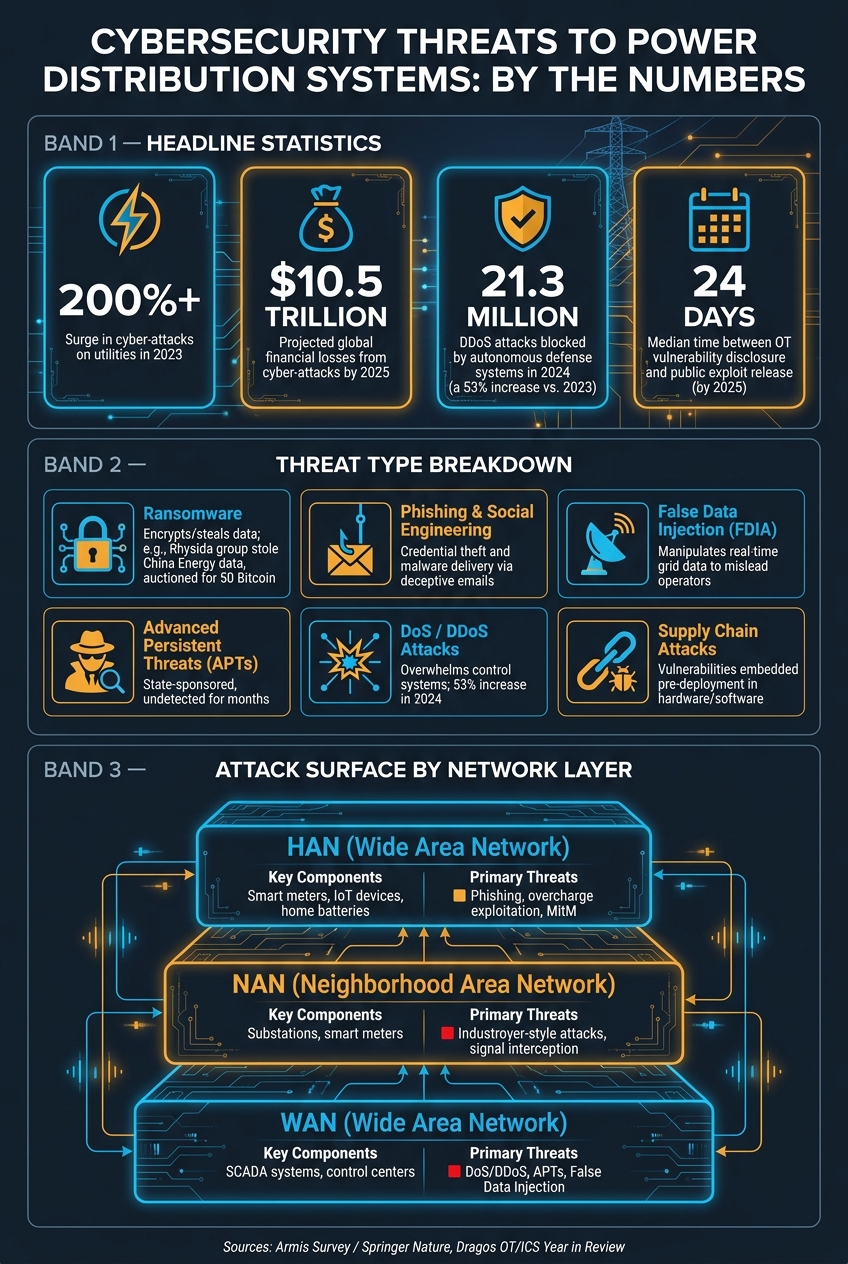
Cybersecurity Threats to Power Grids: Key Stats & Attack Surface
The security risks facing U.S. power distribution systems have expanded both in complexity and frequency. Cyber-attacks on utilities surged by over 200% in 2023, with global financial losses from such attacks expected to hit $10.5 trillion by 2025. This rapid escalation highlights the critical need to identify and counter these evolving threats. The sections below explore key cyber threats and their impact on various components of power distribution systems.
Common Cyber Threats to Power Distribution Systems
Several types of cyber threats pose significant risks to power distribution systems:
Ransomware continues to be one of the most disruptive threats. In 2023, the Rhysida Ransomware group targeted the China Energy Engineering Corporation, stealing sensitive corporate data and later auctioning it for 50 Bitcoin - all without causing a single blackout. This incident underscores how ransomware can inflict severe damage even when grid operations remain intact.
Phishing and social engineering remain common attack methods. Cybercriminals use deceptive emails to steal credentials or plant malware, paving the way for deeper system intrusions. Other notable threats include:
- False Data Injection Attacks (FDIA): These attacks manipulate real-time data, such as system frequency, to mislead operators and disrupt grid control.
- Advanced Persistent Threats (APTs): Often state-sponsored, these long-term infiltrations can remain undetected for months, mapping out critical systems.
- Denial of Service (DoS/DDoS): These attacks overwhelm communication networks, rendering control systems inaccessible. Autonomous defense systems blocked 21.3 million DDoS attacks in 2024 - a 53% increase compared to 2023.
- Supply chain attacks: These attacks compromise hardware or software during manufacturing, embedding vulnerabilities before deployment.
"Cyber-attacks on utilities have grown by > 200% in 2023, with total cyberattacks growing by 104%." - Armis Survey via Springer Nature
While these threats are widespread, understanding how they target specific components within the system is key to mitigating their impact.
How Threats Target Specific System Components
Attackers often focus on components that offer the most leverage for disruption or concealment.
Protection relays (IEDs) are high-value targets. These devices monitor voltage and current, sending trip commands to circuit breakers within milliseconds. By manipulating relay logic, attackers can suppress valid fault responses or trigger false trips, potentially causing cascading failures. For instance, the Industroyer malware used in December 2016 issued unauthorized commands to a substation in Kyiv, Ukraine, resulting in a blackout for roughly an hour.
Engineering workstations (EWS) are crucial during the reconnaissance phase. These workstations store relay configurations, VPN credentials, and software for reprogramming relay logic. A single compromised workstation can provide attackers with the tools to alter substation operations without raising alarms.
Distributed Energy Resources (DERs), such as home batteries and rooftop solar systems, represent an emerging attack surface. In December 2025, the ELECTRUM group launched a coordinated attack on Polish energy infrastructure, marking the first major global assault targeting DERs. Vulnerabilities in smart batteries connected to Home Area Networks (HANs) could also be exploited to bypass overcharge protection, leading to fire or explosion risks.
The table below illustrates how threats align with the three main network layers in power distribution systems:
| Network Layer | Key Components | Primary Threats |
|---|---|---|
| Wide Area Network (WAN) | SCADA systems, control centers | DoS/DDoS, APTs, False Data Injection |
| Neighborhood Area Network (NAN) | Substations, smart meters | Industroyer-style attacks, signal interception |
| Home Area Network (HAN) | Smart meters, IoT devices, home batteries | Phishing, overcharge exploitation, MitM |
"In electric environments, vulnerabilities do not become dangerous when they are disclosed, they become dangerous when they are exposed, reachable, and tied to systems that influence grid visibility and control." - Dragos
Knowing where threats originate and which components they target is essential for developing effective defenses. This understanding lays the groundwork for implementing robust security measures and system architectures.
Building a Secure Architecture for Power Distribution
Creating a secure architecture is essential for limiting an attacker’s ability to move laterally after a breach. A layered design not only separates critical functions but also minimizes the potential damage caused by unauthorized access.
Key Security Controls for OT Networks
Modern substation systems are structured into three main layers: the Process Bus, the Station Bus, and the Industrial Demilitarized Zone (IDMZ). Each layer plays a specific role in ensuring secure and efficient operations:
- Process Bus: Handles time-sensitive communication between Intelligent Electronic Devices (IEDs) and field equipment.
- Station Bus: Manages data aggregation, local human-machine interface (HMI) operations, and SCADA gateway functions.
- IDMZ: Acts as a controlled buffer, isolating corporate IT systems from operational technology (OT) networks.
This layered approach is critical. Without it, a breach in the corporate IT network could directly compromise protection relays, exposing the entire system to significant risk.
| Communication Layer | Primary Function | Key Protocols Used |
|---|---|---|
| Process Bus | Real-time IED-to-field equipment communication | IEC 61850-8-1 (GOOSE), IEC 61850-9-2 (SV), PTP |
| Station Bus | Data aggregation, local HMI, and SCADA gateway | MMS (IEC 61850-8-1), DNP3, IEC 60870-5-104, SNMP |
| Engineering Access | Privileged maintenance and configuration | MMS, RDP, SSH, Serial Console |
To enhance daily security operations, five key controls should be implemented:
- Update default credentials immediately: Factory-set passwords on IEDs and gateways are often published in manuals, making them an easy target for attackers.
- Disable unused protocols: Turn off Telnet, HTTP, and FTP if they’re not actively in use, as these are commonly enabled by default on protection relays.
- Implement redundancy protocols: Use PRP (Parallel Redundancy Protocol) and HSR (High-availability Seamless Redundancy) to ensure critical traffic isn’t disrupted during link failures.
-
Centralize asset management: Track firmware versions, enforce version control on relay logic, and monitor device telemetry for unauthorized changes, like the
SETCHGbit. - Integrate physical security alerts: Connect cabinet door alarms and Electronic Access Control Systems (EACS) to SCADA, so operators are alerted if a relay cabinet is accessed without authorization.
"Securing protection relays is no longer just a best practice; it's absolutely essential for ensuring the resilience of both transmission and distribution power grids." - Mandiant
These measures form the backbone of a secure network, setting the stage for robust remote access management.
Securing Remote Access and Managing Vendors
Remote access is a frequent target for attackers in power distribution systems. To mitigate this risk, all remote sessions should pass through the IDMZ and engineering jump hosts, preventing direct access from corporate IT. Additionally, encrypted VPNs and multi-factor authentication (MFA) are non-negotiable for all remote pathways.
Vendor access remains a persistent challenge. Many utilities still use stand-alone VPN credentials for contractors and OEM vendors, which often bypass centralized identity systems, lack MFA, and are reused across multiple projects. This opens the door for attackers, who can leverage open-source intelligence (OSINT) to identify engineering staff and exploit vendor-specific tools like DIGSI, PCM600, or AcSELerator to gain entry.
"Many utilities still use stand-alone VPN credentials for contractors and OEM vendors. These accounts often bypass centralized identity systems, lack 2FA, and are reused across projects." - Mandiant
Continuous monitoring of device logs is crucial for spotting unauthorized access. Indicators such as BADPASS (failed authentication attempts) and SETCHG (unauthorized setting changes) can provide early warnings of credential abuse or tampering. These alerts allow security teams to respond quickly, preventing minor incidents from escalating into major breaches. The next section will focus on effective monitoring and incident response strategies to complete the defense framework.
Monitoring, Detection, and Incident Response
Monitoring and Threat Detection
Once a secure architecture and remote access controls are in place, the next step is to monitor OT networks for unusual activity. Passive monitoring is the go-to method here. Unlike active scanning, which can introduce data into the network and potentially disrupt legacy controllers or trigger unintended operations, passive monitoring observes network traffic without interfering. Tools like Claroty's CTD platform offer real-time visibility, automated asset discovery, and anomaly detection - all without disrupting active processes.
To detect threats effectively, it’s essential to combine data from multiple sources. For instance, merging information from Active Directory, DHCP servers, and configuration management databases (CMDBs) with OT network data provides valuable context. This helps analysts differentiate between routine activities, like firmware updates, and suspicious changes to configurations. Additionally, integrating OT data with IT security platforms such as Splunk or IBM QRadar creates a unified view of threats across IT and OT environments.
This robust detection framework sets the stage for an incident response plan that prioritizes grid stability.
Incident Response Planning
Detection alone isn’t enough - incident response must ensure the grid continues to operate smoothly.
A strong OT incident response plan follows the standard lifecycle: Preparation, Detection, Containment, Eradication, Recovery, and Post-Incident Review. However, it must also keep grid stability front and center at every stage. For example, containment might involve isolating the SCADA network from corporate IT systems to block lateral movement, while still ensuring that breakers and switches remain operational.
A key element of any plan is the "fail to manual" procedure. If digital systems are compromised, operators need to be ready to manually control breakers and switches at substations to maintain grid stability. This approach proved effective in a 2015 incident, where operators quickly switched to manual control and restored power within hours.
Recovery efforts should go beyond simply restoring backups. It’s crucial to verify the firmware and logic integrity of every field device before bringing systems back online. Using tools like AUVESY versiondog or Rockwell AssetCentre can streamline this process by automating configuration backups and speeding up recovery. Another helpful strategy is pre-staging "jump bags" at critical substations. These kits - complete with clean engineering workstations, verified firmware images, and essential cables - can significantly cut down on recovery time.
For U.S. power utilities, incident response plans must also meet NERC CIP-008 requirements. This standard mandates documented processes for identifying, classifying, and responding to cyber incidents. Running joint tabletop exercises involving both cybersecurity teams and grid operators is an excellent way to test and refine these plans. Such exercises ensure that defensive actions won’t unintentionally disrupt critical infrastructure. Together, these strategies build on earlier protective measures, creating a comprehensive defense for OT networks.
Workforce Training and Governance
Cybersecurity Training for Operators and Staff
Once technical defenses are in place, the next critical step is equipping your team with the right knowledge and skills. Cybersecurity isn’t just about technology - it’s about people. Employees and contractors are often the last line of defense against cyber threats, and their actions can make or break a system's security. According to the 2024 SANS ICS/OT Cybersecurity Survey, 41% of respondents flagged employees and contractors not following security practices as a major risk, while 66% pointed to a lack of security skills as a key challenge.
Training must be specific to each role. For example, control room operators should learn to spot unusual HMI behavior, such as unexpected breaker commands or frozen data, and know when to escalate issues or switch to manual operations. Field technicians need hands-on sessions to practice connecting to relays using hardened laptops, verified firmware, and approved tools. Engineers, on the other hand, should focus on conducting design reviews that align with guidelines like NIST SP 800-82.
The frequency and format of training also matter. NERC CIP-004 offers a solid starting point: initial training before access is granted, followed by refreshers every 15 months, with documented completion records. However, leading utilities are going beyond compliance. They’re using short, targeted training modules, phishing simulations to track user behavior, and tabletop exercises that bring together operators, IT, OT, and management. A 2022 IBM report highlights the financial impact of strong training programs, showing that organizations with security awareness training averaged $2.60M in breach costs, compared to $5.01M for those without - nearly a 48% reduction.
To make cybersecurity second nature, it should be woven into everyday routines. For instance, pre-job briefs or switching orders can include a simple cyber check: "Are we using an approved, hardened laptop for this relay connection?" Real-world examples, like the 2015–2016 Ukraine grid attacks, drive home the point that fundamental practices - such as using MFA and limiting remote access - are essential for grid stability.
Industry Standards and Frameworks to Follow
Strong training programs work best when paired with established cybersecurity frameworks. These frameworks provide clear guidelines for training, risk management, and overall security governance in power systems:
| Framework | Applicability | Key Focus Areas |
|---|---|---|
| NERC CIP (CIP-003, CIP-004) | Required for registered bulk electric system entities | Training protocols, access control, audit-ready documentation |
| NIST CSF 2.0 | Voluntary but widely used by U.S. utilities | Emphasizes Awareness & Training (PR.AT), Governance (GV), and Risk Management |
| ISA/IEC 62443 | OT/ICS system design and lifecycle | Focuses on security maturity, organizational skills, and lifecycle governance |
For utilities not bound by NERC CIP, pairing NIST CSF with NIST SP 800-82 offers a practical, voluntary framework. The Department of Energy’s Cybersecurity Capability Maturity Model (C2M2 v2.1) goes even further, detailing maturity levels for workforce management. This includes defining cyber roles, setting competency standards, and establishing a regular training schedule. DOE survey data shows that higher maturity levels are linked to fewer reportable incidents.
Governance is just as critical as training. A Cybersecurity Steering Committee - comprising OT, engineering, IT, compliance, and procurement - ensures the program has authority and direction. Clear RACI matrices (outlining who detects, decides, communicates, and recovers during incidents) eliminate confusion during critical moments. Additionally, vendors and contractors must meet documented cybersecurity expectations, such as using MFA, following logging protocols, notifying incidents promptly, and securely handling equipment like relays or RTUs.
Conclusion
Key Takeaways
Securing power distribution systems has become a critical challenge. The utilities sector has seen a sharp rise in cyber-attacks, with weekly incidents increasing by 47% between 2021 and 2024. By 2025, the median time between the disclosure of an operational technology (OT) vulnerability and the release of a public exploit was just 24 days. This compressed timeline underscores the urgency of staying ahead of emerging threats.
A few essential principles stand out when building a defense strategy. Protection relays and Intelligent Electronic Devices (IEDs), now prime targets, must be monitored continuously for indicators like SETCHG and BADPASS - signals that could reveal patient, stealthy adversaries. Modern attackers often avoid loud, immediate disruptions, favoring prolonged, covert infiltration instead.
"Electric environments are not being 'breached' loudly at a point in time; they are being inhabited silently over time." - Dragos
The integration of Distributed Energy Resources (DER) and Battery Energy Storage Systems (BESS) has further complicated grid protection. These decentralized systems expand the attack surface and often lack consistent monitoring, making them vulnerable. A stark example occurred in December 2025, when the threat group ELECTRUM coordinated a major attack on Polish energy infrastructure. This incident highlights how adversaries are increasingly targeting decentralized grid assets.
To counter these threats, a layered defense is essential. This approach should include defensible architecture, real-time OT visibility, secure remote access, risk-based vulnerability management, and a workforce trained to view cybersecurity as an ongoing responsibility - not just a compliance task. Combining technical measures with human vigilance creates a stronger, more resilient security posture.
Resources for Further Learning
For those looking to enhance their cybersecurity efforts, these resources offer practical guidance:
- NERC CIP Standards: The regulatory framework for bulk electric system entities in the U.S., addressing access control, training, and incident response planning.
- NIST SP 800-82 Rev. 3: A comprehensive guide to securing industrial control systems, published by the National Institute of Standards and Technology.
- SANS Five ICS Critical Controls: A practitioner-focused framework covering key areas like incident response, network visibility, and secure remote access.
- DOE Cybersecurity Capability Maturity Model (C2M2 v2.1): A tool to assess program maturity and identify workforce development needs.
- Dragos OT/ICS Cybersecurity Year in Review: An annual report providing up-to-date threat intelligence for industrial environments.
If you’re in need of hardened or replacement electrical equipment - whether it’s breakers, transformers, relays, or other power distribution components - Electrical Trader offers a centralized marketplace for both new and used items. This can be particularly valuable when replacing aging or compromised hardware as part of your security strategy.
FAQs
What should we secure first in a substation OT network?
To strengthen a substation OT network, begin by implementing network segmentation and safeguarding critical assets. Adopt a layered defense approach that includes limiting access to sensitive areas and securing essential components like protection relays and control systems. These steps play a crucial role in minimizing risks and maintaining system reliability.
How can we enable vendor remote access without increasing risk?
To securely manage vendor remote access, implementing a zero-trust architecture is key. This approach prioritizes strict access controls and continuous monitoring to minimize risks. Here’s how you can do it:
- Use identity-aware proxies to restrict access to specific applications.
- Enforce multi-factor authentication (MFA) for an added layer of security.
- Replace traditional inbound VPNs with outbound-only connections to reduce vulnerabilities.
- Deploy deep packet inspection to monitor activity and detect anomalies in real time.
- Ensure comprehensive session logging to maintain a detailed record of all interactions.
- Opt for solutions that eliminate direct network connections, helping you stay compliant while lowering exposure to potential threats.
By layering these measures, you can significantly enhance security while maintaining control over vendor access.
What’s the safest way to monitor OT traffic without disrupting operations?
The best approach to monitor OT traffic is by using passive, non-intrusive methods that don’t interfere with the live network. Tools like network TAPs or configuring switches with mirror ports enable traffic analysis without altering or generating any packets. These techniques ensure there’s no added latency and maintain the system’s operational stability, which is crucial in environments where continuous functionality is essential.