IEC 62040-2 EMC Standards Overview
IEC 62040-2 sets electromagnetic compatibility (EMC) standards for uninterruptible power supply (UPS) systems. It ensures systems operate without causing or being affected by interference. The standard focuses on:
- Emission limits: Prevent UPS systems from disrupting nearby devices.
- Immunity requirements: Protect UPS systems from external electrical disturbances.
Key Points:
- Applies to: UPS systems in low-voltage networks (up to 1,000 V AC or 1,500 V DC) across residential, commercial, and industrial environments.
- Categories (C1–C4): Defines UPS types based on their intended environment and emission limits.
- Testing: Covers emissions (conducted, radiated) and immunity (e.g., surges, voltage dips).
- Edition 3.0 (2016): Latest version with updates for network port compliance.
- Installation: Proper setup and maintenance are critical for compliance.
This standard is vital for ensuring UPS systems work reliably without disrupting or being disrupted by other devices. It also aligns with U.S. regulations like UL certifications and FCC requirements.
Key Components of IEC 62040-2
IEC 62040-2 UPS Categories C1–C4: EMC Compliance Guide
Core EMC Concepts
The IEC 62040-2 standard ensures that UPS (Uninterruptible Power Supply) systems operate without causing or being affected by electromagnetic interference.
Emissions refer to the electromagnetic energy a UPS system releases. These emissions can travel through power lines (conducted) or through the air (radiated), including magnetic field (H-field) disturbances, which might disrupt nearby equipment.
Immunity gauges how well a UPS can withstand external electromagnetic disturbances. The standard tests UPS systems against scenarios like electrostatic discharge (ESD), electrical fast transients (EFT) from switching devices, surges caused by lightning, and temporary voltage dips or outages.
"This standard defines emission limits, immunity levels, test methods and performance criteria for a complete UPS to comply with the essential EMC requirements necessary to avoid the UPS interfering with other apparatus, e.g. radio receivers, and to avoid the UPS being affected by external phenomena." - IEC 62040-2
These principles form the foundation for categorizing UPS systems into specific product groups.
IEC 62040-2 Product Categories (C1–C4)
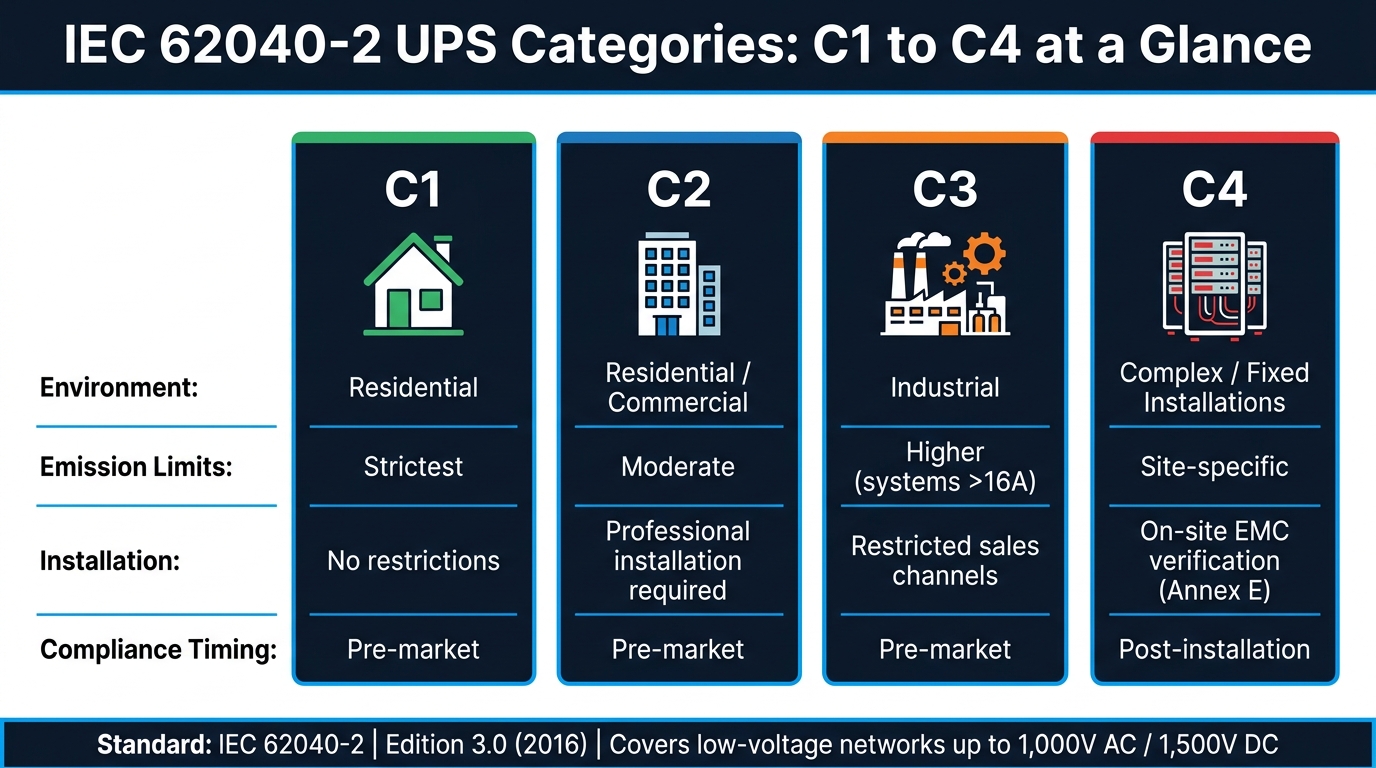
The standard divides UPS systems into four categories, each tailored to specific environments and installation needs. This classification helps ensure proper testing and installation for different applications.
| Category | Intended Environment | Key Requirement |
|---|---|---|
| C1 | Residential (First Environment) | Strictest emission limits; no installation restrictions |
| C2 | Residential/Commercial (First Environment) | Moderate limits; requires professional installation |
| C3 | Industrial (Second Environment) | Higher emission limits; for systems rated above 16A |
| C4 | Complex/Fixed Installations | Compliance verified on-site after installation |
For C1, C2, and C3 categories, compliance is assessed before the UPS hits the market. However, C4 systems are usually large, integrated setups, so their compliance is checked after installation at the site.
Emission and Immunity Requirements
Meeting emission and immunity standards is critical for ensuring a UPS operates reliably without disrupting other systems. The emission limits in IEC 62040-2 regulate the amount of electromagnetic noise a UPS can produce. These limits apply to mains ports (connections to the power grid) and network ports (like Ethernet or PSTN). The 2016 Edition 3.0 update introduced specific limits for network ports, aligning the standard with other global EMC guidelines.
On the immunity side, UPS systems undergo rigorous testing to simulate real-world electromagnetic challenges. Each test targets a specific type of interference the UPS might encounter.
| Immunity Test | Simulated Scenario |
|---|---|
| Electrostatic Discharge (ESD) | Static electricity from operators or nearby objects |
| Radiated RF Immunity | Radio-frequency interference from wireless devices |
| Electrical Fast Transients (EFT) | Sudden transients on power or control lines |
| Surge Immunity | High-energy spikes from lightning or load switching |
| Voltage Dips & Interruptions | Short-term voltage drops or outages |
| Power-Frequency Magnetic Fields | Interference from 50/60 Hz magnetic fields |
After these tests, the UPS must demonstrate it can continue functioning within the performance limits defined by the standard.
sbb-itb-501186b
Applying IEC 62040-2 in UPS Design and Selection
How Manufacturers Build EMC Compliance Into UPS Systems
To align with IEC 62040-2 standards, manufacturers embed electromagnetic compatibility (EMC) measures into the design of uninterruptible power supply (UPS) systems. This begins with engineers conducting electromagnetic simulations early in the design process. These simulations help predict how the UPS will behave, allowing potential interference issues to be identified and resolved before creating physical prototypes - saving both time and money.
On the hardware side, manufacturers incorporate key features like electromagnetic shielding, input/output filtering, and harmonic distortion control. These elements ensure that emissions stay within the limits specified for each UPS category. Proper grounding and insulation are equally critical. Even with excellent shielding, a system can fail immunity tests if these fundamentals are overlooked.
To avoid costly delays during certification, manufacturers conduct in-house pre-compliance testing. The typical process includes designing according to IEC guidelines, validating the design internally, testing at accredited labs, verifying compliance, and finally obtaining certification.
"Subject to installing, operating and maintaining the UPS in the manner prescribed by the manufacturer, this standard defines emission limits, immunity levels, test methods and performance criteria for a complete UPS to comply with the essential EMC requirements." - BS EN IEC 62040-2:2018
The next step involves selecting the appropriate UPS category to match your specific environment.
Choosing the Right UPS for Your Facility
Selecting the correct UPS category is essential to ensure compliance and optimal performance. The table below outlines the key factors for each category:
| UPS Category | Environment | Key Consideration |
|---|---|---|
| C1 | Residential, small office | No installation restrictions; strictest emission limits |
| C2 | Commercial, light industrial | Requires professional installation |
| C3 | Industrial | Higher emission limits; restricted sales channels |
| C4 | Large, complex installations | Site-specific compliance verified post-installation |
If your UPS connects to external networks like Ethernet, PSTN, or xDSL, make sure it complies with the 3rd Edition (IEC 62040-2:2016). This edition introduced specific disturbance limits for network ports. UPS units tested under earlier editions may not address these updated requirements. Additionally, consider the electromagnetic environment of your facility. For example, areas near heavy machinery or switching equipment demand a UPS with strong immunity to ESD, EFT, surges, and voltage dips.
For those seeking compliant UPS solutions, Electrical Trader offers a wide range of products crafted to meet these EMC standards.
Installation Practices That Support EMC Compliance
Even the most well-designed UPS can fail in the field if installed incorrectly. Proper grounding and cable management are critical to maintaining the emission and immunity levels defined by the standard. Keeping power cables separate from signal and data cables reduces the risk of conducted noise. Additionally, all shielding and filtering components must remain intact. Any alteration can void the system's EMC compliance.
For Category C4 systems, compliance is only confirmed after installation. On-site EMC verification is required, as outlined in Annex E of IEC 62040-2. Following the manufacturer's installation manual is essential since the standard assumes these instructions are strictly adhered to. Neglecting these steps can compromise the UPS's ability to meet EMC requirements.
Testing and Documentation for IEC 62040-2 Compliance
How Compliance Testing Works
IEC 62040-2 requires type testing for UPS categories C1–C3 before they can be introduced to the market. These tests focus on two main areas: emissions and immunity.
For emissions, laboratories measure disturbances conducted through mains supply and network ports (like Ethernet or PSTN connections) and assess radiated electromagnetic fields, including magnetic H-field disturbances. These tests follow the guidelines set by CISPR 11 and CISPR 22.
Immunity testing is broader in scope. The table below outlines the specific tests and the standards they adhere to:
| Test Type | Specific Procedure | Referenced Standard |
|---|---|---|
| Immunity | Electrostatic Discharge (ESD) | IEC 61000-4-2 |
| Immunity | Radiated RF Electromagnetic Field | IEC 61000-4-3 |
| Immunity | Electrical Fast Transient/Burst | IEC 61000-4-4 |
| Immunity | Surge Immunity | IEC 61000-4-5 |
| Immunity | Conducted RF Disturbances | IEC 61000-4-6 |
| Immunity | Power Frequency Magnetic Field | IEC 61000-4-8 |
| Emission | Conducted (Mains/Network Ports) | CISPR 11 / CISPR 22 |
| Emission | Radiated (H-Field/EM Field) | CISPR 11 |
UPS systems are assessed against performance criteria (A, B, or C) to determine their ability to either function without interruption, temporarily lose functionality, or recover automatically after each immunity test.
Once testing is complete, manufacturers must prepare detailed documentation to demonstrate compliance.
Key Documents Required for Compliance
At the heart of the compliance process is the EMC test report, which records the results of all emissions and immunity tests. This report is critical for regulators and procurement teams as proof of compliance. Accredited laboratories use standardized forms, like the IECEE TRF 62040-2A:2023, to ensure results are documented in a universally accepted format. For systems in Category C4, Annex E test records are used to document site-specific testing performed after installation at the user’s facility.
"This type test-based product standard allows EMC conformity assessment of UPS included in one of categories C1, C2 and C3 before placing them on the market." - BS EN IEC 62040-2:2018
In addition to test reports, installation and maintenance manuals are essential. These manuals serve as a practical guide for users and are a compliance requirement, as the standard’s guarantees rely on following the manufacturer’s instructions.
Keeping EMC Compliance After Installation
Passing the initial tests is just the beginning - maintaining EMC compliance during operation is equally important. Proper operation and maintenance are crucial to sustaining compliance. Even small changes, like replacing filters, rerouting cables, or adjusting shielding, can affect performance and potentially compromise compliance.
Facilities should keep all compliance documentation on hand, including EMC test reports, risk assessments, and category classifications, to prepare for audits or procurement reviews. Significant changes, such as modifications to the low-voltage distribution system or relocating sensitive radio equipment near the UPS, may require a re-evaluation of the system’s compliance.
For larger or custom installations, periodic EMC assessments using the Annex E framework can help identify and address potential issues before they escalate.
Conclusion and Key Takeaways
Let’s wrap up the essentials we’ve covered - from understanding core EMC principles to practical steps for testing, documentation, and installation.
IEC 62040-2 provides a clear, testable framework for evaluating UPS systems before installation. Its guidelines are designed to limit electromagnetic emissions and set immunity standards, ensuring UPS systems function seamlessly alongside other equipment.
One standout feature of this standard is the C1–C4 category system. Choosing the right category for your specific environment is crucial for maintaining system reliability.
"The requirements have been selected so as to ensure an adequate level of electromagnetic compatibility (EMC) for UPS at public and industrial locations." - SIST EN IEC 62040-2:2018
This quote highlights the practical importance of these standards, especially for installations in the U.S. If you’re managing UPS systems in U.S. facilities, here are some key steps to focus on:
- Confirm the manufacturer’s type test documentation for compliance.
- Ensure that any network-connected UPS aligns with Edition 3.0 requirements.
- Keep in mind that changes to installation setups can affect compliance over time.
For sourcing UPS equipment or replacement parts that meet these standards, Electrical Trader offers a range of options to support your needs.
FAQs
Which IEC 62040-2 category (C1–C4) should my UPS be?
The right IEC 62040-2 category for your UPS depends on where and how you plan to install it. Categories C1, C2, and C3 are used for standard conformity checks before a product hits the market. On the other hand, C4 applies to specialized installations that need individual assessments. Choosing the correct category ensures your UPS meets electromagnetic compatibility standards, whether it's for residential, commercial, or industrial purposes. If you're looking for power distribution equipment, check out the options available at Electrical Trader.
Does my network-connected UPS need IEC 62040-2:2016 testing?
Absolutely. IEC 62040-2:2016 is specifically designed for network-connected uninterruptible power systems (UPS). This standard focuses on ensuring electromagnetic compatibility (EMC) for UPS units across various environments - whether residential, commercial, or industrial. It covers all types of systems, including movable, stationary, fixed, and built-in units.
One key aspect of the 2016 update is the inclusion of detailed requirements for network port limits, ensuring consistency and reliability in connected systems. For those looking to align with these standards, Electrical Trader offers a range of components and tools to help you comply effectively.
What installation mistakes can break EMC compliance?
IEC 62040-2 emphasizes that UPS systems must be installed, operated, and maintained strictly according to the manufacturer's instructions. Ignoring these guidelines can void the system's EMC (Electromagnetic Compatibility) compliance.
It's also important to note that this standard applies solely to the UPS as an independent product. Any issues arising from connected output loads or improper wiring and installation - especially those resulting in unexpected load conditions - are outside the scope of the standard. Such scenarios can lead to EMC non-compliance, creating potential operational challenges.