




7 Prerequisites for High Voltage Qualified Status
A high-voltage worker is not "qualified" just because they have a license. In the U.S., the employer has to decide, document, and limit that status by task, equipment, and voltage under OSHA and NFPA 70E. That matters more in systems above 600 V, where a single error can lead to shock, arc flash, or death. In 2023, 142 U.S. workers died from exposure to electricity, plus 5 more from electric arcs.
Here’s the short version: if I’m checking whether someone should work on high-voltage equipment, I’d look for seven things:
- Journeyman-level electrical knowledge
- Lockout/tagout training
- Arc flash and shock hazard awareness
- PPE selection and use
- First aid, CPR, and AED certification
- Electrical rescue skills
- Documented hands-on high-voltage equipment experience
The main idea is simple: qualified status is narrow, documented, and not permanent. A worker may be cleared for one task on one lineup at one voltage, but not for another. And a class card by itself does not settle it.
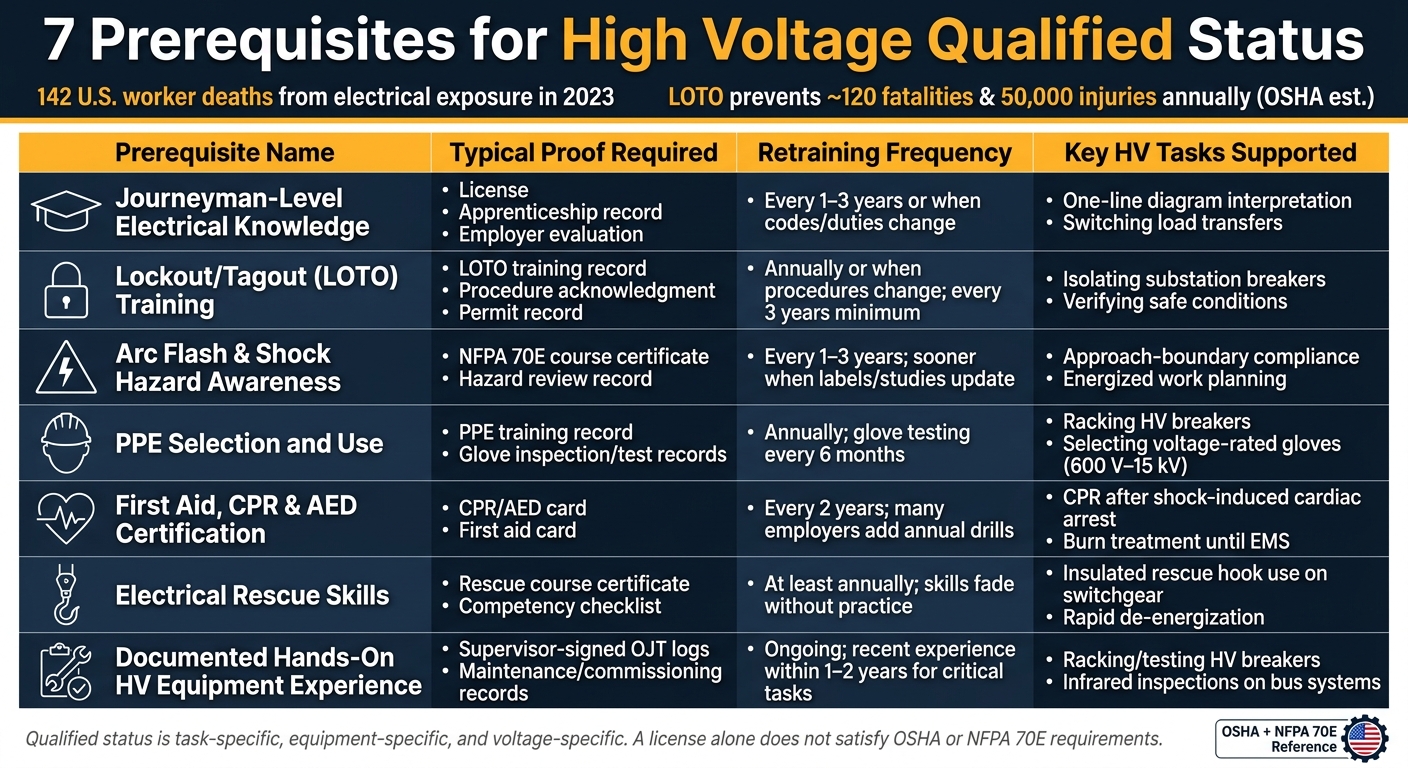
7 Prerequisites for High Voltage Qualified Status: Requirements at a Glance
How to Actually “Qualify” Your Workers in Electrical Safety
sbb-itb-501186b
Quick Comparison
| Prerequisite | What I’d check | Typical proof | When it needs review |
|---|---|---|---|
| Journeyman-level electrical knowledge | Can the worker understand the system and the assigned job? | License, apprenticeship record, employer evaluation | When codes, duties, or equipment change |
| Lockout/tagout training | Can the worker isolate, lock, tag, and verify zero energy? | LOTO training record, sign-off, procedure acknowledgment | At least every 3 years, or sooner if needed |
| Arc flash and shock hazard awareness | Can the worker spot shock and arc flash danger before starting? | NFPA 70E training record, label-reading check | Every 1–3 years, or when studies/labels change |
| PPE selection and use | Can the worker choose, inspect, and wear the right gear? | PPE training file, glove test records | Regular review; glove testing every 6 months |
| First aid, CPR, and AED certification | Can the crew respond within minutes after an incident? | Current CPR/AED and first aid cards | Usually every 2 years |
| Electrical rescue skills | Can a coworker be freed without adding another victim? | Annual rescue drill records, skill sign-off | At least yearly |
| Hands-on HV equipment experience | Has the worker done this job on this equipment under supervision? | OJT logs, supervisor sign-offs, task checklists | Keep current for the task and equipment |
Bottom line: I’d treat these seven items as a checklist, not a theory list. If one is missing, the employer’s qualification decision gets harder to support.
What 'Qualified Status' Means for High-Voltage Work
Qualified status is a documented, task-specific approval for a specific task, on specific equipment, at a specific voltage level. That distinction matters. It sets the bar for every requirement that comes next.
A license may satisfy state trade rules. But under OSHA and NFPA 70E, that alone is not enough. Qualification also calls for documented safety training, proven ability, and employer designation for the exact work. NFPA 70E is plain on this point: a licensed electrician is not automatically a qualified high-voltage worker under NFPA 70E.
The main standards here are 29 CFR 1910.147 and 29 CFR 1910.269. Under 1910.269, a qualified employee must know the equipment, understand the hazards, and have the required training.
In day-to-day work, the rules get tighter when a job moves from de-energized equipment to energized equipment. Someone approved for de-energized work is not automatically approved for energized work in the same enclosure. Energized work may call for an arc-flash assessment, justification, arc-rated PPE, and proven skill.
NFPA 70E also sets a baseline through the idea of an electrically safe work condition. That means equipment is de-energized, locked out, tested, and grounded as needed.
And qualification is not permanent. It can be limited or changed when equipment changes, procedures change, or standards are updated. Those rules set the stage for the seven prerequisites below.
1. Journeyman-Level Electrical Knowledge
Journeyman-level knowledge is the baseline for high-voltage qualified status. Before an employer can label someone as qualified for high-voltage work, that person needs a solid grounding in how high-voltage systems work and how to handle them safely.
But that baseline only counts when it’s proven on the exact equipment and exact voltage class involved. General electrical knowledge isn’t enough here. High-voltage work is less forgiving, and the details matter.
NFPA 70E and OSHA Alignment
For high-voltage tasks, the baseline needs to match the specific voltage class, the equipment in use, and the switching or maintenance work being done. That includes knowing the OSHA rules that apply - especially 29 CFR 1910.269 for power generation, transmission, and distribution - along with NFPA 70E shock and arc flash boundary requirements.
In plain terms, the worker needs training that fits the job in front of them, not just broad classroom knowledge. The standards set the floor. Field evaluation shows whether the person can use that knowledge safely on the job.
Task-Specific High-Voltage Competency
Task-specific high-voltage competency means the worker can safely perform the exact work assigned. That may include:
- Racking medium-voltage breakers
- Reading one-line diagrams and switching orders
- Verifying absence of voltage with live-dead-live testing
- Maintaining minimum approach distances
- Spotting abnormal conditions such as noise, odor, or overheating
That last point often gets missed. A worker may know the steps on paper, but can they notice when something sounds off, smells hot, or looks wrong? In high-voltage settings, that kind of judgment matters.
Documented Training or Certification
Documentation makes qualification easier to defend. If it isn’t recorded, it’s hard to prove later.
Typical records include a journeyman license, apprenticeship completion, employer high-voltage training, and vendor training for specific equipment. Workers should be retrained at least every 3 years, or sooner if equipment, procedures, or job duties change.
Demonstrated Field Proficiency
Employers also need proof from the field. A qualified supervisor should watch the worker perform specific high-voltage tasks - such as switching, lockout/tagout on high-voltage feeders, and voltage verification - and then sign off on a competency checklist tied to those exact tasks.
That evaluation should go into the worker’s training file, and the worker’s high-voltage qualified status should be tied to it. This field proof sets up the next requirement: lockout/tagout training.
2. Lockout/Tagout Training
LOTO training is required for high-voltage qualified status. In high-voltage work, qualification starts with one basic skill: isolating the exact equipment safely. OSHA estimates that lockout/tagout prevents about 120 fatalities and 50,000 injuries each year, and NIOSH found that lockout was never attempted in 58.8% of fatal incidents. The goal here is simple: steady, correct work in the field.
NFPA 70E and OSHA Alignment
Two standards shape LOTO requirements for high-voltage work.
- OSHA 29 CFR 1910.147 covers the control of hazardous energy in broad terms. It requires authorized employees to identify all energy sources, understand the hazards tied to them, and use the right isolation methods.
- OSHA 29 CFR 1910.269 adds rules for power generation, transmission, and distribution. That includes group lockout/tagout situations.
For high-voltage tasks, the worker has to isolate every energy source, release stored energy, apply locks and tags, and verify zero energy before touching the equipment. That last step matters a lot. It’s the line between shutting something down and knowing it’s safe to work on.
Task-Specific High-Voltage Competency
High-voltage LOTO can get messy fast. One job may involve multiple feeds, transformer backfeed, capacitors, and site-specific switching orders. So the worker needs to know the exact isolation points, the correct sequence, and the right verification steps for the equipment in front of them.
This isn’t about knowing LOTO as a classroom topic. It’s about applying it to the exact lineup, feeder, or transformer on site. A tag warns; only a lock physically prevents re-energization.
Documented Training or Certification
Documentation matters as much as the hands-on work. Keep training rosters, procedure acknowledgments, equipment-specific sign-offs, and practical evaluation records for the exact LOTO sequence.
NFPA 70E requires retraining at least every 3 years, and sooner if procedures change, incidents happen, or audits show performance gaps. OSHA’s enforcement numbers make the stakes pretty plain: from October 2022 through September 2023, the agency issued 2,532 citations for the LOTO standard across all industries, with penalties totaling about $20.7 million. Documentation gaps don’t just look bad on paper - they can cost a lot.
Demonstrated Field Proficiency
Supervisors should watch workers perform the full LOTO sequence in the field. That includes:
- identifying every energy source
- notifying affected personnel
- isolating the circuit
- applying locks and tags
- dissipating stored energy
- testing for absence of voltage
- confirming the equipment cannot be unexpectedly re-energized
They should also confirm that the worker can explain each isolation point, name any energized sources that still remain, and describe the test used to verify zero energy. Real proficiency means more than following steps by memory. It means doing the sequence correctly and being able to explain why each step matters.
Once isolation is verified, the next risk is shock and arc flash.
3. Arc Flash and Shock Hazard Awareness
Lockout/tagout cuts risk, but it doesn't erase it. Before anyone touches equipment, they still need to spot any leftover shock and arc-flash danger. That's what arc-flash and shock hazard awareness comes down to: seeing the hazard before the job starts. Shock doesn't just come from bare conductors, either. It can move through tools, ladders, and other conductive surfaces.
NFPA 70E and OSHA Alignment
Under NFPA 70E, a qualified person has to do more than recognize that power may be present. They must be able to tell energized parts from other equipment, determine the nominal voltage of exposed conductors, and understand how shock and arc flash boundaries are set for the task at hand.
The arc flash boundary marks the distance where incident energy reaches 1.2 cal/cm². That's the threshold for a second-degree burn. If work happens inside that boundary, the worker needs arc-rated PPE and protection matched to the task.
Task-Specific High-Voltage Competency
General awareness won't cut it here. The worker needs to know the fault current, clearing time, and incident energy at that exact location. NFPA 70E Article 130.5 says arc flash risk assessments must identify hazards, estimate severity, and document risk controls using the hierarchy of controls before work begins.
That same hazard awareness has to carry over into PPE selection. If the worker can't read the risk clearly, they can't choose the right protection.
Documented Training or Certification
Most employers keep proof on file through course records, label-reading checks, and task-specific sign-off sheets. A qualified worker should be able to read an arc flash label and pull out the key details right away:
- nominal voltage
- boundary
- incident energy or PPE category
- analysis date
Demonstrated Field Proficiency
Paper records matter, but field performance matters more. Supervisors should confirm that the worker checks labels, stays outside approach boundaries, uses test equipment the right way, and stops work when conditions change. Knowing when to stop is the real test of qualification.
4. Personal Protective Equipment Selection and Use
Once a worker can spot the hazard, the next check is simple: can they pick the right protection for the job? PPE does not replace de-energizing or LOTO. It’s there to protect workers when some risk still remains.
NFPA 70E and OSHA Alignment
NFPA 70E links PPE selection to the task’s arc-flash risk, voltage level, and work conditions. That means employers have to make sure workers can choose and use the right arc-rated clothing, face protection, gloves, and insulating tools for the work at hand.
OSHA takes a similar view. It relies on NFPA 70E as a recognized consensus standard and requires employers to provide proper PPE and insulating tools when energized work is justified. In medium- and high-voltage work, getting PPE wrong can be fatal. That’s why employers treat correct PPE selection as a required skill, not just a box to check.
Task-Specific High-Voltage Competency
PPE has to fit the task. It follows the hazard assessment from the previous step, and the required protection comes from the arc-flash study. In plain terms, PPE selection must line up with the study’s findings: fault current, clearing time, and working distance set the level of protection needed.
This isn’t guesswork. A worker can’t just grab any arc-rated shirt and call it good. The full setup has to match the actual exposure tied to that specific job.
Documented Training or Certification
Employers usually keep records that show:
- training dates
- topics covered
- competency checks
- glove inspection and test records
Rubber insulating gloves must be tested before first issue, every 6 months after that, and any time there’s reason to doubt the insulation.
Demonstrated Field Proficiency
Qualified workers have to show they can inspect PPE, choose the right ensemble, and wear it the right way before they start the job. Qualified status means the full ensemble is in place, not just one arc-rated garment.
When PPE is chosen and worn the right way, the next layer of qualification is knowing how to respond if a shock or arc-flash event still happens.
5. First Aid, CPR, and AED Certification
High-voltage incidents can still happen. That’s why first aid, CPR, and AED training belongs in every qualification file. This is the response layer after shock or arc-flash exposure. Put simply: it covers what happens when prevention fails.
NFPA 70E and OSHA Alignment
NFPA 70E requires first aid, CPR, and AED training for designated responders, and OSHA 1910.269 requires trained responders within about 4 minutes at fixed locations.
Documented Training or Certification
Most employers want current CPR/AED and first aid cards from a nationally recognized provider. Those records usually need to show:
- course type
- completion date
- expiration date
Recertification is usually required every 2 years. Many employers also ask for annual hands-on CPR and AED drills, with sign-off from a qualified instructor. Those records should stay in the qualification file.
Demonstrated Field Proficiency
A card alone doesn’t prove someone can act well in a live event. Workers also need to perform under pressure, when seconds matter.
Employers often check this through scenario-based drills. For example, they may simulate an arc flash event in a substation where a crew member must confirm de-energization, start CPR, and deploy an AED within a target timeframe. This training covers medical response, not confined-space rescue or equipment removal.
The sequence matters. Training that stresses de-energize first, call 911, then start CPR and use the AED lines up with NFPA 70E priorities.
Once emergency response is covered, the next requirement is being able to rescue a coworker without creating new exposure.
6. Electrical Rescue Skills
Electrical rescue is its own qualification. It calls for specific training and the right tools. And it’s different from knowing how to work near high voltage in the first place. If a coworker makes contact with energized parts, the response has to be fast, controlled, and practiced.
NFPA 70E and OSHA Alignment
NFPA 70E says employees exposed to shock hazards, along with anyone expected to free a victim from energized parts, must be trained in safe release methods. That training has to be refreshed at least once a year.
OSHA’s 29 CFR 1910.269 adds another layer. For field work where employees face exposure to 50 V or more, at least two trained workers must be on site so one can give aid if the other is hurt. After rescue procedures are set, employers need to confirm that the worker can carry them out on the actual equipment.
Task-Specific High-Voltage Competency
Rescue methods need to fit the equipment in front of you. A rescue plan that works for one setup may fall apart on another.
For switchgear and substation work, that usually means:
- Insulated rescue hooks
- Hot sticks
- Nonconductive mats or platforms
- Rated voltage detectors to confirm absence of voltage
For overhead line crews, training should cover pole-top rescue methods and safe approach distances. When voltages go above 600 V, the guidance puts de-energizing first. If that can’t happen right away, rescue has to be done with the proper insulated tools and PPE.
Documented Training or Certification
Most employers keep internal logs for electrical rescue training. Those records should show annual contact-release training, the curriculum used, and a competency sign-off linked to NFPA 70E emergency-response rules.
Crew rosters at each high-voltage job site should also show that rescue-qualified personnel are present. On paper, that sounds simple. In practice, it matters a lot when crews shift, contractors rotate in, or work moves across locations.
Demonstrated Field Proficiency
A training record alone doesn’t show that someone can perform a rescue. NFPA 70E expects workers to demonstrate rescue skills, not just sit through a course.
Good drills use realistic scenarios. That can include removing a mannequin from contact with energized switchgear, carrying out rapid de-energization, verifying absence of voltage, and then moving straight into CPR once the victim is clear. Performance is often checked against a written list covering PPE selection, tool use, disconnect operation, and the medical response sequence.
Run drills every year and again after equipment or procedures change. That field check connects straight to documented hands-on experience with the actual equipment being used.
7. Documented Hands-On High-Voltage Equipment Experience
Classroom training gets someone started. But it doesn't prove they can work on high-voltage equipment in the field. That proof comes from supervised, hands-on work on the actual equipment.
NFPA 70E and OSHA Alignment
NFPA 70E and OSHA both require more than attendance in a class. A worker must show skill, complete safety training, and have that proficiency documented before the employer can treat them as qualified.
Task-Specific High-Voltage Competency
This part is very specific. Workers need to show they can perform the exact tasks they'll handle on the exact equipment they'll touch. It's not enough to know the theory or to practice on something similar.
Many programs also expect a long runway before full high-voltage qualified status is even considered. In many cases, that means at least one to two years of supervised hands-on experience.
Documented Training or Certification
The paperwork needs to go beyond a completion card. One file should include the training provider, course title, equipment type, practical exercises, dates, and evaluation results. Employers should also keep signed field evaluations and hands-on work logs for each worker.
Demonstrated Field Proficiency
A signed training form is not the same thing as proven ability in the field. OSHA is explicit: proficiency must be observed and documented before training is considered complete.
A standard checklist helps keep that process clear and consistent. It should show:
- Task
- Voltage
- Equipment
- PPE
- Errors
- Pass/fail result
- Evaluator signature
- Date
The comparison below shows how the seven prerequisites differ in purpose and evidence.
Side-by-Side Comparison of the 7 Prerequisites
Use this comparison to line up each prerequisite with the proof employers keep on file for a given task and voltage level. The table below shows the seven prerequisites, why each one matters, what proof is usually kept, and where it tends to apply.
| Prerequisite | Why It Matters | Typical Proof of Completion | Retraining / Renewal | Examples of HV Tasks Supported |
|---|---|---|---|---|
| Journeyman-level electrical knowledge | Builds the knowledge needed to work safely on the assigned equipment and voltage level. | Journeyman license, apprenticeship certificate, internal competency assessment. | License renewal and continuing education every 1–3 years, or when code changes. | Interpreting one-line diagrams; switching load transfers. |
| Lockout/Tagout training | Prevents unexpected energization and stored-energy release during maintenance. | LOTO training certificate, signed procedure acknowledgment, permit record. | Annual or when procedures change; sooner after incidents or observed gaps. | Isolating substation breakers; verifying safe condition before work. |
| Arc flash and shock hazard awareness | Lets workers set approach boundaries, read arc flash labels, and choose safe work methods. | NFPA 70E course certificate, hazard review record, job briefing record. | Every 1–3 years; sooner when risk assessments or labels are updated. | Approach-boundary compliance; energized work planning. |
| PPE selection and use | Cuts injury severity through task-matched arc-rated clothing, gloves, face protection, and hearing protection. | PPE training record and inspection records. | At least annually; refresh when PPE types or standards change. | Racking HV breakers; selecting voltage-rated gloves for 600 V–15 kV tasks. |
| First Aid, CPR, and AED certification | Supports immediate, life-saving medical response after electrical shock or cardiac arrest. | CPR/AED card and first aid card. | Every 2 years per certifying body; many employers add annual drills. | CPR after shock-induced cardiac arrest; treating burns until EMS arrives. |
| Electrical rescue skills | Lets a worker remove a victim from an energized area with insulated rescue tools, without creating another casualty. | Rescue course certificate and competency checklist. | At least annual hands-on drills; skills fade fast without practice. | Insulated rescue hook use on switchgear floor; rapid de-energization sequence. |
| Documented hands-on HV equipment experience | Confirms the worker can perform the assigned task on the assigned equipment under supervision. | Supervisor-signed OJT logs, maintenance reports, commissioning records. | Ongoing; recent experience, usually within 1–2 years, for critical tasks. | Racking and testing HV breakers; infrared inspections on bus systems. |
One point matters across the whole table: renewal timing can change by employer and jurisdiction. A card or record helps, but it doesn't prove someone is ready on its own. Employers still need to show the worker can do the assigned task safely, on the actual equipment involved.
The next section lists the records employers usually keep in the qualification file.
Records and Documentation Employers Typically Require
The table above lists the seven prerequisites. This section covers the records that prove a worker meets them. For high-voltage work, employers usually keep a qualification file with training records, certifications, and task evaluations. That file shows task-specific qualification.
Each worker’s file should include apprenticeship completion certificates, journeyman licenses, state or union cards, and notes on the job tasks and voltage levels the person has handled before. In plain terms, employers want more than a title on paper. They want a record that shows what the worker has actually done.
Lockout/tagout records should include:
- Employee name
- Training date in MM/DD/YYYY format
- Topics covered
- Trainer name and qualifications
- Whether the worker is authorized under 29 CFR 1910.147(c)(7)
Arc flash training certificates should list the worker’s qualification level, approved voltage levels, training hours, completion date, renewal date, and certificate ID. CPR and AED cards should show the employee’s name, course type, completion date, renewal date, provider, and instructor ID.
Equipment records matter too. Employers should track each item, including rubber insulating gloves, arc-rated clothing, and face shields, by type, arc rating, serial or batch number, issue date, inspection findings, and retirement date.
When it comes to hands-on experience, supervisor or qualified-person sign-offs often carry the most weight. A simple checkbox isn’t enough. The record should name the exact equipment, voltage level, date, and include a written assessment of competence. Rescue drill records should also be specific, with the date, scenario, equipment, participants, and evaluator comments for each drill. Those details help back up the qualification decision.
Keep one dated qualification folder for each worker, whether it’s digital or on paper. The file should have clearly dated sections for training, certifications, task sign-offs, and expiration tracking. Update it each time training expires or a worker is signed off on new equipment.
Conclusion
High-voltage qualified status can't be proven by a single certificate. OSHA and NFPA 70E define a qualified worker as someone who has received training and has shown the skills and knowledge to spot and control electrical hazards - not just someone who sat through a class. That gap matters because high-voltage mistakes can turn fatal fast.
Taken together, these seven prerequisites work as a set. Miss one, and the whole qualification gets weaker.
Use this seven-point list as a qualification checklist, not just a conceptual list. Audit each worker against all seven criteria, then fix any training or record gaps with refresher training and updated sign-offs.
FAQs
Who determines high-voltage qualified status?
The employer decides who counts as high-voltage qualified. OSHA and NFPA 70E lay out the rules, but it’s still up to the employer to confirm that a worker has the right skills and knowledge for the exact high-voltage work involved.
In most cases, that means documented, task-specific training paired with hands-on field evaluations by qualified personnel, such as a supervisor or another competent assessor.
Does a journeyman license make me qualified?
No. A journeyman license by itself does not make you qualified.
Under OSHA and NFPA 70E, qualification is task-specific. That means a person needs proven skills and knowledge for the exact high-voltage work they’re doing. A license, training certificate, or job title isn’t enough on its own. It does not replace documented practical evaluations and hands-on field assessments.
How often should high-voltage qualifications be reviewed?
High-voltage qualifications and training aren't one-and-done. They need regular review to keep people safe and keep your program in line with current rules.
NFPA 70E is updated every three years, so training can't just sit on the shelf. OSHA also requires retraining for certain tasks performed less than once a year.
In practice, competency rechecks are often done every one to three years. The assessment framework should be reviewed once a year or any time there's a near-miss, an incident, a standards update, or a new project type.





