HV Installer Competency Assessment Guide
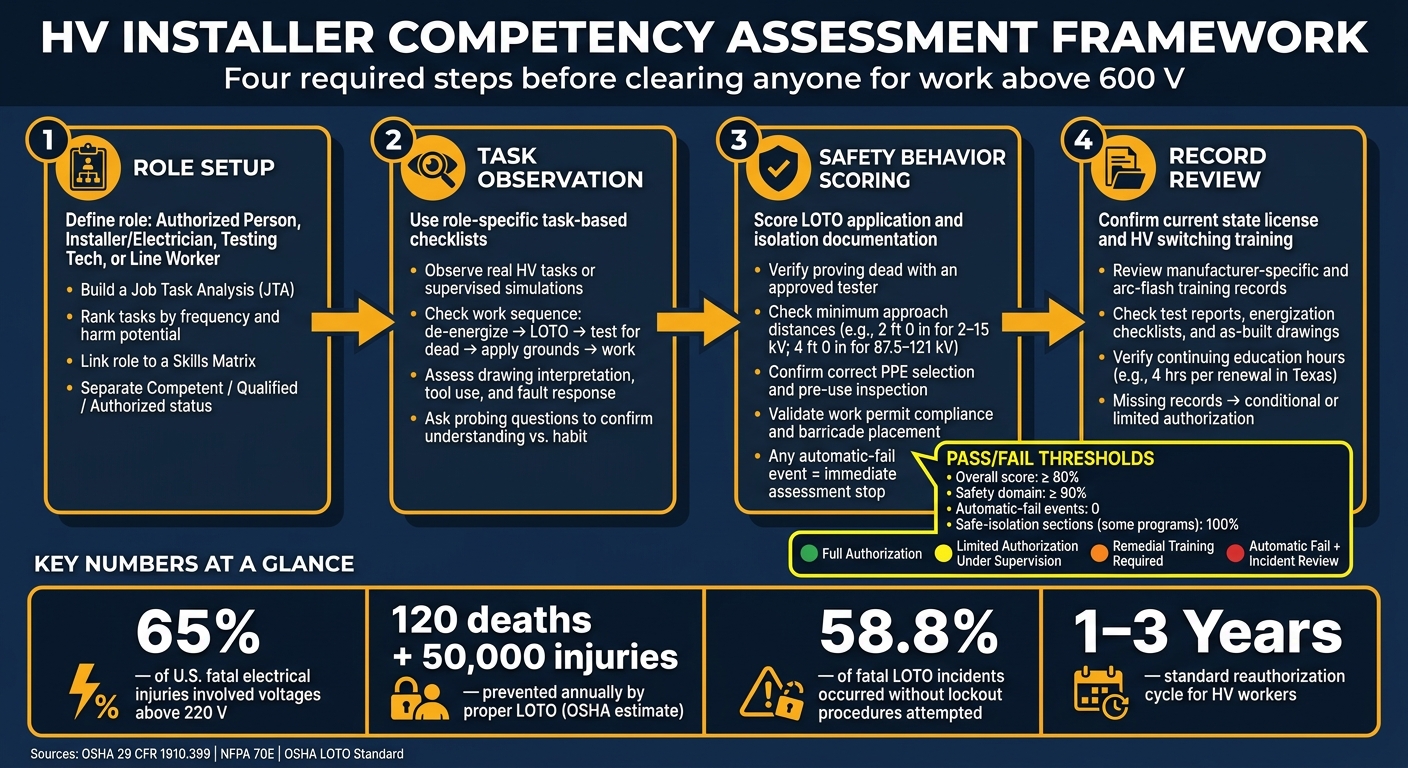
If you let someone work on HV gear without a task-based check, you are guessing with high-risk work. This guide shows me that a solid assessment needs four parts: role setup, task observation, safety checks, and record review before any person is cleared for work above 600 V.
Here’s the short version:
- I define the role first: authorized person, installer/electrician, testing tech, or line worker
- I match that role to a skills matrix and task list
- I watch the person do actual HV tasks or supervised drills
- I score safety actions like LOTO, proving dead, PPE, approach distance, and permit use
- I review licenses, training, test records, and job documents
- I use clear pass/fail rules, with some safety errors causing an instant stop
- I record the result and tie it to what work the person may do, under what level of supervision, and until what date
A few numbers make the point fast:
- 65% of direct fatal electrical injuries in the U.S. involved voltages above 220 V
- Proper LOTO helps prevent about 120 deaths and 50,000 injuries each year
- A common clearance mark is 80% overall, 90% in safety, and 0 automatic-fail events
- Rechecks are often done every 1 to 3 years
What matters most is simple: years on the job are not enough. I need proof that a worker can do a given HV task the right way, follow the safety steps every time, and back it up with current records.
That is the core of this guide.
HV Installer Competency Assessment: 4-Step Framework
High Voltage Safety Training – 6-Hour Certified Course for MV/HV Electrical Professionals
sbb-itb-501186b
Build the Competency Framework Before Testing Anyone
Start with a job task analysis (JTA). List each HV task, rank it by how often it happens and how much harm a mistake could cause, then use that work to build your skills matrix. Low-risk tasks that rarely come up can move down the list. High-risk work - like establishing electrically safe work conditions or doing medium-voltage cable terminations - belongs at the top.
This keeps your assessments tied to the work people do in the field, not to vague ideas about experience. The matrix then becomes the working checklist for task reviews, field observation, and pass/fail scoring.
Define Role Requirements With a Skills Matrix
A skills matrix links each HV role to the competencies needed to do that job safely and correctly. For HV installation work, that includes technical ability, safety knowledge, documentation duties, and how much supervision a person needs before working on their own. OSHA requires demonstrated skill and knowledge. NFPA 70E treats qualification as task-specific.
The table below shows an illustrative example of how that can look in practice.
| Role | Typical Tasks | Min. Experience | Required Training | Supervision Level |
|---|---|---|---|---|
| HV Cable Splicer | Splicing/terminating 5–35 kV cables; insulation resistance tests | 3 years cable work, 1+ year above 600 V | NFPA 70E qualified-person training; arc-flash PPE; lockout/tagout | Direct or limited supervision until fully qualified |
| Substation Installer | Transformer/buswork installation; protection wiring; work near equipment >600 V | 4–5 years HV substation construction | OSHA Subpart V; NFPA 70E arc-flash risk assessment; approach boundaries | Supervised by an experienced foreman; independent only when qualified |
| HV Installation Supervisor | Directing installation crews; reviewing design drawings; overseeing grounding and termination work | 5+ years HV installation | Advanced NFPA 70E; energized work permits; job briefing procedures | May supervise others; holds qualified and authorized status |
Proficiency levels in these matrices often use a 4-point scale: awareness, basic, independent, and expert. For HV work, task access usually starts at level 3 or 4. In many cases, a person also needs formal licenses or certification before independent work is allowed.
Separate Competent, Qualified, and Authorized Status
These terms need to stay clear. Competent refers to general capability. Qualified means task-specific capability. Authorized means the company has given permission.
That distinction matters. Someone can be competent in general electrical work and still not be qualified under OSHA or NFPA 70E to work on exposed energized parts. On the flip side, being qualified does not automatically mean the company lets that person issue switching orders or approve energized work permits.
The table below shows how each status is defined, which standard shapes it, and what records support it.
| Status | Definition | Standard | Documentation |
|---|---|---|---|
| Competent | Basic training and experience; can perform routine tasks under supervision; understands general hazards | General industry practice | Trade certificates; basic safety training records; supervisor sign-offs |
| Qualified | Demonstrated skills and knowledge for specific HV tasks; trained to recognize shock and arc-flash hazards; understands approach boundaries | OSHA 29 CFR 1910.399; NFPA 70E | Task-specific training records; practical field evaluations; refresher training logs |
| Authorized | Company permission to perform or control defined HV tasks (e.g., issuing switching orders, approving energized work permits) | Internal company policy, built on top of qualified status | Written appointment letters; authorized persons list; scope-specific authorization records |
One detail is easy to miss, but it matters a lot: OSHA updated its qualified person definition in 2007 to put the focus on demonstrated skills, not just job title or years of experience. In plain English, that means a training certificate by itself is not enough. You need a practical evaluation on record.
With those definitions in place, the next step is to test the work itself.
Assess Technical Ability Through Task Reviews and Field Observation
Written tests show what someone knows. Task reviews show how they work. In HV installation, that means checking the work sequence, the use of HV-rated tools and test gear, and whether the installer follows drawings and OEM instructions.
Use Task-Based Checklists for Core HV Installation Work
Use the role-specific skills matrix to keep each checklist focused on the steps that matter for that task. Each major HV installation task should have its own checklist built around steps an assessor can see and verify. A generic checklist falls apart fast here. The checks for a cable termination are not the same as the checks for a transformer tap setting.
For HV cable installation and terminations, confirm the right cable type and size per drawings, the required bending radius, correct insulation prep, and stress cones and heat-shrink boots assembled without damage. Check that bolted lugs are torqued to OEM values with a calibrated torque wrench, and that insulation resistance or sheath testing is finished before sign-off.
For switchgear and breaker installation, confirm equipment placement against approved drawings, phase-to-phase and phase-to-ground clearances, documented busbar torque values, and tested interlock operation and contact resistance. Record contact resistance against the project acceptance limit.
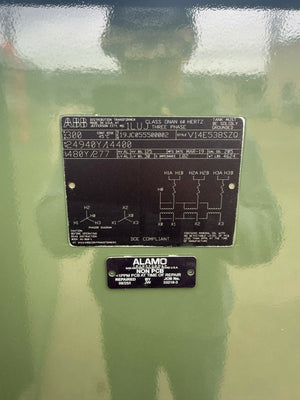
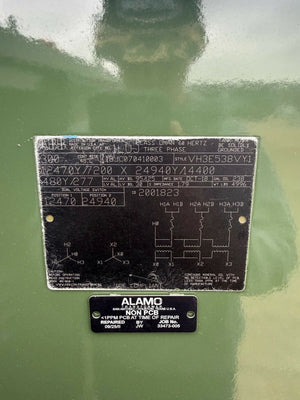
For transformer connections and tap settings, confirm that the installer identifies HV/LV terminals from the nameplate, sets taps on all phases to the design value, and torques tap hardware to OEM values before energization.
For grounding systems, assessors should check conductor sizing, connector quality, and continuity and ground-resistance test results.
Each checklist item should spell out the criterion in plain terms, such as Torque per OEM spec or Clearance ≥ X inches. It should also show how the assessor will verify it - visual check, measurement, or test - and the pass/fail threshold.
Score each task against the same observable criteria so results stay comparable across workers.
Observe Work in the Field or in Supervised Simulations
Before the observation starts, review the work package, drawings, permits, and risk assessment. Then watch four things closely:
- How the installer reads and interprets drawings before starting
- Whether they follow the right work sequence, including de-energize, lockout/tagout, test for absence of voltage, apply grounds, and then work
- Whether they choose and use tools the right way
- How they respond to simulated faults or abnormal conditions
To keep the process practical and avoid dragging down the project schedule, firms usually observe one or two representative tasks, such as a few terminations or one switchgear section, instead of the whole installation. That is often enough to see whether the installer has good sequencing discipline and solid tool handling.
When live field access is limited, or when someone is moving from low-voltage work into medium- or high-voltage work, supervised simulations can close the gap. Mock switching exercises on de-energized training boards show whether the installer follows the written switching program, communicates the right way with the control center, and responds the right way to simulated faults or abnormal conditions. Permit-to-work drills check whether the installer can complete isolation, lockout/tagout, and grounding documents for a sample job. Assessors then verify whether the installer understands the permit boundaries and their own duties under that permit.
The table below maps common HV tasks to the competencies being assessed and shows when direct supervision is required.
| HV Task | Knowledge Assessed | Practical Skill Assessed | Safety Behavior Assessed | Direct Supervision Required? |
|---|---|---|---|---|
| HV cable installation & terminations | Cable ratings, bending radius, stress grading, OEM instructions | Stripping, crimping, torqueing lugs, insulation resistance testing | Lockout/tagout, test for dead, PPE, control of conductive tools | Yes - until competence is documented; spot checks after sign-off |
| Switchgear & breaker installation | Equipment ratings, short-circuit ratings, interlock schemes, clearance requirements | Alignment, busbar connections, CT/PT wiring, functional checks | Arc-flash boundaries, racking procedures, controlled compartment access | Direct for initial or complex installations; reduced after sign-off |
| Transformer connections & tap settings | Winding configurations, nameplate interpretation, tap-changer operation | Making terminations, setting taps per design, polarity and rotation checks | Clearances around oil-filled units, control of ignition sources | Direct for first-time tap setting and energization; periodic audit after |
| Grounding system installation | Grounding design principles, conductor sizing, bonding requirements | Installing conductors, exothermic welding, continuity and resistance testing | Recognizing step and touch potential risks, maintaining site controls | Direct for complex or high-fault-current systems; spot checks for routine work |
Pair observation with a few short questions to check that the installer understands the job, not just the sequence. Ask why they used a certain torque value, or what they would do if a cable tag did not match the drawing. Questions like that make it easier to tell whether solid performance comes from real understanding or simple habit.
Evaluate Safety Behavior, Paperwork, and Pass or Fail Criteria
After you observe the task, score safety behavior and records before you grant authorization. Technical skill alone doesn't cut it. If an HV installer is going to work without direct oversight, safety habits and paperwork matter just as much.
Check Safety-Critical Behaviors During Field Assessment
During the field assessment, score only safety-critical actions and treat any automatic fail as final. The actions that carry pass/fail weight are lockout/tagout, proper isolation, proving equipment is de-energized with an approved tester, correct system voltage identification, keeping the right minimum approach distances, PPE choice and pre-use inspection, barricade and signage placement, and following the work permit and switching process.
These items carry that weight for a reason. LOTO failures still cause serious injuries and deaths. OSHA estimates that proper LOTO prevents about 120 worker fatalities and 50,000 injuries each year in the United States. On top of that, lockout procedures were not attempted in at least 58.8% of fatal incidents analyzed.
Use the same role-based checklist from the technical observation stage. That keeps the scoring consistent and makes it easier to spot a gap that can't be brushed aside. Here's how common field behaviors should be classified:
| Behavior | Acceptable Practice | Deficiency | Automatic Fail |
|---|---|---|---|
| Lockout/Tagout | Personal LOTO device applied, and isolation points documented on the switching sheet | Incomplete tagging or unclear documentation, corrected after coaching | Working without LOTO applied, or removing another worker's lock |
| Proving de-energized | Meter tested before and after use, zero energy confirmed and recorded | Hesitation about procedure, corrected with prompting | Working on presumed de-energized equipment without verification |
| Minimum approach distance | Boundaries identified and respected throughout the task | Momentary boundary uncertainty, corrected before entry | Entering the restricted approach boundary without appropriate PPE |
| PPE selection and inspection | Correct voltage and arc-flash rating chosen; glove air test and face shield check completed | Minor inspection step missed, with no defective gear used | Defective PPE used, or PPE omitted within the approach boundary |
| Barricades and signage | Arc-flash and approach boundaries marked; signs specify voltage, hazard, and access rules | Barriers placed slightly off distance, corrected before work begins | No barriers or signage in place around energized or potentially energized equipment |
| Work-permit compliance | Permit valid for date, location, and task; job briefing documented | Missing one approval signature, resolved before work proceeds | Work performed outside permit scope or without an active permit |
Approach distance rules also need to be checked against OSHA guidance. For unqualified personnel, the minimum distance is 10 ft. For qualified workers, the distance changes by voltage. For example, it's 2 ft 0 in for systems above 2 kV up to 15 kV, and 4 ft 0 in for systems above 87.5 kV up to 121 kV.
Review Licenses, Training Records, and Job Documents
Once field behavior is scored, check whether the paperwork supports the same result. Confirm current state license status, HV switching training, manufacturer-specific training, and current test and energization records. If records are missing, authorization should be limited.
Licenses and continuing education need close review too. Texas requires most electrician license types to complete 4 hours of continuing education for each renewal. That must cover NEC, state law, and NFPA 70E safety content, and proof must be kept for at least one year. New Hampshire requires NEC update training within 12 months of each new code edition. If that doesn't happen, the license becomes invalid until the missing hours are completed. That isn't just box-checking. Eighty percent of workers injured in LOTO-related incidents had not received proper training.
Go beyond the license card. Review switching paperwork for accuracy, as-built drawings for completeness, test reports for recorded results and anomalies, and energization checklists for all required sign-offs. Missing or outdated records often lead to conditional authorization, limited authorization, or a full fail on documentation competency.
Set Scoring Rules and Actions After a Pass or Fail Result
A practical scoring split is:
- Safety: 40% to 50%
- Technical execution: 30% to 40%
- Documentation: 20% to 30%
Automatic-fail items sit outside the numeric score. If one happens, the assessment stops, even if everything else looked fine.
A common threshold for full authorization is 80% overall, with at least 90% in the safety domain and zero automatic-fail events. Some formal competency programs require a 100% pass mark for safe-isolation sections because there is no room for error in proving-dead steps.
Outcomes usually fall into four categories:
- Full authorization: All thresholds met, with current licenses and training. This applies only to tasks listed in the skills matrix, with reauthorization every one to three years.
- Limited authorization under supervision: Technical ability is acceptable, but there are paperwork gaps or minor safety issues. The installer may perform defined tasks under direct supervision while a fully authorized person leads switching and energization.
- Remedial training required: Scores fall below the threshold, or minor deficiencies show up more than once. Assign focused training such as HV safety, switching procedures, or arc-flash PPE, then set reassessment within 30 to 90 days.
- Automatic fail with incident review: A critical safety violation ends the assessment on the spot. The installer is removed from HV work until the review, corrective action, and documented retraining are finished.
Document every result in a signed assessment report stored in the competency system, ready for OSHA inspections or client safety reviews. The report should list the task scope, checklist scores, reviewed documents with expiration dates, final authorization status, and next reassessment date. After that, debrief the installer on the result, any retraining needed, and the reassessment date. Then record the outcome and use it to set task scope and the next review date.
Conclusion: Turn the Assessment Into a Repeatable Company Process
Treat HV competency assessment as a standing control, not a one-time gate. It works when role requirements, task review, field observation, and document review are written down and used the same way across sites and assessors. And that control has to connect to work assignment, not sit in a file after the job is already handed out.
Make assessment part of the work-assignment gate, not an after-the-fact formality. Build it into onboarding, role changes, and scheduled reauthorization. Then track results in a central competency register before any HV assignment.
Assessors need alignment too. Use version-controlled templates, train assessors to apply the criteria the same way, and run periodic scoring alignment sessions. Update the framework on a set review cycle - usually once a year, and again after a near-miss, incident, standards update, or a new project type. Record effective dates on every revision so the audit trail stays clear and defensible.
For simulated evaluations, realism matters. In training bays and equipment-ID drills, use real de-energized switchgear, transformers, breakers, and disconnects. That way, candidates work from actual labels, layouts, and manuals. It’s much closer to the job they’ll face in the field, and it makes the final authorization decision easier to defend.
A repeatable assessment process strengthens OSHA readiness, client audit readiness, and role clarity. It also gives supervisors something they can use right away: a current authorization record tied to who can do what.
FAQs
Who should assess HV installers?
HV installers should be assessed by qualified personnel who are responsible for safety, quality, and technical standards. In most cases, that means a Qualified Supervisor or another competent assessor. When needed, certified third-party testing teams should also be involved.
The assessment should look at more than a checklist. Assessors should review:
- Technician authorization or certification
- Safety records
- Instrument calibration traceability
- Field evidence, such as workmanship observations and pass/fail results
That gives you a clearer picture of whether an installer can do the work safely and to the right standard.
What tasks should be observed first?
Start with a visual inspection. Before any live testing or technical procedures, the candidate should look over the equipment for visible damage, like loose connections, scorch marks, or damaged insulation.
Then watch for safety-critical actions, including proper PPE use and following lockout/tagout (LOTO) procedures.
What causes an automatic fail?
In high-voltage assessments, an automatic fail usually means safety, compliance, or equipment integrity has been compromised.
Common triggers include:
- Electrical breakdown or flashover
- Smoke
- Physical damage
- Missing or broken grounding
- Exposed live parts
- Bypassed interlocks
- An absent nameplate
- Missing test records
- Mismatched nameplate data
- Failure to isolate circuits properly