7 Causes of GFCI Nuisance Tripping
If a GFCI keeps tripping, the cause is usually one of seven things: moisture, a shared neutral, line/load wiring errors, leakage from an appliance, a long extension cord, a worn receptacle, or a failing breaker.
I’d start with the fastest checks first: unplug everything, press TEST and RESET, and see whether the device trips only when it’s wet, only with one appliance, or even with no load at all. Since most GFCIs trip around 4 mA to 6 mA of ground-fault current, even a small leak can set one off.
Here’s the short version:
- Trips after rain, steam, or washdown: look for moisture
- Trips when another circuit turns on: check for a shared neutral on an MWBC
- Won’t reset after installation: check LINE vs. LOAD
- Trips with one tool or appliance: suspect equipment leakage
- Trips only with a 50 ft to 100 ft cord: look at the cord run
- Trips with nothing plugged in: the GFCI receptacle may be worn out
- Breaker trips at random with no clear fault: the GFCI breaker may be near end of life
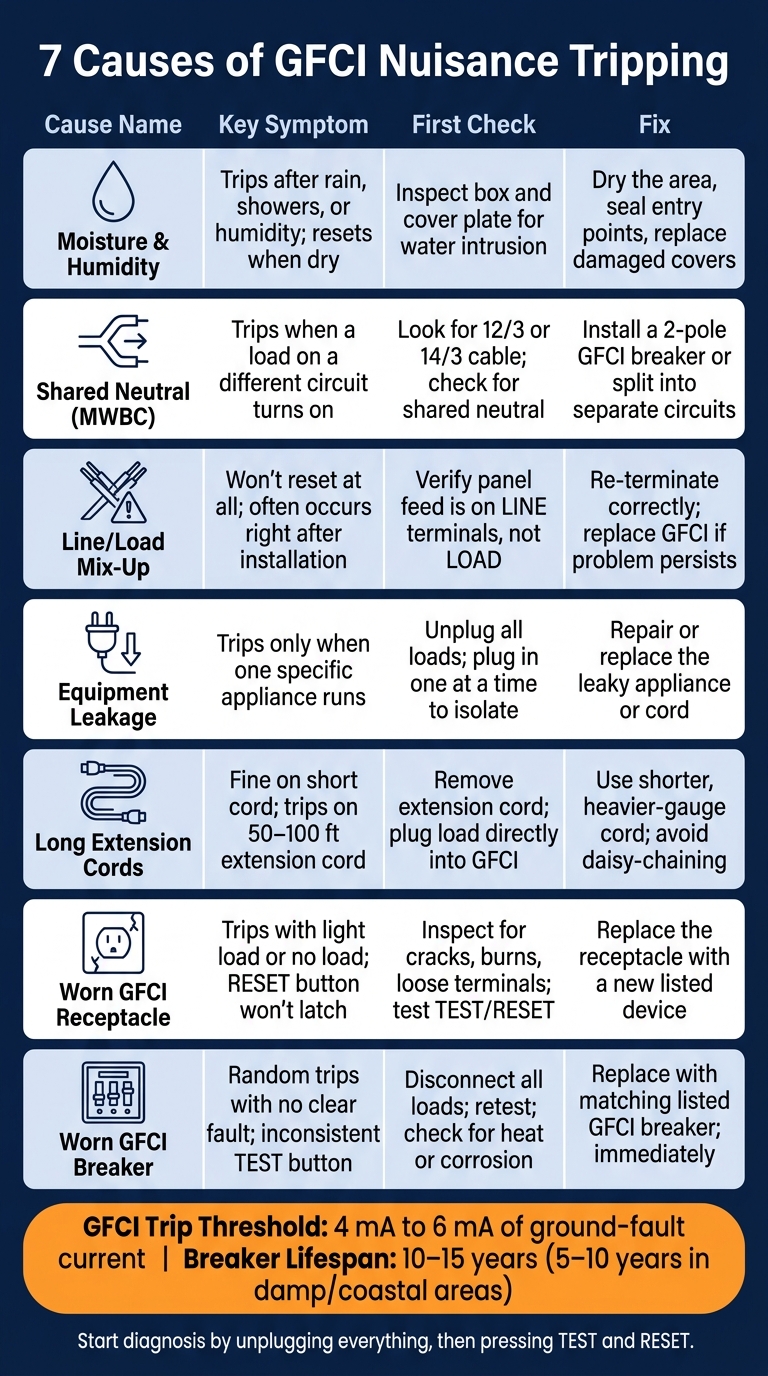
7 Causes of GFCI Nuisance Tripping: Symptoms & Fixes
Troubleshoot a Tripping GFCI Ground Fault Circuit Interrupter
sbb-itb-501186b
Quick Comparison
| Cause | Common sign | First thing I’d check |
|---|---|---|
| Moisture | Trips after rain, showers, or humidity | Dry the outlet and inspect for water entry |
| Shared neutral | Trips when a load on another circuit turns on | Check for MWBC wiring and shared neutral setup |
| Line/load mix-up | Won’t reset, often after replacement | Verify feed is on LINE |
| Equipment leakage | Trips with one appliance or tool | Plug in loads one at a time |
| Long cords | Fine on short cord, trips on long cord | Remove the extension cord |
| Worn receptacle | Trips with light load or no load | Test TEST/RESET and inspect for damage |
| Worn breaker | Random trips at the panel | Disconnect loads and retest |
If I had to narrow it down fast, I’d use the symptom pattern first, because it usually points to the right fix without guessing.
Quick Troubleshooting Checklist
Start with the GFCI’s Test and Reset buttons. This quick check helps you tell the difference between a simple device problem and something tied to wiring, connected devices, or moisture.
- Press Test. The GFCI should trip.
- Press Reset. Power should come back to the GFCI and any downstream outlets.
- If it won’t reset, check the circuit breaker that feeds the GFCI.
If it trips the way it should but still won’t reset, move on to wiring, load, and moisture checks.
1. Moisture and Humidity in GFCI Locations
Bathrooms, kitchens, garages, basements, and outdoor outlets are common problem areas because they deal with steam, splashes, and condensation all the time.
Typical Field Symptom
This pattern shows up again and again: the GFCI trips during or after rain, showers, dishwashing, mopping, or a garage washdown, then resets once the area dries out. Outdoor receptacles that trip overnight and won’t reset until mid-morning are often reacting to condensation.
Why the GFCI Trips
Moisture can create a path to ground through a metal box, wet concrete, damp masonry, or dirty residue on plugs and receptacles. That ground leakage throws the circuit out of balance and trips the device.
First Check
Start simple. Unplug everything connected to the outlet, reset the GFCI, and plug devices back in one at a time. If the GFCI trips when one cord or appliance goes back in, inspect that item for moisture or damaged insulation.
Repair vs. Replacement Trigger
Dry the box and fix the point where water is getting in. That might mean replacing a torn gasket, resealing a conduit entry, or swapping out a damaged cord.
Replace the device if it won’t reset when dry and unloaded, shows corrosion or staining, or fails the TEST button.
If the GFCI resets when dry but still trips under load, check for shared neutrals next.
2. Shared Neutrals on Multi-Wire Branch Circuits
A multi-wire branch circuit (MWBC) uses two hot conductors on opposite phases of the panel and one shared neutral. That setup is allowed when it’s wired the right way. But it can turn into a nuisance-tripping mess if someone puts a standard single-pole GFCI receptacle or breaker on one leg and ignores the shared neutral.
Typical Field Symptom
One of the clearest signs is a GFCI that trips when a load on the other leg switches on or off. A nearby light comes on, the garbage disposal kicks in, or another load gets energized, and the GFCI drops.
That’s the clue. The receptacle may look fine when you test it by itself, but if the trip tracks with activity on a different breaker instead of something plugged into the GFCI, suspect a shared neutral first. That pattern points to the wiring, not the device.
Why the GFCI Trips
Here’s the issue in plain English: on an MWBC, return current from the other hot leg can use the shared neutral outside the GFCI’s sensing path. The GFCI sees current leaving on the hot but not all of it coming back through the path it monitors, so it reads that as an imbalance and trips.
First Diagnostic Check
Start simple. Disconnect the load conductors, cap the disconnected conductors, and then try resetting the device with only the LINE side connected. If it holds, the problem is downstream, often a shared neutral or a miswired neutral bundle.
Also look for 12/3 or 14/3 cable feeding the circuit. Then check for about 240 V between the two hots and confirm that they land on opposite legs with a 2-pole breaker or handle-tied breakers.
Repair vs. Replacement Trigger
Swapping in a new GFCI won’t fix a shared-neutral problem. The wiring has to be corrected first.
The usual fixes are:
- Install a 2-pole GFCI breaker listed for MWBC use so it monitors both hots and the shared neutral together
- Split the MWBC into two separate circuits with dedicated neutrals and protect each one with its own single-pole GFCI
Correct the wiring first, then think about device replacement only after the load conductors are disconnected and the line wiring checks out.
If the wiring is correct and the GFCI still trips, check for a line-load mix-up next.
3. Line-Load Mix-Ups and Wiring Errors
Every GFCI receptacle has LINE for the incoming feed and LOAD for downstream protection. Mixing those up is one of the most common wiring mistakes. And it can do two things: stop the device from resetting or leave downstream outlets without protection. If you've already ruled out moisture and shared neutrals, this is the next thing to check.
Typical Field Symptom
The most obvious signs are pretty consistent. The GFCI won't reset at all, it trips the second you press RESET even when nothing is plugged in, or the receptacle itself has power while every outlet downstream is dead or not protected. In many cases, this starts right after installation or after someone has worked on the circuit.
Why the GFCI Trips
If LINE and LOAD are reversed, the GFCI can't read current the way it's supposed to. When that happens, it may lock out or trip as soon as you try to reset it.
First Diagnostic Check
Turn power off first. Then pull the GFCI out of the box and identify the feed cable before touching the terminal setup. Use a non-contact voltage tester or a multimeter. Don't rely on wire color or where the cable sits in the box, because that guesswork can send you in the wrong direction fast.
Make sure the incoming hot and neutral from the panel are connected to the terminals marked LINE. Any downstream branch conductors should be on LOAD. If you don't need downstream protection, leave the LOAD terminals empty.
A simple isolation test can help:
- Disconnect the load-side wires
- Cap them safely
- Try resetting the GFCI with only the LINE side connected
If it resets and stays on, the problem is downstream. If it still won't reset with the load side removed, the issue is likely the GFCI itself or the line-side wiring.
Repair vs. Replacement Trigger
If the device is fairly new and the only problem was reversed terminals, fixing the wiring is often enough. After rewiring, test it with the built-in TEST button to make sure it's working the right way.
If it still won't reset, or if it keeps tripping after the wiring is fixed, replacement is the safer move. For panel-mounted GFCI breakers, check the white pigtail too. It needs to land on the correct neutral bar based on the manufacturer's diagram. A pigtail on the wrong bar can cause the same kind of nuisance tripping.
If the wiring checks out and the GFCI still trips, move on to the connected equipment next.
4. Leakage Current from Connected Equipment
If the wiring checks out, the next place to look is the load. A lot of appliances leak a small amount of current during normal use. On its own, that may not be enough to trip anything. But when a few devices are running at once, those small leaks can stack up and trip a 6 mA GFCI even if no single appliance is outright bad.
Typical Field Symptom
The pattern is often pretty clear: the GFCI resets and holds with nothing plugged in, then trips when one appliance starts up or when several devices run at the same time. This shows up a lot with older refrigerators, freezers, washers, dishwashers, garage door openers, and older power tools. If the trip follows one device over and over, start there.
Why the GFCI Trips
A GFCI compares the current on the hot and neutral conductors. If some of that current leaks to ground through the equipment, the device sees an imbalance and trips. That’s the whole game.
Modern electronics and variable-speed motors tend to leak more current than older, simpler loads. That’s why this issue comes up so often in kitchens, garages, and workshops. It’s not always a dramatic failure. Sometimes it’s just small bits of leakage adding up until the GFCI says, “enough.”
First Diagnostic Check
Unplug the suspect load, reset the GFCI, and then plug devices back in one at a time. If the GFCI trips when one appliance turns on, especially during motor startup or a heating cycle, you’ve likely found your main suspect.
A clamp meter around both conductors together on the suspect cord can show the leakage imbalance directly. If you’re seeing readings close to several milliamps on one appliance, that’s a strong sign the device is helping cause the trip.
Repair vs. Replacement Trigger
Once you find the leaky appliance, fix it or replace it before you test again. If the issue is a damaged cord, a heating element that can be swapped, or moisture that can be corrected, a repair can make sense - but only if leakage drops back to a normal level after the work is done.
If the appliance is old, shows internal moisture damage, or has a pattern of repeated trips, replacement is the safer and more cost-effective call.
In workshops and commercial spaces, it also helps to place high-leakage equipment on separate GFCI circuits so one group of tools or machines doesn’t pile enough leakage onto a single device to trip it.
5. Long Cable Runs and Extension Cords
If the appliance checks out, the next thing to look at is the cord run.
Typical Field Symptom
A tool or appliance runs fine when it's plugged straight into the GFCI receptacle. Add a long extension cord, though, and the GFCI starts tripping. You see this a lot with pressure washers, shop vacs, and outdoor lighting on 50 ft to 100 ft cords or more. The trips are often off and on, and they usually get worse when things are wet.
Why the GFCI Trips
Long cord runs can add capacitance to ground. That extra leakage can pile on top of the appliance's own leakage and push the setup into the GFCI trip range. If you're daisy-chaining extension cords, you're making the problem worse.
First Diagnostic Check
Start simple: plug the load directly into the GFCI, or switch to a much shorter cord. If the tripping stops, check the extension cord for:
- Cracked insulation
- Crushed spots
- Corroded blades
Then use a clamp meter to check leakage on the full setup with the appliance off. If the reading is close to the GFCI trip range, the cord run is part of the problem.
Repair vs. Replacement Trigger
Most of the time, this is a setup issue, not a sign that the GFCI needs to be swapped out. A shorter, heavier-gauge cord often fixes it. It also helps to avoid daisy-chaining and keep cords away from metal framing or other energized conductors, since that can cut down on coupling.
If the GFCI still trips after you shorten the run, and leakage readings stay well below the trip range, then the device itself starts to look suspicious. A GFCI that keeps tripping at random on a clean, short setup may be worn out or too sensitive, and replacement is a reasonable next step.
If a shorter cord still trips the device, inspect the receptacle and breaker next.
6. Damaged or Worn GFCI Receptacles
If the load, cord, and wiring all look fine, the GFCI receptacle itself may be wearing out.
Typical Field Symptom
The biggest clue is a GFCI that trips with a very small load, or even with no load at all. You might also notice that the RESET button won't latch, the outlet feels warm, or the device shows discoloration, scorch marks, or a cracked faceplate.
Another sign is when downstream outlets lose power off and on. That can point to an older upstream GFCI starting to fail.
Why the GFCI Trips
Over time, the parts inside a GFCI can drift out of spec. Heat damage can also create leakage paths inside the device. When that happens, the GFCI may read those tiny leaks as a fault and trip.
Physical damage makes things worse. Loose internal parts can affect the sensing coil or contacts, and burned or corroded terminals can create small leakage paths that trigger the device. Heat, corrosion, and worn contacts all make nuisance tripping more likely.
First Diagnostic Check
Start with everything unplugged and try to reset the outlet. If it still won't stay reset, the device is likely failing.
Next, test the built-in TEST button. It should trip cleanly, and pressing RESET should bring power back. If the TEST button doesn't work the same way each time, the internal trip mechanism may be damaged.
A UL-listed plug-in GFCI tester can help confirm the issue. If the device doesn't trip, or it trips slowly - above 50 ms - replace it.
Repair vs. Replacement Trigger
GFCI receptacles are not fixed internally. Before replacing one, check the basics:
- Tighten the terminals
- Fix any line/load wiring error
- Clear moisture from the box
If nuisance tripping keeps happening after that, replacement is the only safe move. Replace any device that is old, heat-damaged, or cracked right away. Don't keep pressing reset on a unit with visible damage.
On self-testing models, a red LED that stays on after a test-reset means the manufacturer is telling you to replace the device.
If the receptacle still trips after replacement checks, inspect the breaker next.
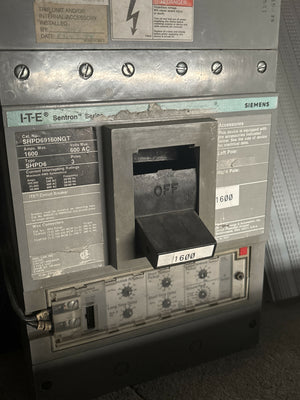
7. GFCI Breaker Wear and End of Service Life
If the receptacle, wiring, and connected loads all look fine, the breaker becomes the main suspect.
GFCI breakers usually last 10–15 years under normal use. In damp, coastal, or outdoor spots, that life can drop to 5–10 years.
Typical Field Symptom
The clearest clue is a breaker that trips at random even when you can't find any fault on the circuit. Sometimes it trips with no load connected at all. Other times, it trips the second you try to reset it, or the TEST button works one time and acts odd the next.
A common pattern is that the rest of the breakers in the panel stay put while that same GFCI keeps acting up. That’s usually a strong hint the problem is inside the breaker, not somewhere else on the branch circuit.
Why the GFCI Trips
Over time, heat changes, corrosion, plain wear, and dirt or moisture can throw off the breaker's trip point. Power surges can also damage the internal parts and lead to erratic tripping.
Think of it like an old light switch that starts feeling loose. It may still work for a while, but it no longer reacts the way it should.
First Diagnostic Check
Start by disconnecting all loads. If the breaker trips right away with nothing connected, and the wiring has already checked out, the breaker is a likely cause.
An inconsistent TEST/RESET result is another strong sign of internal wear.
Repair vs. Replacement Trigger
GFCI breakers can't be recalibrated in the field. If you replace one, match it to the panel brand, frame series, amp rating, and GFCI type.
After installation, test it right away. Replace the breaker if it fails TEST/RESET or still trips with no load after the wiring has been verified.
Field Symptoms at a Glance
Use the table below to match the symptom pattern with the most likely cause, what to check first, and what to do next.
| Cause | Field Symptom | What to Check First | Next Step |
|---|---|---|---|
| Moisture & Humidity | Trips after rain, showers, mopping, or heavy dew; may trip with nothing plugged in | Inspect the box, cover plate, and nearby junction boxes for water intrusion or condensation. Make sure outdoor covers are weatherproof or rated as in-use covers. | Dry the area, stop the water entry, and replace damaged covers or enclosures. |
| Shared Neutrals (MWBCs) | Trips only when loads on two different circuits run together; turning off one breaker stops tripping on the other | Check for an MWBC with a shared neutral | Use a 2-pole GFCI breaker for the MWBC, or rework the circuit with dedicated neutrals. |
| Line-Load Mix-Up | Won't reset at all, or trips the instant downstream outlets are energized; TEST/RESET won't behave normally; often appears right after a new install or swap | De-energize the circuit, pull the device, and verify that the panel feed lands on LINE terminals and downstream conductors land on LOAD | Re-terminate correctly; test with the built-in TEST button; replace the GFCI if correct wiring still fails. |
| Equipment Leakage | Trips only when one appliance, such as a pump, refrigerator, charger, or power tool, runs; all other loads hold fine; tripping follows the device to other circuits | Unplug all loads, reset the GFCI, then plug appliances back in one at a time to isolate the problem device. Inspect cords for damage or moisture. | Repair or replace the appliance or cord; move high-leakage equipment to a separate circuit if needed. |
| Long Cable Runs / Extension Cords | Holds fine with a short cord but trips with a 100-ft extension cord or on a long branch run; tripping often happens at motor startup or shutdown | Remove the long cord and test the same load directly at the GFCI with the shortest possible connection. Check for coiled or bundled cords. | Use shorter, properly rated cords; move the receptacle closer to the load. |
| Damaged / Worn Receptacle | Intermittent trips with light loads; cracked plastic, burn marks, or loose plug tension visible; TEST/RESET feels spongy or inconsistent; common in high-use or older locations | With power off, inspect for cracks, burns, and loose terminals. Test with a plug-in GFCI tester and the built-in TEST button. | Replace the receptacle with a new listed device; torque terminals correctly. |
| Worn GFCI Breaker | Trips randomly with normal loads; may trip with no load at all; TEST button behavior is inconsistent; only that one breaker keeps acting up while the rest of the panel stays put | Disconnect all loads, check for heat or corrosion in the panel, and use a clamp meter to confirm load current is within rating | Replace with a new, listed GFCI breaker of the same rating and type; verify operation immediately after installation. |
A couple of patterns stand out fast in the field.
Moisture trips often go away once the area dries out. On the other hand, equipment leakage tends to follow one device from outlet to outlet. That’s a strong clue the problem isn’t the receptacle at all.
If the GFCI will not reset with no load connected, check LINE/LOAD wiring first.
If the symptom points to wear instead of wiring, the next section covers replacement choices.
Buying and Replacement Considerations
Once you know what's causing the problem, the next step is pretty simple: match the fix to the fault. Dry the area, fix the wiring, or swap out the device. If the unit is damaged, fails the TEST/RESET check, or still won't reset after the box is dry, replace it. And if the GFCI has been in service for 10 to 15 years, replacement is a smart move anyway. Older units can fail silently and may stop tripping the way they should during an actual fault.
The replacement itself also needs to fit the location. For outdoor outlets and other damp or wet spots, use a receptacle clearly marked "WR" (Weather-Resistant). These devices hold up better against moisture and corrosion, which matters in places exposed to condensation, salt air, and big temperature swings. Any exterior WR GFCI should also be paired with an in-use cover rated for wet locations, so the setup stays weatherproof even when something is plugged in. In dwelling units where code calls for it, including many exterior outlets on single-family homes, the device should also be marked "TR" (Tamper-Resistant). After the replacement is in, test the circuit again with the built-in TEST button and a plug-in tester.
If you've confirmed a multi-wire branch circuit (MWBC), don't use a single-pole receptacle as a workaround. Use a listed 2-pole GFCI breaker instead. It monitors both hot legs and the shared neutral at the same time, which is often the cleanest fix for nuisance tripping when you don't want to rework the neutral setup. Make sure the breaker matches the panel manufacturer and listing. GFCI breakers are brand-specific, so they need to be approved for that exact panel. If you're sourcing replacement GFCI receptacles or panel-compatible breakers, Electrical Trader lists new and used GFCI devices and compatible breakers.
Conclusion
GFCI nuisance tripping usually points to one of a few common causes: moisture, wiring mistakes, equipment leakage, long cord runs, worn-out devices, or breaker wear. That short list gives you the fastest way to move from symptom to cause.
Start simple and check one thing at a time. Unplug the load, test again in dry conditions, and then verify the wiring. Use the symptom in the field to narrow down the cause, and try the simplest fix first.
Replace the device if the TEST button fails, RESET won’t stay on with nothing plugged in, or an older unit keeps tripping under no load.
Treat every nuisance trip like a warning sign. Fix the cause, don’t bypass required GFCI protection, and call a qualified electrician if shared neutrals or panel-level faults are involved. Match the symptom to the cause, fix the fault, and retest before putting the circuit back into normal use.
FAQs
Can a GFCI trip with nothing plugged in?
Yes. A GFCI can trip even when nothing is plugged in. People sometimes call this a ghost trip.
A few things can cause it:
- Wiring issues, such as shared neutrals
- Reversed line and load connections
- A downstream neutral-to-ground bond
- Moisture
- Damaged wiring
- An internal device fault
Start by checking that the wiring is correct and that the GFCI itself is in good shape. If it keeps tripping, the device may need to be replaced by a licensed electrician.
How do I tell if a GFCI problem is the outlet or an appliance?
Unplug everything on the affected circuit. Then reset the GFCI. If it stays on, plug devices back in one at a time.
If the GFCI trips when you plug in one specific device, that appliance is probably the problem. If it still trips with nothing plugged in, the issue may be the GFCI itself, damaged wiring, or a wiring mistake such as a reversed line-load connection.
When should I replace a GFCI instead of troubleshooting it?
Replace a GFCI as soon as it fails the test button check or shows clear damage, like cracks, melted plastic, discoloration, or a burning smell.
You should also swap it out if plugs no longer fit snugly or if it keeps tripping with no load even after the wiring has been checked. As a general rule, think about replacing it when it gets close to its usual 15-year lifespan, or when basic troubleshooting doesn’t solve the issue.