

10 Reasons RCDs Trip and How to Fix Them
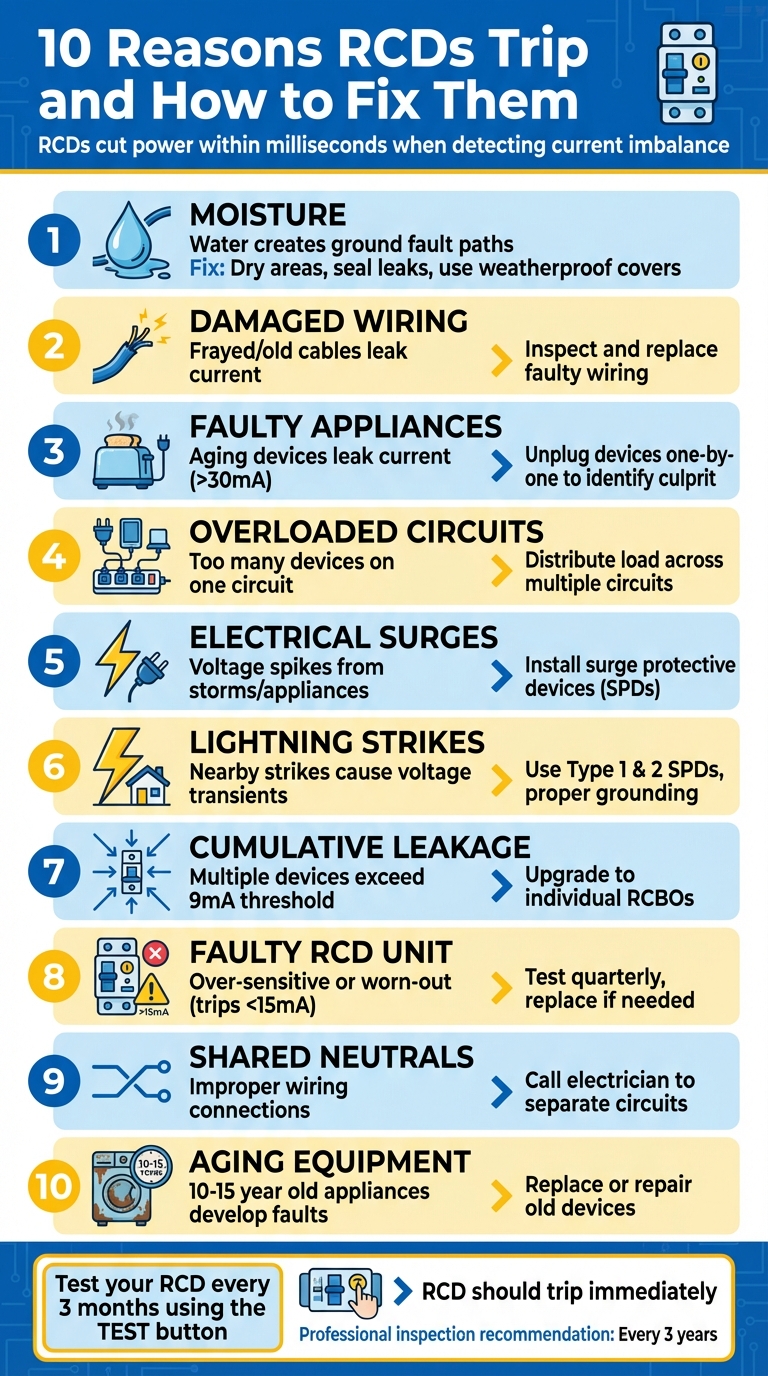
Residual Current Devices (RCDs) are essential for electrical safety, cutting power within milliseconds when they detect a current imbalance. If your RCD keeps tripping, it’s a warning sign of an issue that needs attention. Here’s why it happens and how to fix it:
- Moisture: Water near outlets or appliances can cause ground faults. Dry affected areas and seal leaks.
- Damaged Wiring: Frayed or old cables can leak current. Inspect and replace faulty wiring.
- Faulty Appliances: Aging or damaged devices often leak current. Test appliances by unplugging them one by one.
- Overloaded Circuits: Too many devices on one circuit can trip the RCD. Distribute the load across multiple circuits.
- Electrical Surges: Spikes in voltage from storms or appliances may confuse the RCD. Use surge protectors.
- Lightning: Nearby strikes can cause voltage transients. Install surge protection devices.
- Cumulative Leakage: Small leaks from multiple devices can add up. Upgrade to individual RCBOs if needed.
- Faulty RCD: Over-sensitive or worn-out RCDs may trip unnecessarily. Test and replace if required.
- Shared Neutrals: Improper wiring connections can confuse the RCD. Call an electrician to fix it.
- Aging Equipment: Old appliances often develop faults. Replace or repair them before issues arise.
Key Tip: Regularly test your RCD (press the "Test" button) and schedule professional inspections to ensure your system stays reliable and safe.
10 Common Causes of RCD Tripping and Quick Fixes
How To Diagnose and Fix a Tripping RCD
sbb-itb-501186b
1. Moisture Causing Ground Faults
Moisture is a common culprit behind RCD trips, especially after heavy rain, in high-humidity conditions, or in areas with poor ventilation. When water - whether from leaks, condensation, or humidity - comes into contact with live electrical components, it creates a path for electricity to escape to the ground or grounded metal surfaces. Even clean water can cause enough current leakage to exceed the 30 mA threshold, triggering the RCD to trip.
"Water can cause current leakage to the ground, which makes the RCD trip. Even clean water can cause this, unlike MCBs that need stronger leaks to trip." - Onesto
Moisture-related trips can be unpredictable. You might notice your RCD tripping during rainstorms, shortly after a shower, or when you power up a heating appliance that hasn’t been used in a while. Devices like electric heaters or older sunbeds can accumulate moisture, leading to a trip the moment they’re activated.
To address this, start by pinpointing the source of moisture. Check outdoor outlets, attics, and spaces beneath floors for signs like water stains, mold, or damp patches. Use fans or dehumidifiers to dry these areas quickly. Pay close attention to water-reliant appliances such as dishwashers, washing machines, or refrigerators with ice makers. Enhancing ventilation in rooms prone to high humidity can also reduce the likelihood of trips.
For a more permanent solution, consider installing weatherproof covers on outdoor outlets and sealing switches and sockets in damp areas with silicone. Regularly inspect the weather seals on outdoor distribution boxes and replace them if they show signs of wear. If the problem continues even after unplugging appliances, it’s a good idea to have an electrician conduct an insulation resistance test on your wiring.
2. Damaged or Faulty Wiring
The condition of your wiring plays a huge role in keeping your RCD from tripping. Damaged or worn-out cables are often to blame. Over time, insulation can break down due to factors like age, heat, physical stress, or even rodent activity. When this happens, electrical current can leak from its intended path and flow to the ground. Surprisingly, even a small leakage current - just 30 mA - can trigger your RCD. When this happens, it’s a clear sign that your wiring needs a thorough inspection.
"An RCD trip is not just a nuisance but also an indication alarm that your electrical installation has detected a possibly dangerous fault." - Electrical Test & Trace Ltd
Keep an eye (and ear) out for warning signs like burn marks or discoloration around outlets and switches, crackling or popping noises when flipping a switch, or a burning smell near the fuse box.
"A short circuit can occur for multiple reasons, but the most likely is due to faulty wiring or a weak connection. You can usually identify the location of a short circuit by a burning smell." - Checkatrade
These signs can help you locate the issue before it worsens. Inspect accessible wiring for signs of trouble, such as rodent damage, cracked insulation, or exposed wires. If you spot anything suspicious, turn off the power to that circuit immediately and call a licensed electrician.
If your RCD keeps tripping, it’s a red flag for a more serious wiring problem. Persistent issues like this can lead to fire hazards or electric shocks. A professional electrician can use tools like an insulation resistance tester to uncover hidden faults in walls or ceilings that you can’t see during a basic check. In older homes where wiring has significantly deteriorated, a partial or full rewire might be the safest solution. To avoid future problems, make sure to seal any entry points that rodents could use to access your wiring.
3. Faulty or Damaged Appliances
Household appliances are often to blame when an RCD trips. Over time, the internal insulation of these devices can deteriorate due to constant heat and wear, leading to current leakage that surpasses the 30 mA limit.
Heating appliances are common offenders. Devices like washing machines, ovens, kettles, toasters, and dishwashers tend to develop faults in their heating elements as they age. For example, water leaking into a dishwasher or washing machine can cause an immediate RCD trip. Even modern gadgets like computers and LED lights can play a role. Their switch-mode power supplies might create pulsating DC leakage, which older Type AC RCDs often fail to manage effectively. Identifying the problematic appliance is the next step.
"If the MCB or RCD trips again, it is usually the last appliance you plugged in that is causing the RCD to trip." – Checkatrade
To pinpoint the issue, start by unplugging all devices on the affected circuit. Simply turning them off at the outlet isn’t enough, as faults can still occur between the neutral and earth wires. After resetting the RCD, reconnect each appliance one by one. The device that trips the RCD is the likely culprit. Don’t forget about less obvious appliances, such as extractor fans, water heaters, or outdoor pumps, which might be connected to the same circuit.
If you notice visible damage, like frayed cords or burn marks, replace the appliance immediately. Small issues, such as a broken heating element in a toaster, might be fixable, but larger appliances like washing machines or ovens should be checked by a professional.
4. Overloaded Circuits
An overloaded circuit is another common reason for RCD trips, alongside issues like moisture, wiring problems, or faulty appliances. When too many devices are connected to a single circuit, it can exceed its capacity. While circuit breakers are designed to handle overcurrent, overloads can still trip an RCD - especially in RCBO units (which combine RCD and circuit breaker functions) or when high current causes an imbalance.
Certain warning signs can signal an overloaded circuit. These include flickering or dimming lights when high-power devices like microwaves or space heaters are turned on, buzzing or clicking sounds from outlets, and switches or power points that feel warm to the touch. Such signs should prompt immediate action to redistribute the electrical load. For instance, in 2026, TIS Electrics investigated an office in Austin, Texas, where lights and computers would shut down every time a commercial coffee machine was used. The high-draw coffee machine, combined with other devices on the same circuit, caused repeated RCD trips.
Typical offenders include kitchen appliances like electric kettles, microwaves, dishwashers, and toaster ovens, as well as devices like space heaters, air conditioners, washing machines, irons, and hair dryers. Modern households often use more electricity than older systems were built to handle, which increases the likelihood of nuisance tripping.
The solution? Distribute the load. Start by identifying which outlets are on the same circuit - your electrical panel should have labels to guide you. Then, relocate high-power appliances to outlets on different circuits and avoid running multiple heavy-duty devices at the same time. Unplugging devices when they’re not in use can also help reduce the overall load and minimize cumulative leakage current.
If these steps don’t solve the problem, your electrical system might need an update. A licensed electrician can install dedicated circuits for high-capacity appliances or upgrade your consumer unit. For older homes, a full switchboard upgrade may be necessary, with costs typically ranging from $800 to $2,000. Managing circuit overloads is essential for preventing RCD trips and ensuring electrical safety throughout your home.
5. Electrical Surges or Fluctuations
Electrical surges and fluctuations are a common yet often overlooked reason for RCD trips. Unlike steady overloads, surges are sudden spikes in voltage or current that happen in an instant. These surges can come from external factors - like lightning strikes affecting power lines or large equipment switching on the grid - or from high-power devices starting up within your home.
When a surge happens, it disrupts the normal current balance. A brief, strong current pulse flows through the wiring's natural capacitance, which the RCD misinterprets as a leakage fault, causing it to trip. Modern electronics can make this problem worse. Devices with switch-mode power supplies - such as computers, LED lights, and phone chargers - can generate high-frequency noise, sometimes reaching into the MHz range. As Etek Electric explains, "The high-frequency energy can be misinterpreted by the RCD's sensing circuit as a higher-level fault current, causing it to trip prematurely".
Some appliances, even when functioning properly, can create surges that confuse your RCD. For instance, fridge-freezers often cause surges when their compressor motors kick in during a cooling cycle. Similarly, office equipment like photocopiers and printers, or household devices such as washing machines and hair dryers, can also trigger these spikes. The TIS Electrics team highlights, "Switching on certain types of office equipment, like photocopiers or printers, can sometimes cause a transient surge that trips the RCD". Even healthy appliances contribute small leakage currents - usually around 1–2 mA each - that can add up, eventually nearing the RCD’s 30 mA trip threshold.
To minimize these issues, consider installing surge protective devices at your consumer unit. These devices divert high-voltage spikes, reducing the likelihood of RCD trips. Using power boards with built-in overload protection and spreading high-power appliances across different circuits can also help. If your home has a lot of modern electronics, it might be worth consulting a licensed electrician about upgrading to a Type A or Type B RCD, which can handle high-frequency noise more effectively.
Another important step is to test your RCD quarterly using the test button. Over time, repeated surges can wear down the RCD’s internal mechanism, making it overly sensitive - tripping at 15 mA instead of 30 mA - or less responsive to actual faults. Regular testing ensures that your RCD continues to offer reliable protection.
6. Lightning and Power Surges
External factors like lightning strikes and power surges can also cause RCD trips, much like internal electrical faults. When lightning strikes nearby or a power surge occurs, high-voltage spikes disrupt the balance between the live and neutral wires, leading the RCD to trip. Even without a direct hit, a nearby lightning strike can produce high-voltage transients that create a momentary imbalance. The RCD detects this as a leakage fault and disconnects power almost instantly.
Here’s how it works: High-frequency transients from these events move through leakage paths between the live wire and the ground. This generates short pulses of current that the RCD mistakenly identifies as ground faults. As electrical engineer Bert Hickman notes:
"During a lightning storm, nearby lightning strikes often induce large voltage impulses between the incoming power lines and local ground... these voltage transients can appear as significant unbalanced current pulses to the DCT [Differential Current Transformer]".
In addition, lightning strikes can cause rapid changes in ground potential. This forces current to flow through unexpected paths, which the RCD picks up on and responds to in just 25–40 milliseconds.
Storms bring another challenge: moisture. Rainwater can seep into outdoor outlets or electrical fittings, creating a conductive path to the ground. The RCD detects this as a leakage fault and trips. Even if a surge protective device (SPD) successfully redirects the surge current to the ground, the RCD may still trip because it interprets the redirected current as a fault.
To safeguard your system, consider these measures:
- Install Type 1 SPDs at the service entrance and Type 2 SPDs at distribution boards.
- Ensure your grounding system is low-impedance and securely bonded.
- Place SPDs upstream of the RCD whenever possible. If an SPD must be downstream, use an RCD with a surge immunity of at least 3 kA (8/20 µs waveform). Time-delayed "S-type" RCDs naturally meet this requirement.
Finally, during thunderstorms, unplug sensitive devices and wait until the storm passes before resetting the RCD. This simple step can go a long way in protecting your equipment and ensuring safety.
7. Nuisance Tripping from Earth Leakage Currents
Beyond faults like moisture or wiring issues, everyday devices can also lead to unexpected RCD (Residual Current Device) trips. Even when individual appliances are functioning normally, their combined leakage currents can add up and cause problems. Modern devices - like computers, LED drivers, printers, and televisions - naturally generate small amounts of earth leakage current during operation. When multiple devices share the same circuit, these small currents can accumulate. Since a standard 30mA RCD typically trips at around 26–27mA, this cumulative leakage can trigger a trip before reaching the device's rated limit.
The 18th Edition Wiring Regulations recommend that total earth leakage during normal operation should not exceed 30% of the RCD's rated current. For a 30mA RCD, this means keeping leakage below 9mA. Ray from RW Electrics Ltd explains it well:
"If the combined leakage across your installation is already sitting above 9mA, you're edging closer to a critical level that may trigger nuisance trips. Think of it as similar to a glass nearing its brim, where even a small addition causes overflow."
To address these unexpected trips, start by measuring cumulative earth leakage with a clamp meter. If the leakage approaches 9mA, consider upgrading circuits with individual RCBOs (Residual Current Breakers with Overcurrent protection) to isolate issues. This approach avoids relying on a single RCD for multiple circuits. Also, ensure you're using the correct RCD type for your equipment - Type A RCDs are suitable for most modern electronics, while Type B RCDs are better for specialized equipment like EV chargers, which may produce smooth DC leakage.
8. Faulty RCD Unit
Sometimes, the RCD unit itself can be the culprit behind frequent trips. These devices can wear out over time, causing them to trip at leakage currents below their rated 30mA. Unlike external issues, this happens because the unit becomes overly sensitive. If an RCD trips at around 15mA or less, it’s considered too sensitive. Paul Higgins, an experienced electrician and electrical tutor, explains:
"Once the device begins tripping at 15mA or less it is TOO sensitive and will likely cause a NUISANCE TRIPPING situation."
To check if your RCD is functioning properly, press the test button labeled "T." The switch should trip immediately. If it doesn’t, the unit is faulty and needs to be inspected by a qualified electrician. ProCerts Software emphasizes:
"If the RCD does not trip when the test button is pressed seek expert advise from an Electrician without delay."
It’s a good habit for homeowners to test their RCD every six months using the test button to ensure it’s working as it should. If you suspect the device is overly sensitive, a professional electrician can perform a ramp test with specialized equipment to determine the exact current level at which the RCD trips.
If the RCD still trips after disconnecting all appliances, the issue likely stems from the unit itself. Look for signs like warmth, discoloration, or scorch marks, which indicate the need for a replacement. Over time, repeated electrical surges - caused by lightning strikes or high-frequency spikes from modern devices - can wear down the components, reducing the unit’s lifespan.
9. Shared Neutral Conductors or Incorrect Installation
Sometimes, RCDs trip even when there are no apparent appliance faults, and the culprit is often improper installation. A common issue is shared neutral conductors - this happens when multiple circuits use the same neutral wire or when neutral wires from different circuits are incorrectly connected in a junction box.
To understand why this causes trouble, let’s revisit how an RCD works. It compares the current flowing out on the live wire with the current returning on the neutral wire. If the currents don’t match, the RCD trips. When a neutral wire is shared between circuits, the RCD detects an imbalance because some current may return through a neutral path outside the protected circuit. As The Local Guys Test & Tag explains:
"An RCD... operates by comparing the incoming current on the live wire with the returning current on the neutral wire in an electrical circuit. If there is an imbalance... the RCD trips, cutting off the power supply almost instantaneously."
A key indicator of a shared neutral issue is when the RCD trips only after turning on a specific light or appliance on a different circuit. This is especially common in older homes or after DIY electrical work, where someone may have tied into an existing neutral without confirming its circuit.
If you’ve had recent wiring work or your RCD trips immediately after resetting, it’s time to call a licensed electrician. They can trace neutral wires back to the panel, identify any crossed connections, and ensure each circuit’s neutral is correctly paired with its live conductors. As Electrical License Renewal advises:
"Group the grounded neutral with its corresponding live conductors."
Never assume a neutral wire in a junction box belongs to the circuit you expect. Professional verification is essential to ensure your RCD operates correctly and to protect your home from electrical hazards.
10. Aging Appliances or Equipment
Even though appliances might still work, their age can turn them into potential hazards. Over time, wear and tear can lead to small electrical leakages that, when combined, may exceed the RCD (Residual Current Device) threshold. For instance, household staples like washing machines and ovens typically last 10 to 15 years before their internal components start posing safety risks.
As appliances age, their parts often fail in predictable ways. Heating elements in older ovens or washing machines, for example, can develop tiny cracks due to years of heating and cooling cycles. Similarly, motor windings in appliances like fridge-freezers or vacuum cleaners may degrade over time, leading to internal shorts. Even worn-out seals or damaged hoses can allow moisture to seep into electrical compartments, triggering the RCD.
While an individual aging appliance might only leak a small amount of current, the cumulative effect of multiple devices on the same circuit can surpass the RCD's 30 mA trip threshold. Pay attention to patterns - if the RCD trips during specific cycles, like when a washing machine spins or an oven heats to a certain temperature, it could indicate a failing internal part. Additionally, if plugs or wall sockets feel warm after use, it might signal internal resistance or deteriorating connections. These are early warning signs that the appliance or circuit needs inspection.
Inspect power cables frequently for wear, such as fraying or cracks, especially on appliances that are moved often. To identify faulty devices, unplug all appliances on the circuit, reset the RCD, and reconnect them one at a time. The one that trips the RCD is likely the culprit. For safety, consider replacing high-power appliances once they reach 10–15 years of age to reduce the risk of electrical failures.
For safer and more reliable replacements, Electrical Trader provides a range of new and used electrical products to help maintain system safety and functionality.
How to Maintain RCDs
Once you've tackled the common causes of RCD trips, keeping them in good working order is essential. Start by testing your RCD regularly to ensure it's functioning as it should. Most RCDs have a test button, often labeled "T" or "Test." Press this button every three months. It simulates a small internal fault, causing the device to trip and cut power to the connected circuits. If the RCD doesn’t trip, it’s a serious issue - contact a qualified electrician for an inspection and replacement immediately. Regular testing helps catch problems early before they lead to frequent tripping.
In addition to these manual checks, professional inspections play a key role in maintaining safety. Arrange for an Electrical Installation Condition Report (EICR) roughly every ten years. During these inspections, a professional can also perform a ramp test to confirm the RCD trips at the correct current level.
Keep an eye on your consumer unit for any signs of trouble, such as moisture, discoloration, or insect activity around the RCD housing. For outdoor sockets, ensure they have weatherproof covers to guard against water and pests. Also, check plug sockets and switches for signs of overheating, such as scorch marks.
If your RCD shows physical damage, heat marks, or is nearing 10 years of service - especially if it trips frequently - it’s time for a replacement.
When replacing an RCD, make sure to choose components that meet modern safety standards. For a wide range of reliable new and used RCDs, RCBOs, and other electrical equipment, visit Electrical Trader.
Conclusion
RCDs play a crucial role in preventing electrical shocks and fires - but they only do their job if they're functioning correctly. Understanding the ten common causes of RCD trips, from moisture to aging equipment, equips you to troubleshoot effectively. Start by unplugging all devices, resetting the RCD, and reconnecting them one by one to locate the issue. If the RCD stays tripped even after everything is unplugged, the problem likely lies in the wiring or the RCD itself - this is when you should call a licensed electrician.
Once faults are identified and resolved, regular maintenance becomes essential. Systems that don't undergo routine checkups are three times more likely to fail. To stay ahead of potential issues, test your RCD every three months, arrange professional inspections every three years, and keep an eye out for warning signs like moisture, heat marks, or frequent tripping. These proactive measures help catch hidden problems before they become dangerous.
Upgrading your equipment can further enhance safety. Modern homes often need Type A or B RCDs to handle the demands of electronics, EV chargers, and smart devices. Older Type AC units are becoming less effective, as they can't manage pulsating DC currents, which can render them ineffective. When replacing or upgrading, choose components that align with current safety standards.
For a trusted source of new and used RCDs, RCBOs, and other electrical equipment, check out Electrical Trader. Prioritizing quality components and consistent maintenance is essential for ensuring your safety.
FAQs
Is it safe to keep resetting a tripping RCD?
It's typically safe to reset a tripped RCD, but before doing so, you should pinpoint and address the cause. Start by switching off all appliances and the circuit breaker. Then, reset the RCD. Once that's done, turn your appliances back on one at a time to identify the problematic device. If the RCD continues to trip, it’s a sign of a fault that needs attention from a licensed electrician.
How can I tell if my RCD is the problem or the wiring?
If your RCD keeps tripping, start by unplugging appliances one at a time. When the tripping stops, you've likely found the faulty appliance. If the issue continues even after unplugging everything, the problem might be due to an overload, damaged wiring, or even external factors. If none of these seem to be the cause, it could point to a fault in the RCD itself or an issue with the wiring. In such cases, it's best to call a qualified electrician to inspect and diagnose the problem properly.
Should I upgrade to a Type A/B RCD or use RCBOs?
When deciding between a Type A RCD, Type B RCD, or RCBO, it all comes down to your specific electrical setup.
- Type A RCDs are designed to handle AC and pulsating DC currents, making them a solid choice for homes with modern appliances and electronics.
- Type B RCDs, on the other hand, offer additional protection against smooth DC currents, which is essential for specialized equipment like EV chargers or solar inverters.
- RCBOs combine the functions of an RCD and a circuit breaker, providing both residual current and overcurrent protection for individual circuits. This ensures more precise safety by isolating only the affected circuit during a fault.
Each option serves a distinct purpose, so choose based on the requirements of your electrical system.